
Executive Summary
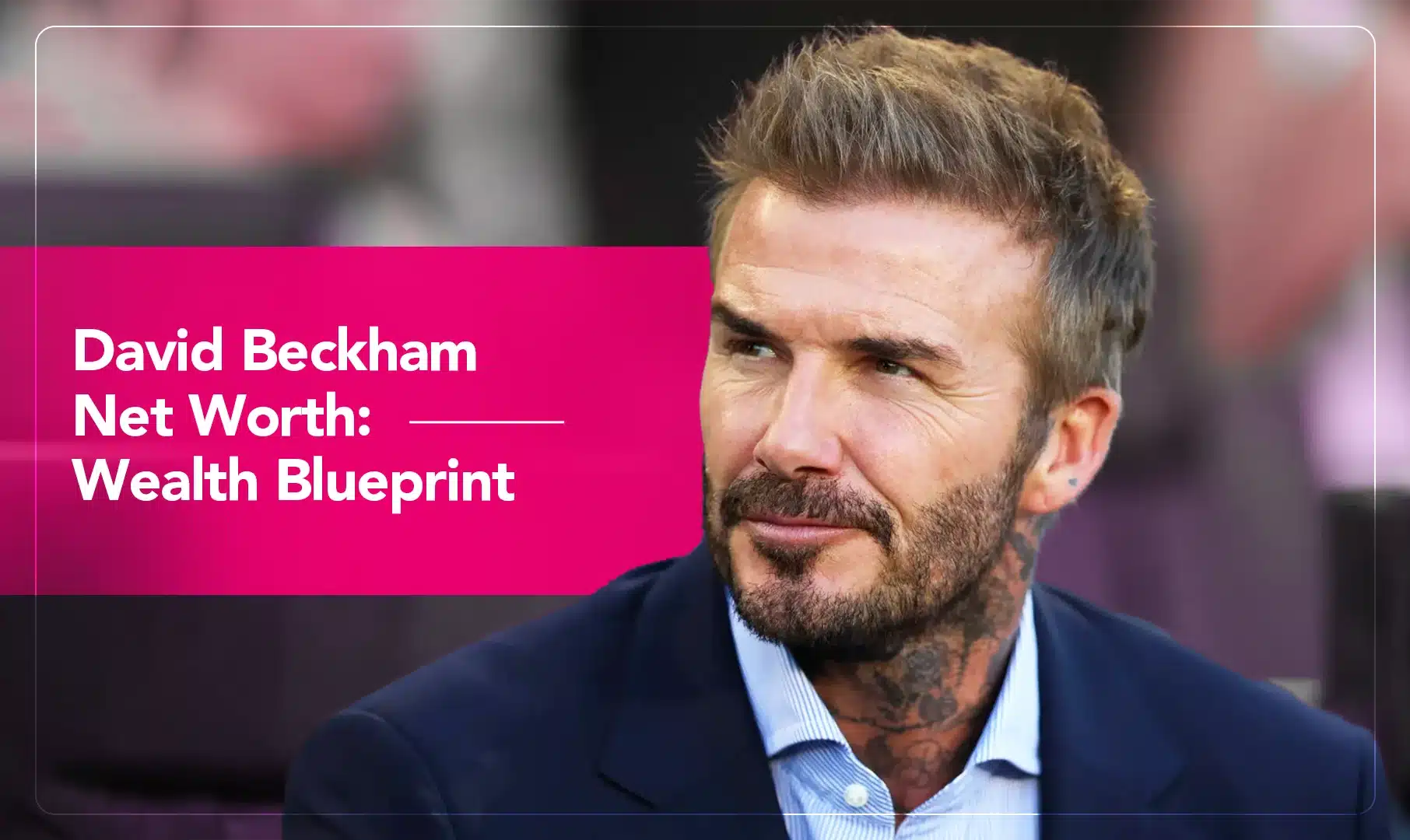
Sir David Beckham, who was newly knighted in 2025, boasts an estimated net worth of roughly $450 million (approximately £350 million) as of late 2025. This valuation reflects Beckham’s personal fortune; combined with his wife Victoria (former Spice Girl turned fashion mogul), the Beckham family’s wealth is around £500 million. Beckham’s riches stem from a rare blend of elite football earnings, blockbuster endorsements, and savvy business ownership. Over a two-decade playing career, he became one of the highest-paid athletes ever, then parlayed his fame into global brand deals and equity stakes that now dwarf his old paycheques.
On the pitch, Beckham’s trophy-laden career with Manchester United, Real Madrid and others made him a superstar. But off the pitch is where his wealth truly skyrocketed. He pioneered the monetisation of image rights in football, signing a lifetime adidas endorsement worth $160 million in 2003, and built the ‘Brand Beckham’ persona with sponsors from Pepsi to Armani. Crucially, his 2007 move to LA Galaxy included an innovative contract clause granting him the right to buy an MLS expansion team at a fixed fee. That ‘golden ticket’ led to his co-ownership of Inter Miami CF, now valued at $1.2 billion. In 2022 he also sold a 55% stake in his brand management company to Authentic Brands Group for around $269 million, cashing in on years of carefully cultivated marketing clout.
What sets Beckham apart is how he converted celebrity into equity. He didn’t just collect paycheques; he negotiated ownership. Whether it was equity in a football club, a share of endorsement ventures or a partnership in global brands, he had clearly developed a strong business intelligence. Few athletes have so successfully transformed sporting fame into an international business empire. In financial terms, his trajectory can be summarised as early-career salaries + big-brand endorsements + strategic equity deals = a compounded fortune. In the sections that follow, we’ll dissect how Beckham earned, invested and grew his wealth – and the key money moves that made it happen.
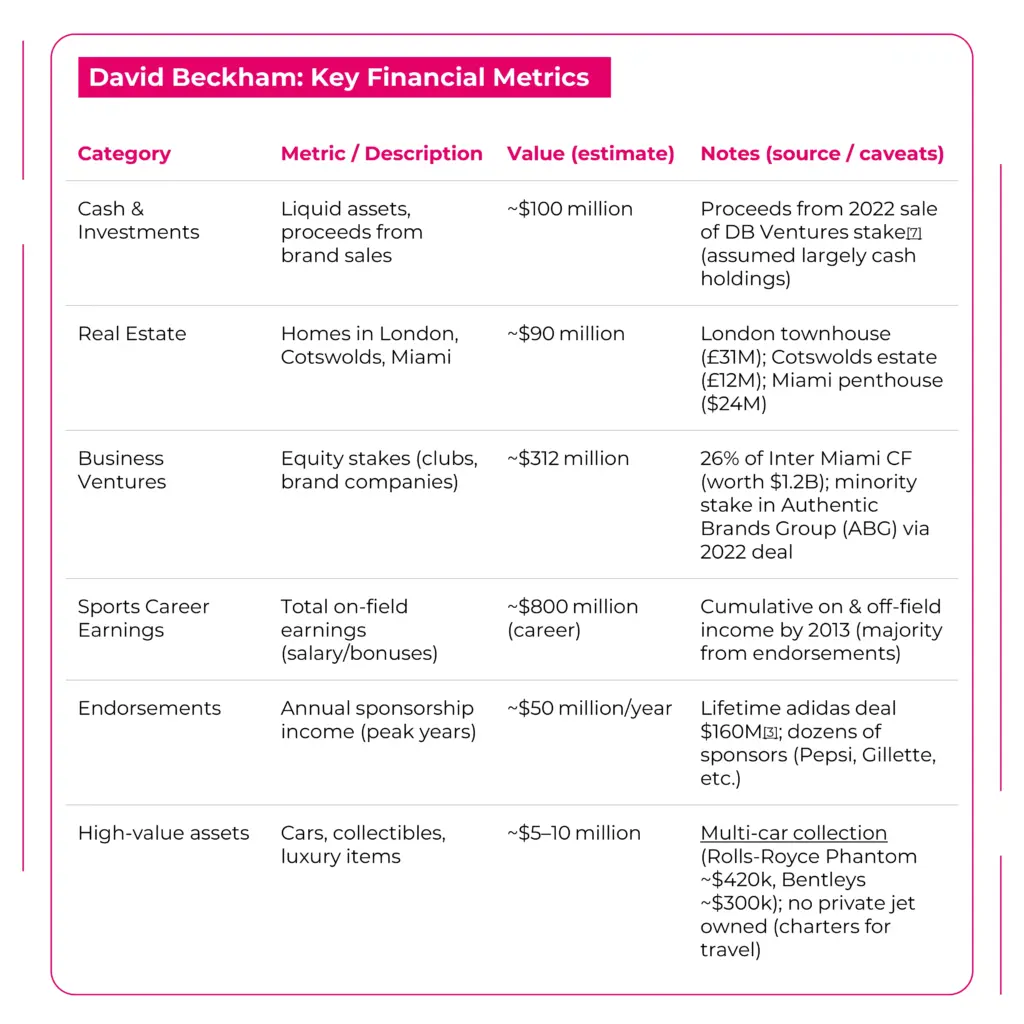
David Beckham’s Primary Income Streams
Beckham’s earnings flow from three main channels: his football career, his endorsement empire and his business ventures. In his prime, Beckham earned more off the field than on it, turning his fame into a marketing machine. Since retiring, he’s doubled down on ownership deals and brand partnerships that continue to pay dividends. Below, we break down each income stream and how it evolved over time.
Core Football Career Earnings
Even in an era before today’s astronomical football wages, Beckham was a top earner on the field. Across two decades (1993–2013), playing for clubs in England, Spain, the US, Italy and France, he amassed substantial salary, bonus and prize income. However, this was modest compared to his endorsement haul. By the time he hung up his boots in 2013, Beckham had reportedly earned around $800 million from football and endorsements combined, making him the world’s 7th highest-paid athlete ever at retirement.
A detailed look at Beckham’s contracts shows a pattern of steady salary growth and savvy deal-making:
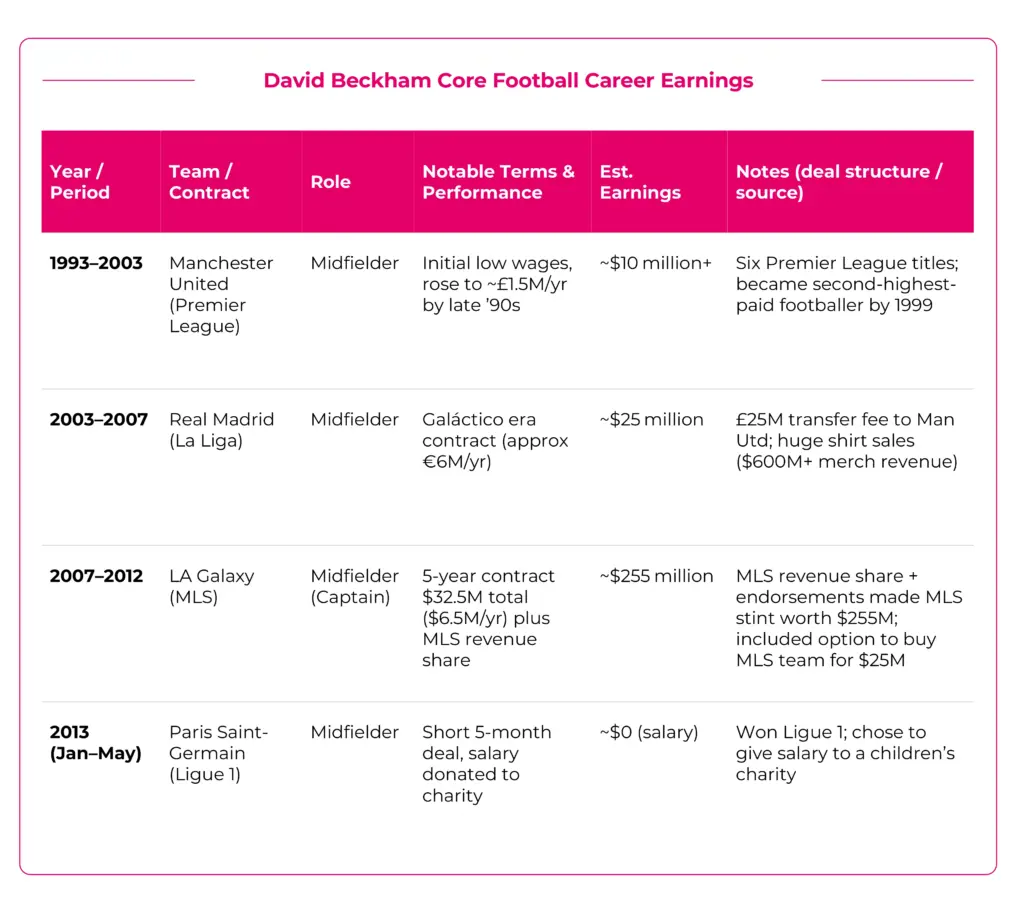
Despite solid salaries (e.g. $6.5M/year in LA), Beckham’s club wages were often outstripped by sponsorship income. Notably, during 2007–2012 in MLS he earned an estimated $255 million total, but only around $32 million of that was base salary, with the rest coming from revenue sharing and endorsements tied to his presence in the league. His Real Madrid stint similarly showed the Beckham effect: the club reportedly sold over $600 million worth of merchandise during his four years in Madrid, illustrating his value beyond the pitch (though that revenue mostly benefited the club’s coffers).
Two major inflection points defined Beckham’s earning curve: 1999, when he became the world’s second-highest-paid footballer at Man Utd, and 2007, when his Galaxy contract introduced equity upside. By 2012, his final full season, Beckham’s annual earnings hit $51 million, and in 2014 (post-retirement) they peaked at $75 million, which was an unheard-of sum for a retired footballer, propelled by off-field deals. While his football talent made him famous, it was the strategic contracts and global profile that made him rich.
Endorsements & Sponsorships
Beckham’s endorsement portfolio is the stuff of legend. He transformed from a mere player into a global brand icon. Throughout his career and beyond, he inked deals across fashion, food, tech, and even governments, at one point having over a dozen concurrent sponsors (including four in China). During his playing days, he was consistently among the world’s top-paid athletes thanks to endorsements, not just salary.
Some of Beckham’s most lucrative and notable endorsement deals include:
- adidas – Lifetime Deal (2003): A $160.8 million agreement granting adidas perpetual rights to Beckham’s name and image. This was one of the largest sports sponsorships ever at the time and ensured Beckham would be a face of adidas for life (he famously wore adidas boots his entire career).
- PepsiCo & Coca-Cola: Long-running deals with Pepsi (including iconic Pepsi ads in the early 2000s) reportedly netted him millions annually; he also promoted Coca-Cola’s brands like Vitamin Water in later years.
- Fashion and Luxury Brands: Beckham became a style icon, signing with Giorgio Armani in 2007 (famously modeling underwear), and later partnerships with H&M (launched a bodywear line in 2012, expanded to swimwear by 2014), and Tudor Watches (Rolex’s sister brand) as a global ambassador post-2017.
- Personal Care & Lifestyle: He was the face of Gillette razors in a multi-year deal, fronted Breitling watches, and even had a line of fragrances with Coty, with Beckham-branded perfumes generating £67 million a year in sales and earning him about £4 million annually.
- Telecoms and Media: Early 2000s deals with Vodafone (jersey sponsor and ads) and Sky Sports in the UK further boosted his income and visibility.
- Automotive: He endorsed Maserati with ad campaigns (post-retirement) and previously had ties to Ford (he was a spokesperson for Ford’s luxury brand in the 2000s).
- Food & Beverage: In addition to Pepsi, Beckham did campaigns for Burger King, Haig Club whisky (more on this venture below) and even Simon Fuller’s Healthy Water drink.
- Major Events & Tourism: The most controversial bag was a £150 million deal over 10 years with Qatar (signed 2021) as an ambassador for Qatar and the 2022 FIFA World Cup. This averages ~£15M per year for essentially lending his image to a nation’s tourism and sports efforts, a testament to Brand Beckham’s global pull.
At his peak in the early-to-mid 2010s, Beckham was earning $30–50 million per year from endorsements alone. In 2014, for example, endorsements (including new deals with Diageo’s Haig Club whisky and China-specific sponsors) helped him earn $75 million, making him the highest-paid retired athlete that year, second only to Michael Jordan. Even a decade after retirement, he’s remained a sought-after pitchman, recently fronting campaigns for Maserati, Sharp (SharkNinja) and even Alibaba’s AliExpress in Asia.
The breadth of Beckham’s sponsorships – from high fashion to supermarkets (he’s appeared in Sainsbury’s ads) – underscores how he leveraged his wholesome-yet-glamorous image. His marriage to Victoria ‘Posh Spice’ only amplified the brand appeal. Together, the Beckhams were featured in joint campaigns (e.g. Armani) and their combined celebrity gave David a crossover appeal far beyond sports. In summary, Beckham’s endorsement strategy was about global diversification: he wasn’t just a footballer selling boots; he became a lifestyle icon selling everything from underwear to whiskey, achieving an estimated nine-figure endorsement income over his career.
Business Ventures & Ownership Stakes
Beckham’s most significant wealth drivers in recent years are his business ventures and equity stakes, areas where he’s transitioned from merely promoting products to owning them. His post-football playbook has centred on investing in teams, brands and his own enterprises to generate long-term wealth beyond endorsement fees. The standout ventures include:
- Inter Miami CF (Major League Soccer) – Arguably Beckham’s shrewdest financial move. As part of his 2007 Galaxy contract, he secured an option to buy a future MLS expansion team for a fixed $25 million. He exercised this option, and in 2018 his ownership group (with the Mas brothers) launched Inter Miami CF. The team began play in 2020, and by 2023 the arrival of superstar Lionel Messi sent the club’s valuation soaring. As of 2025, Forbes values Inter Miami at $1.2 billion, meaning Beckham’s roughly 25–26% stake is worth around $300+ million on paper. Fromom a $25M buy-in to a stake worth over $300M, this venture alone constitutes the majority of Beckham’s net worth. It exemplifies owning the upside rather than just taking a salary.
- DB Ventures / Beckham Brand Holdings – This is the Beckham family’s brand management and licensing vehicle. In 2022, Beckham made headlines by selling a 55% majority stake in DB Ventures to Authentic Brands Group (ABG) for approximately $269 million. ABG, a giant that manages celebrity brands from Shaquille O’Neal to Elvis, now co-owns Beckham’s brand and image rights, while Beckham retained 45% and a role in the business. Effectively, Beckham ‘went public’ with Brand Beckham – monetising half his future commercial earnings for a nine-figure sum upfront. Notably, ABG’s deal also made them stakeholders in Beckham’s production company Studio 99 (founded 2019), which produces documentaries (including the hit 2023 Netflix Beckham series). The ABG partnership provides global scale for his brand and a lucrative payout, turning decades of image rights into cash and shares (ABG itself is valued at $12.7B, and Beckham likely received some equity interest).
- Haig Club Whisky – A spirits venture launched in 2014 with Diageo. Beckham co-founded and is the celebrity face of Haig Club, a single-grain Scotch whisky. While exact equity splits aren’t public, Beckham’s involvement was deep: he helped design the stylish blue bottle and campaigns. The deal likely provides him a share of profits. Haig Club has become a globally distributed brand, leveraging Beckham’s cachet in markets like Asia. This venture aligns with Beckham’s strategy of partnering with established firms (Diageo) where he brings brand value rather than capital.
- Sports Team Investments – Beyond Inter Miami, Beckham also holds a stake in Salford City F.C., a lower-league English club, alongside his Manchester United Class of ’92 teammates. Though small (Salford is valued in the tens of millions, not billions), it demonstrates his interest in sports club ownership. He was also an early investor and ambassador in Guild Esports, a UK-based esports organisation, taking a ~3% stake. Guild floated on the stock market in 2020, but struggled; Beckham’s involvement netted him a reported £15 million five-year ambassador deal, though the equity’s value fluctuated. These smaller ventures haven’t moved the needle like Inter Miami, but show Beckham’s willingness to branch out.
- Beckham Brand Holdings & Victoria’s Businesses – The Beckham family’s holding company (co-owned by David, Victoria, and their manager-turned-partner Simon Fuller until 2019) consolidates various businesses. Victoria Beckham’s fashion and beauty lines are part of this portfolio. In fact, the couple reportedly owns 35% of Victoria Beckham Beauty, valued at ~£130 million (though Victoria leads that venture). David’s involvement is likely passive investor, but as co-owners their fortunes are intertwined. Beckham Brand Holdings also manages their joint endorsements and licensing. By structuring as a family office, they’ve been able to reinvest earnings into new ventures and maintain control.
- Other Investments – Beckham’s name has been attached to numerous ventures: he’s been an ambassador for Sands casino in Macau, invested in an organic skincare startup, and partnered on a Miami-based esports team. He also launched Seven Global LLP (a licensing venture for branded products like grooming items and apparel) and has dabbled in the restaurant business (he’s been linked to opening a London pub and an upscale eatery in partnership with Gordon Ramsay in the past). While none of these smaller investments individually contribute a large portion of his wealth, collectively they indicate a diversified approach. Beckham isn’t afraid to try his hand in various industries, often leveraging his brand rather than massive capital.
In summary, Beckham’s business ventures revolve around leveraging his brand equity for ownership. Whether it’s owning a piece of a team, selling part of his brand to a larger conglomerate, or co-founding lifestyle products, the common theme is turning his star-power into long-term equity stakes. These moves have provided the biggest boosts to his net worth in the post-playing years, far eclipsing what he could ever earn merely by endorsing products for a fee.
David Beckham’s Asset Portfolio Analysis
Beyond income streams, Beckham has accumulated an enviable portfolio of tangible assets, from prime real estate to luxury vehicles, that both store wealth and signal his status. Below we examine what Becks owns and how these assets fit into his wealth picture.
Real Estate Holdings
The Beckham’s have built a significant real estate portfolio concentrated in elite locales in the UK and USA. David’s properties serve both as residences and long-term investments, often appreciating in value. His known major holdings include:
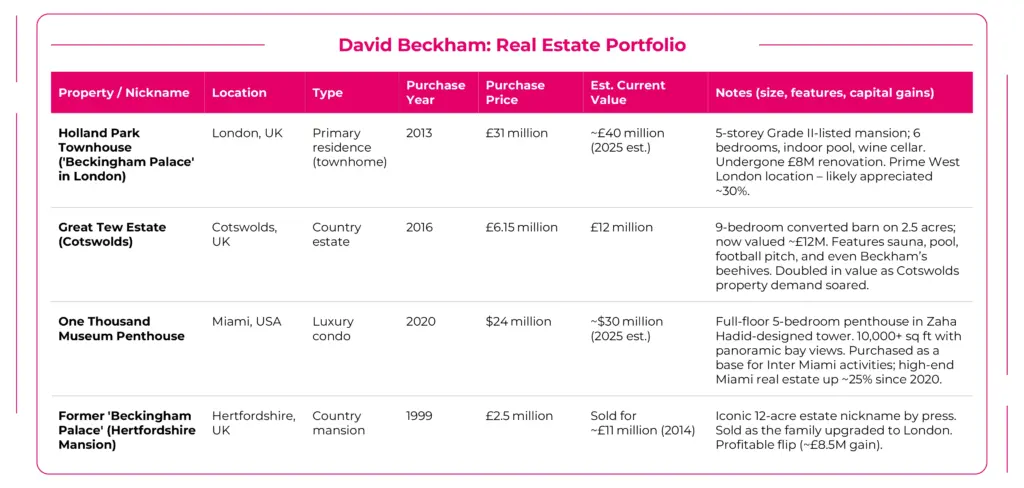
Beckham’s real estate strategy shows a preference for blue-chip properties: ultra-prime London, a leisure retreat in the English countryside and a foothold in booming Miami. This offers a mix of lifestyle and investment benefits. The geographic spread (UK and US) provides some currency and market diversification, although all are in the high-end luxury segment.
He has generally followed a ‘buy and hold’ approach, holding these marquee properties for years, investing in improvements (the Hollander Park home renovation, and constant upgrades to the Cotswolds estate). There’s also an element of ‘trading up’: moving from the relatively modest early-career Hertfordshire mansion to a much more expensive London base as his wealth grew.
It’s worth noting that Beckham has had other homes: a Beverly Hills house bought in 2007 for $18M (during his LA Galaxy days) which sold in 2018 for $33M (a nice gain) – and he was gifted a luxury villa on Dubai’s Palm Jumeirah in the 2000s, which he later gave to his parents. These illustrate how at Beckham’s level, homes often come as part of endorsement or lifestyle packages (the Dubai property was part of promoting UAE tourism).
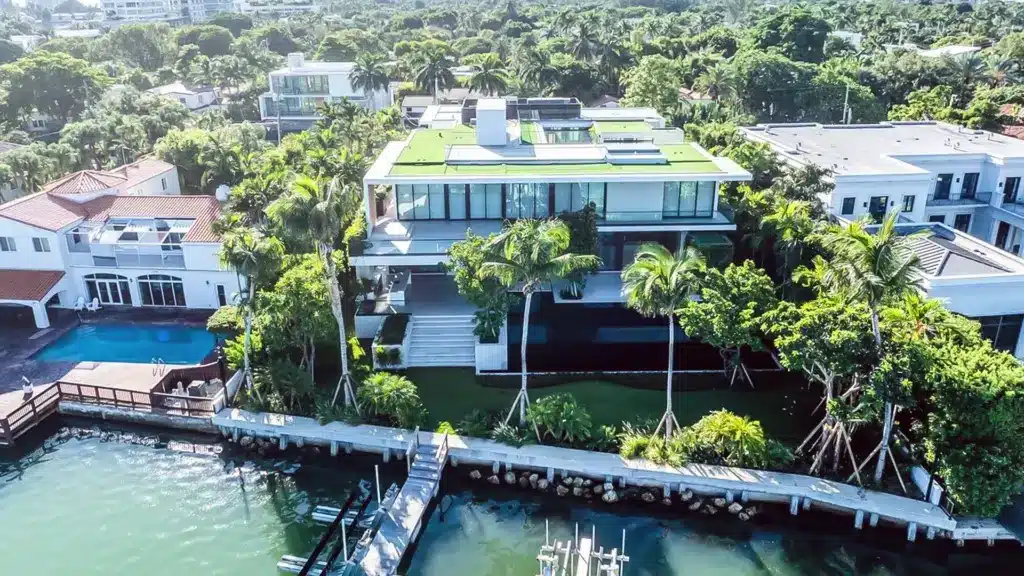
Overall, Beckham’s property holdings (worth an estimated £70–£75 million total in 2026) not only appreciate but also underscore his brand: opulent yet tasteful living. The capital gains on many of these properties contribute to his net worth growth (e.g. doubling of the Cotswolds barn’s value, significant appreciation of the LA and London homes). Real estate forms the second-largest chunk of his wealth after business equity, and provides both a stable asset base and tangible legacy for his family.
Vehicles, Jets, Collectibles & Luxury Assets
As a global style icon, Beckham has amassed an impressive collection of luxury vehicles and other high-end toys.
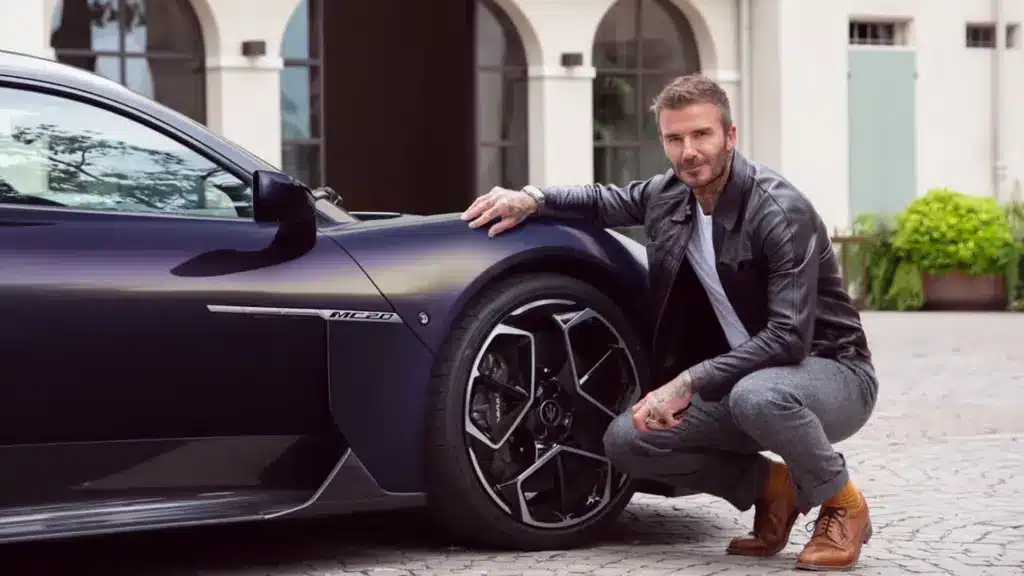
While these depreciating assets are a small fraction of his net worth, they are emblematic of his success (and some limited-edition items may even appreciate). Here’s a glimpse into his notable luxury assets:
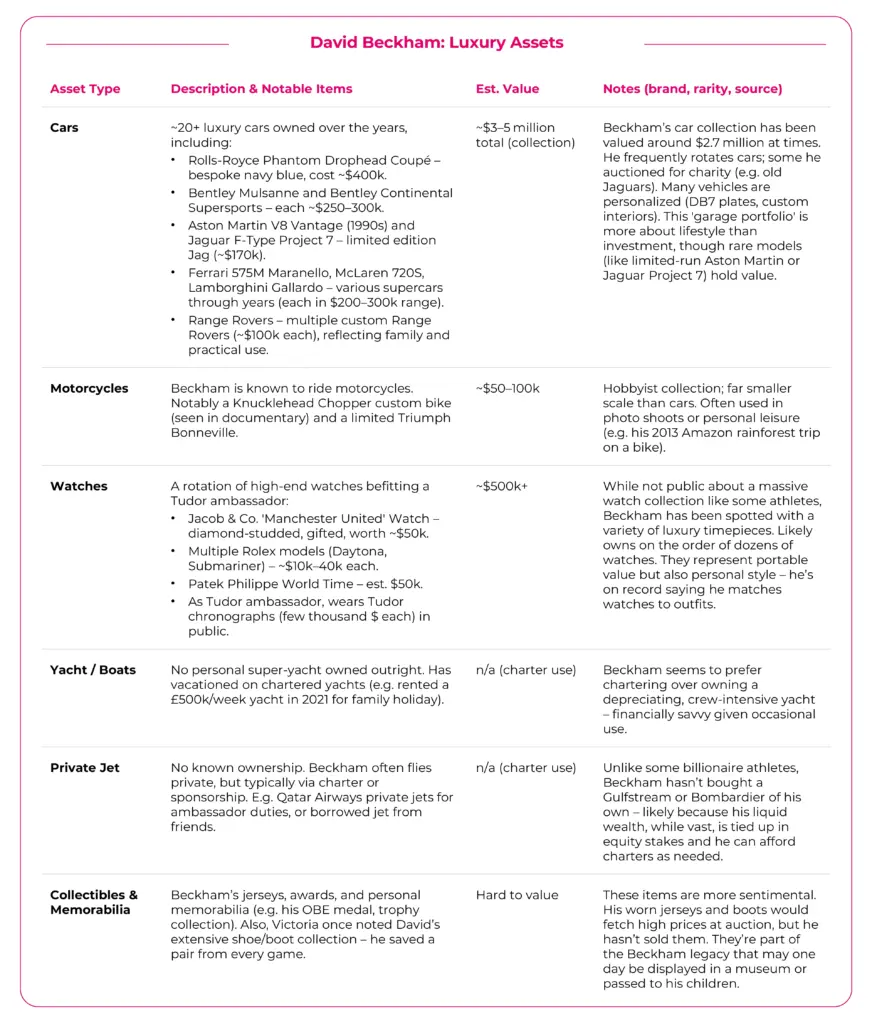
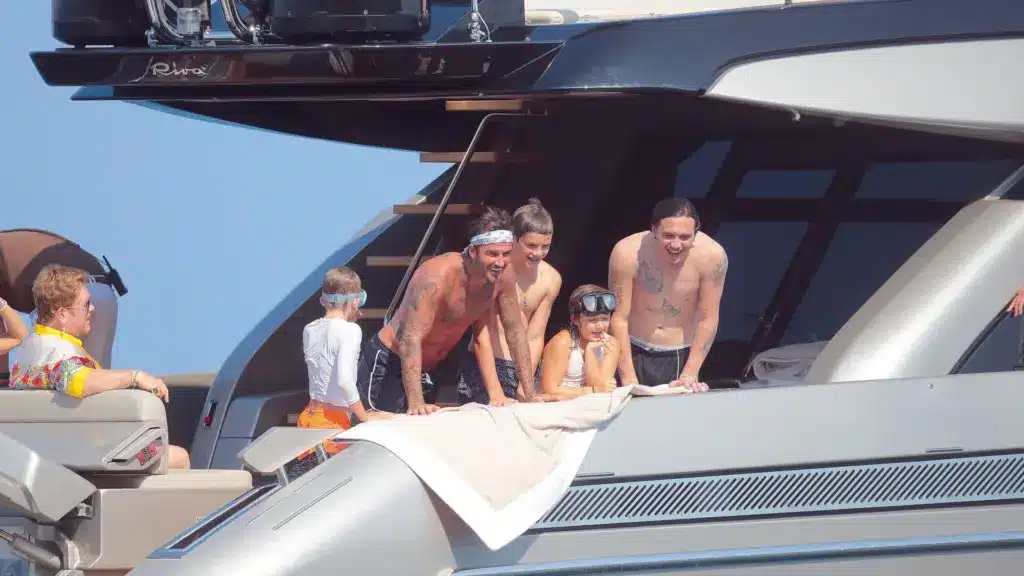
In total, Beckham’s ‘toys’ are valued around $5–10 million, which is a drop in the ocean when it comes to his net worth. He appears to spend on luxury in a measured way; for example, he’ll drive top-end cars and wear bespoke suits, but he’s not known for absurd extravagance like a personal yacht or fleet of supercars beyond a point. In fact, one of his indulgences is relatively wholesome: collecting Lego (he has admitted to spending hours building big Lego models to relax).
Financially, these lifestyle assets are more about enjoyment and image than returns. Beckham’s classic cars or limited-edition watches could appreciate, but that’s incidental. He insures key assets (famously, his legs were insured for £100 million in 2006, essentially treating his body as a valuable asset during his playing career). This massive insurance policy underscores how his true valuable asset was his athletic ability and image, which he then converted into the business ventures described earlier.
Investments & Financial Instruments
Public information on Beckham’s paper investments (stocks, bonds, funds) is limited, which is unsurprising as private figures often keep these details confidential. However, given his substantial liquidity events (e.g. the ABG payout in 2022), it’s likely he has a family office or wealth manager investing in a range of financial assets. Some insights and logical assumptions:
- Equities & Funds: Beckham likely holds a portfolio of stocks or equity funds, possibly focusing on blue-chip companies or sectors he’s interested in (tech, sports, luxury). For instance, his involvement with start-ups and tech (like MyFitnessPal, in which he invested via an app partnership) suggests a taste for growth investments. In 2020, he joined a SPAC (special-purpose acquisition company) board aimed at investing in sports tech, implying he may have some venture-style investments.
- Private Equity/Venture: Through Beckham Brand Holdings, he has exposure to private businesses (including his wife’s fashion label and other brand ventures). Additionally, his partnership with ABG effectively gives him a stake in a large portfolio of brands (ABG itself is a private company valued at $12B+). He also reportedly put money into a cannabis skincare startup in 2021 (Cellular Goods) and a sports e-commerce platform. These are relatively small bets in the context of his wealth, but indicate a moderate appetite for venture investments.
- Bonds & Cash: Post-2022, Beckham likely had a large cash influx. A portion of that could be parked in bonds or money-market instruments for capital preservation. As a UK resident (and with UK businesses), he may hold premium bonds or UK gilts, especially given the interest rate rises in 2024–2025 making bonds more attractive.
- Trusts & Structures: The Beckhams have reportedly set up trusts for their children. It’s common for ultra-high net worth individuals to use trusts to manage inheritance and tax. Beckham’s OBE and now knighthood indicate he’s mindful of legacy; likely, some assets (like the properties or future royalties) are held in family trusts or holding companies (indeed, Beckham Brand Holdings serves this role).
- Crypto or Alternatives: There’s no strong evidence Beckham dove into cryptocurrency mania personally. He did launch an NFT in 2022 (a digital art collaboration), but that seemed more marketing than major investment. Given his prudent track record, he hasn’t publicly bet big on crypto or exotic assets like art collections (beyond a reported love of contemporary art, no major art purchases are known).
Beckham’s overall risk profile appears balanced. He takes big swings when he has inside understanding or control (sports teams, his own brand), which is where he concentrated wealth. For more generic investing, he likely favours a diversified, conservative approach managed by professionals. He’s not known for flamboyant stock picking or gambling on risky ventures outside his expertise. This suggests an emphasis on wealth preservation for the portion of his fortune not tied up in businesses.
In summary, while David Beckham lives luxuriously, a huge portion of his wealth is reinvested in businesses or solid assets rather than sitting idle. His portfolio reflects a mix of tangible assets (real estate, clubs) and intangible brand equity, with a smaller layer of traditional investments quietly compounding in the background.
Timeline of Major Financial Milestones
To understand how Beckham’s empire came together, let’s walk through the chronological inflection points – the deals and decisions that most impacted his financial trajectory:
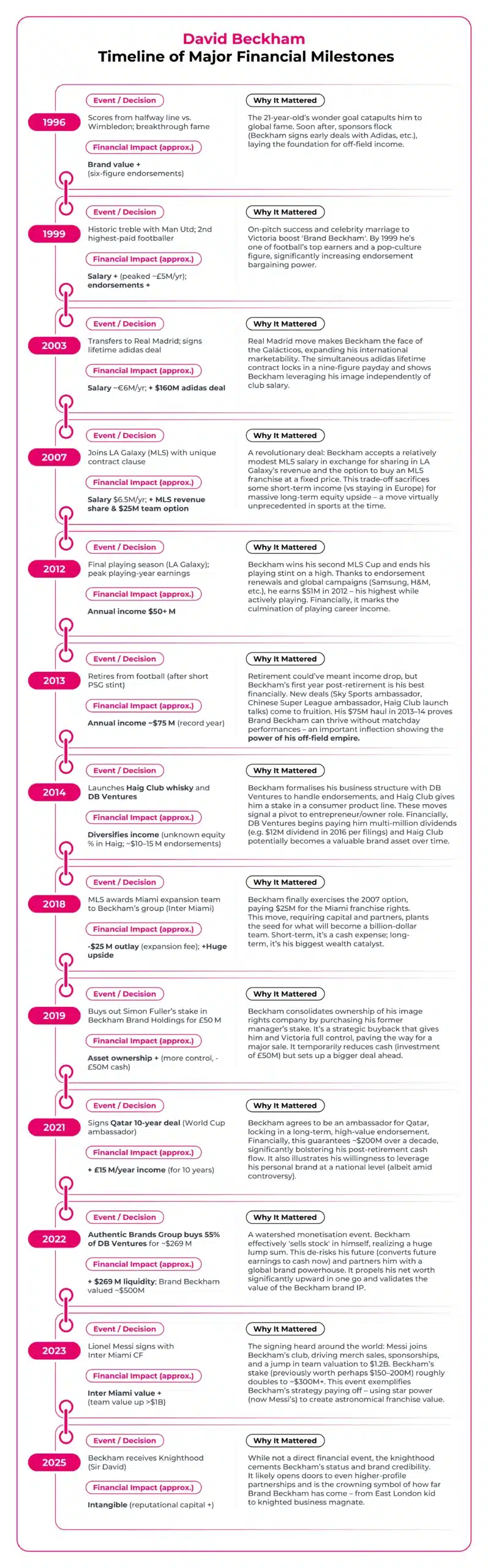
2007 (Galaxy/MLS deal) and 2022 (brand sale to ABG) stand out as transformative. The former introduced equity upside in sports (leading to Inter Miami) and the latter turned celebrity into cash at massive scale. Additionally, 2003 (adidas lifetime deal) locked in a long-term revenue stream, and 2023 (Messi to Miami) greatly magnified an asset’s value. Through these moments, we see Beckham’s shift from earning like a player to profiting like an investor.
Strategic Pillars Behind Beckham’s Wealth-Building
Analysing Beckham’s financial journey, a few strategic pillars emerge, which are guiding principles that allowed him to build an empire out of a football career:
1. ‘Own the Upside’ (Equity Over Salary)
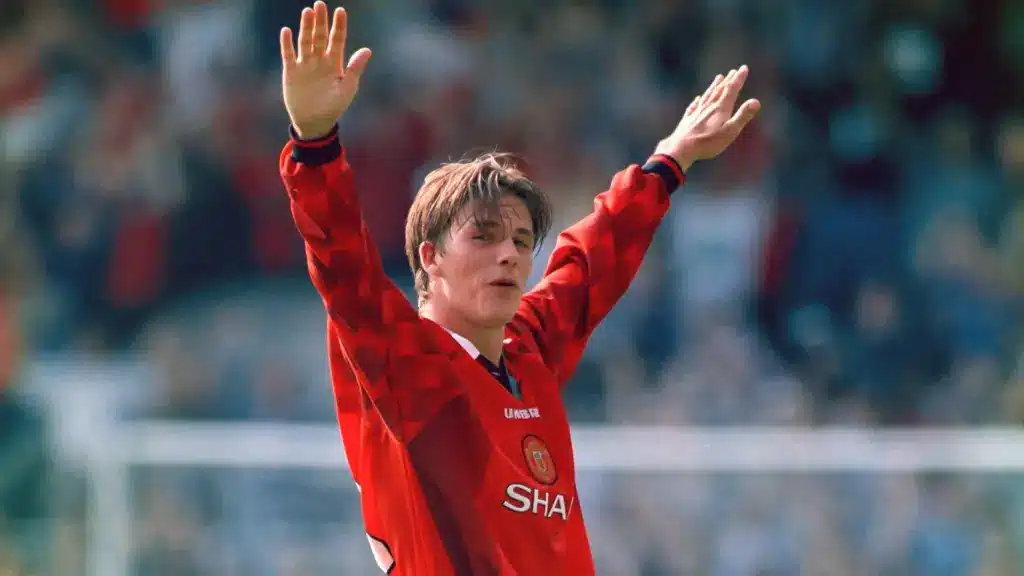
Beckham’s most distinctive strategy was negotiating equity stakes in lieu of maximum salary. The clearest example: in 2007 he accepted a lower MLS pay in exchange for the option to own a team (Inter Miami). That move (Timeline 2007) turned a $25M investment into a $300M asset by 2023. Similarly, instead of endless endorsement fees, he eventually took ownership of his brand (buying out his manager in 2019) and sold part of it in 2022. The pillar here is the mindset to invest in long-term ownership rather than just collecting short-term income. This approach, often used in Silicon Valley rather than football, set him apart from peers who simply signed the biggest contracts on offer.
2. ‘Transform Fame into a Brand Empire’
From early on, Beckham treated himself as more than an athlete; he became a commercial brand. He capitalised on his celebrity (bolstered by the pop-star spouse) to sign unprecedented deals like the adidas lifetime contract in 2003. Over time, he built Brand Beckham Holdings to manage his image rights and launched products (fragrances, apparel, Haig Club whisky) with his name. This pillar is about scaling personal brand equity. Beckham turned his popularity into a diversified enterprise. For instance, his 2014 creation of DB Ventures institutionalised his brand deals as a business, leading to the ABG partnership. Unlike many athletes who license their name haphazardly, Beckham’s team approached it systematically, which directly led to a half-billion valuation of his brand by 2022.
3. ‘Global Diversification of Income’
Beckham didn’t rely on one club or one country for earnings. He went global. He played in Europe, then America and cultivated fanbases in Asia (multiple China-specific endorsements around 2013. He also diversified the types of income: sports salaries, endorsements spanning industries, and business ventures. When one income stream ended (football wages in 2013), others (ambassadorships, investments) ramped up, so his overall earnings graph kept rising. The 2013 retirement to 2014 earnings jump is a case in point: while most athletes see income plummet after retirement, Beckham’s broad revenue base meant he hit a new high. This pillar (multiple streams and markets) protected and grew his wealth consistently.
4. ‘Partner with Power Players’
Beckham often teamed up with bigger forces to amplify his success. He joined Galácticos at Real (boosting his profile), partnered with the Mas brothers for Inter Miami (bringing local real estate clout and capital) and struck the deal with Authentic Brands Group (global brand powerhouse) rather than going it alone. By aligning with strong partners, he could punch above his weight financially. For instance, ABG’s backing plugged him into a multi-billion-dollar enterprise network, ensuring his brand can keep expanding without him personally managing every deal. This pillar is about leveraging partnerships to achieve scale, a move many independent stars fail to do, but Beckham executed well (often crediting his management team for navigating these alliances).
5. ‘Constant Reinvention & Relevance’
A subtle but crucial factor: Beckham continuously reinvented his role to stay financially relevant. In his 20s, he was the fashion-forward football icon; in his 30s, the seasoned global ambassador; in his 40s, the team owner and entrepreneur. He anticipated the end of his playing days and had business ventures already in motion (e.g. he was planning Inter Miami as early as 2014). The Netflix documentary in 2023 reintroduced him to a new generation, boosting his brand again. This pillar of staying in the spotlight with purpose meant his endorsements and opportunities never dried up. Many athletes fade from public consciousness after retirement, but Beckham remained a household name (helped by high-profile endeavors like the 2012 Olympics role and UNICEF ambassadorship). This ensured that when big chances came (like the Qatar deal in 2021 or Messi’s arrival in 2023), Beckham was still a relevant figure to capitalise.
In essence, Beckham’s wealth isn’t an accident of celebrity, it’s the result of these strategic pillars working in concert. He owned what mattered, branded himself smartly, diversified globally, partnered shrewdly and evolved with time. Each pillar can be linked to key timeline moments (from 2007’s equity play to 2022’s brand sale, etc.), demonstrating a deliberate playbook for turning fame into fortune.
Actionable Insights: Lessons from Beckham’s Wealth Blueprint
What can entrepreneurs and investors learn from David Beckham’s financial playbook? Here are concrete takeaways inspired by his journey:
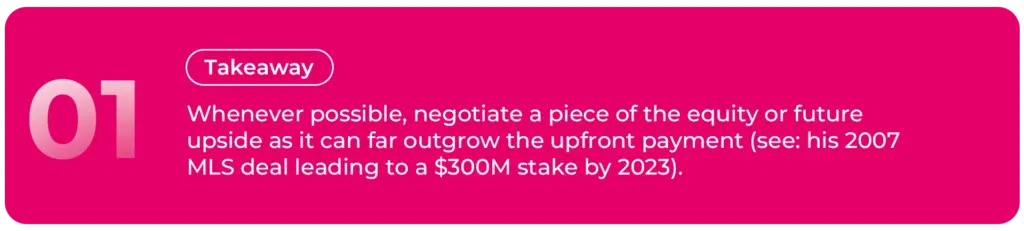
1. Negotiate for Equity, Not Just Cash
Beckham’s fortune soared when he started taking ownership stakes (Inter Miami, DB Ventures) instead of only salaries or fees.
2. Build a Personal Brand – Then Treat It Like a Business
Beckham cultivated ‘Brand Beckham’ deliberately and eventually sold part of it for nine figures. He didn’t leave his image to chance; he productised it.
3. Diversify Your Income Streams
At his peak, Beckham had money coming in from sports contracts, endorsements across continents and businesses. When one stream dipped, others filled in (post-retirement, his ambassadorships and ventures took over).
4. Align with Strong Partners for Bigger Deals
Instead of solo ventures, Beckham teamed up with ABG for his brand, with co-owners for Inter Miami, with Diageo for Haig Club. These partnerships brought capital, expertise and scale.
5. Leverage Your Core Expertise into New Arenas
Beckham leveraged what he knew (football and fame) into adjacent opportunities: a football club, endorsements in sports fashion, etc. He didn’t stray into completely alien fields without support.
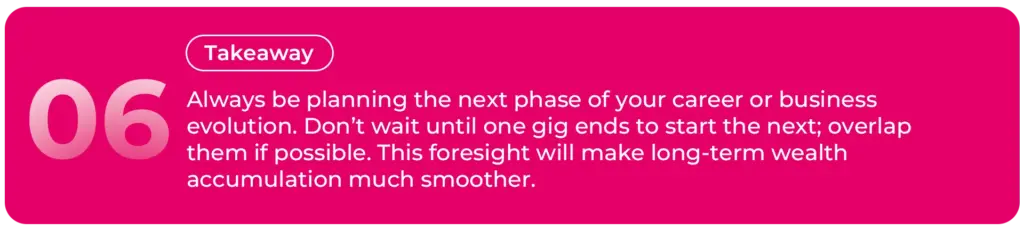
6. Plan Your Second Act Early
Beckham was laying groundwork for post-playing ventures (like MLS ownership) years before retirement. He smoothly transitioned to business so there was no income gap.
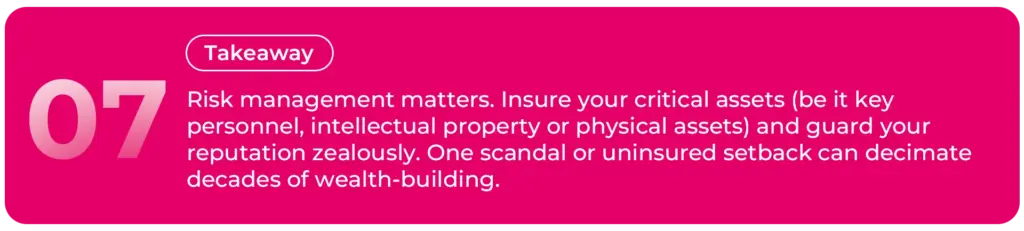
7. Protect the Downside (Insurance and PR)
It’s not luck that Beckham never had a financial disaster despite big moves. He literally insured his legs for £100M in case of career-ending injury, and he and his team carefully managed his public image through crises (ensuring Brand Beckham remained intact and valuable).
Each of these insights is rooted in Beckham’s real experiences, from contract negotiations to global branding to risk management. Entrepreneurs might not bend it like Beckham on the football field, but certainly can blend it like Beckham in the boardroom, by applying these principles to their own ventures and careers.
Final Thoughts
David Beckham’s evolution from sports superstar to business mogul offers a masterclass in proactive wealth-building. Instead of resting on the laurels of a lucrative playing career, Beckham charted a course to keep his net worth compounding long after the final whistle. At the core of his strategy was a simple realisation: fame is finite, but smart investments can be forever. By trading some short-term earnings for long-term equity (be it a football club or his own brand IP), Beckham built assets that work for him 24/7, independent of his time or effort.
What truly sets Beckham apart is how he bridged two worlds – sports and enterprise – with exceptional finesse. He recognised early that athletic prowess alone wouldn’t make him as wealthy as leveraging the business of being David Beckham. This self-awareness allowed him to do things like turn a contract clause into a $1 billion enterprise, and to transform endorsement deals into a half-billion dollar brand sale. In a sense, Beckham treated his career as a launchpad for a diversified business portfolio, not as the endgame itself.
Of course, not every aspect of Beckham’s approach is easily emulated. His level of global fame is rare, and some deals (like the Qatar partnership) invite ethical debates that each person must weigh. However, the underlying principles (owning equity, diversifying income, strategic partnering, and constant reinvention) are broadly applicable to anyone serious about building wealth.
Perhaps the most inspiring takeaway is that Beckham played the long game. He was patient for payoffs (waiting years to see Inter Miami materialise and appreciate), and he invested in intangible assets like brand and relationships, which don’t show up on a balance sheet immediately but yield enormous returns down the line. For entrepreneurs and investors, the message is clear: think like an owner, not just an earner. Whether you’re negotiating a stake in a company, cultivating a personal brand or planning your career moves, aim for the kind of value that grows exponentially. That’s the real Beckham effect. Not just bending a football, but bending the trajectory of one’s financial future by making savvy, forward-looking decisions.
In the end, David Beckham’s wealth blueprint is as much about mindset as money. It’s a blueprint that says: be more than your core skill, be thoughtful about every major decision (from contracts to partnerships), and always keep an eye on the legacy you’re building. Copying his free kicks might be impossible, but copying elements of his wealth-building playbook might just be the smartest move you can make in your own financial journey.
For more insights on the wealthy, wise and successful, check out my No Bollocks Podcast for more like this.
Read more of our wealth reports including Tom Cruise, Donald Trump, Mark Zuckerberg, Elon Musk, Ryan Giggs, Taylor Swift and more on our No Bollocks Business HQ.