Who is Taylor Swift?
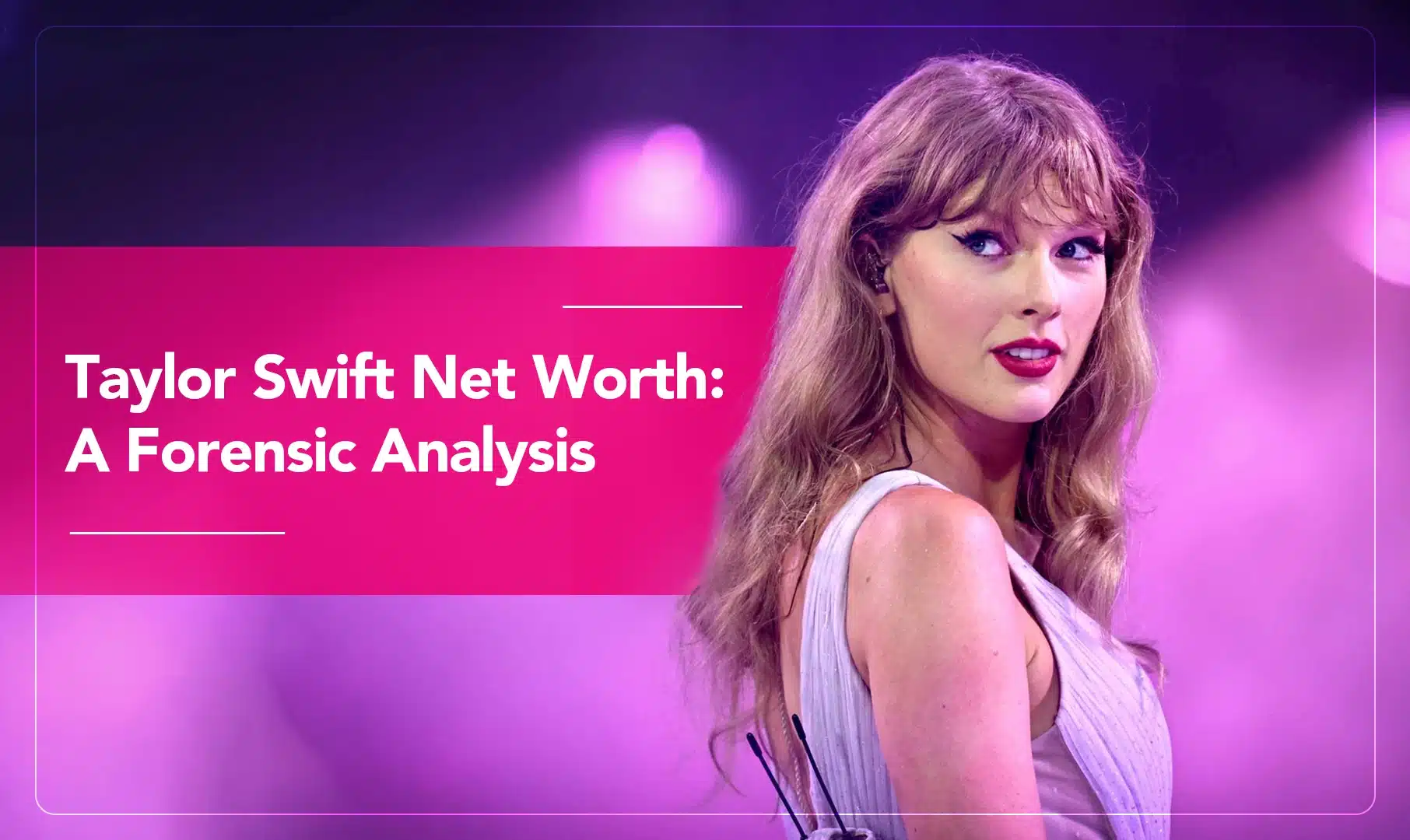
Taylor Swift is an American singer-songwriter who became the first musician to build a billion-dollar fortune on songs and concert tickets alone. She started as a teenage country artist signed to a small Nashville label in 2005, crossed over into the biggest pop star on the planet, and along the way turned into one of the shrewdest business operators in the music industry.
She’s the artist behind a run of record-breaking albums and the Eras Tour, the highest-grossing concert tour in history. Underneath that sits a money story that matters more: she spent twenty years fighting to own her work rather than rent it out, and that single obsession is why she’s worth what she is. She got rich the hard way, on assets she controls, not on the usual celebrity side doors.
The number
Taylor Swift is worth around $1.8 billion as of mid-2026. No make-up line, no vodka brand, no tech float, none of the usual side doors to a fortune that size. Just songs and concert tickets, which no musician in history had ridden that far before her, let alone to nearly two billion.
Her Eras Tour grossed over $2 billion on its own, the first tour ever to do it and roughly double the previous record. In 2025 she made an estimated $202 million without playing a single show. And in May 2025 she bought back the master recordings of her first six albums, the ones she was forced to hand over at fifteen, reportedly for less than the man who sold them paid.
She got rich in a way almost no other star does. Most rent themselves out. They take the fee, the endorsement cheque, the salary, and when the fame cools the money stops. Swift did the opposite. She spent twenty years turning her fame into things she owns: master recordings, publishing, a touring operation she controls, a production company, property. The fee is temporary. The asset keeps paying.
The short version
She’s worth around $1.8 billion, and about $1.3 billion of that exists for one reason: she owns her work instead of renting it out. Add up the cash she actually banked over her career and you get maybe $500 million. The rest is the value of assets she owns and controls, worth far more than the fees they ever paid her.
That gap is the entire lesson, and it scales to any business:
- Own the asset, don’t rent yourself out. A fee pays once. An asset you own pays forever, and it grows.
- Turn a setback into a weapon. She lost her masters, then re-recorded her catalogue to make the originals worthless to whoever held them, and bought them back cheap.
- Build demand until you set the price. 149 stadium shows, still not enough tickets. When you’re the only one with what people want, you stop competing on price.
The full breakdown, the two ways we size the fortune, and the rest of the playbook are below.
Taylor Swift’s net worth: the numbers
| Category | Value (est.) | Notes |
|---|---|---|
| Total net worth | ~$1.8bn | Our valuation, mid-2026 |
| Music catalogue and IP | ~$1.0bn | Owned masters plus publishing (her biggest asset) |
| Cash and financial assets | ~$600m | Retained touring and royalty income |
| Real estate | $125m | She paid about $95m for it |
| Private jet and other | ~$60m | Falcon 7X; second jet sold 2024 |
| The Eras Tour gross | $2.08bn | First tour ever past $2bn |
| 2025 income, no tour | ~$202m | Catalogue, streaming, recordings |
How the number is built
We sized it two different ways, and the answers land a long way apart. That gap is the point.
Model A, the asset stack. Add up what she owns today. Catalogue and publishing at around $1 billion. Cash and financial assets from two decades of touring and royalties, topped up by the enormous 2024 and 2025 earnings, at roughly $600 million. Real estate at $125 million. Jet and other big-ticket items at about $60 million. That lands near $1.8 billion.
Model B, earnings and retention. Total what actually reached her over her career, pre-tax, across touring, royalties, publishing, the film and endorsements: roughly $1.2 billion. Take off tax at about 45 per cent, a team cut of 15 to 20 per cent, and the cost of living like Taylor Swift. A disciplined earner keeps maybe 35 to 45 per cent as durable cash, so about $500 million.
Model B says $500 million. Model A says roughly $1.8 billion. The gap, well over a billion, is the ownership premium: her catalogue and publishing are worth far more than the cash they ever paid her, because she owns appreciating, income-producing assets rather than fees.
The same maths applies to anyone, not just a pop star. She banked maybe $500 million and is worth more than three times that, because she put the money into things she owns and controls instead of leaving it as cash or spending it. What you own outgrows what you earn, at any size.
The assumptions behind our figure: tax around 45 per cent, team take 15 to 20 per cent, the catalogue valued at $1 billion, real estate at $125 million, retention of 35 to 45 per cent in Model B. The one real judgment call is the catalogue, because no one publishes an audited value of it, so we’ve valued it on the royalty income it throws off and the prices comparable catalogues have sold for.
How Taylor Swift makes money: the primary income streams
Taylor Swift career earnings come from two very different places. There’s the money from the work, which is recorded music, touring and the film. And there’s the money from owning the rights to that work forever. Most artists have the first. Very few have the second at her scale, and the second is what turned a rich pop star into a billionaire.
Recorded music and streaming
Swift has sold over 105 million certified album units in the United States alone, per the RIAA, the first woman past 100 million.
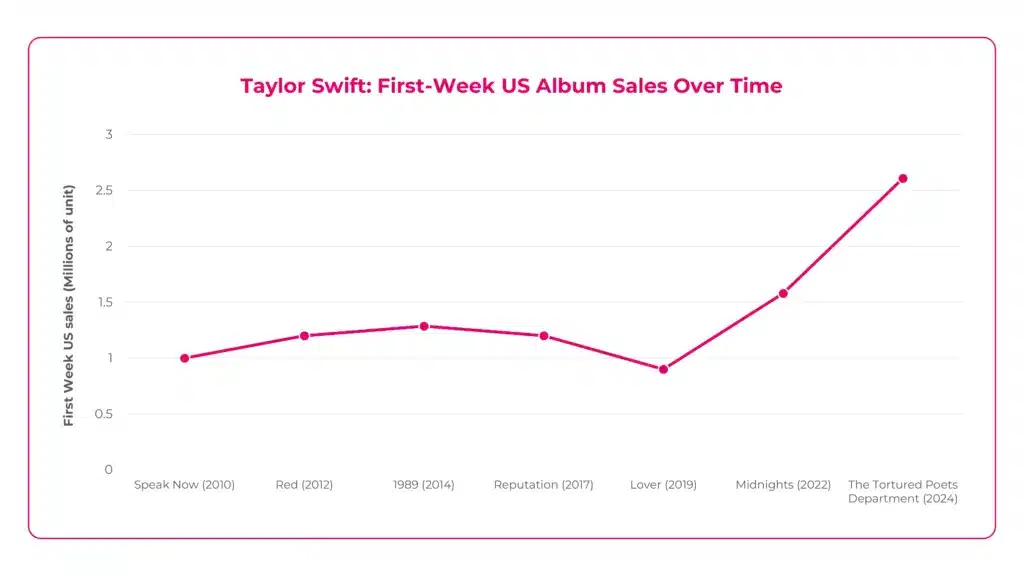
The Life of a Showgirl opened in 2025 with 4.002 million units in a single week, the biggest week in the modern sales era, ahead of Adele’s 25. The Tortured Poets Department did 2.61 million in 2024, with 859,000 of those on vinyl alone. Midnights did 1.578 million in 2022. 1989 (Taylor’s Version) did 1.65 million in 2023. The average major album release would take one of those weeks and frame it.
Streaming is the annuity underneath the sales. She became Spotify’s most-streamed artist of all time in 2024 and passed 100 billion streams in early 2025. The Tortured Poets Department alone drew 1.17 billion streams in its debut week, a record. At a rough industry rate of $0.003 to $0.005 a stream, that single week is worth several million on one album, and it keeps paying every month after.
Streaming doesn’t pay per play the way the old business paid per album, but at her volume it compounds. And since 2019 it flows into recordings she owns outright. That’s the difference between a royalty cheque and a rent cheque, and it’s the whole reason the ownership fight was worth having.
Touring and live revenue
Touring is the engine, and the Eras Tour took it somewhere no artist had gone.
| Tour | Years | Reported gross |
|---|---|---|
| The Eras Tour | 2023 to 2024 | $2.08bn |
| Reputation Stadium Tour | 2018 | $345.7m |
| The 1989 World Tour | 2015 | ~$250.7m |
| The Red Tour | 2013 to 2014 | ~$150.2m |
| Speak Now World Tour | 2011 to 2012 | ~$123.7m |
| Fearless Tour | 2009 to 2010 | ~$66.5m |
Her tours climbed from $66 million to $345 million across a decade, a strong career on its own. The Reputation Stadium Tour in 2018 was the highest-grossing US tour in history at the time, which shows the trajectory was already steep before Eras. Then the Eras Tour did $2.08 billion, a different scale from every tour before it, hers included.
It ran 149 shows across nearly two years, sold over 10.1 million tickets at an average of $204 each, and became the first tour past $2 billion, roughly double the old record.
A tour gross isn’t what the artist keeps. Production, crew, venues and promoters take their cut first, and the Eras production was one of the most expensive ever staged. She personally netted an estimated $190 million post-tax, and that single figure is what pushed her over the billion-dollar line. One tour. One decision to go bigger than anyone thought was sensible.
The Eras economics compounded outward. She priced in tiers, from standard seats to four-figure VIP packages, and let demand carry face values higher. The tour then fed everything around it: the concert film added $261 million, merchandise ran into multi-million-dollar nights, and the shows pushed her back catalogue up the streaming charts through 2023 and 2024. Cities reported hotel and hospitality booms wherever it landed, though that Swiftonomics spend went to local economies, not to her.

Everyone stares at the $2 billion gross and misses the actual masterclass, which is pricing and demand. She built demand to the point where she could run 149 stadium shows and still leave people begging for tickets. When you're the only one who has what people want, you set the price. Most business owners discount to compete. She did the opposite and made it an event you had to be at. Get your product to where people queue and you never compete on price again
Publishing, catalogue and the masters she fought to own
When Swift signed with Big Machine Records in 2005 at fifteen, she did what almost every young artist does and signed away the master recordings of her music. For her first six albums, from her 2006 debut through Reputation in 2017, the label owned the recordings. She always held her songwriting and publishing separately, but the recordings, the things that get streamed and licensed, belonged to Big Machine.
Then it got worse. In June 2019, Scooter Braun’s Ithaca Holdings bought Big Machine for just over $300 million, and her masters with it, with no deal for her to buy them on terms she’d accept. In November 2020, Braun sold those masters to the private equity firm Shamrock Capital. The reported price runs from about $300 million to $405 million; neither side confirmed it.
She could have moved on. Instead she started re-recording her old albums as Taylor’s Version and told her fans to stream the new ones. Fearless (Taylor’s Version) came in 2021, then Red, then Speak Now, then 1989. Every one hit number one. Every stream of a Taylor’s Version was a stream that didn’t go to Shamrock, and it drained the value out of the masters someone else owned.
The re-recording mechanic is worth understanding, because it’s pure financial engineering. A master’s value is the future royalty income it throws off. Redirect the streams, syncs and licences to a new version, and the old one stops earning, so its value falls. Every Taylor’s Version that hit number one, and all four did, moved more income off the Shamrock masters and onto hers, cutting the price she’d eventually pay to buy the originals back.
It worked. In May 2025 she bought all six albums’ masters back from Shamrock. The price wasn’t disclosed, but it was a nine-figure sum, reportedly below what Shamrock had paid. She now owns every recording she’s ever made.
Two things make that ownership pay. Her publishing and songwriting, held separately throughout the fight, moved from Sony/ATV to Universal Music Publishing in 2020, so both halves of every song, the composition and the recording, now sit under deals she controls. And every future use of the catalogue, every stream, every sync in a film or advert, every licence and re-issue, now flows to her rather than a label or a fund.
On a catalogue we value at around $1 billion, this income is the single biggest line on her balance sheet.
This is the exact play I've run in acquisitions, just in a boardroom instead of a studio. You create a credible threat that tanks the value of the asset for the person holding it, then buy it at the number you set, not the number they wanted. Her threat was the re-recordings. Every Taylor's Version made the originals worth less to Shamrock, because why stream the version that pays the private equity firm when the artist is begging you to stream hers? By the time she bought, the asset was worth a fraction of what they'd paid. If you're ever buying a business, find the thing that makes it worth less to the current owner than to you, and press on it. If you're working through a deal like that right now, it's exactly the kind of situation worth talking through — book one-to-one consulting.
Film, television and other creative work
In October 2023 she released the Eras Tour concert film, and how she released it matters more than the film. She didn’t sell it to a studio. She financed it herself and took it straight to the cinema chain AMC, which distributed it directly to its own screens and rivals’. That cut out the traditional studio middleman entirely, the layer that normally funds a film and takes the largest share for doing so.
The film grossed $261.6 million worldwide, the highest-grossing concert film ever, ahead of Michael Jackson’s This Is It, and it opened to a record $92.8 million domestic weekend. Cinemas took 43 per cent; the remaining 57 per cent split between Swift and AMC. Her exact cut wasn’t disclosed, but as the self-financing producer she kept the majority of a quarter-billion-dollar gross a studio would normally have carved up, and she owns the film outright afterwards.
Cutting the studio out is the whole game here. A film studio exists to take the risk you can't and charge you for it. Swift could take her own risk, because she had the cash and the audience, so she cut the studio out and kept its slice. The middleman's cut is your margin if you can carry the work and the risk he carries. Most owners pay the middleman forever because it feels safer. She ran the maths, saw she could self-fund, and kept the lot.
Her primary income, the touring and recordings and film, is why she holds several hundred million in cash and financial assets. The larger share of her fortune sits in the catalogue she owns and the property she bought with it, and the catalogue is her single biggest asset. The recordings make the money. Ownership keeps it.
Taylor Swift’s secondary income streams
The primary streams built the fortune. The secondary ones are smaller.
Endorsements and sponsorships
Over her career Swift has had deals with Diet Coke, Keds, CoverGirl, Elizabeth Arden, Capital One and AT&T, plus a well-known appearance in Apple Music’s 2016 advertising after she publicly pushed Apple into paying artists during free trials. None of the deal values were ever disclosed. The often-quoted “$26 million from Diet Coke” traces to a single tabloid, and the Apple spot was an appearance, not a confirmed paid deal.
Real money, in amounts nobody outside her camp knows. A viral claim that she “lost $125 million in brand deals” is false, per Snopes.
Business ventures
The big one is structural, not a side hustle. In November 2018 she left Big Machine for Universal Music Group’s Republic Records. The deal was reported at $100 million in guarantees, up to $200 million, but the money isn’t the point. Two clauses were. First, she owns the master recordings of everything she records under it, so from 2019 she stopped renting her own future work.
Second, she negotiated that if Universal ever sold its equity stake in Spotify, the proceeds would go to artists on a non-recoupable basis, meaning they keep it. That clause paid out for every Universal artist when the label later sold down its Spotify stake.
Look at what she optimised for. The headline was the guarantee, the big number the press reported. She spent her negotiating capital on two clauses that made no headlines: owning her future recordings, and that Spotify payout. Amateurs negotiate the cheque. Operators negotiate the ownership terms, because the cheque is spent in a year and the ownership pays for decades. Next time you do a deal, read past the money to who owns what at the end. That's the line I check first.
Beyond the recording deal she runs Taylor Swift Productions, behind the Eras film and her documentary work, plus her fan-marketing and management operations, Taylor Nation and 13 Management. All private, no public financials. She’s often linked to Tait, the firm that builds her stages, but she’s a client, not an owner: Goldman Sachs bought majority control of Tait in 2024.
Licensing, merchandising and royalties
Merchandise is a serious business in its own right, with multi-million-dollar takings reported on single tour nights. Licensing and sync royalties, the money from her music in films, adverts and games, flow into recordings she now owns.
Taylor Swift assets and income streams: the portfolio
Income is what comes in. Assets are what it turns into. Swift converted.
Real estate
She buys quality property and holds it, usually in cash. The portfolio is worth around $125 million today; she paid about $95 million for it.
| Property | Location | Bought | Price |
|---|---|---|---|
| “Holiday House” (Harkness estate) | Watch Hill, Rhode Island | 2013 | $17.75m cash |
| Tribeca compound (three units) | New York City | 2014 to 2018 | ~$47.7m combined |
| Samuel Goldwyn Estate | Beverly Hills, California | 2015 | $25m |
| Adelicia penthouse | Nashville, Tennessee | 2009 | $1.99m |
| Northumberland estate | Nashville, Tennessee | 2011 | $2.5m |
She paid cash for the Rhode Island house in 2013. The Tribeca holding is really three units assembled on a single block between 2014 and 2018, a penthouse duplex bought from the film director Peter Jackson, a townhouse and a second apartment, combined into one compound worth close to $50 million.
She bought the Beverly Hills estate, once owned by the Goldwyn film family for eighty years, then restored it and had it granted historic-landmark status in 2017. This is property as a store of wealth, held and improved, not a lifestyle flex financed with debt.
Jets and luxury assets
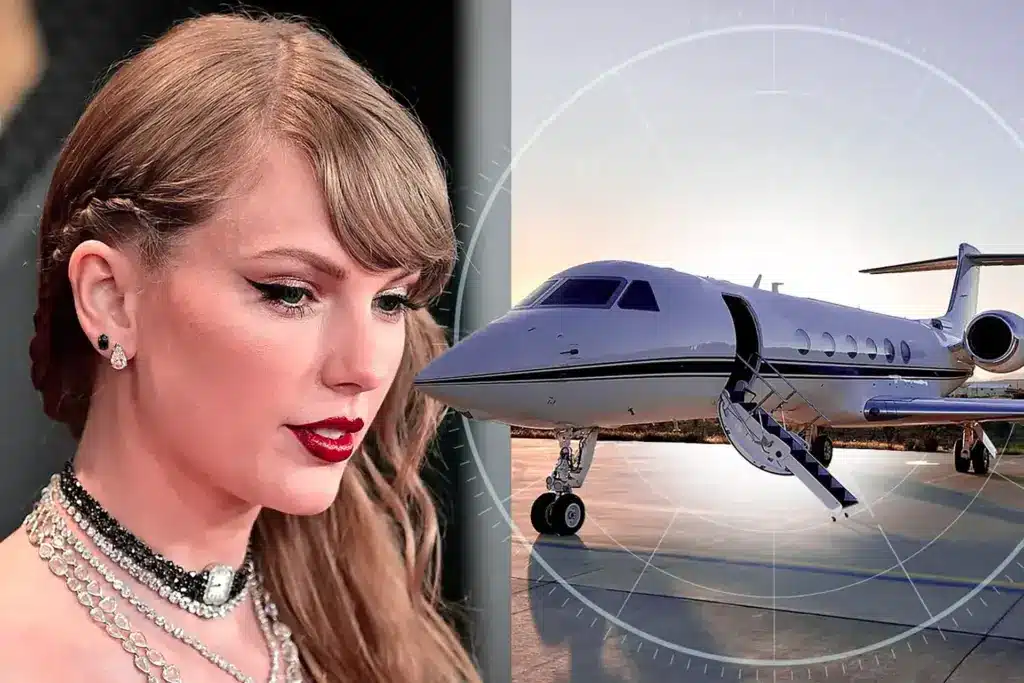
Swift owned two Dassault Falcon jets and sold one in early 2024, at an undisclosed price, amid a row about flight-tracking. She keeps a Falcon 7X, worth an estimated $54 million. No notable car collection or other big luxury assets on record. For someone worth around $1.8 billion, the burn is modest, which is part of why the net worth is what it is.
Investments and financial instruments
The rest sits in investments and cash. There’s no public detail on the holdings, so call it roughly $600 million in financial assets built from retained earnings, the durable capital left after two decades of tax, team and living costs, plus the very large 2024 and 2025 income.
Taylor Swift net worth breakdown
Where the $1.8 billion sits:
| Asset class | Value (est.) | Share | What drives it |
|---|---|---|---|
| Music catalogue and IP | ~$1.0bn | ~56% | Owned masters plus publishing |
| Cash and financial assets | ~$600m | ~34% | Retained touring and royalty income |
| Real estate | $125m | ~7% | Seven properties, mostly bought in cash |
| Jet and other assets | ~$60m | ~3% | Falcon 7X and miscellaneous |
More than half is the catalogue and IP she owns, worth far more than the cash it ever paid her. Around a third is cash and financial assets, her earnings turned into investments instead of spent. The property and jet are the rest. The engine is the music, and she kept the money the music made because she owned the music.
Timeline of major financial milestones
Careers have a lot of events. Fortunes have a few. These are the ones that moved the money.
| Year | Event | Financial impact | Why it mattered |
|---|---|---|---|
| 2005 | Signs with Big Machine at fifteen | Standard deal, doesn’t own her masters | Set up the ownership trap that drove everything for twenty years |
| 2009 to 2010 | Fearless Tour, her first headline tour | First touring income at scale | Established touring as the core engine |
| Nov 2018 | Signs with Universal and Republic | Owns masters going forward, plus the Spotify clause | Stops renting her future work |
| Jun 2019 | Braun’s Ithaca buys Big Machine for ~$300m | Loses control of her old masters | Triggered the re-record strategy |
| Aug 2019 | Announces she’ll re-record her first six albums | Turns a loss into a plan | The smartest value play of her career |
| Nov 2020 | Braun sells the masters to Shamrock for ~$300m to $405m | Third party owns the catalogue | Set the ceiling she’d later negotiate down from |
| 2021 to 2023 | Releases four Taylor’s Version albums | Redirects royalties, drains the originals’ value | Proof the strategy worked |
| Oct 2023 | Eras Tour film grosses $261.6m via AMC | Keeps the majority, cuts out the studio | Disintermediated the film business |
| Oct 2023 | Crosses $1bn | First musician there on songs and shows alone | The billionaire line |
| Dec 2024 | Eras Tour ends at $2.08bn gross | The biggest single jump in her net worth | The growth engine |
| May 2025 | Buys back her masters from Shamrock | Owns 100% of her recordings | Closes the loop opened in 2019 |
| 2026 | Valued at ~$1.8bn on our valuation | Up more than half on the 2023 billion | Ownership compounding |
Four gear-changes stand out: the 2018 Universal deal, where she started owning her future work; the 2019 decision to re-record, where she turned a loss into a bargaining chip; the 2023 to 2024 Eras Tour and film, which drove the biggest jump; and the 2025 buyback, where she converted a rented back catalogue into one she owns. Three of the four are ownership moves. The earning got her rich. The owning made her a billionaire and kept her one.
The pattern behind the wealth
Strip out the celebrity and one move sits under everything: she earned like a superstar and owned like an investor. From the 2018 Universal deal she stopped signing away her recordings; in 2019 she turned the loss of her old masters into a weapon; through 2023 and 2024 the Eras Tour and film doubled the fortune; and in 2025 she bought the old catalogue back. Every big decision pushed money out of temporary fees and into assets she controls.
That’s why the fortune is more than three times the cash she actually retained. The earning was extraordinary, but plenty of stars earn and end up with a fraction of it, because they rent themselves out and let others own the work. Swift’s whole career reads as a twenty-year campaign to own the thing that makes the money, and then to keep the income it throws off flowing to her instead of a label, a studio or a fund.
Actionable insights: what to copy from the Swift blueprint
Anyone can admire a billionaire. The question is what a normal business owner does with this the moment they finish reading. Each lesson has the move she made, the principle underneath it, why it worked, your version at different sizes, the thing to do now, and the trap.
Own the asset, don't rent yourself out
The move. Swift re-recorded her catalogue and bought back the masters, reclaiming ownership of the recordings that generate her royalties instead of earning a fee and letting someone else own the thing.
The mechanism. Own the asset, don't rent it out. The person who owns the recording earns every time it plays, forever. The person paid a fee earns once.
Why it worked. Royalties on an owned asset compound and appreciate. A fee doesn't. It's why her $500 million of retained earnings sits inside a net worth of around $1.8 billion: the assets she owns, above all the catalogue, are worth far more than the earnings that paid for them.
Renting yourself by the hour: package one thing you own and can sell more than once, a productised service, a template, software, so the money stops being tied to your time.
Earning well but owning little that recurs: turn a service into an asset, a subscription, a licence, a product that sells while you sleep.
Scaled: buy back the equity and control you gave away cheap when you were small.
Do this now. List every way your business makes money and mark each one "fee" or "asset". If it's all fees, you own a job with better branding. Pick one fee and design the asset version of it this week.
The trap. Ownership is worthless if nobody wants the thing. Swift could re-record because the demand already existed. Build the demand first, then own what it flows into.
Takeaway: Get paid for what you own, not just what you do.
Turn your worst setback into your sharpest weapon
The move. When she lost her masters, she re-recorded the albums and pointed her audience at the new versions, draining the originals' value until she could buy them back.
The mechanism. Create a credible threat that lowers an asset's value for its current owner, then acquire it at your price.
Why it worked. Every Taylor's Version stream was a stream that didn't pay Shamrock. The asset they'd paid a fortune for kept getting cheaper, because the artist was steering her audience away from it, so the price she paid to buy it back fell with it.
Supplier or platform has you over a barrel: build a credible ability to walk, a second supplier or your own version, so the threat is real.
Buying a competitor or supplier: find what makes their business worth less to them than to you (you're their biggest client, you can replicate them) and price off it.
Scaled acquisitions: engineer the leverage before you bid, from what you can take away, not what they want.
Do this now. Take one negotiation you're stuck in. Write down what you have that weakens the other side if you walk. If it's nothing, building that is the job before you negotiate again.
The trap. It only works if your threat is real and you'll use it. Swift spent years and real money on four albums. A bluff the other side sees through changes nothing.
Takeaway: Your power in a deal is what you're willing to do, not what you already hold.
Build demand so high you stop competing on price
The move. The Eras Tour ran 149 shows and still couldn't meet demand, which let her charge premium prices and add high-margin tiers on top.
The mechanism. Pricing power. When you're the only one with what people want, you set the price.
Why it worked. She spent fifteen years turning fans into superfans, so by 2023 the constraint wasn't demand, it was how many nights she could physically play. Sold out, with a waiting list, at prices she set.
Just you: stop competing on price and become the obvious choice for one specific type of customer.
A team and referrals: build a result so strong that referrals outpace your capacity, then raise prices into the queue.
Scaled: it's brand, people pick you over cheaper options because of who you are, so invest in the brand that lets you hold price.
Do this now. Raise your price on one product by 10 to 20 per cent this week. If nobody flinches, you were underpriced. If demand holds, you found free profit.
The trap. Pricing power is earned, not declared. Charge premium before you've built premium demand and you lose the sale.
Takeaway: Compete on price and you're replaceable. Build demand and you're the price.
Cut out the middleman when you can carry the risk
The move. She financed the Eras film herself and took it straight to cinemas, keeping the majority of a $261 million gross.
The mechanism. Own more of the chain, capture more of the margin.
Why it worked. A studio would have taken the biggest slice for financing and distribution. She had the cash and the audience to do both, so she kept what the studio would have taken.
Just you: sell direct instead of through a marketplace that takes 30 per cent.
A team: bring a service you outsource in-house so you keep the margin you were paying out.
Scaled: buy a supplier or distributor so you own the step you used to rent.
Do this now. Find the biggest cut anyone takes before revenue reaches you, a platform fee, an agency, a distributor. Work out what doing it yourself would cost and whether the margin justifies it.
The trap. Cutting out the middleman means taking on his risk and work. Swift could self-finance a film because she could afford to lose the money if it flopped.
Takeaway: The middleman's cut is your margin, if you can carry the risk he carries.
Convert income into assets before it disappears
The move. Cash from touring became property bought outright and a catalogue bought back.
The mechanism. Turn windfalls into owned, appreciating assets fast, before lifestyle absorbs them.
Why it worked. Income is temporary and taxed. Assets are durable and can appreciate. Moving money out of the bank account and into property and IP compounded it. Jeff Bezos ran the same discipline at Amazon for two decades, ploughing profit back into the business instead of paying it out, and it built one of the largest fortunes in history.
Just you: stop inflating your lifestyle every good month and reinvest the surplus into things that make more money.
A team: build cash reserves, then buy income-producing assets on purpose.
Scaled: turn operating profit into an owned asset base as a deliberate strategy, not an afterthought.
Do this now. Take your best month this year and work out what happened to the money. If it got absorbed into spending, set a rule: a fixed share of every windfall goes into an asset, not a lifestyle upgrade.
The trap. Don't buy assets you don't understand to feel productive. Swift bought property and her own catalogue, things she knew cold.
Takeaway: Spend from the yield, not the tree.
Negotiate for ownership, not the biggest cheque
The move. In 2018 she signed a deal reported at up to $200 million, but the clause that mattered was owning her future masters, not the headline guarantee.
The mechanism. The ownership terms outlast the cash terms.
Why it worked. The guarantee was a one-off, spent and taxed. The ownership pays every year the catalogue keeps earning, which is the difference between a good year and a fortune.
Just you: on any deal or partnership, look past the cheque to who owns the IP and the customer at the end.
A team: when you take investment or a big client, protect ownership and renewal rights as hard as you protect price.
Scaled: structure every deal around the equity and control position you hold once it's over.
Do this now. Read your next contract for the ownership terms, the IP, the equity, the renewal rights, and make them as good as the money terms. If you only negotiated price, you negotiated the wrong thing.
The trap. Ownership you can't use or enforce is worthless. Fight for rights you can actually monetise.
Takeaway: The cheque is temporary. The ownership is the deal.
Use your audience as your unfair advantage
The move. She mobilised her fanbase to stream the Taylor's Versions and turn the tour and film into events, using her audience as the force behind every commercial move.
The mechanism. An owned audience is an asset you can point at any problem.
Why it worked. She didn't need a label's marketing budget or a studio's distribution, because she had a direct line to millions who'd act on her word. That line did the job money usually buys.
Just you: start building a direct audience you own, an email list, a following, a community, not one you rent from an algorithm.
A team: treat that audience as your cheapest sales channel and sell to it deliberately.
Scaled: use it to launch new products without paying for reach.
Do this now. Count how many customers you can reach directly, without paying a platform, right now. If it's small, building it is the highest-return work you can do this quarter.
The trap. An audience you only ever sell to burns out. Swift's fans act because she gives them years of value first.
Takeaway: Rent attention and you pay forever. Own the audience and you never pay for reach again.
Final thoughts
The number is around $1.8 billion, and it’s the least interesting thing here. What matters is the mechanism, and it’s boringly repeatable: she earned like a superstar and owned like an investor.
Her edge over every other rich musician is ownership, not talent. Plenty of broke musicians have talent. She treated her career as a set of assets to own rather than fees to collect, and when she was forced to give up ownership young, she spent years and a fortune buying it back. That single obsession is why her fortune is more than three times the cash she actually retained.
The risks are real. A fortune this concentrated in one person’s brand rises and falls with that person’s relevance, and the catalogue is only worth what future demand pays for it. Copy the ownership discipline, not the concentration.
For a business owner the message is simple. Stop optimising for the biggest cheque and start optimising for what you own at the end. Turn your fees into assets. Turn your audience into your unfair advantage. Turn your setbacks into the reason you end up owning more, not less. You won’t build a billion-dollar catalogue, but the maths works the same way at your scale. Own the asset. Everything else is just income.
Taylor Swift net worth: frequently asked questions
How much is Taylor Swift worth?
Around $1.8 billion as of mid-2026. Her single biggest asset is the music catalogue and publishing she owns, worth around $1 billion; the rest is cash and financial assets, property and a jet. She’s the first musician to reach a billion on songs and shows alone.
How did Taylor Swift make her money?
Recorded music, touring and a concert film, and then owning the rights to all of it. The Eras Tour alone grossed over $2 billion. Since 2019 she has also owned her master recordings, so the royalties flow to her rather than to a label.
Does Taylor Swift own her masters?
Yes. She owns everything recorded since 2019 outright, and in May 2025 she bought back the masters of her first six albums from Shamrock Capital. After a twenty-year fight that started when she signed them away at fifteen, she now owns every recording she has ever made.
How much did the Eras Tour make?
The Eras Tour grossed $2.08 billion, the first tour in history past $2 billion and roughly double the previous record. That’s the gross, not what she kept: after production, crew and venues, she personally netted an estimated $190 million, the figure that pushed her over the billion-dollar line.
Is Taylor Swift a billionaire?
Yes. She’s worth around $1.8 billion on our valuation, and she crossed the billion mark in 2023. She’s the first musician to get there on music and touring alone, without a make-up line, a spirits brand or a tech investment doing the heavy lifting.
How much is Taylor Swift’s music catalogue worth?
Around $1 billion, and her single biggest asset. That covers the master recordings of all her albums plus her songwriting and publishing. We value it on the royalty income it throws off and the prices comparable catalogues have sold for, because no audited figure is public.
Sources
The load-bearing figures here are drawn from primary and trade sources for the data, and the net-worth valuation is our own. Tour grosses, sales, the film gross and the property record are documented. The catalogue value and the split of her financial assets are our estimates, built from that data.
- Billboard and Pollstar: Eras Tour gross and year-end touring data (2024); Reputation Stadium Tour gross (2018) and the earlier tour grosses.
- Variety and Luminate: first-week album figures and streaming records (2019 to 2025).
- RIAA: certified US album units (over 105 million).
- AMC Entertainment and Variety: the Eras Tour film gross and the direct-to-cinema deal structure (2023 to 2024).
- Variety, Billboard, Deadline, Washington Post and Music Business Worldwide: the Big Machine, Ithaca and Shamrock masters transactions and the 2025 buyback.
- Wall Street Journal, The Real Deal, StreetEasy and NBC News: the real-estate purchases and prices.
- Snopes: fact-check of the false “$125 million lost brand deals” claim.
Read more of our wealth reports including Jeremy Clarkson, Tom Cruise, Donald Trump, Mark Zuckerberg, Elon Musk, Ryan Giggs, Jeff Bezos and more on our No Bollocks Business HQ.
Browse more celebrity wealth reports across music, sport and business.
If you’re building a business of your own and want experienced support, you can work with Matt directly.