
Executive Summary
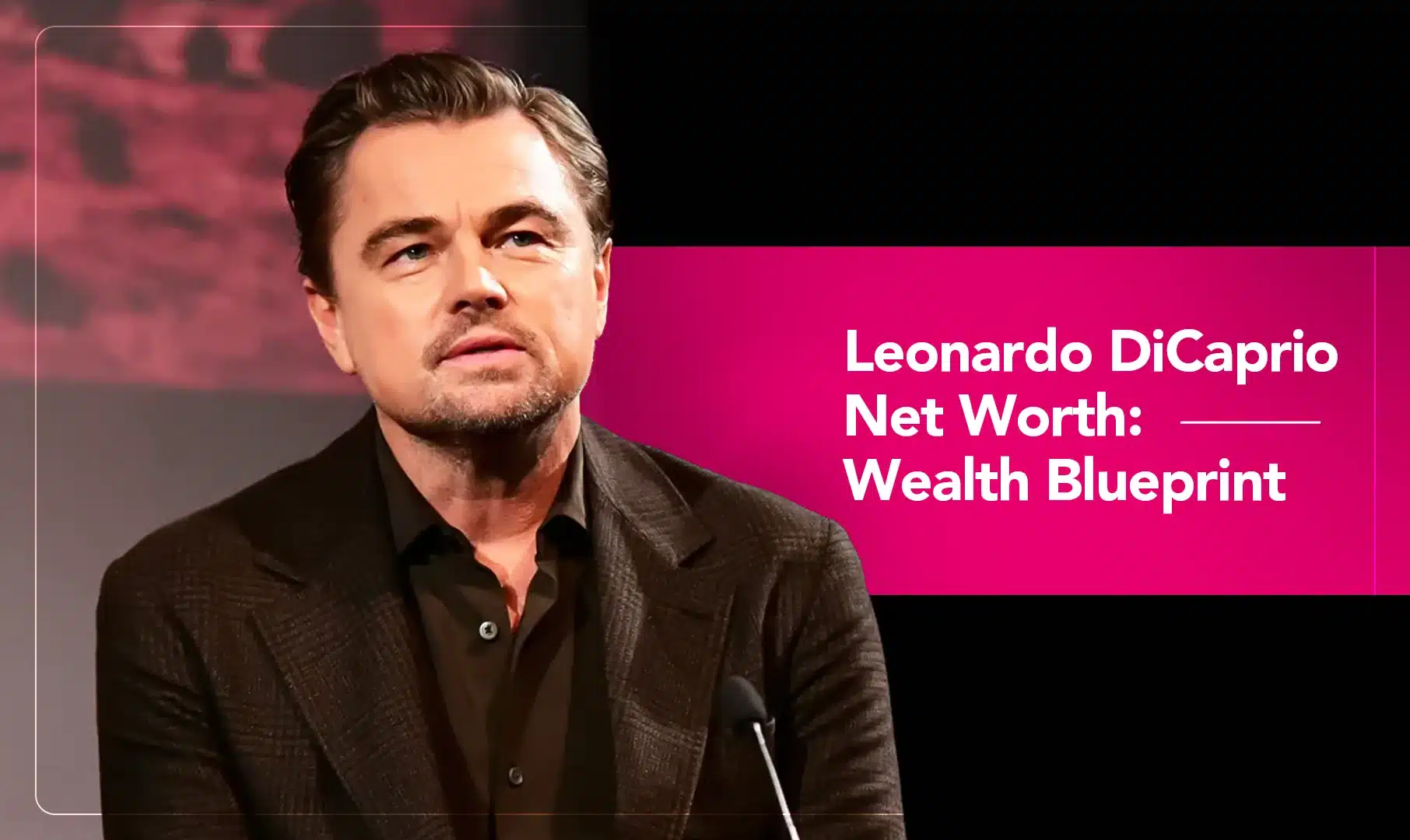
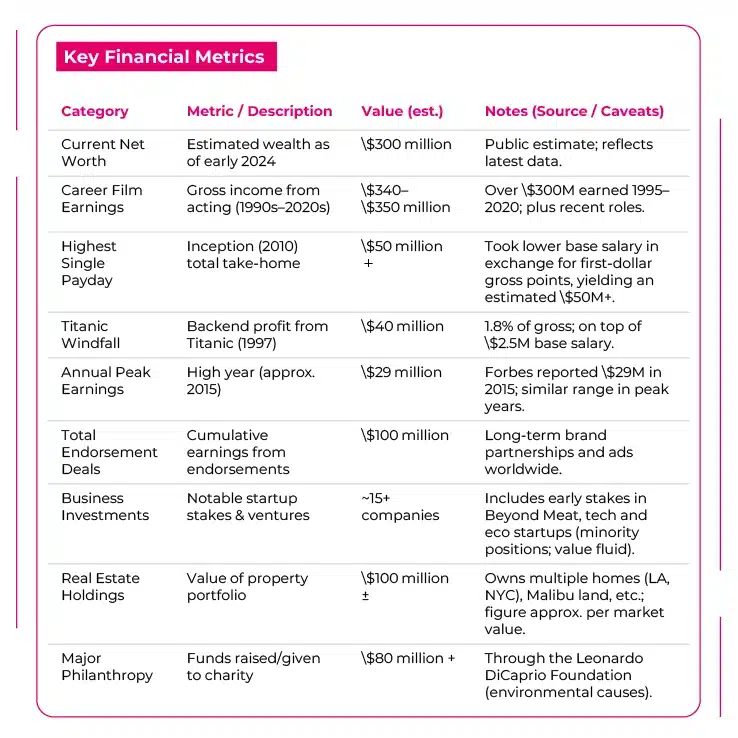
Leonardo DiCaprio isn’t just a Hollywood icon. He’s also the architect of a vast fortune. As of early 2024, DiCaprio’s net worth is approximately $300 million, a figure built over three decades of savvy career moves, strategic partnerships and investments. Best known for blockbuster films like Titanic and Inception, the Oscar-winning actor has parlayed his on-screen success into off-screen wealth. He has commanded eight-figure film salaries, negotiated lucrative backend deals, invested in real estate and start-ups and even monetised his environmentalist brand through selective endorsements. The result is a multifaceted financial empire that offers a masterclass in long-term wealth building.
This comprehensive blueprint breaks down exactly how DiCaprio earned, invested and grew his wealth, from record-breaking film paydays to sustainable business ventures, and what lessons we can draw from his journey.
To understand DiCaprio’s financial success, we’ll first examine his key financial metrics at a glance, then delve into the major income streams and assets underpinning his net worth. From his early acting breakthroughs and peak Hollywood earnings to his real estate portfolio and equity stakes, every material facet of his wealth is explored. We’ll chart a timeline of pivotal money moves and distil the strategic pillars that have underpinned his wealth-building. Finally, we’ll highlight actionable insights from DiCaprio’s playbook that readers can apply to their own financial lives.
Let’s dive into how Leonardo DiCaprio ‘never lets go’ of an opportunity to grow his fortune, turning talent and timing into a $300 million (and rising) legacy.
Acting Career and Hollywood Earnings
DiCaprio’s acting career has been the cornerstone of his wealth. Breaking out in the 1990s with critically acclaimed roles (This Boy’s Life, What’s Eating Gilbert Grape), he earned modest five- to six-figure paychecks early on. His true financial ascent began with blockbuster success in 1997: James Cameron’s Titanic made DiCaprio a global star and also extraordinarily rich. While his upfront fee for Titanic was only around $2.5 million, he wisely negotiated for 1.8% of the gross, netting an estimated $40 million bonus when the film smashed box-office records. This windfall instantly propelled the 22-year-old into Hollywood’s earning elite and set the template for future deals. In the decades since, DiCaprio has balanced artistic pursuits with big commercial paydays, consistently leveraging his clout to command top dollar for leading roles. Tom Cruise’s first-dollar-gross deals remain the gold standard of star compensation.
By the early 2000s, DiCaprio had joined the exclusive ‘$20 million-per-film’ club. Following Titanic, his quote skyrocketed. For example, he earned $20 million each for films like The Beach (2000), Catch Me If You Can (2002), The Aviator (2004), Blood Diamond (2006) and The Departed (2006). This reliable eight-figure salary became a baseline for his starring roles. Notably, DiCaprio often prioritised working with renowned directors (Spielberg, Scorsese, etc.), sometimes accepting slightly lower fees in exchange for quality or backend participation. A prime example is Inception (2010): viewing Christopher Nolan’s project as a worthwhile risk, DiCaprio agreed to a reduced upfront salary (reported around $10 million) in return for first-dollar gross points. The gamble paid off spectacularly, as Inception’s success yielded him at least $50 million in total earnings, his single biggest paycheck to date. This reflects a shrewd strategy: DiCaprio bets on himself and the films’ success, converting box-office grosses into personal profit.
By 2015, DiCaprio’s acting income peaked again with The Revenant, a film that finally earned him an Academy Award and about $20 million in salary. According to Forbes, he grossed roughly $29 million in 2015 alone, underscoring his status among the world’s highest-paid actors. Even as he entered his 40s, his earning power remained undiminished. In the streaming era, DiCaprio proved his marquee value commands premium rates from new studios: Netflix reportedly paid him $30 million for Don’t Look Up (2021), and Apple TV+ $30 million for Killers of the Flower Moon (2023). These figures place him near or at the top of annual acting pay rankings in those years. In total, over 30+ films, DiCaprio’s lifetime gross earnings from acting are well over $300 million (before taxes and fees). He has also achieved massive global impact: as of 2019, the collective worldwide box office of DiCaprio’s films exceeded $7.2 billion, a testament to the bankability that underpins his hefty pay.
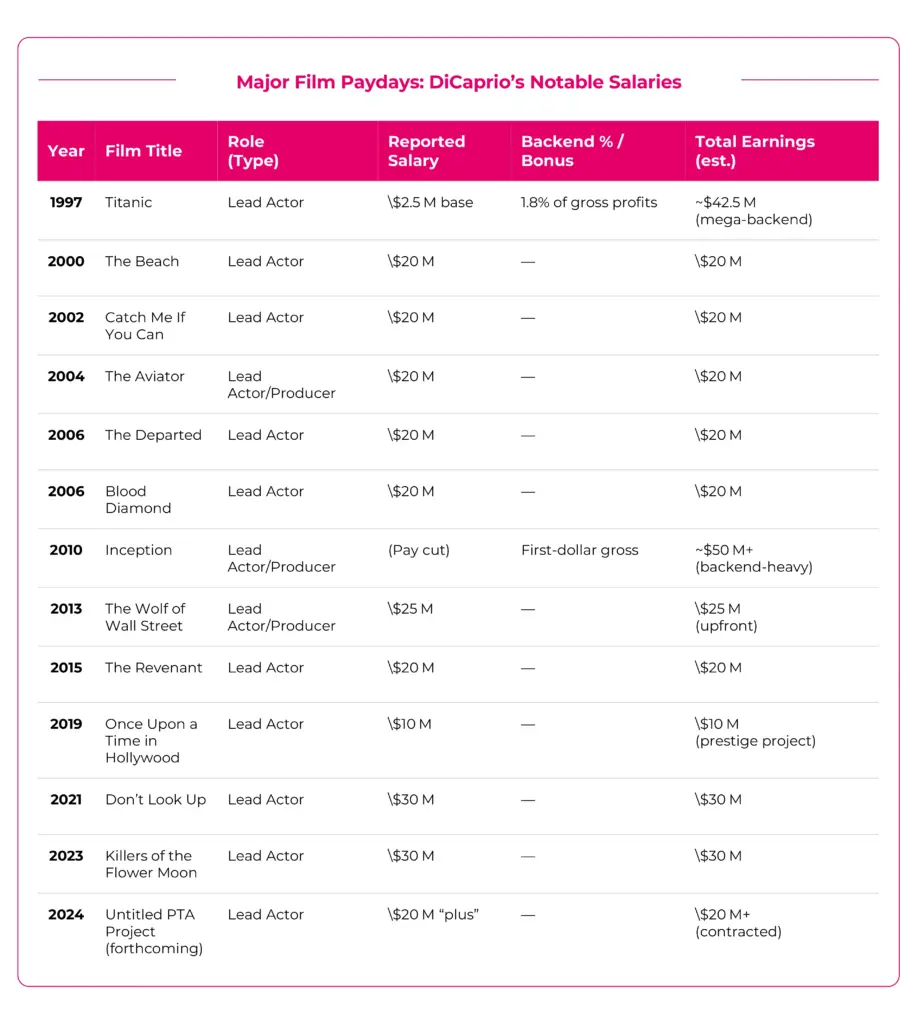
DiCaprio’s disciplined approach to film choices has financial benefits: he limits his output to 1–2 films per year, ensuring each project gets full focus and that demand for ‘a Leonardo DiCaprio film’ stays high. This selectivity, combined with working with acclaimed directors, has kept his brand prestige intact and allowed him to negotiate some of the richest deals in Hollywood. Importantly, he also wears multiple hats on many projects. Not just actor, but also producer. This brings us to another key facet of his wealth-building: earnings beyond acting, including production credits, endorsements and business ventures.
Endorsements and Brand Partnerships
Unlike some celebrities who lend their name to every product, Leonardo DiCaprio has been strategic and selective with endorsements. He isn’t known for flashy U.S. ad campaigns or ubiquitous commercial appearances; instead, he’s aligned his endorsements with his personal brand and global appeal, often opting for high-end or international partnerships that quietly yield substantial paychecks. Over the years, DiCaprio has reportedly earned at least $100 million from endorsements, a staggering sum considering his relatively low-key advertising presence. How did he do it? Primarily through a few lucrative, long-term deals and carefully chosen campaigns that leverage his star power overseas and his image as a sophisticated, environmentally-conscious A-lister.
One of DiCaprio’s most famous brand relationships was with luxury watchmaker TAG Heuer. As a brand ambassador in the late 2000s, he signed a multi-year deal rumored to be worth tens of millions, funneling a portion of his fees to environmental charities as part of the arrangement. This partnership was a win-win: Tag Heuer gained Hollywood glamour and eco-credibility by association with Leo, while DiCaprio monetised his ‘timeless’ appeal in line with his values. He has also appeared in international advertising campaigns. For example, in Asia he featured in commercials such as a Chinese credit card and a Japanese whiskey ad, markets where A-list celebrities can command enormous fees out of the Western spotlight. These deals allow DiCaprio to pocket eight-figure endorsement income without diluting his image among his core film audience.
In recent years, DiCaprio’s endorsements have increasingly intertwined with his environmental activism. Rather than promoting random products, he has backed companies that fit his sustainability ethos. For instance, he became a brand investor and advisor for Beyond Meat, the plant-based protein company, lending his fame to a cause (reducing meat consumption) that he genuinely supports. He has also popped up in campaigns related to electric vehicles and eco-friendly initiatives, not traditional ‘celebrity spokesmodel’ gigs, but positions where his advocacy and financial interest align. This approach has two benefits: it enhances his credibility (audiences see him endorsing what he truly believes in), and it often gives him an equity stake or profit share in the businesses he promotes (blurring the line between endorsement and investment). For the modern counterpoint to fee-based stardom, see how Ryan Reynolds out-earned the A-list with equity.
Financially, while endorsements are a smaller slice of DiCaprio’s wealth compared to film earnings, they’ve provided a significant additional income stream with minimal time commitment. A single commercial shoot or print campaign can yield a seven or eight-figure payday. For example, insiders noted that DiCaprio’s one-film deal with Netflix (Don’t Look Up) was rivalled only by his endorsement haul that year, underlining how profitable a well-negotiated brand partnership can be. Over time, his endorsement earnings (from watches, cars, credit cards, alcohol and more) have compounded to nine figures. The key takeaway is that DiCaprio monetises his celebrity selectively: he could have chased quick cash with ubiquitous ads, but instead he preserved his brand’s rarity and commanded higher prices from a handful of blue-chip partners. This restraint means every time his face is attached to a product, it’s a premium event. And he’s paid accordingly.
Business Ventures and Investments
Beyond the soundstage and red carpet, Leonardo DiCaprio has quietly built a portfolio of business ventures and investments that both diversify his income and reflect his passions. Central to this is his role as a producer and entrepreneur in the film industry itself. In 2004, DiCaprio founded Appian Way Productions, a production company through which he develops films and documentaries. Appian Way has produced many of his own movies (e.g. The Wolf of Wall Street, The Aviator, Shutter Island) as well as projects he doesn’t star in. This gives DiCaprio additional revenue streams (producer’s fees and a share of profits) on top of acting salaries.
For example, as a producer of The Wolf of Wall Street (2013), he not only earned his $25 million acting fee but also benefited from the film’s box-office success (it grossed $392 million worldwide). Running a production company also positions DiCaprio to own intellectual property and story rights, which can pay off through remakes, spin-offs or streaming licensing down the line. In essence, he isn’t merely a hired actor; he often has equity in his own films.
Outside Hollywood, DiCaprio has proven to be a savvy early-stage investor, especially in tech, sustainability and consumer startups. He has a clear strategy: back companies that align with emerging trends and/or his environmental values, often lending his celebrity to boost their profile. Over the last decade, he’s amassed a portfolio of at least 15 startup investments. Some of the notable ones include:
- Casper Sleep (2017) – DiCaprio was an early investor in the online mattress retailer Casper. The company’s valuation hit $1 billion+ and went public in 2020. While Casper’s IPO ultimately underperformed, DiCaprio likely profited from selling some shares or earlier funding rounds, demonstrating his willingness to enter buzzy consumer tech ventures.
- Rubicon (2015) – In a bid to support clean technology, DiCaprio invested in Rubicon, an ‘Uber for trash’ startup that optimises waste recycling. Rubicon later went public via a SPAC in 2022 at a ~$2 billion valuation. Though his stake was undisclosed, being part of such a high-profile investor group (alongside billionaires like Marc Benioff and Henry Kravis) shows DiCaprio’s clout in venture circles.
- Diamond Foundry (2015) – Reflecting his eco-conscious stance, DiCaprio took a stake in Diamond Foundry, a Silicon Valley company producing lab-grown diamonds as a sustainable alternative to mined gems. His involvement gave the startup a publicity boost and signalled that he’s keen to invest in ‘future of luxury’ businesses that reduce environmental harm.
- Kingo Energy (2018) – DiCaprio joined investors in Kingo, a solar energy firm bringing off-grid power to remote areas. This aligns with his climate advocacy while also tapping into the growing renewable energy sector.
- ID Genève (2022) – Expanding into sustainable fashion, he put money into a Swiss watch startup that upcycles materials. It’s a smaller niche investment but shows how he seeks out innovative green businesses across industries.
Perhaps DiCaprio’s most publicised investment win is Beyond Meat. He became an early backer and advocate of the plant-based protein company prior to its 2019 IPO. When Beyond Meat listed on NASDAQ, its market cap shot up to around $10 billion, making initial investors a hefty return. While DiCaprio’s exact stake wasn’t disclosed, his involvement likely translated into a multi-fold gain on paper during the IPO boom (even though the stock later fluctuated). Likewise, in 2022 he acquired a minority equity stake in Champagne Telmont, a century-old French champagne house aiming to go fully organic. This venture marries his love of fine wine with his environmental principles and positions him in the luxury beverages market as both investor and ambassador.
The table below summarises a selection of DiCaprio’s known ventures and investments:
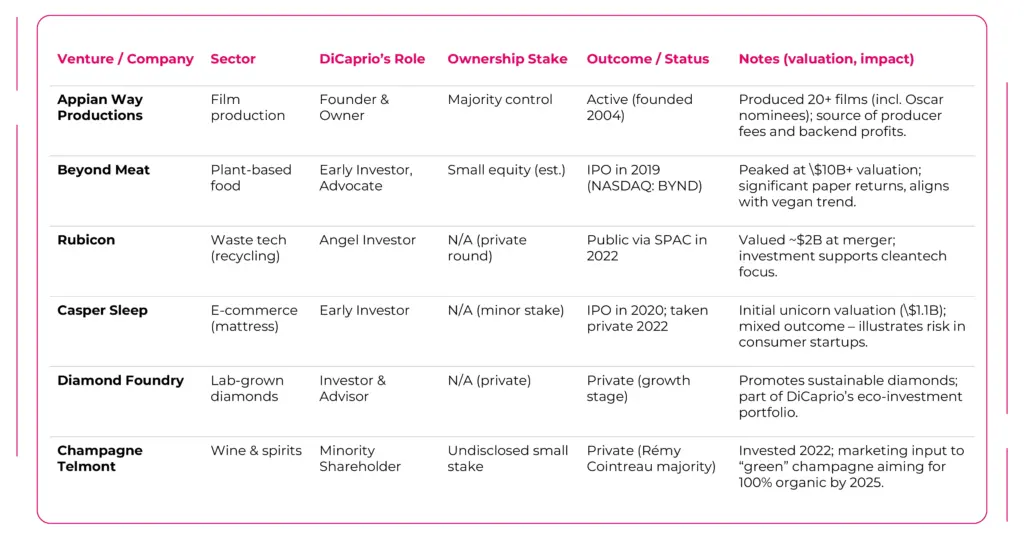
Through these ventures, DiCaprio behaves as a strategic investor rather than a passive celebrity endorser. He often combines capital with advocacy, helping companies by lending his name and network. While many of these stakes are minority positions (hence not contributing enormous sums to his net worth yet), they represent long-term upside. His strategy spreads bets across sustainability (food, energy, materials) and lifestyle (tech, consumer goods), potentially high-reward sectors. Importantly, this diversifies his wealth beyond Hollywood, giving him financial footholds in businesses that could pay dividends well into the future, even as his acting eventually slows down.
It’s worth noting that DiCaprio’s involvement can itself add value to a company, dubbed the ‘Leo effect’ by some industry watchers. For instance, when he invested in a circular economy watch startup, the news made headlines in fashion media, effectively providing free marketing. Similarly, his backing of Beyond Meat signaled to other investors that plant-based protein had the endorsement of an influential figure, arguably helping to drive wider interest. In that sense, his celebrity is a form of capital in business ventures, one that he wields carefully.
In sum, DiCaprio’s wealth-building isn’t confined to cashing acting checks. He has steadily built equity, whether in films, startups or brands. While the exact value of his private investments can fluctuate, they are an integral part of his $300 million fortune and indicate a forward-looking approach: he’s planting seeds that could yield large returns down the line, all while furthering causes and industries he believes in.
Leonardo DiCaprio’s Real Estate Portfolio
Real estate has been one of Leonardo DiCaprio’s most tangible and profitable investments. The Los Angeles-born star started acquiring property early in his career and has since assembled an impressive portfolio of homes and land on both coasts (and even an island in Belize). His approach to real estate can be characterised as buy, hold, and selectively sell, often turning hefty profits thanks to savvy timing in high-end markets. DiCaprio’s properties serve a mix of personal use and investment: some are beloved homes for family or retreats for himself, while others have been rented out or flipped for gain. As of 2025, he owns an estimated $100 million worth of real estate spanning California, New York, and beyond.
One of his earliest moves was in the Hollywood Hills of Los Angeles. In the 1990s, riding on his initial success, a young DiCaprio purchased a secluded compound on Oriole Way. In fact, he bought the property from Madonna in 1994 for around $2–3 million, later adding a neighbouring lot to create a combined estate. This compound (with multiple houses spread over five acres) has been a sort of ‘home base’ for DiCaprio, a place for him to live, entertain and even let close friends stay. Over nearly 30 years, the value of this estate has grown substantially (estimated around $7–8 million today) as Los Angeles property prices soared. DiCaprio’s willingness to invest early in a prime-location home and hold it long-term exemplifies his real estate patience; he didn’t cash out during intermediate booms, instead enjoying the asset and letting it appreciate.
Another headline-making purchase came in Malibu. In 1998, flush with Titanic earnings, DiCaprio paid $1.6 million for an oceanfront bungalow on Carbon Beach (nicknamed ‘Billionaire’s Beach’). The modest-size house became one of his best investments: he rented it out for years (at rates reportedly up to $150,000 per month in summer) and then sold it in 2021 for $10.3 million. That’s roughly a 545% increase in value over two decades, not including the rental income he collected. This Malibu sale, which pocketed him almost $9 million profit, shows DiCaprio’s knack for timing the market. He listed and sold when coastal demand was high.
Interestingly, he wasn’t done with Malibu; earlier, in 2017, he had bought a larger undeveloped parcel in Malibu’s Paradise Cove for $23 million. That property, essentially a 1.8-acre plot with a small cottage, represented a land-banking play. Plans were drawn for a new mansion, and while it’s unclear if he proceeded with construction, the lot alone in that exclusive enclave remains extremely valuable. This indicates DiCaprio’s willingness to reinvest gains: profits from one Malibu home rolled into another, potentially setting up a future even bigger payoff if developed or sold.
On the East Coast, DiCaprio became a bicoastal real estate holder. In 2008, he bought an eco-friendly apartment in New York City’s Battery Park for $3.67 million, and later added the adjacent unit for $8 million in 2014. By combining two penthouses in the ‘Riverhouse’ building (well-known for its green design and Hudson River views), he created a spacious New York residence. Today, this double-unit is estimated to be worth over $30 million, a reflection of Manhattan’s property appreciation and the premium for sustainable luxury buildings. DiCaprio’s New York foray underscores diversification: he hasn’t limited his holdings to California, but also capitalised on New York’s real estate boom in the 2010s.
DiCaprio’s portfolio also includes more exotic assets. In 2005, he famously purchased Blackadore Caye, a 104-acre private island in Belize, for $1.75 million. Far from a vanity folly, this island was intended for an ambitious eco-tourism project. DiCaprio announced plans to build an eco-resort, blending luxury villas with environmental restoration. Development has faced delays and as of 2025, the resort isn’t yet operational. However, owning a Caribbean island is a unique asset that could dramatically appreciate if the resort opens (or even as undeveloped land, given its size and celebrity cachet). It’s a long-term bet that aligns with his brand: turning an over-fished island into a sustainable paradise could yield both financial returns and set a model for green development.
Rounding out his real estate holdings are a variety of homes primarily in Southern California. He bought a Mid-century modern estate in Palm Springs (Dinah Shore’s former residence) for $5.2 million in 2014, which he now uses as a luxury rental property for holidaymakers (commanding around $4,000 a night). He has also owned properties in Los Feliz (Los Angeles), including one purchased for his parents. Some of these he sold, for instance, a Los Feliz Tudor he bought for $4.9M and sold in 2022 for roughly the same amount, indicating not every deal is a big money-maker, but often these are family-related transactions. Overall, however, DiCaprio tends to hold properties through multiple market cycles, selling only when it’s advantageous or when he has redundant assets.
Below is a snapshot of key properties in Leonardo DiCaprio’s real estate catalogue: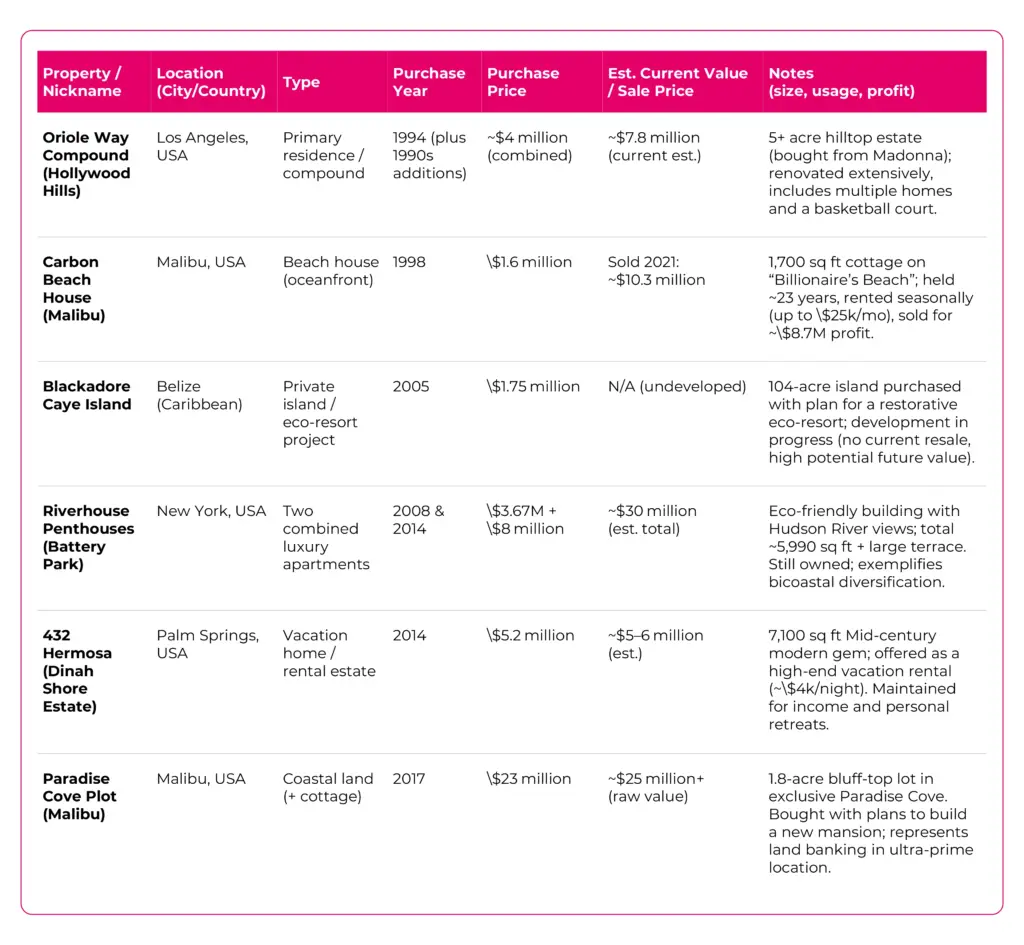
DiCaprio’s real estate strategy shows a pattern of early entry and long holds in desirable markets. He often buys properties during career highs (late ’90s, mid-2010s) and enjoys or leases them for years. Sales are infrequent but usually lucrative, capitalising on market peaks (as seen with the Malibu sale). His holdings are geographically concentrated in California’s prestige areas and Manhattan, offering both lifestyle benefits and capital appreciation. Notably, he’s unafraid of unconventional assets (like a private island) which carry more risk but also the possibility of outsized reward. All told, property forms a substantial asset base within his net worth, providing diversification away from equities and Hollywood, and a hedge through hard assets.
It’s also worth noting that DiCaprio’s real estate moves sometimes double as lifestyle statements. His purchases of eco-friendly homes and restoration of a historic Palm Springs estate align with his public persona (green advocate, classic Hollywood aficionado). By renting out properties like the Palm Springs house or previously the Malibu beach home, he turns luxury assets into income generators, effectively letting his fans and affluent vacationers subsidise his ownership costs. Meanwhile, holding multiple residences in LA (Hollywood Hills, plus properties for family) shows a commitment to using wealth to provide for loved ones and create a comfortable living environment, not just pure profit.
In sum, Leonardo DiCaprio has built a real estate empire that’s both personally enriching and financially rewarding. The combination of savvy market choices and emotional investments (buying what he loves) has served him well, adding tens of millions to his balance sheet through value appreciation over time.
Timeline of Major Financial Milestones
To understand the evolution of DiCaprio’s wealth, it’s helpful to map out the timeline of key financial milestones in his career. The following timeline highlights pivotal years and decisions that significantly impacted his net worth, from breakthrough deals and paydays to strategic investments and asset sales. Each event marks a point where DiCaprio’s financial trajectory accelerated or took a new turn, illustrating how his fortune was built step by step.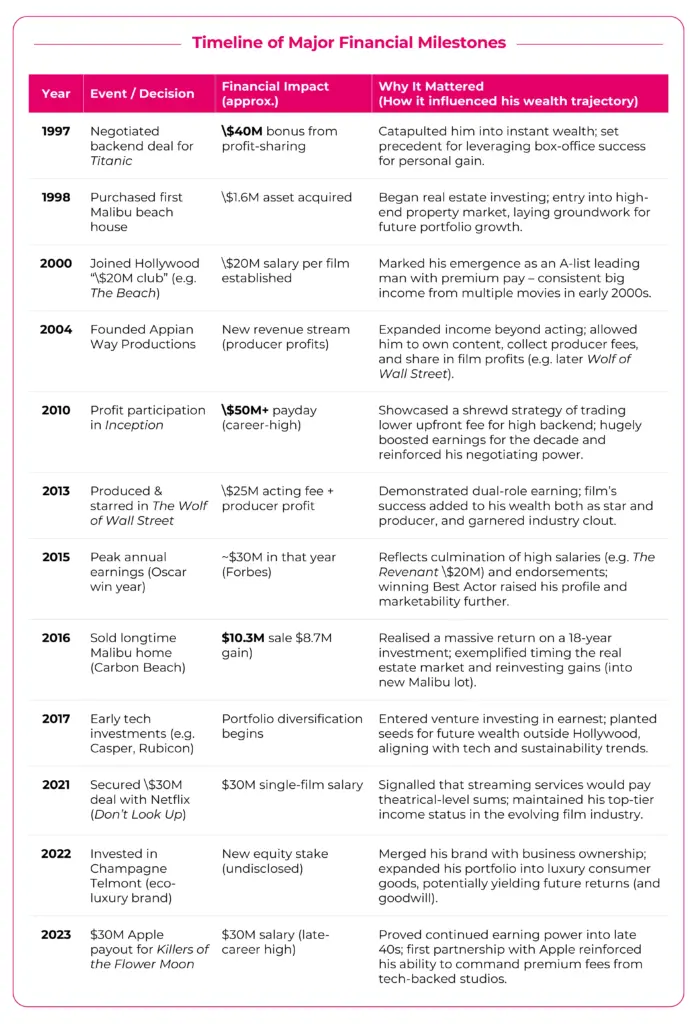
This timeline underscores how DiCaprio’s fortune wasn’t built overnight by a single film, but through a series of strategic moves and sustained successes. Early on, Titanic was the quantum leap, a one-time event that gave him the capital and clout to be choosier with projects. By investing that capital (buying real estate in 1998) and maintaining a high salary standard (2000s), he ensured his wealth grew steadily. The mid-career decisions to create a production company and invest in ventures (2004 onwards) show foresight in diversifying his income. Key inflection points like the Inception deal in 2010 exhibit his willingness to innovate in deal-making for greater reward. Later, monetising his fame via streaming deals (2021, 2023) and aligning with sustainable businesses (2022) indicate adaptation to new opportunities in the market.
Notably, the timeline reflects that DiCaprio’s net worth gains often coincide with moments of professional achievement (e.g. Oscar win year, working with top directors, starting new companies). His financial strategy has been largely about maximising the value of his talent, securing the biggest returns when his career momentum is highest, and then smartly investing those returns.
Strategic Wealth Pillars
Leonardo DiCaprio’s financial success rests on several strategic pillars. There are the core principles and tactics that he has consistently employed to build and protect his wealth. They’re not one-off tricks, but recurring themes evident throughout his journey from 90s heartthrob to multimillionaire mogul. Each pillar is tied to concrete actions and phases in his career (as seen in the timeline above), demonstrating how deliberate strategy has amplified his earnings. Here are the key pillars of DiCaprio’s wealth blueprint:
Pillar 1: Selectivity and Big-Leverage Deals in Acting
DiCaprio learned early that quality over quantity in his film roles would pay dividends financially. Rather than taking every lucrative offer post-Titanic, he became highly selective, choosing films with acclaimed directors and strong box-office potential. This selectivity created scarcity value around him (studios competed and paid more to secure him) and also ensured projects were likely to succeed.
More importantly, when he did commit to a film, he often leveraged his star power for backend participation or higher terms. This pillar is exemplified by his Titanic and Inception deals. In both cases he wagered on the film’s success and was handsomely rewarded with tens of millions in profit share. By being patient and only doing one film at a time, DiCaprio could also devote his full promotional energy to make each release a hit (further increasing those backend payouts). In practice, this strategy meant he consistently earned at the top of the market for two decades, whether via upfront salary (e.g. $20M every time out in the 2000s) or via innovative contracts.
DiCaprio treated his acting career as a high-end brand, not flooding the market, and negotiating like a partner in the film’s success rather than just an employee. This pillar laid the foundation of his fortune by maximising the value of his core talent.
Pillar 2: Owning the Product – Production and Content Ownership
Complementing his acting income, DiCaprio made a strategic decision to move up the value chain in Hollywood by becoming a producer and content owner. Founding Appian Way Productions in 2004 was a pivotal step: it meant that for many projects, he would not only get a paycheck as an actor but also equity in the film or a cut of the producer profits. This dual role transformed him from simply a well-paid performer to a stakeholder. For instance, on a film like The Wolf of Wall Street, DiCaprio’s production involvement meant he benefited from the film’s success beyond his salary.
Over time, owning a production company also builds an asset portfolio (IP rights, first-look deals) that can generate revenue through distribution, remakes or streaming licensing. Essentially, DiCaprio applied the classic wealth principle of ownership. Real wealth often comes not just from labor (acting) but from owning assets that grow in value (films, content libraries).
This pillar of owning what he works on has likely added tens of millions to his net worth that he might have left on the table had he remained solely an actor for hire. It also gives him creative control, allowing him to steer projects that align with his brand (which in turn sustains his bankability and income – a virtuous circle). In sum, by thinking like a filmmaker-entrepreneur, DiCaprio has turned his Hollywood career into a scalable business, not just a series of paychecks.
Pillar 3: Diversification Through Eco-conscious Investments
Another cornerstone of DiCaprio’s approach is strategic diversification, channeling his earnings into investments outside of Hollywood, particularly in sectors he anticipates will thrive in the future. What stands out is his focus on environmentally conscious and innovative companies.
This isn’t random; it’s a space where his personal passion (environmental activism) converges with major economic trends (the green economy, tech disruption). By investing in plant-based foods, renewable energy, sustainable luxury (like electric cars, lab-grown diamonds, organic champagne), etc., DiCaprio diversified his wealth into industries with high growth potential. This pillar has a dual effect: financially, it positions him to reap potentially massive returns as those startups succeed or go public (e.g. the Beyond Meat IPO surge); reputationally, it bolsters his image as the ‘eco-investor’ actor, which in turn attracts more of the right opportunities (both in business and even roles like Don’t Look Up which align with his climate advocacy).
By putting his money where his mouth is in terms of values, he also potentially secures deals on favourable terms. Startups eagerly welcome his involvement for PR, which can mean access to early investment rounds that most people cannot touch. This pillar is essentially about future-proofing his fortune: he knows acting income is dependent on age and industry whims, so he’s building a parallel portfolio that could sustain and grow his net worth independently. And because these are mission-driven investments, even when one doesn’t pan out financially (say a tech startup fails), it still aligns with his long-term purpose, making it a calculated risk he’s willing to take. Overall, diversification through targeted, meaningful investments has expanded DiCaprio’s wealth far beyond the confines of film sets, giving him a foothold in the industries of tomorrow.
Pillar 4: Monetising Fame Without Oversaturation
Leonardo DiCaprio’s brand is golden in large part because he has carefully controlled how it’s commercialised. This pillar revolves around monetising his celebrity in high-impact, limited ways, ensuring that when he does cash in on his fame, it yields significant returns and doesn’t diminish his public esteem. Unlike many peers, he’s avoided the quick buck of endless endorsements or personal product lines which could cheapen his image.
Instead, DiCaprio has taken a ‘less is more’ approach to endorsements, choosing a handful of upscale partnerships (like Tag Heuer, or overseas campaigns) that pay top dollar. By not appearing in every other advert, he maintains an aura of exclusivity, which ironically enables him to charge more for the few deals he does agree to. This restraint means his endorsement earnings, reportedly $100M+, come from big one-off deals rather than dozens of smaller ones. It protects the long-term credibility of his image, which circles back into his acting career (audiences aren’t fatigued of him as a salesperson, so they focus on him as an actor, keeping his box-office appeal high).
Additionally, when he lends his image, it’s often structured in a way that he gets equity or profit share (for example, investing in the businesses he promotes, as with Beyond Meat or a watch startup). That way, he isn’t just trading a moment of fame for a fee, he’s potentially getting a long-term stake.
In essence, DiCaprio treats his personal brand as a scarce asset that must be safeguarded and only exchanged for commensurate value. This discipline is a pillar because it has preserved and enhanced the very foundation of his earning power: public trust and star appeal. It’s why at nearly 50 years old, he’s still able to open a film at #1 and also get audiences to take notice when he tweets about a climate startup. By monetising his fame selectively and wisely, he ensures both immediate financial gain and the longevity of his income streams.
Pillar 5: Real Estate as a Store of Wealth
Finally, a tangible but often underrated pillar of DiCaprio’s strategy is his use of real estate as a store and builder of wealth. Throughout his career, he has converted substantial portions of his income into prime real estate holdings. This serves multiple purposes in wealth management: properties can appreciate significantly (often outpacing inflation), they provide utility (homes to live in or enjoy), and they can generate cash flow (through rentals).
For DiCaprio, real estate has been a stable backbone of his net worth, kind of a personal ‘wealth insurance’. By buying properties in coveted locations like Malibu, Hollywood Hills and Manhattan, he parked his money in assets that historically trend upward in value. Even during economic downturns, luxury real estate in these areas tends to rebound over time, thus preserving his capital. For example, his $1.6M investment in Malibu in 1998 turned into a $10M asset by 2021, demonstrating how patient ownership creates wealth almost passively.
Additionally, property gives him diversification, a counterweight to the volatility of films or startup investments. It also affords lifestyle benefits that enhance his work (e.g. a comfortable retreat in Palm Springs to recharge between projects, or a New York pad when filming on the East Coast). DiCaprio’s real estate pillar is also evident in how he manages these assets: he often improves them (renovating homes, adding eco-friendly features), which increases their value, and he watches market conditions to decide when to sell or hold.
By treating real estate as a long-term investment rather than just expenditure, he has turned millions of earnings into tens of millions of equity. This pillar of ‘land and luxury property’ ensures that a substantial portion of his wealth is secured in solid, real assets that can be liquidated or leveraged if needed, giving him financial stability regardless of Hollywood’s ups and downs.
Each of these strategic pillars – selective high-leverage deals, content ownership, diversified eco-investments, careful brand monetisation and real estate investment – has reinforced the others in DiCaprio’s wealth-building story. They collectively portray a celebrity who has been intentional about evolving from just a star into a savvy businessman. By anchoring these pillars to concrete actions (as seen in the timeline), DiCaprio’s wealth blueprint emerges as a coherent narrative: a young actor uses a massive early success to springboard into sustained high earnings, then smartly funnels those earnings into ownership and investments that yield more wealth, all while maintaining a brand that keeps the opportunities coming.
Actionable Insights and Takeaways
Leonardo DiCaprio’s financial journey offers more than just celebrity trivia, it holds valuable lessons for anyone looking to build and preserve wealth. Here are some actionable insights distilled from his strategies, with key takeaways that readers can apply in their own context:
- Takeaway: Bet on Yourself and Negotiate for Upside. DiCaprio’s career shows the power of believing in your own value and negotiating for a share of future success. Rather than settling for a standard paycheck, he often structured deals (like Titanic’s backend or Inception’s gross points) that rewarded him when the project did well. Lesson: In your own career or business, if you have confidence in the outcome, seek performance-based compensation (bonuses, equity, profit share). A smaller base today could turn into a much larger payoff tomorrow if you deliver exceptional results.
- Takeaway: Turn Income into Assets, Not Just Expenses. When DiCaprio earned big money, he didn’t fritter it away on liabilities; he converted a large portion into enduring assets like real estate and equity stakes. Buying property with his Titanic money or investing in startups with his later earnings created additional wealth streams. Lesson: Whenever you experience a financial windfall (a raise, a bonus, a profitable year), consider channeling a significant chunk into investments – whether it’s property, stocks, or a business – rather than merely upgrading consumption. Assets work for you over time; expensive toys or lifestyle inflation do not.
- Takeaway: Align Investments with Knowledge and Values. DiCaprio invests in what he knows and cares about – films, environmental tech, sustainable products – giving him an edge and personal motivation. By focusing on sectors where he has insight or passion, he increases the likelihood of picking winners (or at least of staying committed for the long haul). Lesson: Don’t chase random fads because they’re ‘hot.’ Instead, invest in industries or opportunities you understand deeply or that resonate with your principles. Your expertise and enthusiasm are assets that can improve your investment decisions and persistence.
- Takeaway: Protect Your Brand and Demand a Premium for It. One reason DiCaprio can command $30M from a streaming service or millions for an endorsement is that he’s kept his brand pristine and rare. He avoids overexposure, chooses quality projects, and stays true to his image. This creates trust and high demand. Lesson: Whether you’re an individual professional or a business, cultivate a strong, consistent reputation. Don’t dilute your brand by taking every short-term opportunity; be strategic. When you’ve built a reputation for excellence, you can charge higher rates for your work or product – people will pay more for proven quality and integrity.
- Takeaway: Diversify after Securing a Core Stream. DiCaprio didn’t dive into ten businesses at the start; he first cemented his primary earning stream (acting) and then used that capital to branch out. His wealth is not reliant on one source, but it also isn’t spread too thin at the wrong time. Lesson: Focus on excelling in your main career or business first to become financially stable and successful in one arena. Then use that stability as a platform to explore other investments or side ventures. Diversification is crucial, but trying to do everything at once can backfire. Sequence matters: build your ‘cash cow’ before chasing new pastures.
- Takeaway: Play the Long Game. Perhaps the overarching theme of DiCaprio’s wealth-building is patience. He held onto properties for decades, waited years between passion projects, nurtured business investments without expecting overnight riches, and even waited over 20 years for his Oscar (meanwhile focusing on the work, not just the accolade). Lesson: Wealth accumulation is a marathon, not a sprint. Adopt a long-term mindset in financial planning. Make decisions that may not pay off this month or even this year, but could yield substantial benefits down the line. Avoid knee-jerk reactions to trends or short-term market noise. Consistency, patience, and a bit of delayed gratification – as DiCaprio’s journey illustrates – can lead to extraordinary outcomes.
By internalising these principles, individuals can emulate aspects of DiCaprio’s strategy in their own scale and domains. You don’t need to be a movie star to negotiate smarter, invest in meaningful assets, guard your personal brand, or think long-term. These insights are broadly applicable, whether you’re a freelancer setting your rates, an entrepreneur reinvesting profits, or someone planning for retirement. As DiCaprio’s story shows, wealth isn’t just about how much money comes in, it’s about how wisely it’s managed and grown once you have it.
Final Thoughts
Leonardo DiCaprio’s financial ascent from a child actor with humble TV beginnings to a $300 million empire is a study in strategic evolution. He leveraged talent and timing (that breakthrough role on a sinking ship) into not just fleeting fame but lasting fortune. What’s striking is that behind DiCaprio’s heartthrob image is a disciplined wealth-builder: someone who combined the instincts of an artist with the calculations of an investor. Over 30 years, he showed that you can pursue creative excellence and commercial success simultaneously, if you play it smart.
DiCaprio’s journey also reflects the changing landscape of celebrity wealth. He navigated the old studio system of the 90s, the franchise/blockbuster era of the 2000s, and now the streaming and startup era of the 2020s, each time adapting his strategy to new opportunities. He didn’t remain static or rely on past laurels. When the film industry shifted, he found new paymasters in Netflix and Apple. When the world’s focus tilted to climate change, he turned his advocacy into investment opportunities in green tech. In doing so, he has remained relevant, influential and financially flourishing, while many of his contemporaries plateaued or faded away.
Ultimately, Leonardo DiCaprio’s wealth blueprint isn’t about flashy extravagance, it’s about intentional choices and longevity. He epitomises the idea that true wealth affords freedom: freedom to pick the projects you love, to back causes you believe in, to take a year off for passion projects or philanthropy, and to secure your family’s future. His financial decisions over the years have given him exactly that freedom. And perhaps that is the greatest takeaway of all: the goal isn’t just to make money for money’s sake, but to build a life where your money enables you to live on your own terms. DiCaprio has achieved that, starring in the roles he wants both on screen and in business, unencumbered by financial necessity at this point.
For readers and aspiring wealth-builders, Leonardo DiCaprio’s story is both inspiration and instruction. You may not win an Oscar or buy an island, but the principles he employed – know your worth, invest in your future, stand by your values, and play the long game – are universally powerful. In a world often looking for shortcuts, DiCaprio’s measured, savvy path reminds us that sometimes the best way to ‘make it’ big is to think big, act smartly, and stay true to yourself as opportunities arise. That’s a script anyone aiming for financial success can follow.
For more explorations into the net worth of major entrepreneurs and celebrities, read the No Bollocks Wealth Reports and listen to No Bollocks Podcast.
Read more of our wealth reports including Jeff Bezos, Taylor Swift, David Beckham, Ryan Giggs, Elon Musk, Tom Cruise, Donald Trump, Justin Bieber, Dwayne Johnson and more on our No Bollocks Business HQ. Explore more wealth blueprints from the full series.
If you’re building a business of your own and want experienced support, you can work with Matt directly.