
Executive Summary
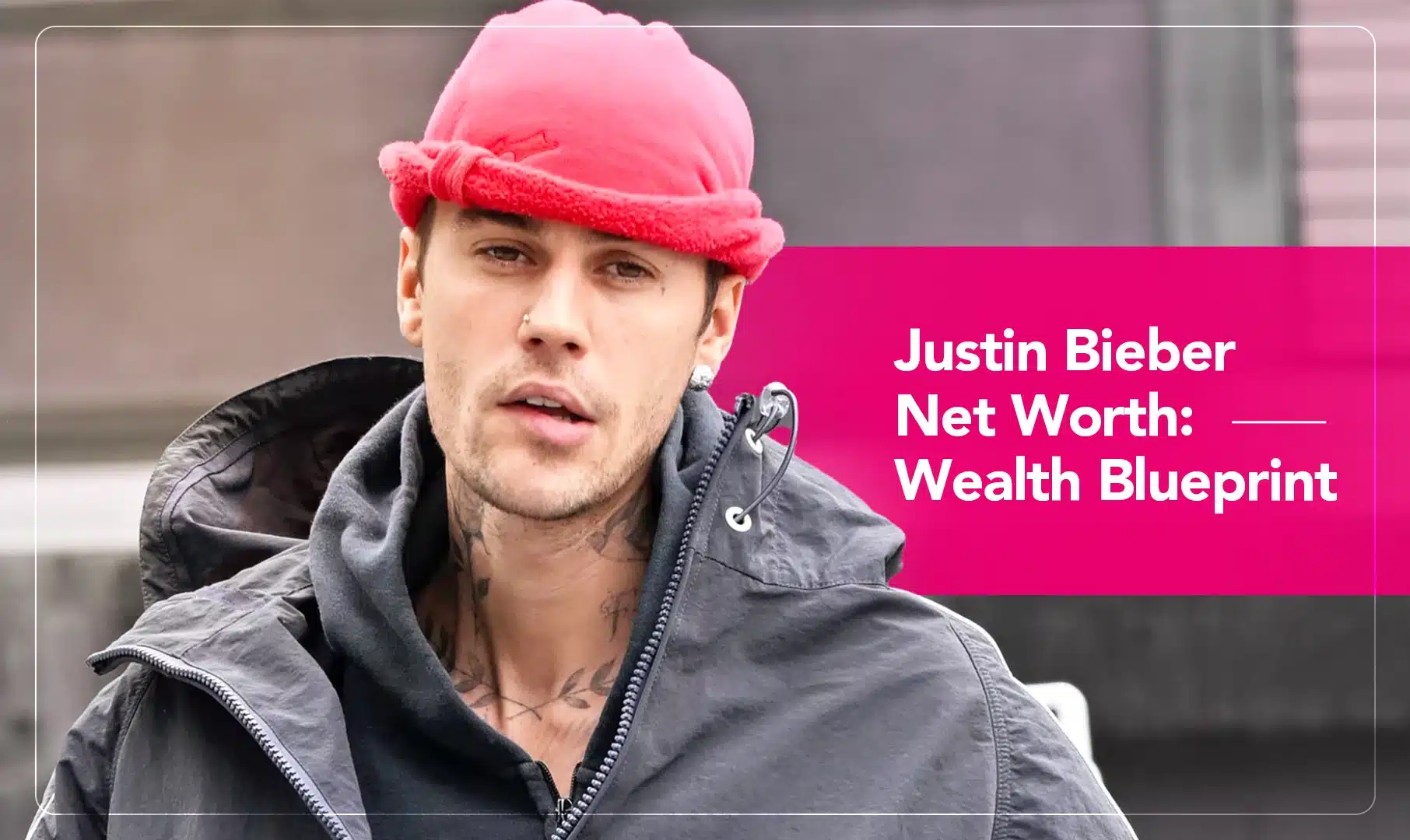
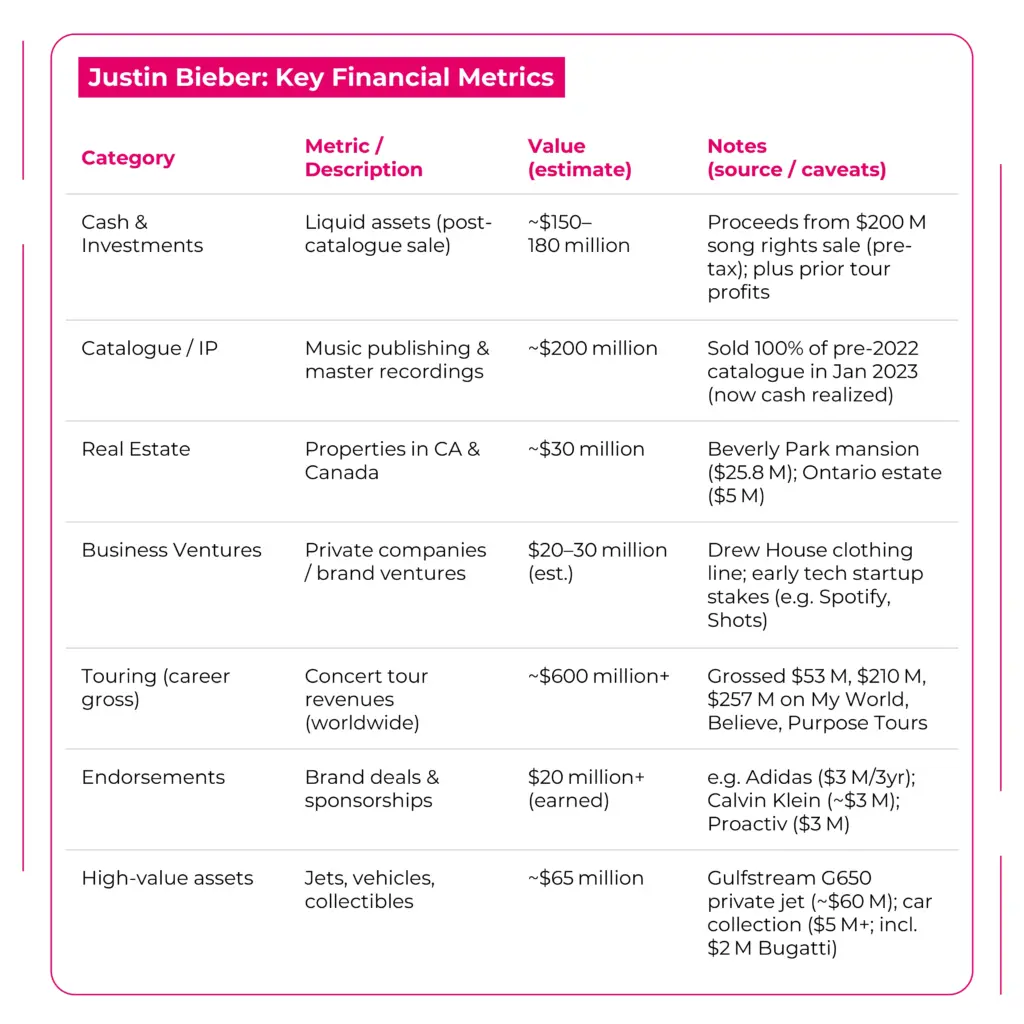
As of 2026, Justin Bieber’s estimated net worth is roughly $300 million. The Canadian pop superstar has built this fortune through a blend of blockbuster music revenues, global touring and savvy business moves. Bieber’s wealth is powered primarily by his music empire, spanning record-breaking tour grosses, billion-stream hits and a lucrative song catalogue and augmented by major brand endorsements and entrepreneurial ventures. Among his most significant financial feats: three world tours by his early 20s that collectively grossed over $600 million, a $200 million sale of his music rights in 2023, and early investments in tech startups that paid off handsomely. In an industry where teen idols often flame out, Bieber’s money strategy stands out. He leveraged fame into long-term assets, from equity stakes to a fashion line, rather than relying on short-term paychecks like many peers.
Now 29, Bieber’s financial trajectory shows a series of sharp inflection points. He went from YouTube discovery to multi-millionaire before he could legally drink, thanks to relentless touring and merchandising in his teens. A mid-decade reinvention with Purpose (2015) turbocharged his earnings, and he topped Forbes’ list of highest-paid entertainers under 30 with an $83.5 million haul in 2017 alone. Most recently, a strategic catalogue sale in 2023 converted his musical success into a nine-figure windfall, cementing his place among the wealthiest artists of his generation. In short, Bieber’s wealth journey can be summed up as early breakout + world tours + brand deals + equity bets + asset sales, each phase building on the last.
Justin Bieber Primary Income Streams
Bieber’s wealth is rooted in music. Not just making hits, but maximising every dollar those hits can generate. His primary income streams flow from his record-breaking music sales, concert tours and related music rights, supplemented by lucrative endorsement deals. In his ascent from teen idol to mogul, Bieber learned to stack revenue streams on top of his core talent: selling millions of albums and tickets, then leveraging that platform for brand partnerships and business ventures. Below, we break down how each major stream contributes to his net worth.
Core Career Earnings
Music sales and streaming have been a constant engine of Bieber’s fortune. He has sold over 150 million records worldwide, placing him among the best-selling artists ever. This includes hit albums like My World 2.0, Believe and Purpose (all multi-platinum) and countless chart-topping singles. With the streaming era, Bieber has dominated online platforms, at one point averaging 82 million monthly listeners on Spotify, translating to steady royalty income. By writing or co-writing many of his songs, he earned a songwriter’s share on hits such as ‘Love Yourself’ and ‘Sorry,’ boosting his publishing income. Billboard noted his 2015–16 Purpose album era as a commercial pinnacle, and indeed 2017 saw Bieber’s highest annual earnings at $83.5 million, fueled by the Purpose World Tour and ubiquitous radio hits. While exact record sales profits are closely held, industry norms suggest Bieber netted tens of millions in royalties over the years, all before the blockbuster catalogue sale (more on that shortly).
Crucially, touring amplified Bieber’s music earnings exponentially. From 2010 onwards, the young star embarked on ambitious global tours that turned fan adoration into cash. His first headlining trek, the My World Tour in 2010–11, grossed $53.3 million across 127 shows, which was an incredible start for a teen newcomer. He followed up with 2012–2013’s Believe Tour, which leapt into stadium territory and grossed $210 million from 155 concerts, putting Bieber among the top touring acts worldwide by age 19. Then came 2016–2017’s Purpose World Tour, an even bigger spectacle that grossed $256 million over 162 shows and cemented his status as a touring heavyweight. (For context, Purpose out-earned tours by many veteran rock acts that year.) While gross revenue isn’t Bieber’s take-home pay, even a conservative artist split would mean well over $100 million earned by Bieber from these three tours alone. This live-performance windfall is reflected in his net worth jumps: by 2014 (after Believe), his estimated net worth approached $200 million, and by 2017 (post-Purpose) it surged further, illustrating how world tours became Justin’s single biggest cash generators.
| Tour (Year) | Gross Revenue | Attendance | Notes |
| My World Tour (2010–11) | $53.3 million | 808,000 | Debut tour, 127 shows |
| Believe Tour (2012–13) | $210 million | 1,694,000 | Global breakout, 155 shows |
| Purpose World Tour (2016–17) | $256 million | 2,852,000 | Career peak, stadiums added, 162 shows |
| Justice World Tour (2022) | $89 million | 636,000 | 49 shows before cancellation due to health reasons |
(Justice World Tour* was cancelled mid-2022, so figures represent partial grosses.)
Bieber also found additional earnings in adjacent entertainment projects. Notably, his 2011 concert documentary film Never Say Never was a surprise box-office hit, grossing $73 million worldwide. While the film’s gross mostly benefited its studio, Bieber likely earned a cut (and it certainly boosted demand for his concert tickets and merchandise). He released a follow-up film (Believe in 2013), and more recently, streaming platforms paid for exclusive documentaries (Seasons on YouTube in 2020, Our World on Amazon in 2021), adding to his income pie. These projects, along with music sales and touring, underscore that Bieber’s core career – music and performances – underwrote the vast majority of his wealth. By his mid-20s, he had parlayed teen stardom into an empire that few peers could match in scale.
Touring / Live Revenue
Live performances have been Justin Bieber’s most lucrative undertakings, turning his popularity into hard cash. Bieber understood early that touring globally could multiply his earnings far beyond album sales, especially as music retail shifted to streaming. Each of his major tours set new personal records and financial benchmarks:
- 2010–11: My World Tour – Bieber’s first tour (at age 16–17) sold out arenas worldwide, grossing $53.3 million. This immediate success proved his YouTube fanbase would pay to see him live. It also introduced lucrative VIP packages and merchandise sales at each show, foreshadowing how much more he could earn on the road versus recordings. By the tour’s end, Bieber had firmly entered eight-figure earnings territory.
- 2012–13: Believe Tour – Riding his second album’s success, Bieber upgraded to larger venues and an expanded itinerary. The result: a $210 million gross from 155 shows across six continents, making it one of the highest-grossing tours of 2013. This tour alone likely added tens of millions to Bieber’s personal coffers and pushed his net worth into nine figures for the first time. As an indicator of scale, Believe out-earned tours by legacy acts many decades his senior, underscoring Bieber’s extraordinary drawing power as a teen/young adult artist.
- 2016–17: Purpose World Tour – After a hiatus and image reboot, Bieber returned to touring bigger than ever. Purpose spanned 162 dates and grossed $256.4 million, making it his highest gross to date. At its peak in 2016, Pollstar ranked Bieber among the top 10 global touring acts, and in 2017 Forbes listed him the 13th-highest paid celebrity with $83.5 M earned, largely from the tour. Notably, Bieber began headlining stadiums on this tour (especially in Latin America and Asia), dramatically increasing per-show revenue. Although he cancelled the final leg citing exhaustion, Purpose had already solidified that live touring was Bieber’s financial powerhouse, likely contributing over $100 million net to him after expenses and promoter cuts.
- 2022: Justice World Tour (cancelled) – Bieber’s most recent tour, launched in early 2022 after two album releases (Changes and Justice), showed strong demand but was cut short due to his health (Ramsay Hunt syndrome). Before cancellation, it grossed about $89 million from 49 shows. Though it didn’t reach its planned 130+ dates, advance ticket sales indicated it could have rivalled Purpose in scale. The cancellation likely meant a substantial opportunity cost, highlighting how Bieber’s earning capacity going forward is somewhat tied to his ability to tour (one reason he moved to monetise his catalogue in 2023).
Each tour’s success fed directly into Bieber’s wealth. Touring revenue also has a domino effect: it drives merchandise (Bieber’s tour merch often sold out, even becoming streetwear fashion via partnerships with retailers like Urban Outfitters) and leads to sponsorship deals (corporate sponsors eager to attach to his tours). For example, Calvin Klein capitalised on his Purpose tour momentum by featuring him in a global ad campaign in 2015, effectively leveraging his touring fame into mutual marketing gains. In summary, Bieber turned live performance into a reliable mint, with each world tour acting as a massive ‘payday’ that underpinned investments and big purchases (like real estate) in the ensuing years.
Publishing / Catalogue / IP Ownership
One often-underappreciated aspect of Bieber’s wealth is the value of his music catalogue and intellectual property (IP). Unlike many young pop stars who focus only on upfront sales, Bieber (and his management) placed emphasis on owning and later monetising his music rights. Bieber co-wrote a significant number of his songs, giving him a stake in publishing royalties. Over a decade-plus career with global hits, those royalties (from streams, radio play, commercials and covers) grew into a valuable asset in their own right.
In January 2023, Bieber made headlines by selling his entire back-catalogue rights for an estimated $200 million. The deal with Hipgnosis Songs Capital covered 290 songs released before 2022, including all his mega-hits. This was a landmark deal on multiple levels: at 28, Bieber became one of the youngest artists ever to strike a catalogue sale of that magnitude (such deals are usually the domain of legacy artists in their 70s). It was described as ‘the biggest acquisition ever of an artist under 70’ by the buying company’s CEO. Hipgnosis acquired 100% of Bieber’s publishing copyrights and his artist royalties in master recordings, meaning they will collect the income from Bieber’s old songs going forward, but Bieber received a nine-figure sum upfront, de-risking his future. Effectively, he traded future royalty streams for a $200 million lump sum.
This move crystallised years of accrued value. Bieber’s catalogue is unusually strong for a contemporary artist. As of the sale, he had amassed 30+ billion streams on Spotify alone, and pop evergreens like ‘Baby’ (which is Diamond-certified in the US) continue to generate royalties. By selling at a young age, Bieber locked in a huge payday that many artists only see later in life (if ever). The sale likely added around $150 million (after taxes and fees) to his investable cash. It also underscores a pillar of his wealth-building: owning IP and knowing when to cash out. Bieber and team recognised that music valuations were sky-high in 2021–2022, and they moved to capitalise on that market peak.
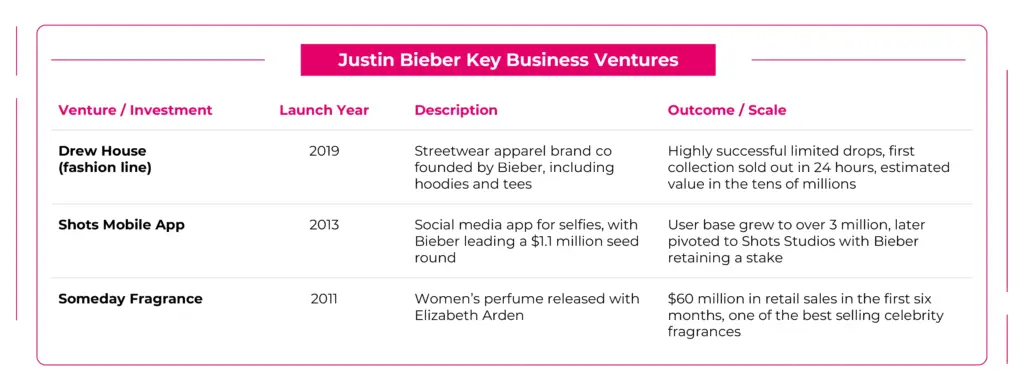
It’s worth noting that prior to this sale, Bieber had already been leveraging his IP in other ways. He launched four fragrances (starting with ‘Someday’ in 2011, which did $60 million in retail sales in its first six months). While not music, this showed how he could spin his brand into intellectual property that generates income. He also famously retained ownership of his likeness and branding; for instance, his 3D concert film Never Say Never and biographical books would have required licensing his own story and image. All these endeavours reflect a mindset of treating his work and persona as valuable IP assets.
In the wake of the catalogue sale, Bieber’s focus can shift to creating new music (anything he releases from 2022 onward remains his property, outside the sold catalogue) and to deploying that $200 million windfall effectively. The sale has essentially turned one of his income streams (music royalties) into a mountain of capital that can be invested in higher-return ventures or simply provide financial security. It’s a one-time event in his wealth blueprint that dramatically boosted his net worth and exemplified the power of owning your masters and publishing. Bieber’s peers have taken note, and younger stars are increasingly negotiating for ownership stakes in their music, seeing the kind of exit Bieber just pulled off.
Film/TV and Other Projects
Outside of music, Bieber’s entertainment forays have been mostly in self-referential projects, but even these added to his wealth indirectly. His 3D concert film Justin Bieber: Never Say Never (2011) grossed $73 million as noted, and while most of that went to Paramount Pictures, it boosted album and merchandise sales around that time. He also released a follow-up documentary Believe (2013) and later partnered with YouTube for the docu-series Seasons (2020) and with Amazon for Our World (2021). These deals likely paid Bieber in the mid-six to low-seven figures each, not major money compared to touring, but valuable for keeping him in the public eye (and thus sustaining his earning power).
Bieber has kept traditional acting cameos rare (a brief appearance in Zoolander 2 and a few scripted TV cameos), preferring to keep the spotlight on his music and persona. In a sense, his life has been part of his business model. High-profile relationships, occasional controversies and a strong social media presence have all fed into the ‘Justin Bieber’ brand, which in turn sells concert tickets and products. While he hasn’t needed a secondary career in Hollywood or sports, he has carefully chosen media projects that complement his music narrative. The financial impact of this media presence is hard to quantify, but certainly, the sustained global interest in Bieber (tens of millions of social media followers, endless media coverage) acts as a force multiplier for everything he sells.
In summary, Bieber’s other projects serve more as marketing and brand maintenance than direct income streams. And given how lucrative his music and tours have been, focusing on those was the right financial call. The lesson here is strategic focus: Bieber didn’t dilute his brand chasing moderate-pay acting gigs or reality shows; he doubled down on his comparative advantage of being one of the world’s biggest pop stars and reaped the maximal rewards from that focus.
Endorsements & Sponsorships
From early in his career, Bieber recognised that his massive popularity with young audiences could translate into significant endorsement deals. Over the years he has been the face of numerous global brands, adding millions to his income outside of music. Notably, Bieber’s endorsements often came with clever deal structures (multi-year campaigns, equity components, or revenue share) that aligned with his long-term approach.
One of his first major endorsement deals was with Proactiv, the skincare brand, at the height of Bieber-fever around 2010. He earned about $3 million for a Proactiv campaign, a huge sum for a teenager but justified by his influence on the teen market. Around the same time, he launched a nail polish line with OPI (marketed via Nicole by OPI) named after his songs, an unorthodox move for a male pop star, but an astute one given his primarily young female fanbase. The OPI deal was reportedly worth $12 million upfront for Bieber, and the products (with shades like ‘One Less Lonely Girl’ lavender) sold out across Walmart stores, proving his name could move inventory well beyond music.
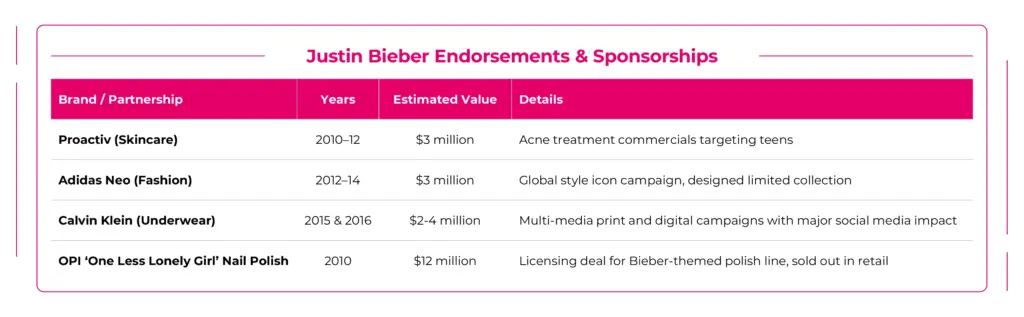
Bieber also struck a two-year endorsement deal with Adidas’s Neo label (2012–2014) aimed at teens, pocketing $3 million for the contract. This partnership saw him feature in ad campaigns and design limited-edition sneakers, again leveraging his trendsetter status with youth. In perhaps his most iconic bit of brand synergy, Bieber became a Calvin Klein underwear model and ambassador in 2015, starring in provocative ads that went viral. That deal, which renewed in later years, was valued in the ‘low seven figures’ (insiders estimate $2–4 million for Bieber’s part), and it gave Calvin Klein a notable sales spike and refreshed relevance with a younger demographic, which was a testament to Bieber’s marketing power.
Other endorsement and sponsorship highlights include: Beats by Dre, early in his career (he appeared in commercials and his music videos often featured Beats headphones, mutually promoting the brand, though financial details weren’t public, it no doubt included generous product placement fees); Elizabeth Arden, which produced Bieber’s series of fragrances (beyond Someday, there were ‘Girlfriend’ and ‘The Key’ perfumes, all strong sellers contributing royalties); and Best Buy, who featured Bieber in a high-profile Super Bowl ad in 2011 to signal the brand’s tech cred with youth. Additionally, Bieber teamed up with StarShop in 2015 (a shopping app) and more recently, did limited product collaborations like the ‘Timbiebs’ doughnut holes with Tim Hortons in 2021, which became a sensation in Canada (the merch for Timbiebs sold out in minutes, showing that even a snack endorsement from Bieber can turn into a money-spinner).
It’s important to note that beyond flat fees, some of Bieber’s deals had broader business angles. For instance, his Calvin Klein partnership coincided with a new album release, effectively cross-promoting both his music and the brand; in another case, his Drew House fashion line (discussed in the next section) partnered with Crocs for a sold-out clog collaboration, a quasi-endorsement that also benefited his own venture. Through these endorsements, Bieber likely earned on the order of $50 million+ in aggregate over his career. More strategically, they extended his brand into lifestyle sectors – fashion, beauty, food – laying groundwork for his own business launches. In Bieber’s wealth blueprint, endorsements provided easy cash during years he wasn’t touring, and also served as market research: seeing the enormous success of products like his perfumes and apparel lines for others surely informed his decision to start his own label (Drew) later.
Business Ventures
While music and endorsements were making him rich, Justin Bieber didn’t stop there. He also ventured into entrepreneurship and investing, planting seeds for longer-term wealth. Over the years he has dipped into several business ventures, both as a founder and as an investor, translating his celebrity into enterprise.
The flagship of Bieber’s own ventures is Drew House, his streetwear clothing line launched in 2019. Co-founded with his longtime friend and stylist Ryan Good, Drew House (named after Bieber’s middle name) offers unisex casual wear. Things oversized hoodies, T-shirts and slippers, often featuring a quirky smiley-face logo. The brand was introduced quietly via limited drops, but thanks to Bieber’s enormous influence, it became an instant hypebeast favourite. The first collection sold out within a day, and subsequent releases have consistently been snapped up by fans and fashionistas. While Drew House’s financials are private, industry observers estimate it to be an eight-figure brand in revenue. Bieber has been frequently spotted wearing Drew House attire head-to-toe, essentially turning his daily paparazzi candids into free advertising for his company. By creating Drew, Bieber effectively shifted from simply endorsing others’ apparel to owning the upside in the fashion business.
Bieber also seized opportunities in the tech and startup realm, a somewhat unusual path for a teen pop star. In fact, at just 18 he graced a Forbes cover as a ‘Venture Capitalist’, highlighting his early investments. One of his first major bets was on a social media app called Shots (originally ‘Shots of Me’), a selfie-sharing app, in 2013. Bieber reportedly led a $1.1 million seed round in Shots at age 19, attracted by its anti-cyberbullying stance and its appeal to his fan demographic. The move was shrewd: not only did Shots gain millions of users (many likely Beliebers following their idol), but it also showed Silicon Valley that Bieber was more than just a poster boy. He could be a serious investor with skin in the game. Shots later pivoted into a content studio and management company (Shots Studios) representing digital influencers, with Bieber remaining involved as a shareholder.
More significantly, Bieber was an early backer of Spotify, investing quietly in the music streaming giant during its early US expansion. If he held onto that equity until Spotify’s IPO in 2018, it would have yielded a multi-million dollar return. He also put money into tiny startups like Stamped (a social recommendations app acquired by Yahoo in 2012) and game-maker SoJo Studios, often alongside more seasoned tech investors. Bieber’s motivation, as he told Forbes, was simple: ‘I’m not going to invest in something I don’t like; I have to believe in the product‘, a mantra any angel investor might espouse. By leveraging his celebrity insight (knowing what young audiences want) and teaming up with experienced investors (e.g. he invested alongside actor Ashton Kutcher in some deals), Bieber gained early exposure to high-growth companies. These bets likely account for a modest but meaningful slice of his portfolio. For instance, if his Spotify stake was, say, $1 million in 2010, it could have been worth $10–15 million by 2018.
Another notable business windfall came via his longtime manager Scooter Braun. In 2021, Braun’s company Ithaca Holdings (which Bieber had an interest in) was acquired by South Korea’s HYBE (the K-pop powerhouse behind BTS). As part of the $1 billion deal, HYBE issued shares to Bieber, he received 53,557 shares, worth about $11 million at the time. This effectively cut Bieber in on the sale of his manager’s empire, a thank-you for being one of the crown jewels of that catalog. Bieber’s shares could be worth even more if HYBE’s stock rises, or provide liquidity if he chose to cash out. Either way, it was a unique equity bonus that further diversified his wealth (few musicians receive stock in a foreign entertainment IPO as part of their career; Bieber did).
Beyond these, Bieber has tried his hand at various ventures: he partnered in 2019 with Schmidt’s Naturals to launch a deodorant called ‘Here + Now’ (capitalising on the wellness trend); he joined the cannabis craze in 2021 with a limited-edition ‘Peaches’ pre-rolled joints line (named after his hit song) in collaboration with Palms Premium, which sold out and donated proceeds to charity; and he has been involved in start-up fashion brands (he was an early supporter of streetwear label Supreme and frequently wore Fear of God, relationships that sometimes blur into investment territory via influencer equity). Not every experiment was a smash hit (some of these were likely more for fun or strategic relationship-building) but collectively they show Bieber’s entrepreneurial curiosity.
Ultimately, Justin Bieber’s ventures reveal a pattern: when he’s passionate about something, he seeks ownership in it. Instead of just drinking the trendy beverage, he takes a stake; instead of merely wearing cool clothes, he launches his own label. This approach means that as Bieber ages and perhaps scales back on touring, he could have multiple businesses (in fashion, tech, media) generating income independently of his singing career. It’s a classic wealth preservation play: use the high-earning years (his teens and 20s) to acquire assets that pay off in the long run.
Licensing, Merchandising & Other Royalties
Apart from formal business ventures, Bieber has consistently monetised his brand through licensing and merchandise, essentially renting out his name, likeness or creative ideas for royalty streams. This is a crucial but sometimes overlooked component of his wealth strategy.
In his teen years, Bieber’s team licensed everything from action figures and lunchboxes to toothbrushes that played his songs. The thinking was simple: capitalize on Bieber’s immense popularity with kids and teens by offering any product they might buy with his face on it. By 2012, merchandise sales had reportedly crossed eight figures. While the fad for Bieber-branded toys faded as his fanbase grew up, it likely generated a tidy sum during the fever-pitch of 2010–2013.
Merchandising took on a new life during the Purpose era when Bieber’s tour merchandise (designed with a edgy streetwear aesthetic by Jerry Lorenzo of Fear of God) became a fashion phenomenon. In 2016, high-end retailers like Barneys and Urban Outfitters started carrying Bieber’s tour merch, a virtually unheard-of crossover at the time, and it sold out swiftly. Fans and even non-fans were wearing $40 Bieber concert tees as trendy style items. This craze not only added hundreds of thousands of dollars in merch revenue per tour stop, but also indicated Bieber’s potential as a fashion brand, which was a signal he took seriously when launching Drew House later. It also opened the door for collaborative merchandising: for instance, in 2018 Bieber partnered with luxury brand Balenciaga for a limited capsule collection, again blurring the line between tour merch and designer apparel (and commanding premium prices).
Licensing deals have also been a goldmine, notably in the fragrance industry. Bieber released four fragrances in partnership with Give Back Brands/Elizabeth Arden: Someday (2011), Girlfriend (2012), The Key (2013) and Next Girlfriend (2014). The first, Someday, broke records, as within weeks of launch, it had over $3 million in sales, and by 6 months, $60 million, making it the best-selling celebrity perfume of 2011. Bieber’s cut from these perfumes likely came as a royalty per bottle and possibly an upfront payment; collectively the fragrance line probably earned him in the high seven figures. Similarly, Bieber’s ‘One Less Lonely Girl’ nail polish line (2010) was a form of licensing: he didn’t manufacture polish, but OPI paid to use his brand and song titles, and he received a royalty on the sales (as noted, that line was valued around $12 million and sold out, so his earnings were substantial).
On the digital side, Bieber also capitalised on content licensing. His music videos and documentaries have been licensed to platforms (e.g., Netflix briefly licensed Never Say Never for streaming, YouTube paid for Seasons), adding a flow of checks for allowing distribution. And as an artist, he enjoyed neighbouring rights royalties, which are payments for when music is publicly broadcast (e.g., radios in countries that pay performers). These are small individually but accumulate given Bieber’s ubiquity on airwaves.
Finally, Bieber’s likeness rights have occasionally been licensed for larger projects. For example, a 2014 Madame Tussauds deal to feature his wax figures worldwide, and video games like Just Dance 4 which licensed his songs and animated avatar. Each such deal might only be in the low hundreds of thousands, but they carry no additional work on Bieber’s part and thus are essentially passive income.
Bieber left no stone unturned in merchandising his brand during his peak fame years. These licensing and merch plays likely added dozens of millions to his overall haul, but perhaps more importantly, they reinforced the Justin Bieber brand in fans’ daily lives, creating a feedback loop where fans buying merchandise feel more invested in him, which in turn drives music sales and concert demand. It’s a virtuous cycle of brand monetisation that Bieber and his management executed brilliantly.
Justin Bieber’s Asset Portfolio
After raking in cash from tours, music, and endorsements, Bieber has strategically (and sometimes extravagantly) deployed that money into assets. His portfolio includes plush real estate, luxury vehicles and other high-value toys that both enhance his lifestyle and serve as stores of wealth. In this section, we’ll dissect how Bieber allocates his riches, from multi-million dollar mansions to a private jet, and what that reveals about his financial mindset.
Real Estate Holdings
Like many wealthy celebrities, Justin Bieber has invested a significant chunk of his fortune in real estate. His property journey reflects both his personal milestones (marriage, settling down) and shrewd timing (buying low in a down market, selling high later). Bieber’s known real estate holdings span Los Angeles and his native Canada, and the combined value of his homes is in the tens of millions.

His first major purchase was a notorious one: in 2012, at just 18, Bieber bought a Calabasas mansion in The Oaks, an exclusive gated community in Los Angeles. The 9,000-sq-ft home became infamous as the site of Bieber’s youthful misadventures (including the well-publicised ‘egg-throwing’ incident). Perhaps due to those neighbourhood disputes, he decided to move on, and in 2014 Bieber sold the Calabasas property to Khloé Kardashian for $7.2 million. Records show he made a small profit, having purchased it around $6 million. Not a huge flip, but it freed him to live more privately and avoid further legal kerfuffle.
After a period of high-end house-hopping (Bieber was reported to rent several mansions in the interim, rather than buy), his next big purchase came in 2018 in his home country. Bieber bought a $5 million lakeside estate in Puslinch, Ontario (near Cambridge). The sprawling property sits on 100+ acres and features a 9,000-sq-ft home, private equestrian facilities, and of course, ample privacy. This Canadian mansion was where Justin and his wife Hailey often spent summers and quarantined during the 2020 pandemic, a true retreat away from the spotlight. Given the Canadian real estate market’s rise, that property is likely worth more now (perhaps $6–7 million), but Bieber seems to intend it as a long-term family estate rather than a flip.
Back in Los Angeles, around the time of his 2018 marriage to Hailey Baldwin, Bieber re-entered the property market in a big way. In 2018, the newlyweds purchased a Beverly Hills home (nicknamed ‘The Tropics’) for $8.5 million. The 1930s-era Monterey Colonial house was stylishly redone and the Biebers initially loved it, but Justin’s restless real estate spirit struck again. Barely two years later, in 2020, they listed it (famously Justin even tried to solicit buyers via Instagram posts). The home eventually sold in early 2021 for $7.955 million, meaning Bieber took a small loss of about $545,000 on that deal. The sale came with a twist: they sold it fully furnished, effectively offloading all contents, a move that suggests convenience and a desire for a fresh start in their next abode.
That next abode was a massive upgrade: in August 2020, Justin and Hailey bought a palatial mansion in Beverly Park (Beverly Hills’ most elite gated enclave) for $25.8 million. This property, their current primary residence, sits on 2.5 acres and boasts 11,000 sq ft of living space with 7 bedrooms, 10 bathrooms, a movie theatre, gym, and tennis court. Essentially a private resort. Notably, Bieber scored it at a relative bargain; the mansion had been listed for $35 million two years prior, so the $25.8 million price represented a steep discount in a softened luxury market. It appears Bieber’s team negotiated shrewdly, capitalising on a motivated seller. This estate is likely worth well over $30 million today, given the surge in high-end real estate values in 2021–2022. For Bieber, beyond being a home, it’s a statement asset. Beverly Park is home to titans like Denzel Washington and Sylvester Stallone, signalling Justin’s arrival in the top echelon of entertainment wealth.
Bieber’s real estate strategy mixes personal use with opportunism. He’s not afraid to sell at a loss if a property no longer suits his needs (as with the ‘Tropics’ house) and he’s willing to invest big in a forever home when the time is right (the Beverly Park estate). All told, his real estate holdings are roughly valued at $30–35 million today, forming a substantial, relatively stable foundation of his net worth.
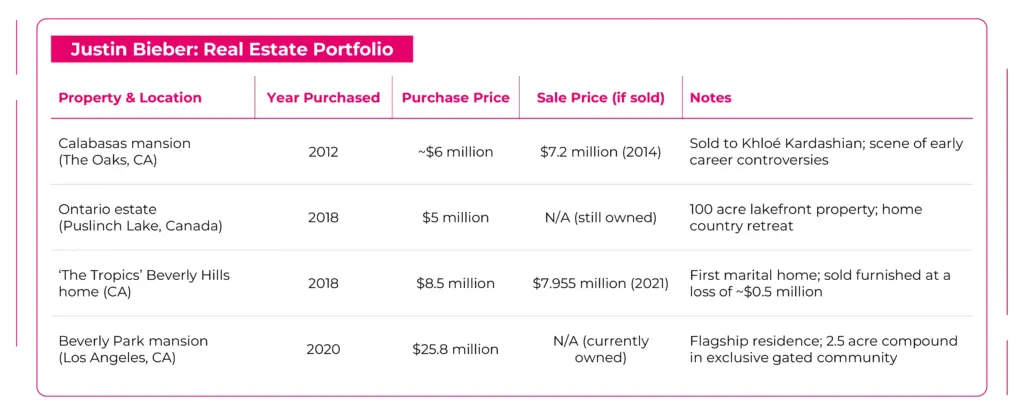
It’s worth mentioning that Bieber has also at times rented ultra-luxury homes (for instance, a $100,000-per-month Beverly Hills rental dubbed the ‘Salad Spinner’ house in 2015), indicative of his willingness to pay for privacy and comfort without always tying up capital. But as the table shows, he ultimately favoured owning significant real estate as his career matured. These properties not only provide enjoyment and privacy, but historically Los Angeles real estate has appreciated, offering potential upside. Bieber’s portfolio is fairly concentrated in residential real estate, which is common for entertainers. The upside is a tangible asset he can use; the downside is carrying costs (property taxes, maintenance) and illiquidity. Given his other investments and continued royalty flows, those downsides are easily managed in his case.
Vehicles, Jets, Collectibles & Luxury Assets
Justin Bieber’s taste for the finer (and faster) things in life is legendary. As soon as he had significant money, he began amassing an enviable collection of luxury vehicles and other flashy toys. While these assets depreciate more often than not, for Bieber they serve dual purposes: personal enjoyment and reinforcing the superstar image that, indirectly, fuels his brand.
The most jaw-dropping asset is undoubtedly his private jet. Bieber reportedly purchased a Gulfstream G650 around 2014, at the age of 20, an almost unparalleled extravagance for someone so young. The Gulfstream G650 is one of the world’s premier business jets, costing in the ballpark of $60 million. Bieber teased this in late 2014 by posting a Christmas photo of a jet’s interior with the caption ‘New jet for Christmas’. While some speculated it might have been a rental or fractional ownership, industry sources like AeroAffaires later noted Bieber indeed had a Gulfstream in his portfolio. Floyd Mayweather even congratulated him on joining the ‘Jet Club’. Owning a G650 outright is a huge ongoing expense (crew, fuel, maintenance easily run into millions annually), but it underscores the scale of Bieber’s wealth. It also offers privacy and flexibility for global travel, which is no small thing for an artist who used to tour 150+ days a year. Many celebrities opt to charter; Bieber having his own jet is a statement that he’s playing in the big league of wealth alongside billionaires and oligarchs. Financially, a plane is more of a liability than an investment, but for someone in Bieber’s bracket, it’s an acceptable indulgence and a time-saving tool.
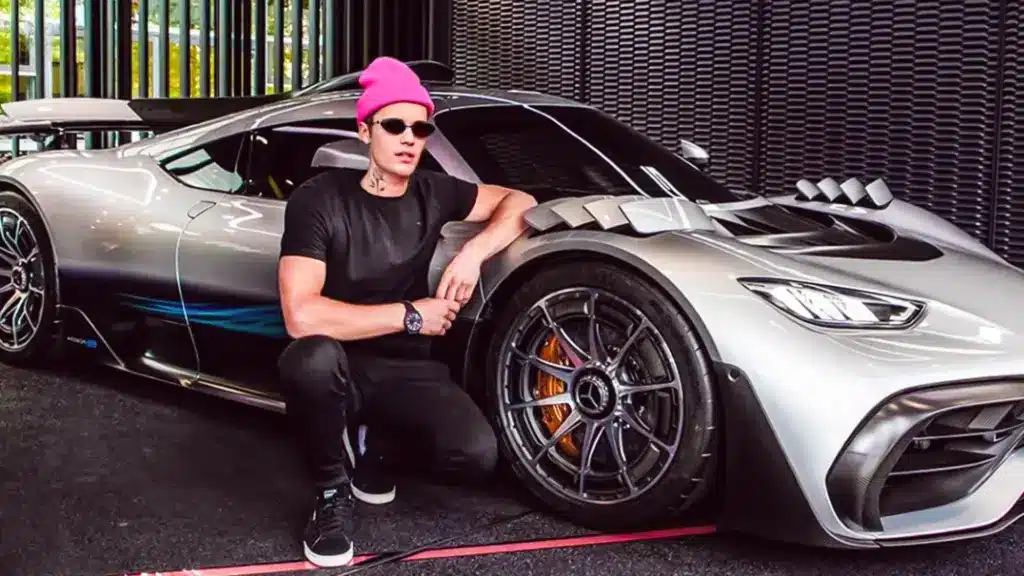
Then there’s the car collection. A rotating stable of sports cars, supercars and custom creations that’s been the subject of countless articles and YouTube videos. Bieber’s garage reads like a petrolhead’s dream. Among the highlights: a Bugatti Veyron Grand Sport, valued at over $2 million, which he received (temporarily) as a gift from rapper Birdman; a one-of-a-kind custom Rolls-Royce Wraith redesigned by West Coast Customs with a futuristic Blade Runner-esque body kit (so unique that Rolls-Royce itself was stunned); several Lamborghinis including an Aventador (he’s been seen in a chrome-wrapped one and a neon blue one over the years); a Ferrari collection that has included a 458 Italia and a limited-edition LaFerrari; plus the usual ultra-lux staples like the Range Rover, Porsche 911, and Mercedes G-Class. He even snagged a Tesla Model X early on, and was one of the first to reserve a Tesla Cybertruck. All told, Bieber’s car collection has been estimated at 15–20 vehicles, worth over $5 million cumulatively, though he does buy, sell, and trade often. For example, he infamously misplaced his Ferrari 458 for a couple of weeks in 2016 (forgot where it was parked after a night out), the kind of ‘problem’ that only arises when one has more cars than they can keep track of.
Other luxury assets include a penchant for high-end watches and jewellery. Bieber has been spotted with watches like the Rolex Daytona and Audemars Piguet Royal Oak, and he commissioned custom pieces from celebrity jeweller Ben Baller (like a $100,000 diamond-encrusted Family Guy necklace in his teens). There was also the matter of a $600,000 engagement ring for Hailey – while not an investment per se, it reflects the scale of expense that barely dents his fortune. He’s also known to splurge on art occasionally; he and Hailey reportedly bought a large KAWS sculpture to decorate their Beverly Hills home, and he’s posed with artworks by contemporary artists (though the extent of his art collection is private).
In terms of collectibles, one of the more modern twists: Bieber jumped into the NFT craze in 2022, purchasing a Bored Ape Yacht Club NFT for over $1 million. As with many NFT buys from that peak period, its market value later plummeted (worth maybe ~$100k now), but it shows Bieber’s willingness to take part in bleeding-edge trends (and absorb losses, a $1 million hit is relatively inconsequential given his net worth). Whether NFTs or sneakers (he has a noted sneaker collection too), Bieber’s hobby investments sometimes lose value, but they serve as experiential spending aligned with his interests.
Summing up his high-end toys: these are largely discretionary spends that signal his wealth but are not major contributors to it (aside from perhaps the cachet they add to his brand). However, Bieber has been judicious in one sense. He hasn’t let these expenses get out of hand relative to his income. Buying a $2 million car or even a $60 million jet is extravagant, but when you’ve earned $300+ million by 29, it’s proportionally akin to a successful professional buying a nice car. And occasionally, he’s made financial moves even with his toys: for instance, he has at times auctioned off cars for charity or sold vehicles when moving houses. There’s also intangible value: the fleet of flashy cars, the private jet, the bling, all of it feeds into the image of success that bolsters his negotiating power for deals. In entertainment, perception can impact pay, and Bieber’s lifestyle reinforces that he is A-list (which in turn keeps the big checks coming).
Investments & Financial Instruments
While hard assets and flashy toys are one side of Bieber’s financial life, the less visible side is his portfolio of investments and financial instruments. Bieber, either directly or via his business managers, has put substantial funds into various financial assets to ensure his wealth grows even when he’s not on stage.
Firstly, Bieber has a history of tech startup investments as discussed earlier, effectively acting as an angel/venture capitalist. By the numbers, he’s invested in over a dozen startups, ranging from tiny app makers to music tech companies. Some have paid off (Spotify, which went public, or Tinychat which sold to Paltalk), others may have fizzled out. Overall, his tech portfolio likely yielded a positive return and, perhaps more importantly, gave him credibility in business circles beyond music. These early moves were somewhat pioneering for a pop star, and they set the template for younger artists (like Jay-Z or Katy Perry) who later dove into startup investing. It’s hard to quantify exactly how much Bieber’s initial tech bets are worth today, but one could estimate eight-figure value if, say, Spotify alone turned a few million investment into $10M+, plus smaller wins here and there.
Beyond startups, Bieber’s team surely has him in more traditional investments: stocks, bonds and funds. With the windfall from the catalogue sale, it’s likely that a good chunk was allocated into a diversified portfolio managed by wealth advisors. This means Bieber’s fortune can grow relatively passively via the stock market or private equity. Celebrity financial filings (when occasionally revealed) show that ultra-rich entertainers often hold broad index funds, blue-chip stocks, and even municipal bonds (for tax-free income). While Bieber’s specific holdings are private, given his net worth, he could easily generate a few million per year in investment income just by parking money in conservative assets.
One specific equity stake we know: the HYBE stock he received in 2021 (worth ~$11 M at issue). If he kept those shares, they represent a foothold in the global music industry beyond his own work. He’s literally a shareholder in BTS’s label and his manager’s parent company. It’s an interesting full-circle moment: Bieber, who benefited from industry backing, now owns a slice of one of the industry’s power players. Should HYBE’s stock appreciate, that stake could swell; if not, it’s still an asset he can liquidate if needed.
It’s also worth mentioning intellectual investments: Bieber has spent money acquiring knowledge and advice (hiring business managers, lawyers and financial planners who guide his wealth). For instance, in 2016 he reportedly hired a financial planning firm to educate him on sustaining wealth after seeing other celebs go broke. This ‘investment’ in financial literacy may have paid dividends by helping him avoid bad deals or overspending. Evidence of this prudence is that, despite his lavish lifestyle, Bieber has never had a known cash crunch or bankruptcy scare, and he even handled legal issues (like settling a few lawsuits) without observable strain on his finances.
Another area is real estate investments beyond personal homes: while not public, Bieber could be involved in property investment funds or development deals (many high-net-worth individuals partner in commercial real estate projects). There was a rumour in 2022 that he and Hailey were exploring starting a line of hotels or an Airbnb portfolio, though nothing concrete has emerged. If he were to do so, it’d be a classic move to turn celebrity into a hospitality brand (à la Soho House vibe for fans).
In terms of debt, Bieber likely has access to low-interest credit lines secured against his assets (for example, he could take a mortgage on the Beverly Park mansion at historically low interest rates and free up cash for investments). Many wealthy individuals use leverage strategically. It wouldn’t be surprising if his business managers had a revolving credit facility for him, though given his abundant cash, he might not need it.
Finally, consider currencies and commodities: Bieber earns in USD mostly, but he’s Canadian and spends time there, so he might hold some assets in Canadian dollars. He also once tweeted about ‘holding some Bitcoin’ years ago, hinting at dabbling in crypto – indeed, buying the Bored Ape NFT implies he had a cryptocurrency wallet with at least a million in Ethereum. It’s speculative, but he might have a toe in crypto investments beyond that, as part of a high-risk slice of his portfolio.
All told, Justin Bieber’s investment strategy seems to be moderately aggressive but grounded. He took big swings (startups, catalog sale) but also made sure to convert a lot of his wealth into stable forms (blue-chip real estate, likely index funds, etc.). The result is that even if Bieber never performs again, his money can make money. This quiet engine of wealth isn’t what tabloids write about, but it’s a major reason his net worth has kept climbing from that first $100 million to now $300 million.
Timeline of Major Financial Milestones
Bieber’s financial journey is best understood by looking at the key milestones. The moments when a deal, release or decision significantly boosted (or protected) his net worth. Below is a timeline highlighting those inflection points in his wealth accumulation:
Note: Net worth figures are approximate and based on public estimates around the time, illustrating the trajectory. Bieber’s wealth saw its largest surges after major tours and the 2023 catalogue sale.
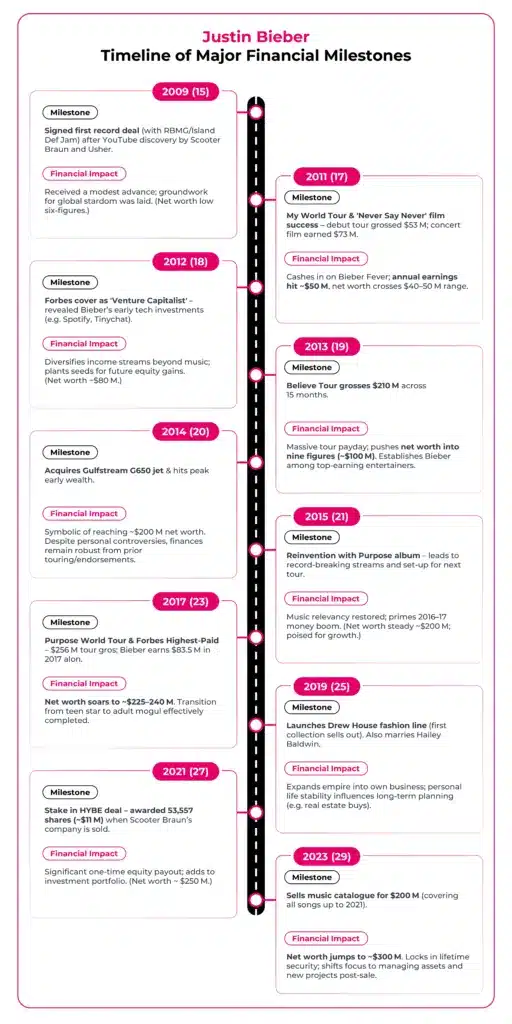
This timeline shows a clear pattern: periodic blockbuster events (world tours, asset sales) that cause step-changes in net worth. In between, Bieber’s wealth grew more gradually through consistent music sales, streaming and endorsements. It also highlights Bieber’s evolution from earning active income (performing, touring) to capitalising on assets (selling rights, investing in companies) as he matured.
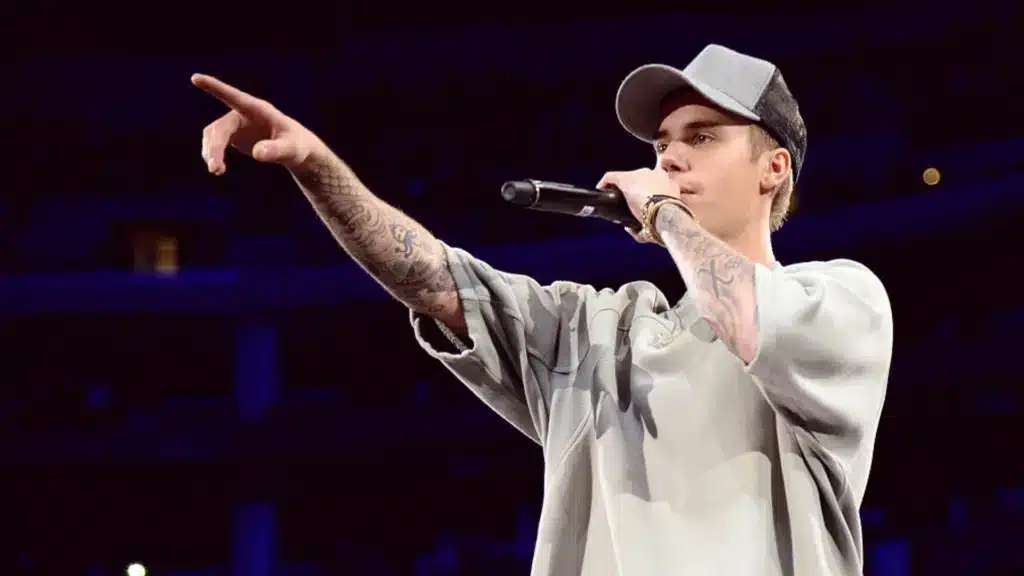
Strategic Pillars Behind His Wealth-Building
What enabled Justin Bieber to amass a $300 million fortune while many teen stars fade out? Looking across his journey, a set of strategic pillars emerges, guiding principles and decisions that underpin his financial success. These pillars, rooted in specific moments from his career, explain how Bieber built and protected his wealth.
1. Tour Early, Tour Globally (Maximise the Live Cash-Cow)
Bieber didn’t wait to grow up before hitting the road; he launched his first world tour at 16 and never looked back. By aggressively touring worldwide during 2010–2013 (My World and Believe tours), he capitalised on peak fan mania and created a massive income stream outside of album sales. This ‘tour early’ strategy meant that by 19 he had already grossed over $250 M from concerts and padded his net worth to nine figures. It also established touring as a reliable cash-cow he could return to whenever he needed a revenue boost (as seen with the Purpose Tour in 2016–17, which yielded his biggest payday). In short, Bieber treated global touring not as an occasional promo tool but as a core business, milking it at an age when many artists are still finding their footing.Britney Spears’s wealth blueprint covers a very different battle over artist earnings.
2. Own Your Audience, Then Sell the Asset (Fandom to IP Equity)
From the beginning, Bieber’s mentality was to own as much of his creative output as possible. He engaged in songwriting, controlled his image rights and later in his career negotiated ownership stakes (e.g., master recordings). The payoff came with the 2023 catalogue sale: because he had ownership in his music rights, he could sell his song portfolio for $200 M at age 28. This move reflects a pillar of converting ephemeral popularity into lasting equity. Bieber built a massive audience (150+ million records sold) and didn’t just earn royalties year-to-year, he packaged the whole royalty stream into an asset and liquidated it. This required foresight (not all young artists ensure they have something to sell) and timing (he sold at a market peak). It’s akin to a founder selling their company: Bieber treated his catalogue as a company he built through the 2010s and cashed out in 2023 for a life-changing sum, far earlier than most do. This pillar shows up in 2023’s milestone and traces back to choices a decade prior about creative control. Taylor Swift’s re-recording masterstroke is the definitive counter-example to selling your masters.
3. Turn Hype into Multiple Revenue Streams (Diversify the Brand)
Bieber didn’t rely solely on music sales; he exploded his brand into every adjacent market his fans cared about. This diversification – fragrances, fashion lines, merchandise, endorsements – meant that at any given time he had 5+ income streams humming. For example, in 2011 at the height of Never Say Never mania, he launched Someday perfume (earning millions from $60 M in sales) and had a bestselling nail polish, on top of music and touring. In 2016, he made music, toured and turned his tour merch into a fashion trend. By 2019, he diversified further by founding Drew House. This ‘don’t put all your eggs in one basket’ approach ensured that a dip in one area (say, album sales during a quiet year) was offset by another (royalties, products, or investments). It also made his empire more resilient; even when he paused music for personal reasons around 2014–2015, revenue still flowed from endorsements and past work. The timeline shows this pillar at work around 2012 (investments started) and 2019 (fashion venture launched), turning short-term hype into long-term enterprise.
4. Leverage Fame for Equity, Not Just Paycheques (Fame-to-Investor Evolution)
Unusually for a pop star, Bieber used his celebrity to get a seat at the investment table early. Instead of just doing sponsored tweets or appearances for a fee, he often sought equity stakes, whether in startups like Spotify or in partnerships like the HYBE deal where he got stock. This pillar is about thinking like an owner. When Forbes put him on the cover in 2012 for venture investing, it signalled that Bieber was flipping the script: he wasn’t just being invested in by labels, he was the investor in others’ ventures. This likely happened due to Scooter Braun’s influence and Bieber’s own interest in tech. The result over time is that some of his biggest financial wins are from equity (the HYBE shares netting $11 M, the potential gains from startups) rather than upfront cash. The pillar shows up in the timeline with events like the Spotify/Shots investments (2012–2013) and the 2021 HYBE payout. By leveraging his fame to access these deals (startups loved having Bieber on cap tables for the publicity, essentially granting him entry to hot investments), he multiplied his wealth beyond what music alone would do.
5. Embrace Reinvention to Sustain Earning Power (Longevity via Brand Rehab)
Bieber’s wealth-building wasn’t a smooth straight line; it faced potential derailment in the mid-2010s amid personal and public-relations troubles. A key pillar was his ability to reinvent and rebrand to keep the money machine going. Around 2014, negative headlines (DUIs, the ‘egg incident’, etc.) threatened his commercial appeal. Bieber’s response was a deliberate image and musical overhaul culminating in 2015’s Purpose, a more mature sound and a public apology tour of sorts. This reinvention restored public goodwill and unlocked his highest-earning phase (2016–17 Purpose Tour, $83 M in 2017 income). Many teen stars fail to transition, which cuts their earning potential short. Bieber’s strategic reinvention ensured his earning power not only recovered but hit new peaks in his 20s. The wealth trajectory from 2013 to 2017 (a dip then a huge rise) is directly tied to this successful pivot. This pillar underscores that protecting and evolving the brand (even if it meant a hiatus and hard work on personal growth) was essential to maintain his financial trajectory.
6. Know When to Cash Out and De-risk (Secure the Bag)
Hand-in-hand with taking risks is knowing when to pull back and lock in gains. Bieber demonstrated this with moves like the catalogue sale in 2023 (cashing out of future music royalties for a guaranteed $200 M). Another example: selling his Los Angeles homes when moving on (he didn’t hesitate to sell the Beverly Hills house in 2020, even at a slight loss, to upgrade into a more private estate, prioritising long-term value and lifestyle). This pillar is about consolidating wins not chasing every last dollar if it means higher risk or diminishing returns. By 29, Bieber effectively ‘secured the bag’. He converted volatile assets (the future success of his older songs) into secure ones (cash and investments). That decision reflects a maturity and understanding that wealth can be fragile; by de-risking through diversification and asset sales, he’s ensured that even if he never has another hit, he’s set for life. This mentality can be seen as early as 2017–2018 when he purposefully stepped back from the limelight to focus on health and marriage, implicitly prioritising stability over the grind of constant touring. In financial terms, it’s a pivot from aggressive growth to preservation, a wise shift as his net worth grew.
Together, these strategic pillars form the architecture of Bieber’s financial empire. They show a pop phenom who combined youthful hustle (touring everywhere, launching products) with surprisingly mature decisions about ownership and timing. Each pillar ties back to concrete moments. The whirlwind tours of 2010–13, the Forbes VC cover in 2012, the Purpose-era comeback, the 2023 sale all demonstrate that Bieber’s wealth hasn’t been accidental. It’s the product of specific plays that maximised upside and managed downside at critical junctures.
Actionable Insights: Lessons from His Wealth Blueprint
Justin Bieber’s wealth-building journey isn’t just entertainment industry lore, it offers practical lessons for entrepreneurs, investors and anyone aiming to build an empire. Here are key insights drawn from his strategic pillars, translated into actionable guidance:
Lesson 1: Scale Up Sooner Than Later
Don’t wait for the ‘perfect moment’ to expand your business or reach. Bieber went global as a teenager, effectively front-loading his biggest growth pushes (touring the world by 17) when many would say ‘he’s too young.’ The result: he captured market share (fans and dollars) before competitors caught up.
Takeaway: If you have a product or skill in demand, leverage it broadly and early – momentum compounds.
Lesson 2: Turn Income into Assets
Bieber didn’t just earn big checks; he converted them into valuable assets (song rights, equity stakes, real estate). This is akin to an entrepreneur reinvesting profits into building company IP or acquiring new ventures.
Takeaway: Use windfalls to acquire assets that generate future income or can be sold for a multiple – don’t just spend the cash.
Lesson 3: Build Multiple Revenue Pillars
Relying on one stream can leave you exposed. Bieber had music, touring, merch, endorsements and investments all churning simultaneously. When one slowed, others picked up slack. For business owners, this means diversify your product lines or client base.
Takeaway: Develop parallel income streams around your core brand, as a diversified empire is more resilient and lucrative.
Lesson 4: Negotiate for Equity Upside
Whether it was startup investing or deals like the HYBE merger, Bieber often positioned himself to get equity (stock or ownership) rather than one-off fees. Entrepreneurs can mirror this by seeking stock options, profit shares, or ownership stakes when providing value.

Takeaway: Think like an owner: structure deals so you benefit from long-term upside, not just immediate salary or fees.
Lesson 5: Rebrand and Evolve When Needed
Instead of clinging to a formula that stopped working, Bieber reinvented himself (the Purpose era) to unlock a new level of success. Businesses should similarly not fear pivoting or rebranding if their current image/product has plateaued or turned negative.
Takeaway: Stay adaptable: refresh your brand and offerings to stay relevant, which can open lucrative second acts that surpass your first.
Lesson 6: Know Your ‘Enough’ and Bank It
A striking Bieber move was cashing out his catalogue at 28. He effectively said ‘this secures my legacy financially, I’m good.’ For entrepreneurs, when you hit a life-changing opportunity (an acquisition offer, a chance to sell a stake at a great price), don’t be too greedy by holding out indefinitely.
Takeaway: Recognise when to take some chips off the table. Locking in a win can fund your freedom to pursue new ventures without pressure.
Lesson 7: Invest in Expertise and Advice
Bieber’s savvy moves weren’t made in isolation; he had experienced mentors (Scooter Braun) and advisors (financial managers). He essentially built a team to manage and grow his wealth, like a company has a board or CFO.
Takeaway: Surround yourself with trustworthy experts – legal, financial, strategic – especially as your enterprise grows. Their guidance can save or earn you millions.
Lesson 8: Capitalise on Brand Power (Then Extend It)
Bieber maximised the monetisation of his brand (faces on merch, name on perfumes). He proved that if you cultivate a strong brand following, you can bolt on virtually any product and find a market. For others, this means once you have an audience or customer trust, look for logical brand extensions.
Takeaway: Don’t be shy to sell beyond your main offering. A passionate community will buy related products or services from you rather than elsewhere.
These lessons all feed into one overarching playbook: think long-term, act with ownership, and be strategic with your star commodity (whether that’s your talent, product or brand). For instance, the way Bieber leap-frogged from just earning royalties to selling the royalty stream in one go – that’s analogous to an entrepreneur not just taking dividends from a business yearly but potentially selling the business for a big multiplier. As readers, we can emulate his willingness to take bold steps (world tour at 16, startup investments at 18) but also his discipline to secure what he’s built (catalogue sale, diversified assets by 29).
This is the playbook behind Bieber’s explosive jump in wealth from roughly 2010 to 2023. Early hustle, mid-game reinvention and late-game consolidation. Entrepreneurs and investors might not have legions of fans or platinum records, but the principles still apply: strike while the iron’s hot, build assets not just income, diversify your bets and cash in when the terms are in your favour.
Final Thoughts
Justin Bieber’s wealth story is far more than a teen idol piling up paychecks. It’s a masterclass in turning fleeting fame into an enduring fortune. At its heart, his strategy was about playing both the short game and the long game. In the short game, he squeezed every drop out of his superstardom: touring relentlessly across continents, slapping his name on products that flew off shelves and securing high-paying brand deals. This aggressive approach earned him hundreds of millions before age 25, a feat few could imagine when he was busking on Stratford streets. But crucially, Bieber didn’t succumb to the common traps of young wealth. Instead, he funneled those earnings into building something more lasting: song rights, companies, property and investments that would keep paying dividends as the spotlight evolved.
What sets Bieber apart from many of his pop star peers is this investor’s mindset underpinning his decisions. He treated his career as an entrepreneur would treat a startup, scaling fast, diversifying products, taking calculated risks and knowing when to exit a position. In doing so, he mitigated the biggest risk of entertainment fame: that the money stops when the hits stop. By age 29, Bieber essentially made himself financially unbreakable. Even if trends change or he opts for early retirement, the machine he built (and in some cases sold) keeps his wealth compounding. It’s a form of financial maturity and foresight we often associate with veteran businessmen, not millennials with tattoos and sports cars, yet Bieber has embodied both the rockstar and the responsible steward of wealth.
There’s also a unique edge in Bieber’s playbook: leveraging youth and fanbase as an asset in itself. He realised that the intense connection he had with fans was a currency; one that brands, investors and markets valued. So he monetised that fan capital at every turn, but (for the most part) without alienating the fan relationship. That’s a delicate balance and not every celebrity manages it; Bieber stumbled at times in his personal life, but he regained trust and maintained his relevance, which was key to sustaining his earning power into his late 20s and likely beyond.
For entrepreneurs and investors looking to copy something from Bieber’s blueprint, perhaps the most valuable takeaway is to think of one’s career or business holistically as an asset, an asset that can be grown, leveraged and at times partially sold to secure value. Bieber didn’t view his work as just a series of gigs; he viewed it as building an enterprise named ‘Justin Bieber’ and acted accordingly. Of course, not everything is worth emulating. His extravagant spending on luxuries is a by-product of having excess capital: fun, yes, but not what created his wealth. What really created it is much more grounded: hard work, shrewd deal-making, continuous adaptation and a solid team around him.
In the end, Bieber’s journey from YouTube sensation to $300 million mogul underlines that massive wealth can be built young, but it requires seeing the big picture and sometimes betting on yourself in unconventional ways. He played the music industry like a chessboard, thinking several moves ahead, while still executing brilliantly in the present. That’s a mindset any ambitious person can appreciate. Justin Bieber’s wealth blueprint is ultimately a story of harnessing the power of a moment and converting it into a dynasty. For those of us charting our own paths, it’s a reminder that with the right strategy, even a meteoric rise need not be fleeting. It can be the foundation of an empire.
For more celebrity net worth deep-dives, check out the No Bollocks Wealth Reports and listen to No Bollocks Podcast.
Read more of our wealth reports including Taylor Swift, David Beckham, Ryan Giggs, Elon Musk, Tom Cruise, Donald Trump, Dwayne Johnson , Leonardo DiCaprio and more on our No Bollocks Business HQ.
Browse more celebrity wealth reports across music, sport and business.
If you’re building a business of your own and want experienced support, you can work with Matt directly.