
Executive Summary
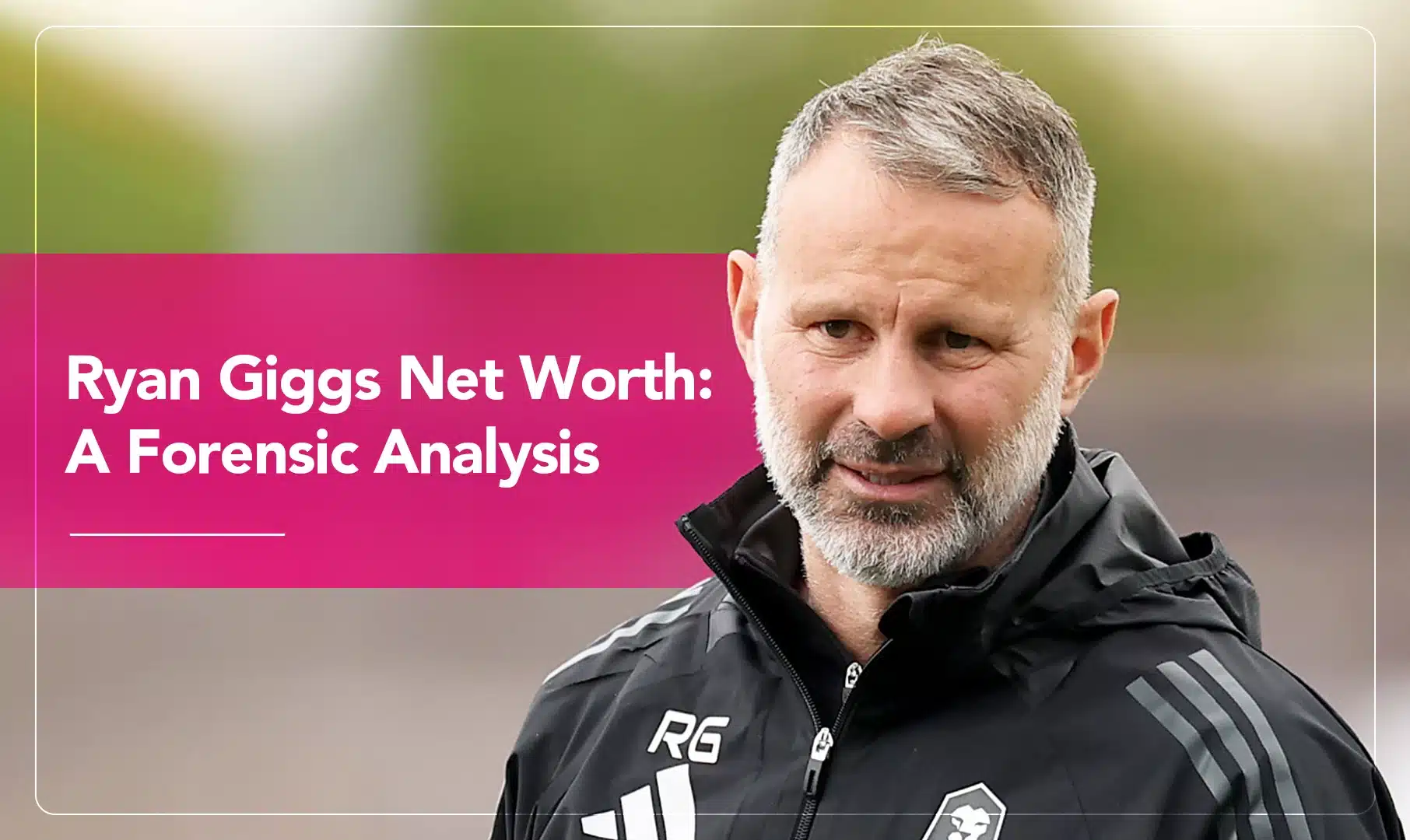
Ryan Giggs has an estimated net worth of £50 million as of 2025, built through a blend of long-term Premier League earnings, endorsement income, property investments, hospitality ventures, and the eventual sale of his stake in Salford City FC. Unlike the modern superstars who earn fortunes through mega-contracts or global branding deals, Giggs built his wealth gradually, relying on career longevity, disciplined planning and steady reinvention.
Across 24 years at Manchester United, he earned tens of millions in wages and bonuses, but the real backbone of his current fortune comes from what he did with that income. Giggs invested early, partnered with trusted teammates on long-term business ventures, and accumulated a strong real-estate and hospitality portfolio that continued to grow even when his coaching career stalled. Although he faced setbacks – failed restaurants, a costly divorce, and a legal case that paused his managerial income – his core assets held firm, largely because he had already shifted from salary-dependence to ownership.
This report breaks down exactly how Giggs built his wealth. We explore his primary income streams as a player, manager and entrepreneur; his secondary income from endorsements, commercial partnerships and media; and the asset base that underpins Ryan Giggs net worth today. Finally, we examine the strategic decisions, turning points and lessons behind the ‘Giggs blueprint’ – a model of patient, level-headed wealth building that offers practical insights for professionals, entrepreneurs and athletes alike.

Ryan Giggs: Primary Income Streams
Football Earnings – The Foundation of His Fortune
Though Giggs never earned the astronomical salaries of modern footballers, his playing career provided the reliable base capital on which his later wealth compiles. And for the third path out of that dressing room, David Beckham’s brand-driven wealth blueprint shows what global endorsement power looks like at full scale.
Early Career Earnings (1990–1995): The Budget Superstar
- £170/week first contract
- £300 per first-team appearance
- £40 housing stipend (paid to his mother as landlady)
- Modest earnings despite meteoric fame
- Reebok locked him into a £1 million boot deal in the early 90s – massive for the era
United began incrementally improving his salary as his impact grew. By 1994–95 he had risen into the low thousands per week but remained far below superstar pay despite his star power.
Real wealth move: Giggs learned frugality early – his humble start set a lifelong habit of saving and investing rather than flashy spending.
Peak United Earnings (1996–2005): Contract Stability & Loyalty Dividends
Key salary phases:
- Late 90s: £10k–£30k per week
- 2001 contract renewal: £50,000/week (matching Roy Keane’s benchmark)
- Early 2000s: rising to £60k+
Despite interest from Inter Milan and Italian giants (where he could have doubled wages), Giggs consistently chose stability, using external interest to negotiate modest raises rather than dramatic transfers.
The biggest financial advantage of loyalty: He secured 24 consecutive years of top-flight wages – something virtually impossible had he moved clubs or missed form.
Estimated total on-field earnings (salary + bonuses): £30–£35 million (United career only)

Later Career Income (2006–2014): Player-Coach Hybrid & Expert Longevity
As a veteran:
- Giggs accepted rolling one-year deals at ~£70k–£80k/week
- Became a player-coach under David Moyes in 2013
- Earned dual income: playing salary + small coaching stipend
- Remained one of United’s most trusted leaders
His adaptability – switching from winger to central playmaker – extended his career significantly.
Longevity Value: Playing until age 40 added millions in wages and allowed Giggs to retire with earnings comparable to players who peaked higher but burned out earlier.
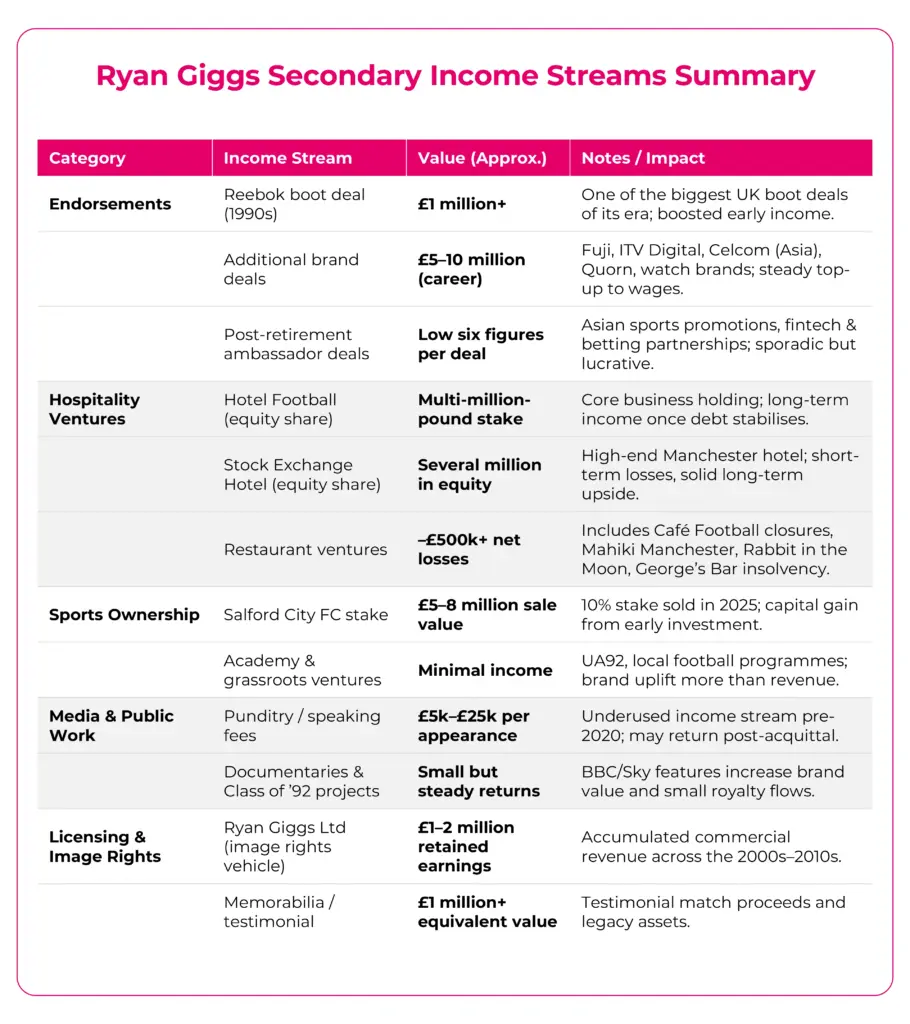
Endorsements & Sponsorships (1991–2010): Global Brand Appeal
Giggs quietly amassed millions through select high-value sponsorships, including:
- Reebok (seven-figure deal)
- Fuji
- ITV Digital
- Celcom (Asia telecom)
- Quorn
- Watch brands (Cyma, Patek Philippe)
He appeared on dozens of magazine covers and became one of the Premier League’s first true marketing faces.
Estimated endorsement income: £5–10 million during playing years . His old captain built his money the opposite way: Roy Keane’s £40m fee-based fortune involved no bricks, no brands and not a single business venture.
Unlike Beckham, who built a global commercial empire, Giggs deliberately kept endorsements selective, protecting his image and avoiding overexposure.
Coaching & Managerial Earnings (2014–2020)
Post-retirement:
- Assistant Manager, Manchester United (2014–2016):
Estimated ~£500k across two years - Manager, Wales National Team (2018–2020):
Estimated £400k/year
He forfeited at least £800k in future Wales salary due to the 2020 legal case. Coaching income never rivalled his business ventures, but kept him relevant and diversified.
 This is the capital that seeded his later wealth. But Giggs’ real financial power now lies in Secondary Income Streams – especially hospitality and sports equity.
Ryan Giggs: Secondary Income Streams
Although Ryan Giggs built his initial fortune on a legendary football career, the majority of his long-term wealth has come from the business ecosystem he constructed after leaving the pitch. His post-playing journey is characterised not by a single blockbuster success, but by a carefully assembled network of hospitality ventures, real estate projects, club ownership, strategic partnerships, and recurring media income.
Together, these ventures form the financial backbone of “Giggs Inc.” – and reflect a strategy very different from many of his contemporaries: stay local, build tangible assets, partner with people you trust, and grow slowly rather than chase flash-in-the-pan global fame.
GG Hospitality: The Centre of Gravity in Giggs’ Empire
The most valuable and recognisable strand of Giggs’ commercial life is GG Hospitality, the company he co-founded with Gary Neville and supported by fellow Class of ’92 teammates and external investors. What began as a modest concept – a hotel for Manchester United fans – evolved into a multimillion-pound hospitality group that now includes high-profile hotels, restaurants, bars, and development projects.
Hotel Football – A Blueprint for Fan-Led Hospitality
Hotel Football is the crown jewel of Giggs’ business world. Opened in 2015 directly opposite Old Trafford, the project was far more than a vanity exercise for two retired footballers. It was a shrewd, brand-aligned commercial move: Manchester United attracts global footfall, and no hotel had ever fully tapped into the matchday experience at that scale.
The result was a 133-room hotel purpose-built to monetise football tourism. Matchdays transform the building into an economic engine – rooms sell out months in advance, the downstairs bar becomes a fan magnet, and corporate guests book premium viewing packages. Despite early operational challenges (including a recorded £601,000 loss in 2023 due to restaurant restructuring), Hotel Football has consistently delivered strong revenues and remains one of the most strategically placed hospitality assets in Manchester.
The hotel’s partnership with Marriott’s Tribute Portfolio added global marketing reach and booking exposure, increasing long-term asset value. As of 2025, industry analysts value the hotel at £40–45 million, with Giggs’ share worth several million on its own.
The Stock Exchange Hotel – Boutique Luxury, Long-Term Promise
If Hotel Football is the engine, the Stock Exchange Hotel is the prestige project. Opened in 2019 after an extensive redevelopment of Manchester’s historic stock exchange building, the 40-room luxury hotel reflects a more ambitious phase of Giggs’ business evolution. It blends heritage architecture with high-end interiors, and has become a go-to destination for business travellers, football celebrities, and affluent visitors.
Its early years were challenging. A high-profile restaurant partnership struggled, contributing to a £2.5M loss recorded in 2023. But commercially, these growing pains are not unusual for a premium hospitality venture. The property itself remains a valuable real estate asset in the beating heart of Manchester, and with improved management alignment and Marriott Autograph Collection integration, the project is widely expected to stabilise.
Giggs’ stake, though smaller than in Hotel Football, still represents several million pounds of equity – and long-term potential far beyond that.
The Restaurant Missteps – A Necessary (and Costly) Education
Giggs and Neville did not escape the pitfalls that often plague athletes entering hospitality. Their foray into standalone restaurants and nightlife – including Café Football London, Mahiki Manchester, Rabbit in the Moon, and George’s Dining Room & Bar – brought painful and very public losses.
George’s, in particular, collapsed in 2025 owing nearly £495,000, including unpaid wages and tax liabilities; Giggs himself was personally left £99,925 out of pocket.
Yet, the crucial point is how they handled these setbacks. Rather than throwing good money after bad, Giggs and his partners made decisive cuts, accepted mistakes, and re-centred all resources around the ventures that were actually working: hotels. These closures ultimately strengthened the GG Hospitality portfolio by eliminating distractions and protecting core assets.
This “fail fast, refocus quickly” approach is one of the most underrated reasons Giggs’ business career hasn’t derailed. Many ex-athletes doubled down on ego-driven vanity ventures; Giggs chose pragmatism.
Salford City FC – A Passion Investment Turned Smart Financial Move
Giggs’ 2014 co-purchase of Salford City alongside the Class of ’92 was portrayed as a heart-over-head decision: a local club revitalised by local legends. But financially, it turned out to be one of the sharpest plays of his post-playing life.
Giggs invested when the club was still in the lower leagues. Over the following decade, Salford climbed into the English Football League, expanded its stadium, attracted global media attention, and increased sponsorship revenue – all factors that lifted its valuation significantly.
In May 2025, Giggs sold his ~10% stake as part of a Beckham-led restructuring. Although official figures remain undisclosed, industry analysts estimate his payout at £5–8 million, representing a substantial return on a modest initial outlay.
For Giggs, Salford was both emotional and strategic. It grew his wealth, boosted his influence in football governance, and embedded him deeper into the Manchester community – reinforcing the local-first ethos of his business empire.
Real Estate Outside Hospitality – The Quiet Foundation of His Wealth
Giggs has always favoured real estate as a conservative, stable wealth vehicle. Long before many footballers thought about retirement, Giggs was buying property in his 20s – a mindset that protected him financially when scandals and setbacks later paused his football income.
His holdings have included:
- A custom-built mansion in Worsley (bought for £1.94M in 2004; listed for £3.5M in 2019)
- High-end Manchester penthouses
- A London apartment worth roughly £2M–£2.5M
- A country retreat in Wales
- Several smaller rental units and investments tied to GG Hospitality developments
Collectively, Giggs’ personal property portfolio outside the hotel group is valued at £10–12 million. These assets have appreciated steadily over time and generated rental yields – quietly doing the heavy lifting during years when endorsements dried up or legal proceedings halted professional work.
Brand Partnerships, Ambassador Work & Media
Unlike global marketing giants such as Beckham, Giggs’ endorsement strategy has always been understated. His brand presence in Asia – especially Vietnam, Malaysia, and China – has generated steady six-figure ambassador fees for appearances, youth academies, sports clinics, fintech partnerships, and corporate events.
Post-retirement, these deals provide predictable annual income without relying on the UK public spotlight. Typical earnings range from £100,000–£200,000 per year, with occasional spikes during major campaigns or promotional tours.
He has also earned from:
- Laureus Sports ambassadorships
- Appearances in documentaries
- Football punditry (limited)
- Speaking engagements and business panels
- Short-term coaching consultancy abroad
Individually small, collectively meaningful – and ideal for someone rebuilding public reputation after years of legal scrutiny.
Coaching and Managerial Roles – Modest but Strategic
Giggs’ coaching career has been sporadic but symbolically important. Assistant manager roles at Manchester United and his appointment as Wales manager expanded his brand beyond playing. Financially, though, these roles were relatively modest compared to his business ventures.
- United Assistant Manager: ~£200–300k per year
- Wales Manager: ~£400k per year
Legal proceedings between 2020 and 2023 effectively cut this income stream off, costing him at least £800,000 in lost wages. With his name now cleared, Giggs is positioned for a coaching comeback, which could add mid six-figure annual income again.
Minor Ventures and Educational Projects
Giggs is also a founding partner in University Academy 92 (UA92) – an educational institution designed to bridge sports, media, and business studies. While not a major cash generator, UA92 builds long-term brand capital and strengthens Giggs’ community presence in Manchester.
Other minor ventures include:
- Small equity stakes in sports and tech initiatives
- Media rights from Class of ’92 documentaries
- Ambassador-linked youth tournaments abroad
These ventures form a patchwork of modest recurring revenue, reinforcing Giggs’ diversified approach.
Asset Portfolio Analysis
While Ryan Giggs earned well during his football career, the real durability of his fortune comes from the asset base he built carefully, quietly, and consistently from his early twenties. Unlike many athletes who let big salaries slip through their fingers, Giggs turned income into assets, and assets into long-term wealth.
Today, his portfolio spans prime UK property, multimillion-pound hotel equity, valuable brand partnerships, luxury vehicles, and financial investments. In typical Giggs fashion, the structure is understated but effective: no outlandish yachts, no super-mansions in Dubai, no scattergun venture portfolio. His wealth lives in tangible, income-producing assets – the kind that survive recessions, scandals, and retirement.
Below is a complete breakdown of the key pillars of Giggs’ asset world.
Real Estate Holdings – The Steady Backbone of His Wealth
If Giggs has a financial “home base”, it is bricks and mortar. Property has been his most reliable and enduring wealth strategy, dating back to his first major contracts in the late 1990s. Rather than splurge on depreciating toys, he bought houses – and not just to live in. He treated property as a store of value and a future income source.
The Worsley Mansion – A Career Trophy That Also Paid Off
One of Giggs’ most valuable personal assets was the modern 6,700 sq ft mansion he built in Worsley, Greater Manchester. Purchased as a £1.94M plot in 2004, he later invested in a full rebuild, creating a bespoke five-bedroom property complete with indoor pool, luxury finishings and the now-famous “batcave” underground kitchen.
By the time he put it on the market in 2019 for £3.5M, the home had nearly doubled in value – even after years of use and several cycles of the UK property market. For an ex-footballer, this was a masterclass in how to turn a lifestyle purchase into a long-term financial win.
Manchester & London Apartments – Quiet but Lucrative
Giggs also owns (or has owned through joint holdings and post-divorce arrangements) several high-end apartments:
- A luxury Manchester penthouse worth approximately £2.5–3M
- A London apartment valued around £2–2.5M
- Additional smaller rental units acquired during his playing years
These properties generate ongoing rental income and have appreciated steadily in two of the strongest UK real estate markets. During the years when Giggs’ public image took a hit and professional opportunities dried up, these were the assets that kept his wealth base secure.
Wales Country Retreat
He also maintains a countryside property in Wales, both as a personal base and a slower-growth asset. While not as high in value as his metropolitan properties, it enhances his net worth and diversification.
Total estimated value of personal property holdings: £10–12 million
Hotel Equity – The Heart of Giggs’ Modern Wealth
Giggs’ biggest wealth engine today is his stake in GG Hospitality – particularly the two flagship hotels:
- Hotel Football, Old Trafford
- Stock Exchange Hotel, central Manchester
These hotels are more than businesses; they are major appreciating assets built on prime land, tied to Manchester’s tourism economy, and benefiting from strong brand alignment with the Class of ’92.
Hotel Football – A Multimillion-Pound Generator in the Shadow of Old Trafford
This is arguably Giggs’ most recognisable and commercially potent asset. With 133 rooms, multiple bars, corporate spaces, and unrivalled match-day demand, Hotel Football is a rare hospitality venture that enjoys almost guaranteed footfall.
Even with temporary losses during post-pandemic recovery (a £601k dip in 2023), the underlying fundamentals remain extremely strong:
- Location is irreplaceable
- Bookings spike every matchday
- Marriott partnership boosts global occupancy
- Corporate hospitality demand remains resilient
Industry experts place the hotel’s valuation around £40–45 million, with Giggs’ stake likely worth £4–8 million depending on the precise ownership split.
Stock Exchange Hotel – High-End Asset, Long Growth Horizon
The Stock Exchange Hotel is the premium counterpart to Hotel Football: 40 rooms, Michelin-ambition dining (despite early misfires), and a boutique appeal. It has already achieved a place among Manchester’s most recognisable hospitality venues.
Financial performance has been mixed – the £2.5M operational loss in 2023 was a wake-up call – but the property itself sits on valuable real estate that typically appreciates regardless of short-term trading fluctuations.
Conservative estimates put Giggs’ stake at £2–4 million, with long-term upside if the hotel stabilises under new management and the Marriott Autograph Collection umbrella.
Hospitality Spin-Offs – Lessons, Write-Offs, and Strategic Retreats
Giggs’ ventures outside the core hotels – from Café Football London to Mahiki Manchester and Rabbit in the Moon – were costly experiments. Several shut down within a year. One of the more painful closures, George’s Dining Room & Bar, ended with £495,000 in debts and Giggs personally owed nearly £100,000.
Yet these failures strengthened his portfolio in the long run. By cutting these ventures quickly and decisively, he prevented them from damaging the core hotel assets – a strategic discipline many retired athletes struggle to maintain.
Giggs’ hospitality assets today are leaner, more focused, and built on far better foundations than when he first dipped his toes into the industry.
Sports Assets – A Passion Project That Delivered Real Returns
Giggs’ most successful non-hotel investment is his 10% stake in Salford City FC, acquired in 2014 when the club was still a non-league side. As the club climbed the divisions, upgraded its stadium, and attracted global attention, its value grew sharply.
The 2025 sale of Giggs’ stake to a consortium fronted by David Beckham delivered a welcome cash injection. While the exact numbers remain private, industry consensus suggests a payout in the region of £5–8 million.
This single transaction turned a sentimental venture into one of the largest liquidity events of Giggs’ career.
Vehicles, Collectibles & Lifestyle Assets
Giggs’ car collection has always been relatively understated by footballer standards, but still includes:
- A Ferrari 550 Maranello (~£150k)
- A Bentley Continental GT Mulliner (~£180k)
- Various Range Rovers and Mercedes SUVs over the years
He has also owned premium timepieces from brands such as Patek Philippe and Cyma, likely totalling £100k+ in value.
These assets are lifestyle perks rather than major wealth contributors, but they reflect a controlled, not extravagant, pattern of consumption.
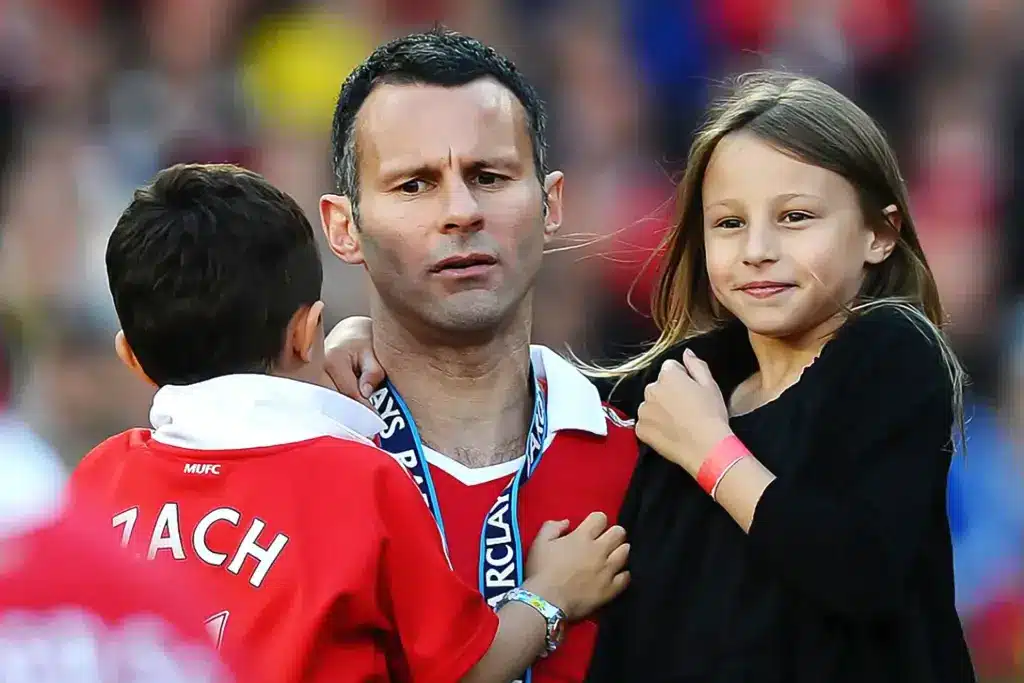
Financial Investments, Cash Reserves & Corporate Holdings
Through his company Ryan Giggs Limited, as well as private investment vehicles shared with partners, Giggs maintains a substantial liquidity position. His investment profile appears conservative:
- Low-risk funds
- Cash reserves
- Dividend income from hospitality assets
- Rental income
- Occasional equity stakes in small commercial ventures
Years of steady savings (and a lack of excessive spending) mean Giggs likely holds £5–10 million in liquid or semi-liquid investments.
This liquidity is one reason he survived a two-year legal battle, several failing restaurants, and the loss of the Wales managerial role without being forced to offload prime assets.
What This Asset Portfolio Tells Us
Ryan Giggs’ wealth endures because:
- His biggest assets are tangible, income-producing, and UK-based.
- Real estate and hotels carry long-term appreciation.
- Salford City provided a rare liquidity event at the perfect time.
- He invested early and avoided lifestyle inflation.
- He diversified into business long before retirement.
- He limited exposure to high-volatility ventures.
In short, Giggs built a portfolio designed to withstand shocks. That resilience has carried him through personal controversy, business missteps, and career transitions – and remains the strongest argument for why Ryan Giggs net worth has stayed solid while many peers faded financially.
Ryan Giggs Net Worth: Career & Wealth Timeline
Ryan Giggs’ wealth story is inseparable from the arc of his footballing life – not because he earned the biggest salaries of his era (he didn’t), but because he understood something that many modern players forget: longevity, consistency and intelligent reinvestment can outperform short bursts of extreme income. His financial milestones map neatly onto the chapters of his sporting career, showing how each phase – from prodigy to veteran, from coach to investor – shaped the fortune he now holds.
Below is the chronological narrative of how his earnings, decisions and setbacks shaped the £50 million net worth he commands in 2025.

Giggs’ career and wealth breakdown in more detail:
1990–1995: Breakthrough, Small Wages, Big Exposure
When Ryan Giggs signed his first professional contract with Manchester United on his 17th birthday, the numbers were modest. He earned £170 per week and £300 per appearance – not much even for the early ’90s. Yet these low wages masked the real financial breakthrough: within two years, Giggs was the marketing face of a new era for United.
By 1993, he had landed a million-pound Reebok boot deal – an astronomical sum for a teenager – and began appearing in national advertising campaigns for Fuji, ITV Digital and other early sponsors who saw him as the next big British star. At a time when footballers rarely crossed into mainstream media, Giggs was one of the first to do so consistently.
Critically, he also learned frugality. His early housing allowance was £40 per week, which he gave straight to his mother. He bought few luxuries. He saved. And as contract renewals came – usually after another trophy – he focused on security, not glamour.
This foundation of early discipline would shape his entire financial life.
1996–2005: Peak United Years, Rising Salaries, Early Investments
As Manchester United became a global football powerhouse in the late ’90s, Giggs’ earnings rose with it – but again, not to the levels of the biggest global stars. While he was one of the most recognisable players in the squad, he deliberately chose stability over aggressive salary battles.
By 2000–2001, after Roy Keane reset the club benchmark at £50k per week, Giggs negotiated wages in a similar range. He earned roughly £2.5M per year at his peak and secured multiple renewals by delivering consistently on the pitch. But unlike Beckham, who embraced the Galáctico market, Giggs didn’t chase overseas transfers. Rumours of Inter Milan interest were leveraged for better terms at United, but he stayed put.
The payoff for that loyalty wasn’t a single huge contract – it was twenty years of uninterrupted top-flight wages.
During this period, he also made one of his most important financial decisions: buying property early. In 2004, he purchased a £1.94M plot in Worsley and built a custom mansion that would later nearly double in value. By his late twenties, Giggs was already building the real estate base that would protect him long after retirement.
2006–2014: Veteran Influence, Transition to Coaching & Multiplying Revenue Streams
Giggs’ thirties marked the period where he subtly transitioned from star winger to strategic veteran. Sir Alex Ferguson offered one-year rolling contracts – a method that kept older players performing and rewarded them season by season. Giggs embraced it. His wages settled around £70–80k per week, still strong but overshadowed by younger stars like Rooney, Tevez and Ronaldo.
Instead of resisting the reality of age, Giggs reinvented himself again – this time as a hybrid player-coach. In 2013 he earned dual income: playing wages plus a coaching stipend when David Moyes brought him into the staff. Few players have ever been able to draw salaries from both sides of the game simultaneously.
Giggs also used this period to aggressively expand his commercial world. He and Gary Neville began planning GG Hospitality, signing early agreements for what would become Hotel Football. They also explored the restaurant market – a move that would eventually cost them money but accelerate their entrepreneurial learning curve.
By the time Giggs retired from playing in 2014, analysts estimated he had earned more than £30–35 million in football wages alone – a solid figure, though modest by modern standards. But the key wasn’t how much he earned – it was how much he saved, and how quickly he turned active income into ownership.
2014–2018: Retirement, Coaching at United & The Birth of the Giggs Business Empire
The year 2014 was transformative. Within months of retiring, Giggs:
- Became interim Manchester United manager
- Joined the coaching staff for two more years
- Co-founded GG Hospitality
- Purchased a 10% stake in Salford City FC
Financially, this phase marked his shift from earner to owner. Coaching salaries at United were solid but not extraordinary; the real wealth creation was happening in boardrooms and construction sites.
By 2015, Hotel Football opened its doors opposite Old Trafford – and immediately became one of the most commercially promising hospitality concepts in Manchester. The Stock Exchange Hotel followed suit, setting the tone for Giggs’ long-term transition into real estate–backed entrepreneurship.
His stake in Salford City was also growing in value as the club rapidly climbed the English football tiers. While it wouldn’t produce cashflow for years, its equity appreciation quietly became one of his most valuable long-term assets.
This period represents the true beginning of Giggs’ second career – one built on ownership rather than wages.
2018–2020: Wales Manager, Brand Expansion & The High-Water Mark Before Crisis
Giggs’ appointment as Wales manager in 2018 delivered prestige and a stable six-figure annual salary. His profile rose again internationally. Hotels were expanding; Salford had reached the Football League; documentary crews were following the Class of ’92; sponsorship opportunities abroad – especially in Asia – were increasing.
From the outside, Giggs appeared to have achieved the ideal post-playing life: respected coach, successful businessman, beloved club legend, and part-owner of a rising football club. The only cloud on the horizon was the operational strain of over-expansion in hospitality, with restaurants such as Café Football, Mahiki and Rabbit in the Moon starting to reveal structural weaknesses.
But the real financial shock was about to come from elsewhere.
2020–2023: Legal Crisis, Income Collapse & Asset Survival
In late 2020, allegations of domestic assault triggered the most difficult period of Giggs’ professional life. He stepped aside from the Wales job – losing two years of managerial salary – and sponsors immediately distanced themselves. Punditry roles vanished. Speaking engagements evaporated. Eventually, he resigned from the Wales job entirely in 2022.
This three-year legal ordeal didn’t just cost income; it cost opportunity. A successful Euro 2020 campaign might have propelled him to Premier League management. Instead, he spent years off the radar.
Yet here lies one of the most significant financial insights in Giggs’ story: his wealth survived because of asset structure, not public favour.
His hotels continued to operate. His properties appreciated. His investment in Salford sat untouched. Even with legal fees, lost income and reputational damage, Giggs did not need to sell core assets.
It was a stress-test of his financial architecture – and the structure held.
In July 2023, he was acquitted. The path back to public life – and income – reopened.
2023–2025: Acquittal, Reputation Rebuild & The Salford Exit Windfall
Following his acquittal, Giggs resumed low-profile commercial activity: brand appearances in Asia, hospitality oversight, ambassadorial roles, and talks of a coaching return. But the most meaningful financial event came in May 2025, when the Class of ’92 sold their shares in Salford City to a Beckham-led consortium.
Although the deal figure remains undisclosed, industry estimates place Giggs’ payout between £5–8 million. For a club he bought into for passion rather than profit, it became one of the most lucrative transactions of his post-playing life.
At the same time, GG Hospitality began returning to profitability after the turbulent pandemic years. New management structures, Marriott partnerships and the closure of loss-making restaurants gave the group a leaner, more sustainable future.
In 2025, Giggs stands with a net worth close to £50 million, supported by a mature asset base, stabilised business interests, ongoing ambassador work, and the possibility of a managerial return. More importantly, his wealth is now structured in a way that is resistant to the volatility that derails many former athletes.
Ryan Giggs never earned like Beckham, never monetised like Ronaldo, and never cultivated a global fashion persona. His path was quieter, steadier and sometimes far rougher. But the overarching pattern is unmistakable:
He built long-term wealth by prioritising longevity, ownership, and asset-backed investments – not short-lived stardom.
This timeline reveals a career in which every phase, every contract, every partnership and even every setback played a role in shaping the financial stability he now enjoys.
Seven Strategy Pillars of Ryan Giggs Net Worth Blueprint
Ryan Giggs’ financial trajectory is an unusual case study in the sporting world, not because he made the highest earnings or launched the most glamorous brand, but because he maintained a consistent, almost understated strategic discipline for more than three decades.
His approach to wealth-building sits somewhere between old-school loyalty and modern entrepreneurial ambition – a blend rarely seen in football. This section breaks down the underlying strategies that shaped his financial life and examines how they compare with the norms of the industry and the decisions of his contemporaries.
Loyalty Over Leverage: The One-Club Model That Refused the Transfer Gold Rush
In an era when star players regularly engineered transfers to spike their earnings, Giggs chose the opposite path. Staying at Manchester United for 24 seasons meant he forfeited the chance at mega-deals abroad – particularly in the late ’90s and early 2000s when Serie A and La Liga wages exploded.
Financially, the modern footballer’s playbook prioritises short-term gain: maximise wages in peak years, chase signing-on fees, and let agents broker aggressive moves. Giggs ignored that model. Instead, he traded a transfer-related windfall for:
- long-term wage stability
- annual contract renewals tied to performance
- loyalty bonuses
- testimonial earnings
- guaranteed post-playing opportunities within the club
This more conservative approach would normally cap a player’s long-term wealth, but for Giggs it had the opposite effect. The absence of knee-jerk moves, contract stand-offs or risky overseas spells allowed him to extend his playing career well into his forties. That longevity alone produced cumulative wages that rivalled the peaks achieved by stars who opted for short bursts of higher pay.
In football, loyalty is rarely seen as a profitable choice. Giggs made it one.
Longevity as a Wealth Strategy: Reinvention, Fitness and Role Evolution
Where many players maximise peak earning years and then fade, Giggs extracted value through reinvention. By transitioning from pacey winger to intelligent playmaker, and then into a hybrid player-coach role, he multiplied the lifespan of his earning power.
This type of adaptation is rare in elite football. The industry norm is a steep performance drop-off around 32 that often precipitates a move to a lower-tier league, MLS, or early retirement. Giggs defied that cycle through:
- tactical reinvention
- meticulous fitness management
- willingness to accept role evolution
- a mindset geared towards adaptation, not decline
From a financial standpoint, every additional year he stayed at United was another year of Premier League-level wages – something almost no player from his generation matched.
Longevity became an asset class in itself.

Playing the Game After the Game: Seamless Transition Into Coaching and Business
Giggs’ transition into his second career was not a scramble; it had been architected years in advance. While still a player, he began earning coaching qualifications, mentoring younger teammates, and forming business plans with trusted partners.
By the time he retired, he already had:
- a dual income stream as player-coach, and
- his first post-playing investments underway
Most footballers struggle with retirement because their income drops to zero overnight. Giggs prevented that cliff-edge by ensuring he had a path before he stepped off the pitch.
Industry comparison highlights the rarity of this approach. Many former stars face:
- failed business ventures fuelled by poor advice
- sharp lifestyle inflation
- no second career plan
- reliance on unsustainable media appearances
Giggs planned his transition like a long-term portfolio shift, not a last-minute salvage mission.
The Class of ’92 Model: Partnership as a Wealth Multiplier
Perhaps the most defining element of Giggs’ wealth strategy is his partnership with the Class of ’92. Collectively, they built a business ecosystem – hotels, restaurants, a football club, educational institutes – that none of them could have undertaken individually.
Partnership is common in business, but rare among athletes who often chase solo brand ventures. Giggs took the opposite route: shared risk, shared capital, shared expertise. The benefits were structural:
- pooled investment power
- access to more ambitious projects
- shared financial burden when ventures struggled
- political influence in Manchester’s development scene
- long-term trust that reduced contractual friction
The hospitality setbacks of 2018–2019 illustrate this clearly. Giggs alone might have been overwhelmed by losses at the Rabbit in the Moon, Mahiki Manchester or Café Football. But the collective absorbed the hit, pivoted, and stabilised the group. This is a form of resilience that most ex-footballers do not have.
His fellow Class of 92 co-investor went even deeper into business: see how Gary Neville turned punditry into a Manchester business empire, from Hotel Football to city-centre towers.
Working as a consortium became a shield against volatility – and a catalyst for wealth creation.
Real Estate Over Flash: Prioritising Tangible Assets Instead of Status Purchases
Giggs earned tens of millions over his career, yet avoided the financial pitfalls that consume many athletes. He didn’t pepper the tabloids with yacht purchases, exotic villas, or hypercars in rotation. Apart from a few high-end vehicles, his major expenditures were appreciating assets:
- his Worsley mansion
- high-value apartments
- hotel equity stakes
- land and development projects
This asset allocation is the opposite of the typical footballer trend, where cars, jewellery and lifestyle consumption often eclipse investment discipline.
Giggs’ approach resembles that of a measured investor: buy assets close to home, understand the local market, reinvest profits, compound equity. It is closer to Warren Buffett than to the archetypal Premier League star.
Crisis Management: Asset Protection During Reputation Collapse
The 2020–2023 legal saga revealed a critical truth: Giggs’ wealth was insulated not by income, but by asset structure. While sponsors fled, managerial wages disappeared, and public reputation collapsed, his financial foundation held firm.
Why?
Because his assets were:
- diversified across property and hospitality
- equity-based rather than income-dependent
- capable of operating without his constant presence
- legally separated through company structures
This is extremely rare in sport. Many athletes would have been financially wiped out by a multi-year loss of reputation. Giggs’ portfolio continued to function even as his personal brand froze.
The crisis demonstrated that he had built wealth that could survive him – not wealth that required him.
The Salford City Exit: A Long-Term Play That Matured Perfectly
Giggs’ 2025 sale of his Salford City stake crystallised one of his smartest decisions. What began as a sentimental, alumni-powered investment became a serious financial asset. As the club climbed divisions, improved facilities, and grew commercially, the equity value multiplied.
Selling his 10% stake just as the Beckham-led consortium sought majority control allowed Giggs to realise several million pounds in gains – turning a fan-driven project into a textbook long-term capital appreciation story.
Where many ex-footballers dabble in clubs emotionally or for vanity, Giggs approached it with patience and timing.
Where Giggs Deviates From the Modern Super-Athlete Blueprint
Giggs’ strategy stands in sharp contrast to many modern stars:
He is not a global lifestyle brand. Unlike Beckham or Ronaldo, Giggs did not seek worldwide monetisation of his name.
He is not a serial entrepreneur chasing trends. He stayed anchored in hospitality and football, not fashion, crypto, supplements or fitness apps.
He is not a short-term maximiser. He preferred steady earnings over opportunistic transfers.
He is not built on social media reach. Most of his wealth compounds privately through property, not public-facing brand deals.
Giggs’ wealth resembles that of an old-school sophisticated investor rather than a contemporary celebrity mogul. This makes his blueprint particularly valuable to entrepreneurs and professionals: it shows how to build a multi-million-pound net worth without needing mass fame or explosive income spikes.
Giggs’ wealth is the product of consistency, partnership, reinvention and disciplined investment – not volatility, hype or peak-year exploitation.
10 Actionable Lessons from Giggs’ Wealth Blueprint
Ryan Giggs’ financial story is one of patience, discipline and reinvention rather than showmanship. He didn’t chase the biggest contracts, he didn’t build a global fashion empire, and he didn’t rely on viral fame. His approach is slower, steadier and far more transferable to ordinary careers and businesses. Below are the core principles embedded in his journey and the practical takeaways that anyone – not just athletes – can use.
1. Play the Long Game (Even When the Short Game Looks Tempting)
Giggs could have jumped ship in the early 2000s when Italian clubs reportedly dangled massive contracts. Instead, he stayed put, taking incremental raises rather than a one-off jackpot. That decision kept him in the Premier League for another decade – years that paid him far more cumulatively than any single transfer.
His loyalty wasn’t a sentimental gesture; it was a strategic one. By anchoring himself in a stable environment where he could thrive, he extended his peak years, protected his brand, and ensured that he remained relevant into his forties.

2. Diversify Early, Not Later
Giggs didn’t wait for retirement to start diversifying. In his twenties and thirties, he was already buying property, experimenting with endorsements, and planning hospitality ventures. By the time he stopped playing, he had multiple income paths ready to go.
This early diversification shielded him when the Wales job disappeared and when sponsors pulled back during his legal crisis. While many former players face financial collapse after retirement, Giggs had already planted seeds that would eventually grow into multi-million-pound assets.

3. Invest in Real Assets That Can Outlive Your Career
Where some footballers collected supercars or luxury rentals, Giggs collected property. His Worsley mansion doubled in value. His apartments rose with Manchester’s boom. His hotels, though volatile at times, sit on land that isn’t going anywhere.
Through these decisions, he built a portfolio that generated stability rather than spectacle. And when turbulence hit – from business losses to personal setbacks – those long-term assets kept his wealth intact.

4. Reinvent Yourself Before You Need To
Giggs survived in elite sport because he reinvented himself. When his pace faded, he became a playmaker. When his playing days ended, he became a coach. When that chapter closed, he became a hotelier and investor.
He transitioned before circumstances forced him to. Most careers collapse because the individual doesn’t adapt until too late. Giggs’ instinct to evolve made him robust in the face of age, competition and personal crises.

5. Surround Yourself with Partners Who Enhance Your Strengths (and Soften Your Weaknesses)
Giggs’ partnership with the Class of ’92 is one of the most valuable relationships in British sport-business. Together, they:
- financed projects none of them could have done alone
- survived failed restaurants
- opened two landmark hotels
- bought and later cashed out of a football club
- established a university
- created a brand ecosystem stronger than any individual member
This collective approach saved them from financial overreach and insulated them during harder periods. It also meant Giggs never faced business decisions alone – a luxury many entrepreneurs don’t have.

6. Cut Losses Early and Pivot Decisively
Giggs and Neville launched several hospitality ventures that failed fast: Rabbit in the Moon, Mahiki Manchester, the Café Football chain. These ventures lost six-figure sums and could easily have snowballed into seven-figure liabilities.
But they didn’t. Why? Because the pair acted decisively. They closed failing units, avoided emotional attachment, admitted their mistakes, and doubled down on the profitable core – Hotel Football and the Stock Exchange Hotel.
Many business people cling to failing projects out of pride or sunk-cost bias. Giggs did the opposite.

7. Protect Your Reputation – It Is Financial Currency
Giggs’ 2020–2023 legal crisis shows, in painfully clear terms, how quickly reputation can evaporate and how expensive that can be. He lost a national team job, sponsorships, media roles, and high-value opportunities. Those two years likely cost him several million pounds in direct and indirect earnings.
And yet, because his assets were strong, he survived. But the lesson is loud and unmistakable: reputation affects earning power more than any CV ever could.
8. Build Financial Buffers That Can Withstand Personal Turbulence
Few athletes experience a reputational freeze as severe as Giggs did – and fewer still emerge financially intact. He survived because his wealth wasn’t tied to his public image but to long-term investments that kept producing value even when he couldn’t work.
This is the kind of financial resilience that most high earners never build. Giggs did – mostly by accident early on, and deliberately later.

9. Know When to Exit (and Take Your Chips Off the Table)
Giggs’ sale of his Salford City stake in 2025 was perfectly timed. The club had climbed through the leagues, Beckham’s consortium wanted majority control, and valuations were peaking. Giggs cashed out at the right moment, securing a sizeable return on a sentimental investment.
Far too many entrepreneurs hold on to assets long after the peak, hoping for “just one more jump”. Giggs avoided that trap.

10. Think Like a Steward, Not a Celebrity
Giggs never built a global brand or monetised himself aggressively. He didn’t need to. His wealth is a product of stewardship – saving, investing, partnering, surviving, compounding. It isn’t glamorous, but it’s durable.
And in the end, durability is worth more than hype.

Grow Your Wealth Like Ryan Giggs
Ryan Giggs’ financial journey is not the story of a superstar who chased the biggest cheques or built a global lifestyle empire. It is the story of a man who treated his career like a marathon, not a sprint – and whose wealth is the result of discipline, reinvention and patient compounding over three decades.
He never earned the towering salaries that define today’s Premier League era, nor did he cash in through brand licensing or celebrity ventures. Instead, Giggs quietly built a foundation of stability through loyalty to Manchester United, extended his earning years through constant adaptation, and channelled much of his income into tangible assets that appreciate over time.
His second career – as a hotelier, investor and club co-owner – shows the same traits that defined his playing days: teamwork, composure under pressure and a willingness to put in the unglamorous work. Even during significant personal and professional turbulence between 2020 and 2023, his wealth held firm because it was anchored in assets rather than image. That resilience is no accident; it is the product of a life lived with long-term thinking.
By 2025, Giggs stands as an example of how steady decisions, smart partnerships and well-timed exits can create a fortune as durable as any built on fame or hype. His approach offers a blueprint for entrepreneurs and professionals alike: prioritise longevity, invest in real assets, cultivate trusted allies, evolve before you must, and protect the reputation that underpins every opportunity.
His story proves that you don’t need explosive income or global celebrity to build meaningful, lasting wealth. You need consistency, ownership, and the courage to play the long game – even when the short-term rewards look tempting.
In the end, Giggs’ greatest financial achievement isn’t the number attached to his net worth. It is the fact he built it in a way that can survive him. And that, in any field, is the hallmark of genuinely sustainable success.
Read more of our wealth reports including Tom Cruise, Donald Trump, Mark Zuckerberg, Elon Musk, Taylor Swift and more on our No Bollocks Business HQ. You can find all our celebrity wealth reports in one place, covering footballers, founders and Hollywood A-listers.