
Executive Summary
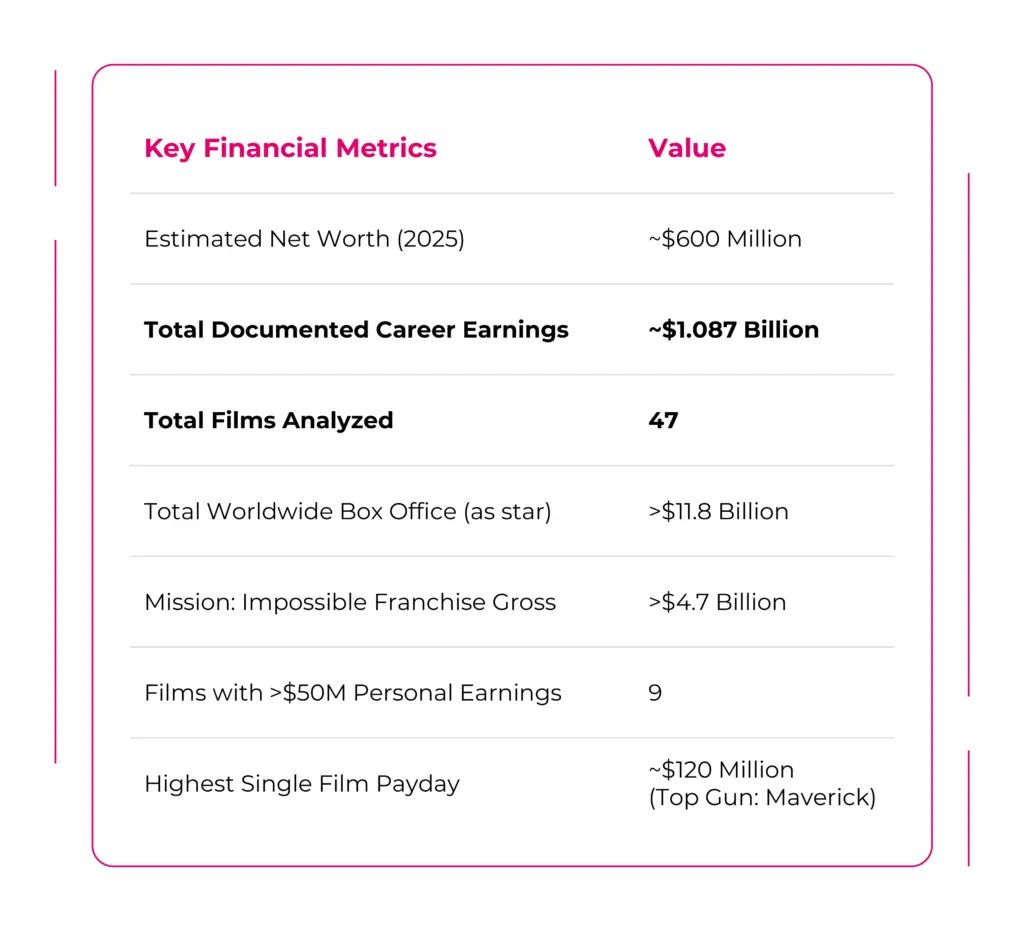
Tom Cruise’s enduring success is one of Hollywood’s most remarkable stories, not just for his four-decade longevity as a leading man, but for the financial empire he has meticulously constructed. With a current estimated net worth of $600 million and documented career earnings now exceeding $1.08 billion across 47 films, Cruise operates less like an actor and more like a global corporation. He has transformed his brand into a multi-billion dollar revenue engine by pioneering aggressive deal structures, seizing control of his intellectual property, and building an unshakeable brand synonymous with quality and authenticity.
This report provides a forensic analysis of Tom Cruise’s net worth. We’ll perform a deep dive into his film-by-film earnings, analyse his business ventures and codify the strategic playbook that has made him one of the wealthiest and most powerful figures in the entertainment industry.
Tom Cruise Net Worth: Why This Report is Different
While many outlets have reported on Tom Cruise’s wealth, most offer a superficial glance. A review of top-ranking articles from sources like Business Insider and TheRichest reveals a common pattern: they highlight 5-10 key films, mention his real estate, and provide a top-level net worth figure. They are entertainment, not education.
What they lack is depth. None provide a complete, film-by-film financial analysis, a breakdown of backend deal structures, or a strategic framework for how he built his fortune. This report fills that gap, providing the most comprehensive public analysis of Tom Cruise’s career earnings and wealth strategy ever compiled. Ryan Reynolds’ equity-first Hollywood blueprint is the next evolution of the deal structures Cruise pioneered.
The Billion-Dollar Actor: A Complete Tom Cruise Film-by-Film Earnings Deep Dive
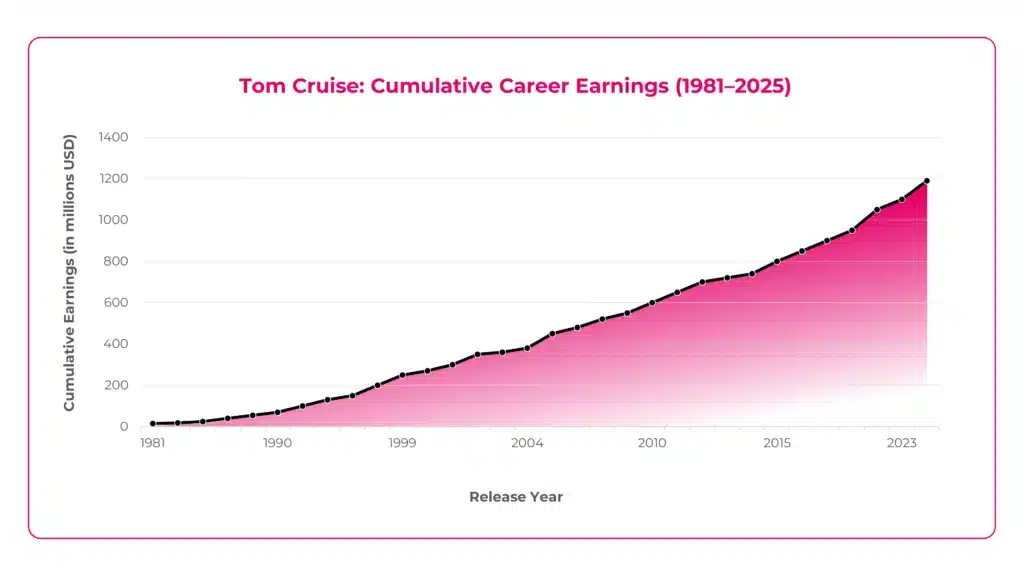
Cruise’s journey to a billion dollars in earnings is a masterclass in leveraging stardom into financial power. His strategy evolved from a standard salary-based actor to a powerhouse who commands a significant percentage of a film’s gross revenue.
The Three Phases of Earnings Power
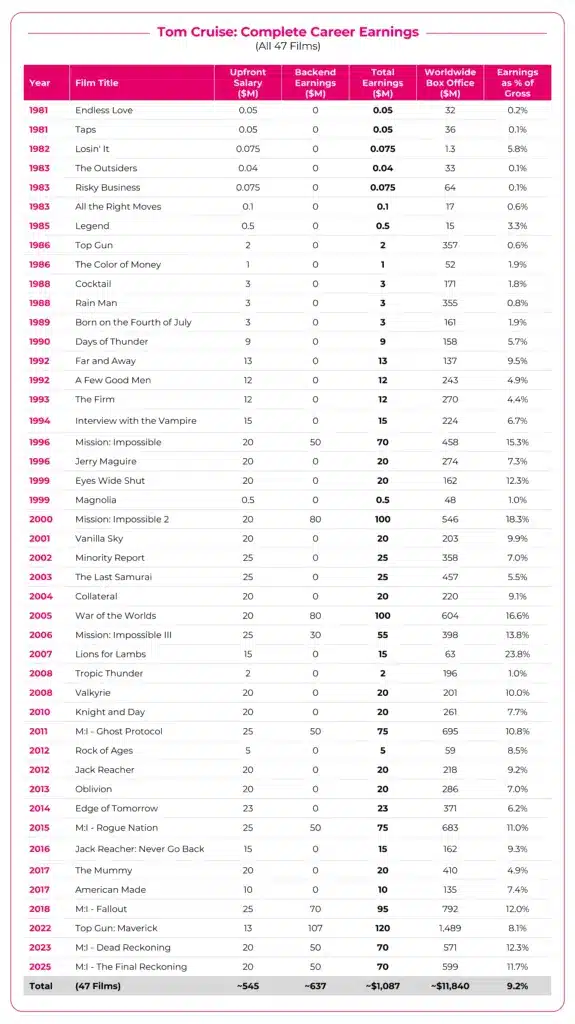
- The Rising Star (1981-1995): Building Leverage. In this phase, Cruise focused on building his box office track record. He went from a $50,000 salary for Taps to a $15 million payday for Interview with the Vampire, proving his ability to open a film and setting the stage for his next move.
- The Backend Pioneer (1996-2010): Seizing Ownership. The first Mission: Impossible changed everything. Cruise took a lower upfront salary in exchange for a percentage of the gross revenue—a “first-dollar gross” deal. This single deal netted him an estimated $70 million and became his primary wealth-building tool for the next decade, with two films (Mission: Impossible 2 and War of the Worlds) earning him an estimated $100 million each.
- The Franchise King (2011-Present): Global Dominance. As the industry shifted, Cruise solidified his power by focusing on the globally successful Mission: Impossible franchise. He consistently earns $70M+ per installment and delivered the biggest payday of his career with Top Gun: Maverick, where a modest $13 million salary was dwarfed by a backend deal that paid him over $100 million.
Tom Cruise: Complete Career Earnings (All 47 Films)
Case Study: The Paramount Divorce, United Artists Gamble, and The Great Recovery (2006-2011)
Tom Cruise’s career is not just a story of success; it is a masterclass in navigating failure and engineering a comeback. The period between 2006 and 2011 represents the most turbulent and educational chapter of his business life, involving a public corporate divorce, a high-stakes attempt to build his own studio, and a strategic, humble return to form.
The Golden Handcuffs: The Cruise/Wagner-Paramount Relationship
From 1992 to 2006, the partnership between Cruise/Wagner Productions and Paramount Pictures was one of the most lucrative in Hollywood history. After representing Cruise for 11 years, super-agent Paula Wagner transitioned to his producing partner, forming a company that gave Cruise unprecedented control and a massive financial stake in his own work. The deal was incredibly rich:
- Overhead Deal: Paramount paid Cruise/Wagner Productions an estimated $10 million per year simply to cover overhead and development costs, regardless of whether a film was made.
- First-Dollar Gross: On top of this, Cruise commanded a percentage of the gross revenue from his films, earning him paydays of $70M to $100M per picture.
This arrangement generated over $2.5 billion for Paramount and made Cruise a billionaire in gross earnings. However, the studio was essentially paying a premium for a partner who was also taking the lion’s share of the profits. This created underlying tension that would boil over in 2006.
The Split: A Public War of Words (August 2006)
In August 2006, the 14-year relationship imploded in a stunningly public fashion. Sumner Redstone, the famously blunt chairman of Paramount’s parent company Viacom, announced the split to the Wall Street Journal, stating:
“His recent conduct has not been acceptable to Paramount. As much as we like him personally, we thought it was wrong to renew his deal.”
Redstone was referring to a series of public relations challenges for Cruise, including his vocal advocacy for Scientology and his infamous couch-jumping on The Oprah Winfrey Show. Redstone later claimed this behaviour cost Mission: Impossible III between $100 and $150 million in ticket sales.
However, Hollywood insiders and financial reporters quickly identified the real cause: money. The public narrative about Cruise’s behavior was a convenient cover for a brutal contract renegotiation that had gone sour.
- The Real Deal: Paramount, looking to cut costs on its expensive star-driven deals, offered to slash Cruise/Wagner’s overhead from ~$10M/year to just $2 million.
- The Counter-Move: Wagner and Cruise, seeing the writing on the wall, had already secured $100 million in financing from two private equity funds to go independent.
This led to a public “he said, she said” battle. Wagner claimed they had walked away from Paramount days earlier, while a studio source dismissively told TIME, “Whatever.”
The Gamble: Reviving United Artists (2006-2008)
Two months later, Cruise and Wagner made a bold recovery move. They partnered with MGM to revive the legendary United Artists studio, the company originally founded by artists like Charlie Chaplin to give talent control over their own work. The deal was structured as follows:
- Ownership: Cruise and Wagner took a 30% ownership stake in the new UA, with MGM owning the rest.
- Leadership: Wagner was installed as CEO.
- The Goal: To produce up to four modestly budgeted films per year, with Cruise starring in some but not all.
This was a high-risk, high-reward play. If successful, it would prove Cruise didn’t need the traditional studio system. If it failed, it would be a major public humiliation. It failed.

The venture crumbled in less than two years. The reasons were a perfect storm of internal and external pressures:
- Clashing with MGM: Despite promises of autonomy, Wagner “frequently butted heads with MGM” over greenlighting films. A change in MGM leadership brought in a new boss who wanted to develop his own slate, not fund UA’s.
- External Shocks: The 2007-2008 Writers’ Guild of America strike killed momentum, causing a key project, Pinkville (to be directed by Oliver Stone and star Bruce Willis), to collapse.
- Underperformance: The lukewarm reception of Lions for Lambs put immense pressure on Valkyrie, which, despite turning a profit, was not the home run needed to sustain the company.
In August 2008, months before Valkyrie was even released, Paula Wagner resigned as CEO, effectively ending the 16-year Cruise/Wagner partnership and the UA experiment.
The Recovery: A Humble Return to Paramount (2011)
After the UA failure, Cruise pivoted. Instead of continuing to fight the studio system, he went back to what he did best: starring in and producing high-quality action films. His recovery strategy was a masterstroke of business acumen and humility:
- He returned to Paramount. The same studio whose chairman had publicly excoriated him just a few years earlier.
- He revived his most valuable IP. He focused on producing Mission: Impossible – Ghost Protocol (2011).
- He accepted a new reality. His deal for Ghost Protocol was likely far less generous than his pre-2006 terms, but it got the movie made.
The result was a resounding success. Ghost Protocol grossed nearly $700 million worldwide, reviving the franchise and cementing Cruise’s status as a global box office powerhouse. The comeback was complete.
Business Lessons from the Brink
This turbulent period offers more insight into Cruise’s business savvy than any of his successes:
- Know Your Core Competency: The UA gamble failed because it took Cruise away from his core competency, starring in and producing massive-scale action films. His recovery came when he returned to it.
- Failure is a Data Point, Not a Destination: Cruise did not let the public failure of UA define him. He analysed the situation, cut his losses, and pivoted to a new strategy.
- Humility is a Powerful Tool: By returning to Paramount, Cruise demonstrated that he valued the business relationship and the franchise’s success more than his own ego. This move rebuilt bridges and secured his financial future.
- Box Office Solves All Problems: The public spat with Redstone, the UA failure, the negative press—it all became irrelevant the moment Ghost Protocol became a global smash hit. In Hollywood, financial success is the ultimate arbiter.
Tom Cruise Asset Portfolio
Tom Cruise’s net worth is comprised of a diversified portfolio of real estate, aviation assets, luxury vehicles, business investments, and a significant amount of liquid assets derived from his billion-dollar career earnings. This section provides a comprehensive breakdown of his known holdings.
Real Estate: A History of High-Value Transactions
Cruise has been an active real estate investor for decades, buying and selling high-end properties in desirable locations. While his portfolio has seen both profits and losses, it has consistently been valued in the tens of millions.
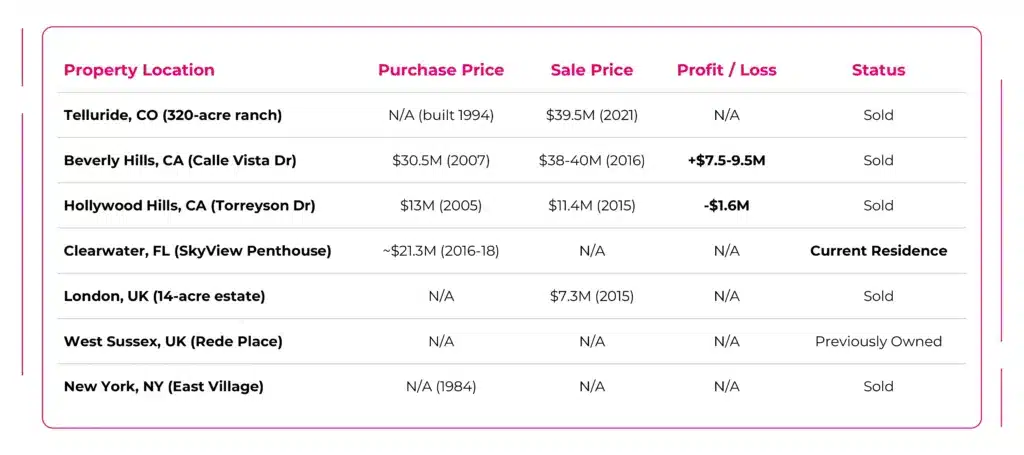
Summary: Cruise’s real estate strategy involves acquiring premier properties, holding them for several years, and then selling. His current primary residence is a multi-million dollar penthouse in Clearwater, Florida, the spiritual headquarters of the Church of Scientology.
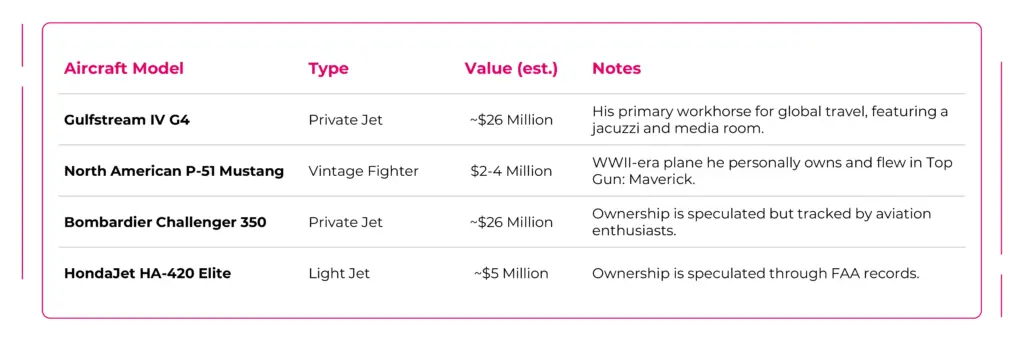
Aviation: A Passion for Flight
As a licensed pilot, Cruise owns a personal fleet of aircraft valued at an estimated $30-35 million. This collection is not just for transportation but reflects his genuine passion for aviation.
Luxury Vehicles: A Collector’s Garage
Cruise maintains an extensive collection of rare and high-performance vehicles, blending vintage classics with modern hypercars. The total value is estimated to be between $2.2 million and $5 million, though some sources speculate it could be much higher.
- Bugatti Veyron (2005): The crown jewel, valued at ~$1.9 million.
- Classic American Muscle: A 1958 Chevrolet Corvette C1 and a 1970 Chevrolet Chevelle SS.
- Porsche Enthusiast: Owns multiple Porsches, including a 1979 Porsche 928 (from Risky Business), a 1996 Porsche 911 (993 variant), and a Porsche 911 (996).
- Film Memorabilia: He kept the 1949 Buick Roadmaster from Rain Man.
- Racing History: Previously owned and raced a Nissan 300ZX SCCA race car.
Luxury Watches: A Connoisseur’s Collection
Cruise is a known horology enthusiast with a collection that includes some of the most coveted “holy grail” timepieces. The estimated value of his collection is between $500,000 and $2 million+.
- Rolex Dominance: He owns multiple rare Rolexes, including a Platinum Daytona, a “Panda” Daytona, and two different models with meteorite dials (a Cosmograph Daytona and a Day-Date 40).
- Cartier Classics: Frequently wears a Cartier Santos de Cartier and a Cartier Chronograph.
- Vacheron Constantin: Owns a favourite, high-end model from this prestigious brand.
- Iconic Movie Watch: The Porsche Design Chronograph 1 he wore in the original Top Gun.
Business Investments & Ventures
Beyond his personal assets, Cruise’s wealth is anchored in his business ventures.
- TC Productions: His 100%-owned production company that gives him control over the Mission: Impossible franchise and other projects.
- Recording Studio: A reported 30% stake in an unspecified recording studio.
- Scientology-Related Ventures: While not publicly detailed, he is known to have invested in ventures related to the Church of Scientology.
- Brand Endorsements: Has earned an estimated $100 million over his career from selective, high-profile endorsements.
The Entrepreneur’s Playbook: Applying the Cruise Formula to Your Business
Tom Cruise’s strategies for building wealth in Hollywood are not just for movie stars. They are powerful business lessons that any entrepreneur, freelancer, or executive can adapt and apply. Here’s how to translate his playbook into actionable tactics for your own venture.
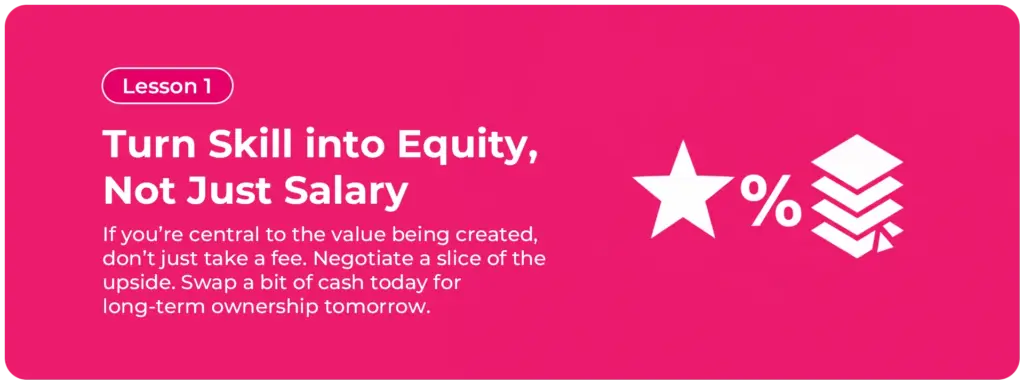
Lesson 1: Leverage Your “Stardom” into Ownership
The Cruise Method: Cruise realized that being the main attraction (the “star”) gave him leverage. He stopped trading his time for a flat salary and started demanding a piece of the upside—equity in the project.
How You Can Apply This:
- For Key Employees & Executives: If you are critical to your company’s revenue or product, you are a “star.” Don’t just negotiate for a higher salary. Argue for stock options, equity grants, or a profit-sharing plan. Frame it as, “I want to be a partner in our success, not just an expense on the balance sheet.”
- For Freelancers & Consultants: Instead of charging a simple project fee, propose a hybrid model. Offer a reduced upfront fee in exchange for a percentage of the revenue increase, cost savings, or other value you generate for the client. This turns a one-time transaction into a long-term partnership.
- For Service Businesses (e.g., Marketing Agencies): Structure deals with a performance-based component. For example: “We’ll accept a 20% lower monthly retainer in exchange for 5% of all revenue generated through the campaigns we manage.” You are betting on your own ability to deliver, just as Cruise bets on his ability to draw an audience.
Lesson 2: Master the “First-Dollar” Deal
The Cruise Method: Cruise’s “first-dollar gross” deals mean he gets a percentage of the box office revenue before the studio deducts its costs. This insulates him from the project’s profitability and guarantees his payday.
How You Can Apply This:
- For Sales Professionals: Negotiate a commission based on total contract value (TCV) or top-line revenue, not net profit. This protects your earnings from factors outside your control, like the company’s operational inefficiencies or high overhead costs.
- For SaaS & Tech Companies: Implement a usage-based or transaction-based pricing model. Payment processors like Stripe are masters of this; they get a small percentage of every single dollar that flows through their platform. This is the ultimate “first-dollar” business model.
- For Content Creators & Affiliates: When partnering with a brand, push for a model that includes a percentage of sales from your unique affiliate link, paid from the very first sale. This is a direct parallel. You are getting a piece of the gross revenue you help generate.
Lesson 3: Control Your Intellectual Property (IP)
The Cruise Method: By forming Cruise/Wagner Productions and later TC Productions, Cruise gained control over his most valuable IP—the Mission: Impossible franchise. This allows him to dictate the creative direction, quality, and release strategy, all of which protect his long-term financial interests.
How You Can Apply This:
- For Founders & Startups: Your IP—your code, your brand, your customer list, your unique process—is your most valuable asset. Protect it fiercely with trademarks, copyrights, and patents. Never sign away ownership of your core IP to a client or partner without significant compensation or a clear licensing agreement.
- For Software Developers & Designers: When doing client work, your contract should explicitly state who owns the final IP. If you develop a reusable framework or a unique algorithm during the project, negotiate to retain ownership of that underlying IP, granting the client a license to use it. You can then re-license that IP to future clients.
- For Authors & Course Creators: Always retain the rights to your content. When you publish a book, you are licensing the right to print and distribute it, but you should own the underlying manuscript. This allows you to create derivative works like audiobooks, courses, or workshops without needing permission.
Lesson 4: Build a Brand of Unimpeachable Quality
The Cruise Method: Audiences trust that a Tom Cruise movie will deliver a high-quality, thrilling, and practical cinematic experience. This brand trust makes his films a reliable bet for both studios and consumers, reducing risk for everyone and justifying his enormous paydays.
How You Can Apply This:
- For Any Business: Define your quality promise and never, ever compromise on it. Are you the fastest, the cheapest, the most luxurious, or the most reliable? Whatever it is, become fanatical about delivering on that promise. This builds brand equity that allows you to command premium prices and fosters intense customer loyalty.
- For Product Companies: Invest in obsessive quality control. Cruise’s insistence on doing his own stunts is a form of quality control. He ensures the final product is authentic. How can you ensure your product is not just good, but flawless? This is how brands like Apple and Rolex justify their price points.
- For Service Providers: Your reputation is your brand. Go above and beyond for every client. Deliver work ahead of schedule. Provide unexpected value. A brand built on exceptional service creates word-of-mouth marketing that is more powerful than any ad campaign.

Lesson 5: Know When to Pivot After Failure
The Cruise Method: The United Artists venture was a public failure. Instead of doubling down on a failing strategy, Cruise cut his losses, shut it down, and pivoted back to his core competency: starring in and producing blockbuster films within the studio system. He swallowed his pride and returned to Paramount.
How You Can Apply This:
- For Entrepreneurs: Be ruthless in analysing what isn’t working. The market doesn’t care about your ego or your original vision. If a product line is losing money or a marketing strategy isn’t delivering ROI, don’t be afraid to kill it. The ability to pivot quickly is a startup superpower.
- For Managers & Leaders: Create a culture where failure is treated as a data point, not a career-ending event. When a project fails, conduct a blameless post-mortem. What did we learn? What data did we gain? How can we apply this lesson to the next project? This encourages risk-taking and innovation.
- The “Sunk Cost” Fallacy: Cruise implicitly understood this. The money and time invested in UA were gone. Making future decisions based on those sunk costs would have been a mistake. Learn to ask: “If I were starting from scratch today, would I invest in this project?” If the answer is no, it’s time to pivot.
Tom Cruise Net Worth: A Blueprint for Building Serious Wealth
Cruise is more than a movie star; he is a strategic businessman who has built a durable and diversified financial empire. His $600 million net worth is not the result of luck, but of a calculated, decades-long strategy of converting his on-screen brand into off-screen ownership. By mastering the art of the deal, taking control of his own intellectual property, and relentlessly pursuing quality, he has created a formula for wealth that is as impressive as any of his on-screen stunts.
Read more of our wealth reports on the No Bollocks Business HQ including Taylor Swift, Donald Trump, Mark Zuckerberg, Ryan Giggs and Elon Musk.
If you’re building a business of your own and want experienced support, you can work with Matt directly.