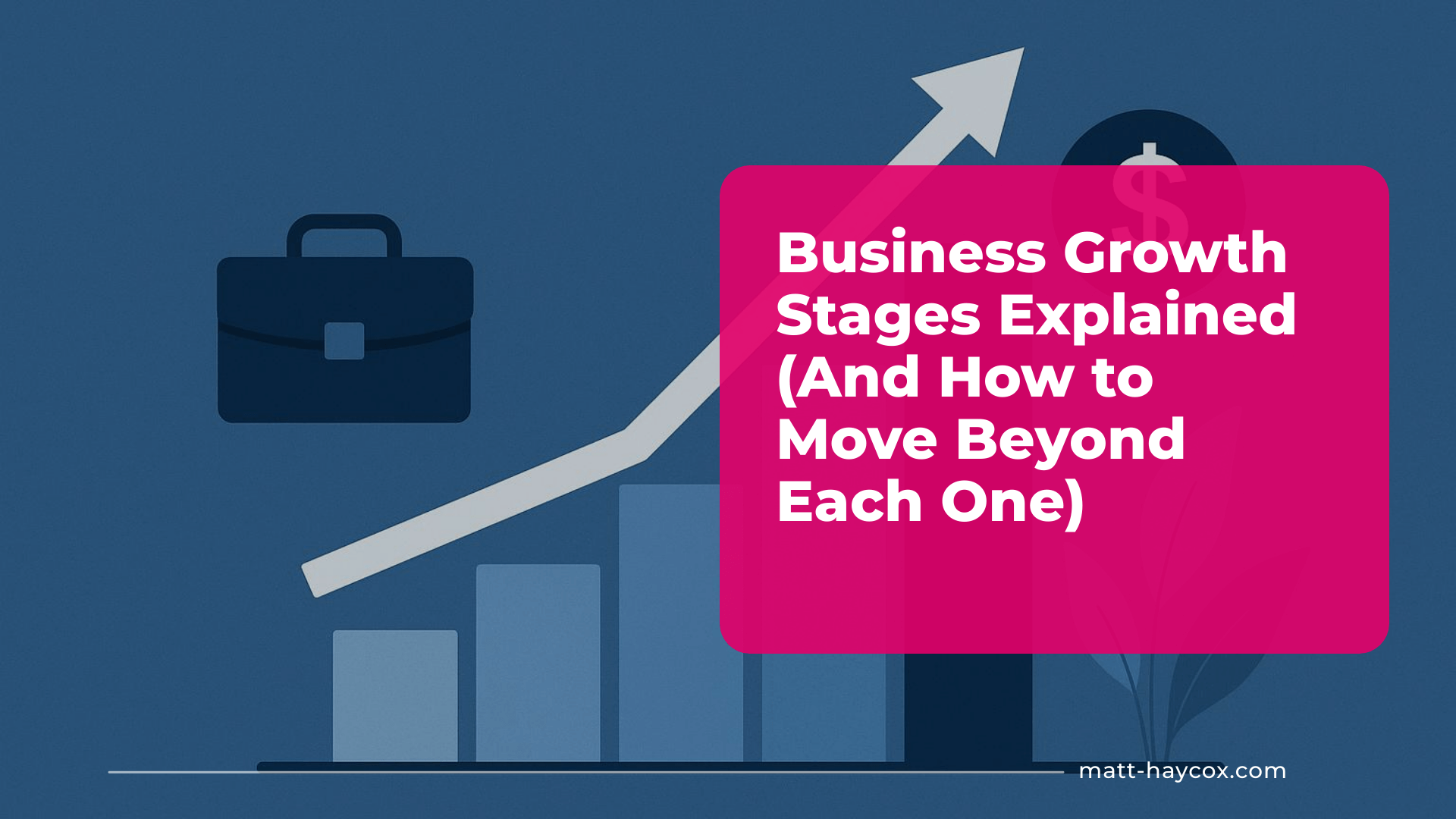

Most companies stall because they treat growth like a straight line. It isn’t. Businesses move through predictable stages, each with its own bottlenecks and economics. Each stage of business growth presents its own set of challenges and opportunities. The business journey is defined by key growth stages, often described as the five stages: existence, survival, success, rapid growth and maturity, that every business experiences.
Every business goes through these distinct stages of growth, and understanding them empowers entrepreneurs to anticipate challenges and capitalise on opportunities. At each stage, businesses face unique challenges and opportunities that require different strategies and resources to achieve sustained growth and success. This guide maps those stages and shows you how to progress from founder-led chaos to scalable, manager-led operations. If you want the full operating system, refer to Business Growth: The Complete Scale-Up Playbook for Founders while you work through these steps.
In this article, we’re going to discuss how to:
- Identify Your Current Stage using signals you can gather in 15 minutes
- Fix The Bottleneck That’s Blocking Progress with small tests and guardrails
- Install cadence and economics so growth survives past the founder
Introduction to Business Growth
Growing your business isn’t a one-off event; it’s an ongoing journey that you’ll need to navigate if you want long-term success. From those early startup days when you’re testing and refining your idea, right through to when your business hits maturity, each stage brings its own challenges and opportunities. You need to understand these stages because that’s how you’ll make smarter decisions, use your resources better, and spot obstacles before they become real problems.
When you map out your growth stages properly, you can build targeted strategies that keep your business moving forward, staying agile and competitive whilst positioning yourself for sustainable growth that actually lasts.
Define Business Growth Stages In Practical Terms
Business growth stages are the discrete maturity levels a company passes as it scales demand, delivery and leadership. Each stage is defined by what is predictable, not by how big you feel. You advance when your next constraint is designed out, measured and owned by someone other than the founder. As a business leader, navigating these stages requires making informed and strategic decisions to address new challenges and opportunities as they arise. Understanding which stage your business is in is essential for making informed decisions about growth strategies.
Sense-checks for a real stage change:
- Revenue can increase by 50% in 90 days without your personal hours rising.
- Contribution margin holds or improves as volume increases.
- A weekly leadership rhythm runs on time with clean data and clear owners.
Stage 1: Proof Of Problem and Founder Sales
This is the phase where the business begins, turning an idea into reality. The startup phase, also known as the existence stage, marks the beginning of a business’s journey and focuses on survival.
What it looks like: The founder closes most deals. Securing early customers is critical, but customer acquisition can be challenging at this stage as you work to attract your first clients and manage relationships. The offer evolves per customer. Customer feedback is essential for refining your product or service and establishing a customer base. Delivery relies on a few capable people and lots of improvisation. Cash is tight, but demand exists.
Core constraint: No repeatable revenue engine. You rely on the founder’s network and heroics.
30-day plan to move to Stage 2 (Repeatable Revenue):
- Decide on a segment and outcome. Write a one-sentence offer line: ‘For {segment}, we solve {pain} with {offer}, delivering {outcome} in {timeframe} for {price}.’
- Choose two channels. One outbound list you can call this week, one inbound with buying-intent keywords or partner referrals.
- Run a 10-deal sprint. Log exact reasons for wins and losses, tighten scope and price, and stop custom extras unless paid.
Economics gate: Contribution per unit must be positive at a small scale and payback must sit inside three months for services or six for software. If not, fix price, scope and rework before you scale volume.
Leadership shift: The founder still sells, but publishes a simple ‘how we sell’ path and starts handing discovery calls to one capable teammate.
Stage 2: Repeatable Revenue (But Fragile Delivery)
What it looks like: Two channels produce qualified conversations, proposals follow a pattern and deals close without the founder every time. Delivery is stretched. Quality varies when volume spikes. As the business scales, managing customer relationships becomes increasingly important to maintain personalised engagement and efficient service. Customer retention also becomes a key focus to ensure ongoing stability and support long-term growth.
Core constraint: Delivery variance, rework and capacity planning. Margin slips because scope leaks and handoffs are messy.
To succeed in the survival stage, businesses need to implement growth strategies that protect cash flow and keep customers engaged. This stage establishes a foundation for future growth.
30-day plan to move to Stage 3 (Standardised Delivery):
- Standardise the 80%. Document the core delivery path in five to seven steps with one owner per step.
- Protect three quality gates. Name the pass/fail criteria, and do not ship if a gate fails.
- Install change control. Any out-of-scope request triggers a priced change request or a later add-on.
Economics gate: Contribution should be at least 45% for services and 60% for software. If you cannot hit this while standardising, your scope is wrong or you are under-pricing.
Leadership shift: The founder exits scoping. A delivery lead owns timelines, quality and capacity, and attends the weekly revenue review to throttle workload.
Stage 3: Standardised Delivery and First Managers
This stage marks the growth phase or growth stage of your business growth trajectory, where sales begin to increase and customer demand rises.
What it looks like: Delivery is consistent at 1.5x to 2x the old volume. The first managers run pods or functions. The sales pipeline is visible in one system. Weekly leadership meetings exist, but sometimes slip.
Core constraint: Leadership bandwidth, hiring speed and onboarding quality. Without a cadence, people default to firefighting and you re-enter the weeds.
30-day plan to move to Stage 4 (Leadership System):
- Install a weekly operating system. 60-minute leadership meeting, one scorecard of 10 to 12 forward indicators and a single commitment per leader due next week.
- Build hiring and onboarding. For the bottleneck role, prepare a scorecard, one paid test task and a first-month plan.
- Publish decision rights. Who decides, who advises, who is informed. If every tough call lands on the founder’s desk, your design is wrong.
Economics gate: CAC payback holds within targets while you hire behind demand. Debtor days fall or hold steady and rework drops month on month. If cash is tight, slow hiring and shorten collections.
Leadership shift: Managers have outcomes, not task lists. The founder coaches in short cycles and blocks at least one deep-work window per day.
Stage 4: Leadership System and Margin Expansion
This is the success stage, marking a significant turning point in your business growth trajectory. At this stage, businesses often begin to rely more on data-driven decisions to guide their growth strategy.
What it looks like: The business meets targets without the founder in the room. Managers hit outcomes. You can raise prices, reduce discounting and deepen proof assets. Cash is strong, operations are boring in a good way.
Core constraint: Strategic focus. With stability, you will be tempted by distractions. At this point, focus shifts from founder-led operations to optimising profitability and making data-driven decisions for future stability. Picking the wrong growth bet can unwind margin and cadence.
30-day plan to move to Stage 5 (Scale Bets):
- Lift price by 5 to 10%. Keep the value story fixed, add give-gets and audit realised price weekly.
- Pick one big lever. Productise a repeating service, verticalise into a lookalike industry or pilot a thin regional entry.
- Run a 14-day test. Two channels in the new area, five proposals at the new price, one delivery run to the documented process.
Economics gate: Contribution trend line up or steady as price rises. Payback stays within the threshold. Cash conversion improves as debtor days shrink.
Leadership shift: The founder spends more time on talent, partnerships and capital. As the business enters the success stage, focus shifts to strategic, data-driven decision-making and ensuring long-term sustainability. One full no-meeting day every fortnight proves the business runs without constant founder intervention.
Stage 5: Scale Bets
This is the expansion stage of your business growth trajectory, where market expansion and expanding operations become the focus.
What it looks like: You take your working model into a new segment or geography via partners, a local lead or a packaged offer. The core business funds the experiment.
Core constraint: Learning cost, complexity and leadership spread. The wrong bet or sloppy sequencing breaks your operating rhythm.
90-day plan to scale without chaos:
- Month 1: Validate demand with 20 discovery calls, secure a launch partner, confirm legal and tax conditions and create a thin delivery plan.
- Month 2: Win the first five customers, protect quality gates and instrument dashboards.
- Month 3: Hold pricing, staff a regional or vertical owner with a weekly leadership call and decide to scale, hold or stop.
Investing in technology and financial tools is critical at this stage to support expanding operations and facilitate successful entry into new markets or products.
Economics gate: Early deals carry a learning cost, but the contribution should be positive and the cash collection clean. If the core business slips, throttle the experiment.
Leadership shift: A P&L owner runs the bet. The founder sponsors outcomes, not operations.
Market Position and Competitive Advantage
Getting a strong grip on your market position is what’ll drive your business growth and keep you ahead of the competition. Start with solid market research to figure out exactly who your ideal customers are and what they really need. Build a business model that tackles these needs head-on, and you’ll generate steady revenue with reliable cash flow coming in.
As you grow, don’t just sit back. Keep checking where you stand in the market and tweak your approach. Maybe that means pushing into new markets, sharpening up what you’re offering or teaming up with the right partners to unlock fresh opportunities. Smart cash flow management and keeping your operations tight will back up your expansion plans and help you stay competitive as things evolve. Invest in new tech and keep your finger on the pulse of market changes, and your business model will stay relevant and resilient. That’s how you’ll capture new customers and fuel the growth that’s coming next.
Small Business Considerations
You’ll face unique hurdles on your path to growth, such as limited resources, smaller market share and fierce competition that can feel overwhelming. But here’s what we’ve learned: these challenges can actually work in your favour. You’re more agile than the big players, and you can pivot quickly when the market shifts. To succeed through each stage of growth, you need to focus on what really matters: building a loyal customer base, streamlining your operations and keeping your cash flow strong. A well-defined strategy, backed by targeted marketing that speaks directly to your customers, will help you punch above your weight and carve out your own space in the market. By regularly reviewing your financial performance and staying close to what your customers actually want, you can overcome those resource constraints and set yourself up for real, long-term success.
Map Your Current Stage In 15 Minutes
You don’t need a consulting project to know where you are. Pull three artefacts: the last 90 days of pipeline by stage, a delivery board snapshot and your most recent P&L. Then ask three questions:
- Does revenue arrive predictably from two known channels with clean win-loss notes?
- Does delivery hit three named quality gates at the current volume without you intercepting?
- Does a weekly leadership rhythm run on time with one scorecard and clear owners?
Strategic decision-making is crucial at this point, as it helps senior management accurately assess your current stage and plan the next steps in your business growth trajectory. Using management solutions that provide detailed customer analytics and operational efficiencies can empower your business to make informed decisions and adapt effectively as you move forward.
If you answer ‘no’ to the first, you are in Stage 1 or 2. If you answer ‘yes’ to the first but ‘no’ to the second, you are in Stage 2. If you answer ‘yes’ to the first two but ‘no’ to the third, you are in Stage 3. If all are ‘yes’, you are operating in Stage 4 and ready to make a disciplined Stage 5 bet.
Cash Flow And Economics That Gate Stage Transitions
The maths forces honesty. A change of stage should improve economics, not hide leaks. During these transitions, strong financial management and robust financial planning are essential to maintain cash flow, retain customers, and ensure long-term sustainability.
Contribution equation: £Price − £COGS − £Delivery per unit = £Contribution per unit
Payback check: CAC ÷ Contribution = months to recover acquisition spend
Targets worth holding:
- Services: 45%+ contribution, payback under 3 months.
- Software: 60%+ contribution, payback under 6 months.
- Mixed models: Blended payback under 4 months unless retention is exceptional.
Effective financial management is crucial for maintaining steady operations and ensuring long-term viability during business growth. As businesses move from the existence stage to the survival stage, cash flow management becomes a top priority. Utilising financial solutions such as business loans and equity finance can help manage cash flow gaps during growth. Personalised advisory services can also assist businesses in navigating their financial needs and securing the most appropriate funding solutions.
If a planned stage change trashes these numbers, fix pricing, scope or process before you move.
Operating Rhythms That Let You Advance Stages
Cadence is how you turn plans into results. Without it, you will circle the same stage. Managing growth effectively requires establishing strong operating rhythms that help businesses move beyond basic survival, focusing on operational robustness and strategic planning.
As your business progresses, using advanced management tools to streamline operations can improve efficiency and provide better customer insights, supporting your business growth trajectory. Employing tailored insights and methodologies specific to each phase of growth is crucial for guiding a business successfully.
Weekly leadership (60 minutes): One scorecard of forward indicators, top ten deals, capacity and quality, one binary commitment per leader.
Monthly finance: P&L, cash flow, debtor/creditor days, variance to plan and one to three changes that move margin or cash in 30 days.
Quarterly reset: What worked, what failed and what you will stop. Three objectives with owners and simple measures.
Risks And Hedges At Each Stage
- Stage 1 risk — wishful pricing: If deals only close with discounts, raise the price with a give-get or narrow the segment.
- Stage 2 risk — scope creep: Freeze the core package, write a change request rule and enforce it.
- Stage 3 risk — manager in name only: Give outcomes, not tasks. Coach weekly, replace quickly if needed.
- Stage 4 risk — distraction: Pick one scale bet per quarter. Kill anything that does not show traction in 30 days.
- Stage 5 risk — cash drag: Stage deposits, milestone billing and partner delivery to protect cash while you learn.
As businesses evolve, especially into mature businesses, they must remain adaptable and leverage technology and scalable solutions to manage complexity and maintain market leadership. During the maturity stage, businesses can face stagnation if they fail to adapt to changing markets and customer preferences. Without ongoing innovation, even successful businesses risk losing relevance. To stay competitive as they reach maturity and face market saturation, businesses must also adapt their financial strategies accordingly.
A 14-Day Path To Move Up One Stage
Days 1 to 2: Map current signals and write the crisp offer line.
Days 3 to 5: Test price on five proposals with give-gets.
Days 6 to 8: Document the 80% of delivery and name three quality gates.
Days 9 to 11: Install the weekly leadership meeting, scorecard and commitments.
Days 12 to 14: Review contribution and payback. If they hold or improve, lock the change.
Having a system in place to manage customer data can improve customer acquisition efforts and set the stage for future growth. As you prepare for the next stage of your business growth trajectory, focus on generating consistent revenue to ensure stability and support sustainable expansion.
Exit Strategy
An exit strategy is vital for any business that’s serious about growth. You need a clear path for when you’re ready to step back, whether that’s through a sale, merger, acquisition or passing things on to the next generation. Start planning early, and you’ll build a business that’s genuinely attractive to buyers and investors. A smart exit strategy aligns what you want to achieve in business with your personal and financial goals. That means you can maximise real value and create something that matters. Build exit planning into your business strategy from day one, and you’ll make decisions that work for both your immediate growth and your plans.
Get The Business Growth Roadmap
Turn stages into a working plan. Understanding small business growth as a multi-stage process, covering existence, survival, success, rapid growth and maturity is essential for long-term success. Having the right strategies and expert support can make all the difference in managing your business growth trajectory effectively.
Download the Business Growth Roadmap: 12-Month Scale Plan Template and sequence your next four quarters with clear owners, numbers and cadences. You can find the download via Business Growth: The Complete Scale-Up Playbook for Founders, where we host the latest tools.
Key Takeaways
- Business growth stages change when revenue predictability, delivery quality and leadership cadence become repeatable without founder effort.
- Move up a stage by fixing the single bottleneck, proving contribution and payback, and installing a weekly operating system that survives the month.
- Use thin tests, strict guardrails and clean artefacts to avoid sliding backwards when you scale.
FAQs For Business Growth Stages
How do I know which stage I’m in?
Check three artefacts: pipeline by stage, delivery quality gates and your weekly leadership rhythm. If any are missing or depend on you personally, you are not past that stage.
Recognising the key growth stages in your business growth trajectory is crucial, as each phase presents unique challenges and opportunities. Navigating through these stages requires a keen understanding of what is needed at each point to ensure sustained success.
What is the fastest way to move from founder-led to manager-led?
Standardise delivery, protect three quality gates and install a weekly scorecard with binary commitments. Streamline operations by adopting advanced management tools and implementing the right technology solutions at each stage. This can make the difference between struggling with growth and confidently scaling operations. Hand discovery calls and scoping to a trained lead within 30 days.
Do I need more channels to advance a stage?
No. Two reliable channels beat five chaotic ones. Advance by improving contribution, shortening payback and tightening delivery, not by piling on traffic.
Customer acquisition is crucial, especially in the early stages of your business growth trajectory, as attracting and managing your first customers sets the foundation for future success. As your business expands, tools that support customer data management and service quality, such as CRM systems, are essential for handling growing demands and maintaining strong customer relationships.
When should I raise prices in the journey?
As soon as delivery hits a repeatable standard. Generating consistent revenue is crucial during the optimisation and stabilising phases of a business, so ensure your income stream is steady before making changes. Lift 5 to 10% with a clear give-get, monitor realised price and lock the change if win rate holds across five to ten deals.
What if my managers are overwhelmed?
Clarify outcomes, reduce meeting load, add number twos in sales and delivery, and adjust spans of control. As a business leader, ensure that strategic decision-making remains flexible yet deliberate, using real-time data and forecasting to anticipate market shifts and guide your business growth trajectory. If performance does not improve in two coaching cycles, replace or reassign.
How do I avoid slipping back a stage during expansion?
Run a thin 90-day plan with deposits, partners and a local owner. If core metrics slip, throttle the bet. When expanding operations, it is crucial to do so carefully and only add overhead once contribution and cash collection are proven. Utilise tools that support customer data management and service quality to effectively handle the growing demands during expansion.
Which metrics matter most at each stage?
At minimum: cost per qualified conversation, win rate, contribution per unit, CAC payback, time per unit and defect rate, debtor days and leadership scorecard completion. Review weekly.
Tracking these key metrics helps you understand your business growth trajectory, and understanding the stages of business growth empowers leaders to anticipate challenges and capitalise on opportunities.
Can I skip stages?
You can accelerate, not skip. Recognising the key growth stages in your business growth trajectory is essential, as each phase requires tailored insights and methodologies for success. If you try to expand without a working cadence or positive unit economics, the market will force you back. Build the foundations and speed follows.