
If you sell a service, you don’t need a complicated sales funnel, you need a repeatable way to turn attention into booked calls and paid work without living in your inbox. Most funnels fail because they’re built like a marketing course, not like an operator’s system. If you want the wider context, cross-reference Sales & Client Acquisition: The Complete Founder’s Playbook as you build yours.
In this article, we’re going to discuss how to:
- Map a simple funnel that matches how services are actually bought
- Validate each step in 7 to 14 days using small, cheap tests
- Protect margin and time with clear qualification and operational guardrails
What A Sales Funnel Looks Like In A Service Business
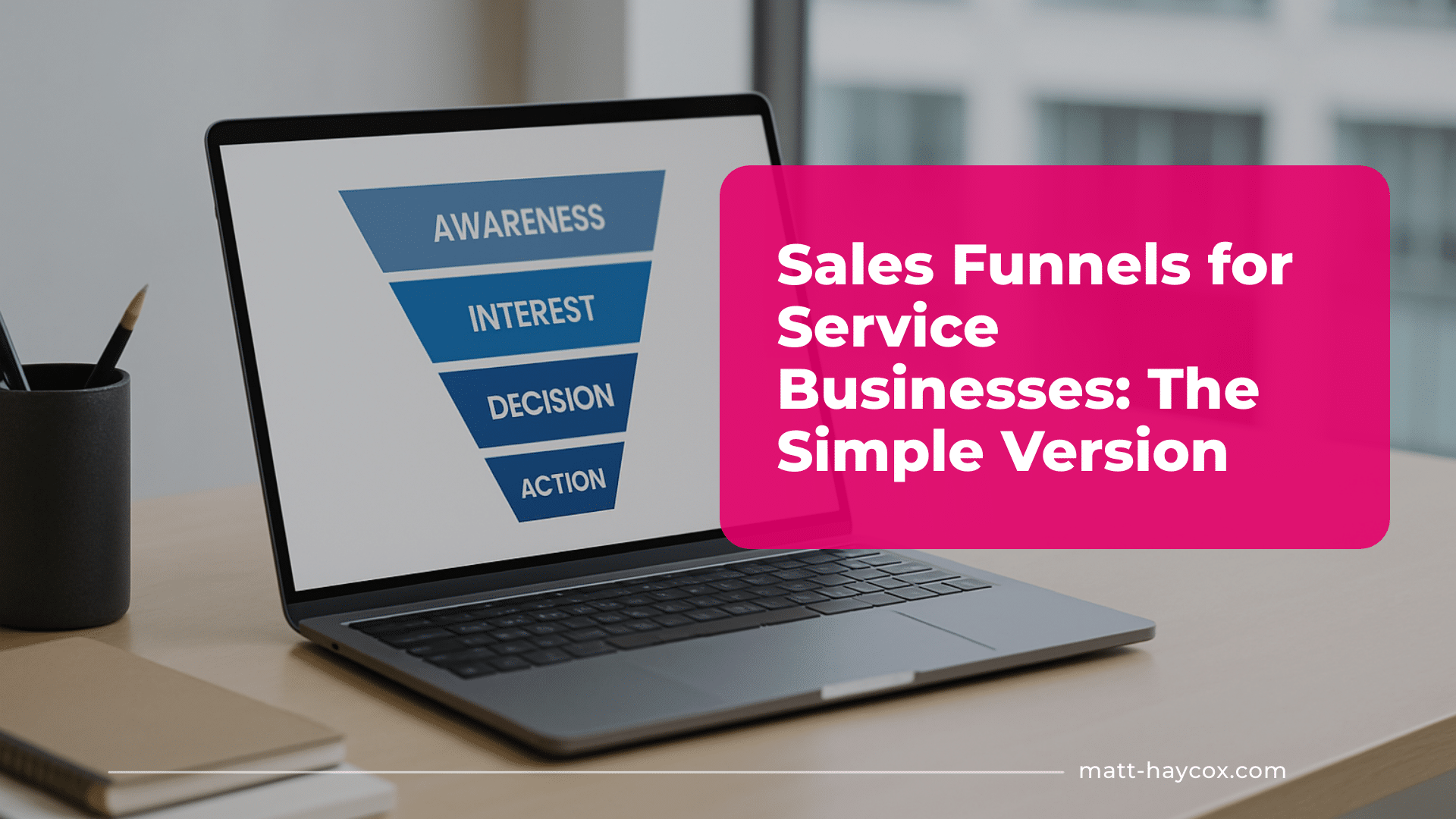
A sales funnel in a service business is the set of steps that moves someone from ‘I’ve heard of you’ to ‘I’ve paid you’, with clear evidence at each step that the lead is getting warmer.
Practical framing: your funnel is not the same as your marketing. Marketing creates demand, the funnel converts demand into revenue in a controlled way.
- Outcome: More qualified conversations, fewer time-wasting calls, steadier cashflow.
- Evidence: You can point to numbers at each stage, not just vibes.
- Assets: A handful of artefacts that do the heavy lifting, a page, a case study, a booking flow, a proposal.
- Behaviour change: You stop treating every enquiry like it’s gold.
A Founder-Friendly Sales Funnel For Service Businesses
Here’s the simple version of a sales funnel that works for most services, agencies, consultancies, B2B freelancers, and local operators. It’s built around one truth: buyers want to reduce risk.
Think of the funnel as five proof points:
- Attention: They notice you exist.
- Credibility: They believe you can solve their problem.
- Conversation: They talk to you in a structured way.
- Commitment: They say yes, with clear scope and price.
- Confirmation: They feel good after paying, which reduces refunds and increases referrals.
You’ll notice what’s missing: 19 email sequences, complicated automation, and a CRM that takes a full-time admin. Keep it ‘boring’, keep it measured.
Start With The Data You Already Have (A 2-Hour Audit)
Before you change anything, pull signals from your own business. Most founders skip this, then build a funnel that solves the wrong problem.
Set a timer for 2 hours and gather:
- Lead sources: Last 50 enquiries, where did they come from, referral, inbound, outbound, partner, ads.
- Conversion rates: Enquiry to call booked, call to proposal, proposal to paid.
- Time to close: Median days from first contact to invoice paid.
- Average deal: £ value, payment terms, and delivery time.
- Drop-off reasons: No budget, no urgency, went with someone else, didn’t reply.
Completion check: you should be able to write one sentence like, ‘We get 20 enquiries a month, book 8 calls, send 5 proposals, close 2, average £3,500, and it takes 18 days.’ If you can’t, your first funnel project is measurement, not marketing.
Then Pull A Few Public Signals (So You Don’t Guess)
Once you know what’s happening internally, look outward. You’re not copying competitors, you’re learning what buyers already accept as normal.
In 60 to 90 minutes, collect:
- Competitor offers: Their packages, starting prices, and what they include and exclude.
- Proof formats: What counts as credibility in your space, case studies, before/after, certifications, client logos, video testimonials.
- Buying triggers: What problems they call out in ads, pages, and LinkedIn posts.
- Lead magnets: If any, what they are, and how strong the call to action is.
Founder tip: screenshot 10 examples, don’t over-research. The goal is to see patterns, not build a competitor database.
Build A One-Sentence Offer That People Can Repeat
If your offer is vague, your sales funnel will leak at every stage. The buyer can’t assess risk, so they stall.
Use this one-sentence offer template and fill it in:
We help [specific buyer] get [measurable outcome] in [timeframe] without [common pain or risk] using [your method].
Example: ‘We help owner-managed manufacturers generate 10 to 15 qualified distributor leads a month in 60 days without hiring an in-house marketer, using a tight outbound and partner programme.’
Completion check: if a prospect can’t repeat your offer back to you after hearing it once, your sales funnel is doing extra work it shouldn’t have to do.
Design The Simple Version Of Your Sales Funnel Assets
You don’t need more content, you need the right artefacts in the right places. A service sales funnel is mostly made up of three assets and two behaviours.
The Three Assets
- One strong page: A services page or landing page that states the offer, outcomes, proof, process, pricing range, and next step.
- One proof pack: 2 to 4 case studies or short ‘proof notes’ with numbers, starting point, what you did, outcome.
- One proposal format: A consistent structure, problem, approach, scope, timeline, price, terms, and next step.
The Two Behaviours
- Fast follow-up: Same day for warm leads, within 24 hours for inbound, because speed signals competence.
- Structured discovery: You lead the call, you qualify hard, and you close cleanly.
If your funnel currently relies on long back-and-forth emails, your immediate win is to replace them with a short form and a booked call. The sales funnel is meant to compress decision time, not extend it.
Qualification: The Part Most Founders Avoid (And It Costs Them)
Qualification is how you protect time and margin. If you don’t do it, your calendar fills up with polite maybes and ‘can you just…’ projects.
A simple qualification scorecard you can use this week:
- Problem: Is the pain specific, active, and acknowledged internally?
- Value: Is there a clear upside, revenue, cost, risk reduction, time saved?
- Budget: Is there a range they can say out loud?
- Authority: Are you speaking to the decision-maker, or can they get one on the next call?
- Urgency: Is there a deadline, event, or consequence inside 30 to 60 days?
Completion check: if you can’t get clear answers to at least 3 of those in the first conversation, you don’t send a proposal. You send a follow-up plan or you park the lead.
Validate The Funnel In 7 To 14 Days With Small Tests
Don’t build the full machine and hope it works. Validate each stage quickly, with small bets, then tighten the system.
Here’s a practical validation path for a service sales funnel:
- Days 1 to 2: Publish or tighten your core page, add 2 proof notes, set one call to action, book a call.
- Days 3 to 6: Run a controlled outreach test, 50 targeted messages, or 10 partner asks, or 5 referral requests to past clients.
- Days 7 to 10: Hold discovery calls using one script, track outcomes, and record objections.
- Days 11 to 14: Ship a proposal template update, follow up in a fixed cadence, and review conversion.
What you’re looking for is not ‘viral’, it’s predictable: can you create 5 to 10 sales conversations a month without chaos?
Useful thresholds for early validation:
- Outbound reply rate: 8% to 15% is a decent start if targeting is tight.
- Call booking rate: 20% to 40% of positive replies to booked calls.
- Proposal rate: 40% to 70% of calls, depending on qualification.
- Close rate: 20% to 40% of proposals for services with clear outcomes and proof.
If your numbers are lower, don’t panic. It just tells you where the funnel leaks. Fix one leak, rerun the test, and keep it moving.
Pricing, Unit Economics, And When A Sales Funnel Is Worth It
A sales funnel should increase profit, not just leads. If you’re buying attention but losing margin in delivery, you’re building a treadmill.
Start with a quick unit economics check:
- Gross margin: If you’re under 50% gross margin on delivery, you’ll struggle to fund acquisition.
- Sales capacity: How many discovery calls can you take a week without hurting delivery?
- Payback: How fast do you get cash back from the cost of acquiring the client?
A Quick Calc You Can Do On Paper
Say you sell a £4,000 project with 60% gross margin, so gross profit is £2,400. If you spend £300 in ads or tools and 6 hours of sales time, your funnel must still leave enough profit to be worth the hassle.
Assign a value to your sales time. If you value it at £150 an hour, 6 hours is £900. Total acquisition cost is £1,200. Gross profit is £2,400, so contribution after acquisition is £1,200.
That’s workable if delivery is controlled. If scope creep turns your 60% gross margin into 35%, your gross profit drops to £1,400 and the funnel becomes a distraction. A good service sales funnel is married to tight delivery, not separate from it.
Operational Guardrails That Protect Margin And Time
This is where founders win. Most ‘funnels’ fail because the business can’t deliver consistently, so referrals dry up, reviews get weaker, and the front end gets harder.
Guardrails that keep you sane:
- Define a minimum engagement: For example, ‘We start at £2,500 and 4 weeks’. This filters time-wasters.
- One channel per stage: Leads come in through a form, calls booked via one calendar, proposals sent via one tool. No exceptions.
- 48-hour proposal rule: If you can’t send it fast, your process is too complex.
- Follow-up cadence: Day 2, day 5, day 10, then close the loop. No endless ‘just checking in’.
- Scope boundaries: What’s included, what’s not, what triggers a change request, and the hourly or day rate for extras.
Completion check: you should be able to run your sales funnel in 60 to 90 minutes a day, max, once it’s set. If it needs more, simplify the offer or tighten qualification.
Micro Cases: Simple Funnels That Actually Work
Here are a few mini examples to show what ‘simple’ looks like across different service models. Steal the structure, not the industry.
Case 1: Leeds-based HR consultancy
They stopped selling ‘HR support’ and sold ‘90-day performance management clean-up’ at £6,000. One page, two case studies, and a qualification form with budget and urgency. Calls dropped from 18 a month to 9, closes went from 2 to 4 because the fit improved.
Case 2: B2B video studio in Bristol
They built a proof pack of 6 short clips showing before and after, with viewer retention and pipeline influenced. Their sales funnel became: LinkedIn post to proof pack to 15-minute fit call. They raised prices 25% and shortened the sales cycle from 6 weeks to 3.
Case 3: Cybersecurity freelancer serving SMEs
They productised a ‘£1,200 security baseline audit’ as the entry offer, then upsold a £4,500 remediation sprint. The funnel reduced risk for buyers and created a clear next step. Close rate on the audit hit 45% within 2 weeks, upsell to sprint ran at 35%.
Case 4: Manchester bookkeeping firm
They added a minimum fee and a simple calculator on the enquiry form. Fewer leads came in, but average monthly revenue per client rose from £220 to £340 and onboarding time dropped because expectations were set upfront.
Common Risks And Simple Hedges
A sales funnel is a system, which means it can fail in predictable ways. Here are the main risks, with practical hedges.
- Risk: You attract the wrong leads
Hedge: Add a minimum engagement, industry focus, and a ‘who it’s not for’ section on the page. - Risk: You overbuild automation
Hedge: Validate the messaging manually first, then automate the bits that are proven. - Risk: You send proposals to everyone
Hedge: Use the qualification scorecard, and replace weak proposals with a paid diagnostic. - Risk: Discounts become the close strategy
Hedge: Add options, core, plus, premium, and trade discount for scope or timeline, not for nothing. - Risk: Delivery quality drops as sales increases
Hedge: Cap new starts per week, document onboarding, and track gross margin per project weekly.
If you want to go deeper on the mechanics of running sales week to week, check Sales & Client Acquisition: The Complete Founder’s Playbook and lift the parts you need, rather than rebuilding your business around a funnel diagram.
Download The Simple Sales Process Blueprint And Build Yours This Week
If you want a cleaner way to run discovery, proposals, follow-up, and close without overcomplicating your sales funnel, download The Simple Sales Process Blueprint and implement it over the next 7 days. You’ll end up with a sales routine you can actually stick to, plus the scripts and checkpoints that stop deals drifting.
- Key takeaway: Keep the funnel simple, attention, credibility, conversation, commitment, confirmation, and measure each step.
- Key takeaway: Validate with small tests in 7 to 14 days, then fix the leakiest stage before adding more channels.
- Key takeaway: Protect margin with qualification, minimum engagement, and delivery guardrails, not more leads.
FAQ For Sales Funnels For Service Businesses
What is a sales funnel for a service business?
It’s the repeatable path that turns attention into paid work, typically from first touch to booked call to proposal to payment. The point is control, you know what happens next, and you can see where leads drop off.
Do I need a CRM to run a sales funnel?
Not at the start. A simple tracker and calendar can work until you’re handling enough volume that you’re losing follow-ups, then a lightweight CRM becomes worthwhile.
How many stages should my funnel have?
As few as you can while staying clear. For most services, 4 to 6 stages is plenty, enquiry, qualified, call held, proposal sent, won or lost.
What’s the fastest way to improve funnel conversion?
Tighten qualification and improve proof. When you stop speaking to the wrong people and show specific outcomes, conversion jumps without extra traffic.
Should I put prices on my website?
Put a range or minimum if your service is bespoke, it filters out poor fit and saves time. If you avoid price entirely, you’ll often attract prospects who want to shop around.
How do I know if my funnel is working?
You’ll see stable weekly activity, a predictable number of qualified calls, a consistent proposal rate, and closed deals at margins you can live with. If revenue grows but your time and stress explode, the funnel is not working, it’s just feeding chaos.
What’s a good close rate for service proposals?
For well-qualified opportunities, 20% to 40% is a solid range. If you’re below that, your offer, targeting, or qualification needs tightening before you chase more leads.
Is a sales funnel the same as a marketing funnel?
No. Marketing creates demand and awareness, a sales funnel is the conversion system that turns interest into a signed agreement and paid invoice.