

Let’s be honest, 2025 went by fast. If you’re already thinking about how to level up your business plans next year, reading non-fiction books for entrepreneurs is for sure linked to better decisions. This kind of reading exposes you to documented case studies, examples, tested frameworks, prior failures, tips, and feedback. It also means learning by trying things with prior guidance, testing, and adjusting with minimal effort because it reduces trial-and-error. When you rely on prior examples rather than acting blindly, you can adjust your decisions before repeating mistakes others have already made.
Therefore, you get a necessary strategic advantage: you consume ideas that challenge your thinking and offer proven systems for immediate use. We selected the following five nonfiction books based on their main chapter takeaways and core ideas, focusing on things that you can actually apply in your work.
We took these books from the Headway app list, where the summaries highlight the most practical concepts. They are from well-known authors, widely cited, and have influenced real company practices over the years with key insights for the year ahead.
1. ‘The Hard Thing About Hard Things’ by Ben Horowitz, 2014: Practical Leadership in Real Business Situations
If you want the core lesson from this book, the author draws on his experience as a tech CEO, where nearly every major decision involved high stakes and imperfect information. What is interesting is that Horowitz the CEO and founder of leading companies like Opsware and Loudcloud, faced decisions that had no obvious correct answer. For example, he describes how the most difficult parts of running a high-tech business weren’t strategy checklists but actions like:
- Laying off people after missing key goals
- Dealing with entitled employees,
- Getting teams to communicate within a new organisational structure
- Focusing on tasks that have no formula/rulebook to solve them
Yes, he argues there’s no recipe for handling these complex issues, but he offers great insights on why leaders must learn to judge trade-offs under uncertainty. So, ‘The Hard Thing About Hard Things’ core argument is that authentic business leadership means making tough trade-offs without explicit formulas.
2. ‘Profit First’ by Mike Michalowicz, 2014 and 2017: Prioritising Profit With Cash-First Management
Quick note: The original publication was in 2014, and later, in 2017, Penguin released an edition that is often cited as the updated version. You can find the book at Goodreads or Amazon, or get it from the official site of the author; in any case, we refer to the 2017 edition because it includes revisions and expanded material.
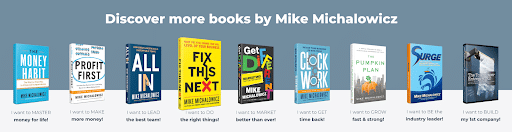
The book’s core idea is that business owners should take profit from each sale before paying expenses. This is a method that flips the traditional formula, we are talking about Sales-Expenses=Profit to Sales-Profit=Expenses. It helps entrepreneurs build stable cash flow and profitability right away, according to Mike Michalowicz. He also offers 9 additional book editions that discuss the traditional models and offer to challenge a different business assumption:
- ‘Profit First‘ (2014, updated 2017): The one we provided for the list, discussing cash management by taking profit first
- ‘The Pumpkin Plan‘ (2012): The primary focus of the book is on the customers
- ‘Clockwork‘ (2018): Building businesses that run without constant owner involvement
- ‘Fix This Next‘ (2020): You will find tips on prioritising business problems in the right order
- ‘Get Different‘ (2021): This one is about practical marketing differentiation, mostly for small startups
- ‘All In’ (2023): The book is focused on committed teams, ownership culture, and so on.
- ‘‘Surge’ (2024): This book is essential due to the tips on managing cash flow during revenue spikes, if you know what we mean
3. ‘Traction: Get a Grip on Your Business’ by Gino Wickman, 2007: Building Operational Discipline With a Clear Management System
The core lesson of the book lies in implementing a simple internal system for clear accountability. What will you find there, and why does it matter?
Wickman presents the Entrepreneurial Operating System (EOS), a straightforward management framework for structuring a business. Many entrepreneurs struggle because they keep their long-term vision internal without establishing repeatable processes for the team. This causes operational poor results.
By using up-to-date tools, you can make the so-called Accountability Chart that clarifies who is responsible for which duties, similar to agile systems. It removes ambiguity over specific outcomes. You will find tips, for example, on how to implement the Scorecard that identifies 5–15 key metrics, not generic financials, that are reviewed weekly to track forward movement.
This process removes guesswork from operations and forces the team to solve major issues every 7 days. After, you will be able to define the main functions in your business (e.g., Sales, Operations, Finance, Product). Assign one person’s name to each function and list the five key duties that person has to own fully. By the way, the book is used by thousands of small and mid-size companies as a practical system.
4. ‘Deep Work’ by Cal Newport, 2016: Protecting Focus for High-Value Knowledge Work
Deep Work is based on research into how distraction affects cognitive performance and output in knowledge workers. It can also be useful for readers who need to start doing deep work. Newport explains that uninterrupted work produces higher-quality results, and he backs this with studies from cognitive science on attention and memory. The book gives:
- Concrete practices
- Scheduling distraction-free blocks
- Tips on limiting shallow work
- How to set strict rules for communication
- Tips to produce complex work faster and with fewer errors
The book’s concept states that successful entrepreneurs must minimise shallow work, as success is achieved by maximising the quality of focused hours. During this concentrated hour, you need to tackle the single most difficult strategic task you face.
5. ‘Never Split the Difference’ by Chris Voss, 2016: Negotiation Techniques Based on Real FBI Hostage Cases
This book is based on Chris Voss’s experience as a former FBI hostage negotiator, where outcomes depended on psychology rather than compromise. Voss explains specific tactics such as:
- tactical empathy,
- calibrated questions,
- labeling emotions,
- real negotiations.
Entrepreneurs use these methods in:
- pricing talks,
- contract negotiations,
- hiring discussions,
- conflict resolution.
The core lesson you would find here is that negotiation requires emotional intelligence. You can use the Mirroring technique in your next difficult discussion, which could help you repeat the last three key words of the other person’s most crucial sentence as a question.
Final Extra Books for Entrepreneurs Planning: Quick List to Follow in 2026
The following non-fiction books for entrepreneurs form an additional reading list you can consider. They’re chosen because they include validated frameworks, quantified insights, AI-related thinking, and operational strategies that founders actually use in high-pressure environments we live in now and take into the next year:
- ‘Atomic Habits’ by James Clear (Note: if you have not read it yet, it is a must-have)
- ‘The Lean Startup’ by Eric Ries
- ‘The Psychology’ of Money by Morgan Housel
- ‘Zero to One’ by Peter Thiel and Blake Masters
- ‘Thinking, Fast and Slow’ by Daniel Kahneman
- ‘Competing in the Age of AI’ by Marco Iansiti and Karim R. Lakhani
As you can see, today, you, as an entrepreneur, are operating in a world shaped by AI competition, where AI decisions and capital-efficient growth shifts happen monthly rather than yearly. Of course, we should mention the AI bubbles we face, too, and much more. We think that reading widely is one of the few defensible advantages left. Enjoy!