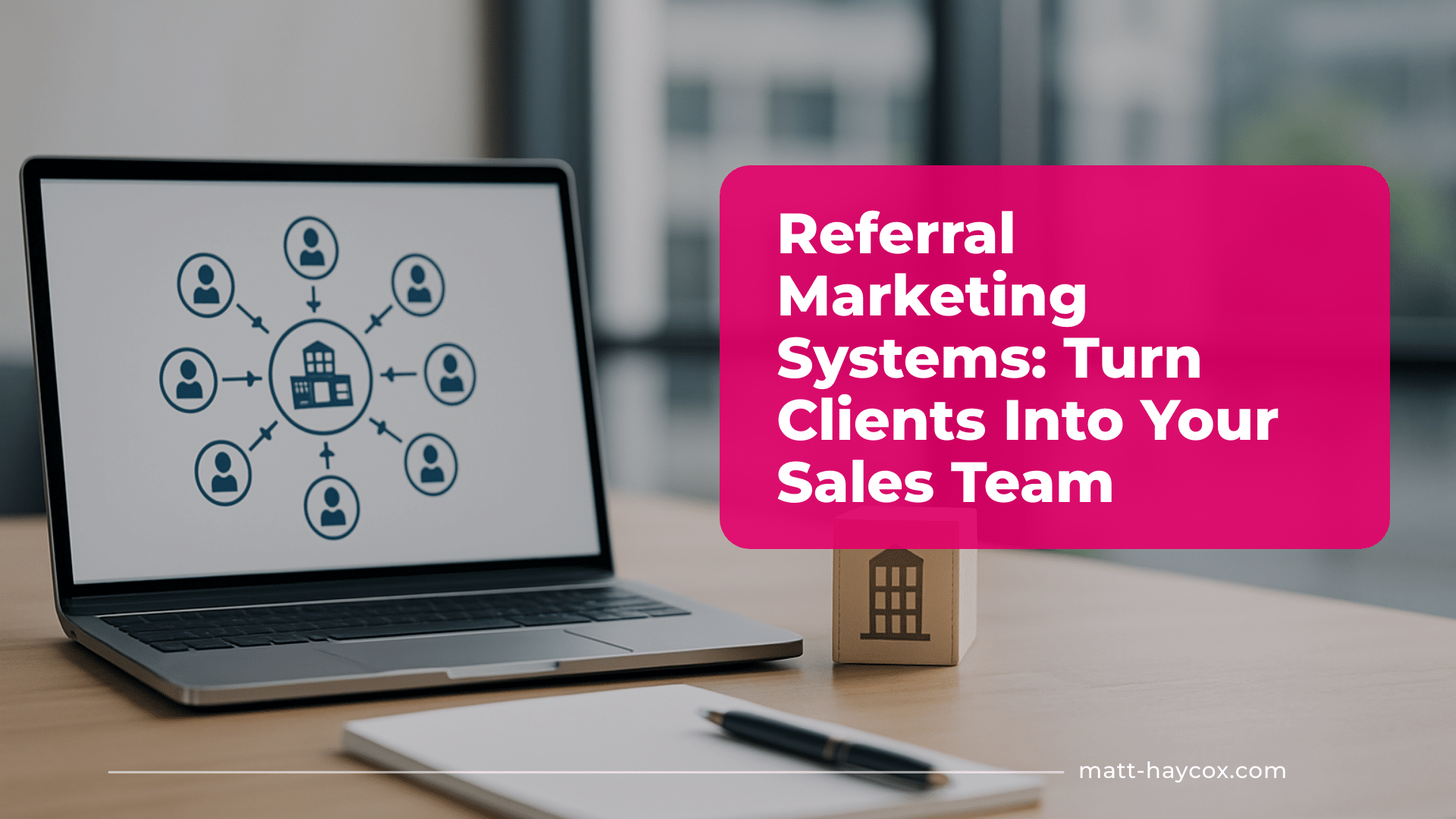

Most service founders say they get referrals, but they can’t predict them, track them or scale them. A proper system turns ‘nice surprises’ into a repeatable pipeline without eating your margin. If you want the wider playbook behind this, cross-reference Business Marketing: The Complete Playbook for Growing Your Brand and Pipeline as you build this out.
In this article, we’re going to discuss how to:
- Design referral incentives that people actually use without wrecking your pricing
- Automate the follow-up, tracking and reminders so referrals don’t rely on your memory
- Use simple scripts to ask at the right moment, without sounding desperate
Referral Marketing Strategy In Practical Terms
A referral marketing strategy is a documented, trackable process that turns satisfied clients into a steady flow of introductions, with clear triggers, incentives, scripts and follow-up. The outcome is measurable: more qualified conversations per month at a lower cost than paid acquisition, with a predictable impact on your capacity and cash.
Here’s the reality check. If you can’t answer these in 10 minutes, you don’t have a strategy, you’ve got hope:
- Source clarity: Can you see, in your CRM, which clients referred and which leads arrived via referral?
- Conversion clarity: Do referral leads close at a higher rate than other leads, and by how much?
- Economics clarity: Do you know what a referral is worth after delivery cost, not just revenue?
- Repeatability: Can a team member run the process without you being involved?
Founders like referrals because they ‘feel free’. Operators like them because they’re usually faster to close and easier to qualify. The trick is making them consistent.
Start With The Numbers You Already Have
Before you write incentives or scripts, pull the data you can gather in a few hours. Start internal, then go public.
Internal Signals To Pull Today
Open your CRM, invoicing tool and calendar and build a one-page picture. You’re looking for behaviours, not opinions.
- Closed-won by source: Last 6 to 12 months, count deals that were referrals
- Referral close rate: Referrals won ÷ referral leads
- Time to close: Average days from first call to invoice for referrals vs non-referrals
- Gross margin by service line: Revenue minus delivery costs, not including your ‘founder time’ fantasy
- Capacity: How many projects or retainers can you actually deliver next month without slipping quality?
If you want a quick ‘is this worth it’ calculation, use this:
Referral Profit Per Month = (Referral deals closed × Average gross profit per deal) − (Referral incentive costs + admin time cost)
Put a value on admin time. If your ops manager costs £40 per hour loaded and referral admin takes 3 hours a month, that’s £120. Most founders never count that, then wonder why things feel messy.
Public Signals To Cross-Check
Now pressure-test what you’re offering against the market. This stops you bribing people for a service that’s already weak.
- Competitor review patterns: What do customers praise, how often do they mention ‘recommend’ or ‘introduced’?
- Partner ecosystems: Who already serves your ideal buyer right before or after you?
- Community density: LinkedIn groups, trade bodies, local networks where your clients hang out
- Category pricing: Is your pricing anchored in the right band, or are you cheap and attracting the wrong work?
Referrals amplify what’s already true. If delivery is shaky, referrals will dry up. If delivery is solid, a referral marketing strategy becomes an engine.
Choose Incentives That Protect Margin
Incentives work best when they’re simple, fair and easy to pay. They fail when they’re complicated, delayed or feel like a gimmick. For service founders, the golden rule is this: an incentive should never cost more than the value of speed and certainty that a referral gives you.
Set A Hard Ceiling Using Unit Economics
Start with your gross profit, then work backwards. Here’s a practical approach:
- Know your gross profit: If you sell a £3k project at 60% gross margin, gross profit is £1,800
- Set an incentive cap: 5% to 10% of revenue, or 10% to 20% of gross profit, whichever is lower
- Require a trigger: Pay only when invoice is paid, not when someone ‘has a chat’
Example: £3k project, cap at 7% revenue = £210. That’s meaningful but not painful. If you’re offering £500 because it ‘sounds generous’, you’re likely buying low-quality leads and training clients to negotiate you down.
Pick The Right Incentive Type For Your Buyer
Different clients want different rewards. Keep it aligned with how they see themselves.
- Credit: ‘£250 credit against your next month’ works well for retainers and encourages retention
- Cash: Clean and clear, but can feel transactional in professional services
- Upgrade: ‘Free strategy session’, ‘priority support’, ‘extra deliverable’ keeps money inside the relationship
- Charity: Great for values-led brands, but still needs tracking and proof
If you work with corporates or public sector, incentives can be sensitive. In those cases, use non-monetary recognition or value-adds rather than cash.
Guardrails That Stop Referral Program Creep
Put these in writing, even if it’s just a one-page policy:
- Eligibility: Who can refer, current clients only or anyone?
- Definition: What counts as a referral, named intro to a decision-maker, not a LinkedIn comment
- Payment: When it’s paid, after first invoice is paid, after 30 days, after completion
- Cap: Maximum payout per quarter
- Behaviour: No spam, no mass emailing your client list on your behalf
Build The System: Triggers, Automation, And Tracking
The difference between ‘we should ask for referrals’ and a working system is automation. Not fancy software, just the right triggers and a boringly consistent follow-up.
Define The Three Best Asking Moments
Don’t ask randomly. Pick moments where the client has evidence that you delivered.
- Moment 1: When the first measurable result lands, for example leads up, turnaround time down, project delivered
- Moment 2: After a strong testimonial or NPS score
- Moment 3: At renewal or scope expansion, when they’re voting with their wallet
Each moment should trigger a task or automated sequence, not a note in your head.
A Simple Automation Stack That Works
You can run this with most CRMs. Keep it simple and visible.
- CRM fields: Referral source, referrer name, incentive status, payout date
- Referral form: A short form to capture name, company, email, context of need
- Email automation: A 3-email sequence to the referrer, ‘thanks’, ‘status update’, ‘payout confirmed’
- Slack or email alerts: Notify your team when a referral lead comes in so response time is under 15 minutes during business hours
- Calendar link: A dedicated referral booking link with pre-qualification questions
If you’re using Zapier or Make, you can wire this in an afternoon. The goal is not complexity, it’s eliminating the awkward silence where the referrer wonders if you dropped the ball.
Tracking That Doesn’t Lie
Don’t overthink tracking links. Service referrals rarely come through a click, they come through an intro. Track the intro and who made it. Your minimum viable tracking setup is:
- One referral intake form that feeds the CRM
- One pipeline stage called ‘Referral’ or a source field you actually fill in
- One monthly report showing referral leads, booked calls, closed deals, incentives paid
Make it a standing item in your weekly ops meeting. If it isn’t reviewed, it won’t be run.
Scripts That Get Referrals Without Feeling Beggy
Most founders avoid asking because they either sound needy or they ramble. You want short, specific and easy for the client to action. Your job is to reduce their effort to near zero.
The One-Sentence Offer Template
Offer template: ‘We help [ideal client] achieve [specific outcome] in [timeframe] without [common pain], if you know one person who’d value that, can you introduce us?’
Fill it properly. ‘We help businesses grow’ is not an offer, it’s noise. ‘We help owner-led accountancy firms add 10 to 20 monthly enquiries in 60 days without hiring a full-time marketer’ is an offer.
Four Referral Asks You Can Copy And Use
1) After a clear win
‘We’ve hit the target we set, and I appreciate how smooth you’ve made this. If you’ve got one mate in your network who’s dealing with [problem], I can help them the same way. Want me to send you a two-line intro you can forward?’
2) After a testimonial
‘Thanks for that testimonial, it genuinely helps. If you think of two people like you who’d benefit, I’ll do a free 15-minute sanity check call for them. No pitch unless it’s a fit. Who comes to mind?’
3) At renewal
‘We’re keeping this rolling because it’s working. If you introduce us to one other [type of client], I’ll apply a £250 credit to your next invoice. Simple as that.’
4) When they’re busy
‘Totally get you’re flat out. If you prefer, just reply with a name and I’ll draft the intro for you to approve. Takes you 30 seconds.’
The Two-Line Intro You Should Provide
Give them something they can copy and paste. Keep it neutral, no hype.
‘Hi [Name], meet [You]. They helped us [specific result]. Thought it might be useful to connect as you mentioned [pain]. I’ll let you two take it from here.’
This is where most referral marketing strategy documents fall down. They tell clients to ‘refer’ but they don’t make it easy.
Validate In 7 To 14 Days With Small Tests
You don’t need a quarter-long programme to see if this works. Run small tests, learn fast, then build the ‘forever’ version.
Test 1: The Trigger Test
Pick 10 clients who’ve had a recent win and send the ‘after a clear win’ script. Track:
- Reply rate: Aim for 30%+
- Introductions made: Aim for 10% to 20%
- Booked calls: Aim for 5% to 10%
If reply rate is low, your timing is wrong or your message is too long. Fix that before you touch incentives.
Test 2: The Incentive Test
Split another 10 clients into two groups. Same script, different incentive:
Group A: £250 credit against next invoice
Group B: A valuable upgrade, for example an extra workshop or priority turnaround
Measure the quality of intros, not just the volume. The best incentive is the one that brings the right type of buyer, not the most buyers.
Test 3: The Follow-Up Test
For any referral that comes in, follow up with the referrer at 48 hours and 7 days with a short update. This improves repeat behaviour because people see the loop closing.
Completion check: you should be able to show a referral pipeline report and a list of pending incentives within 14 days.
Pricing And Unit Economics That Hold At Small Scale
Referrals can hide bad pricing because volume ‘feels’ good. You need economics that work when you only have 10 to 50 customers, not when you imagine you’ve got 1,000.
Set A Minimum Referral Deal Size
Decide the smallest deal you’ll pay incentives on. Otherwise you’ll spend £250 to acquire £600 work that takes the same delivery overhead as bigger projects. A practical rule:
- Minimum eligible revenue: 3x your incentive cap
- Minimum eligible gross profit: 10x your admin time cost per referral
If your admin and follow-up cost is £60 per referral, you want at least £600 gross profit to make it worth running at all.
Protect Your Pricing Position
Never make the incentive a discount for the new buyer. It trains them to expect a deal and it makes the introduction feel like a sales promo. Pay the referrer, not the referred. If you want to support the new buyer, do it as value-add, for example an extra onboarding session.
Know Your Payback Window
If you run retainers, referrals can be lethal in a good way, but only if the payback is sensible. Example:
Monthly retainer £1,500, gross margin 65% so gross profit £975. If you pay a £300 referral credit after month one, your payback is under 1 month of gross profit. That’s fine. If you pay £1,000 because you’re chasing growth, you’re making yourself fragile.
Operational Guardrails That Protect Margin And Time
The biggest failure mode is not that referrals stop, it’s that they succeed and you can’t deliver. Build guardrails before you scale the ask.
- Capacity gating: Pause referral asks when utilisation is above 85%, or when lead time exceeds your promise
- Qualification discipline: Referrals still need to meet your criteria, your client isn’t your sales director
- Response time: Same-day response for referral leads, ideally within 2 hours in business hours
- Owner involvement: Founder does the first call for the first 10 referral leads, then documents the playbook
- Incentive workflow: One person owns paying credits, chasing approvals and updating the CRM
Your referral marketing strategy should reduce founder load over time, not create another set of messages you have to personally manage.
Micro Cases: What This Looks Like In The Wild
These are small, realistic examples. No hero numbers, just what happens when you run the process cleanly.
Case 1: Boutique Finance Broker In Leeds
They were getting 2 to 3 referrals a month but losing track of who introduced who. They added a referral intake form, paid £150 credit after first payment and sent a 3-email update sequence. In 30 days, they logged 11 referrals, booked 6 calls and closed 2 deals worth £4.8k revenue, about £2.7k gross profit.
Case 2: B2B Web Studio Serving SaaS In Manchester
They stopped discounting and moved to a ‘client upgrade’ incentive, a free CRO teardown worth £300 for any intro that turned into a paid project. The referrer loved it because it improved their own site. Over 14 days, 8 clients got asked, 3 intros came in and 1 closed at £9k with 55% gross margin.
Case 3: HR Consultant Working With Care Providers
Compliance made cash incentives awkward, so they ran a recognition model: a quarterly ‘client roundtable’ invite plus a donation to a care charity after a signed engagement. They tracked intros manually in the CRM and followed up at 48 hours and 7 days. It didn’t spike volume, but intro quality jumped, close rate went from 25% to 50% on referral leads.
Risks And Hedges To Avoid Naïve Mistakes
A referral system can go wrong in predictable ways. If you hedge them early, you avoid drama later.
Risk: Incentives Attract Low-Quality Introductions
Hedge: Pay only on paid invoice, set a minimum deal size and keep the incentive modest. If you see lots of ‘nice chats’ with no close, the incentive is rewarding volume not fit.
Risk: You Accidentally Create A Bribery Problem
Hedge: If you sell to regulated industries, confirm what’s acceptable. Offer credits, training or charitable donations rather than cash. Put terms in writing and keep an audit trail of payouts.
Risk: Referral Leads Jump The Queue And Ruin Delivery
Hedge: Use capacity gating. If you’re full, offer a waitlist with a clear start date. It’s better to delay than to disappoint and burn the referrer’s trust.
Risk: You Over-Rely On One Super-Referrer
Hedge: Track referrers like you track lead sources. If 60%+ of referrals come from one client, actively build two more referrer relationships so you’re not exposed to one account changing priorities.
Risk: You Never Close The Loop
Hedge: Automate updates to the referrer. ‘Intro received’, ‘Call booked’, ‘Deal won’, ‘Thanks and payout’ sounds basic, but it’s what makes people refer again.
Download The Inbound Lead Generation Checklist And Tighten The System
If you want to make this more consistent, pair your referral engine with a clean inbound process so every intro lands properly and gets followed up fast. Download the Inbound Lead Generation Checklist and use it to tighten your response times, qualification and follow-up so your referral marketing strategy becomes a dependable pipeline, not a lucky streak.
Key Takeaways
- Build the system first: Define asking moments, track source properly and automate updates so referrals don’t rely on memory.
- Validate quickly and protect margin: Run 10-client tests in 7 to 14 days, cap incentives based on gross profit and pay only after invoice is paid.
- Operate with guardrails: Gate by capacity, qualify referrals like any other lead and close the loop to drive repeat behaviour.
FAQ For Referral Marketing Systems
What’s the best referral incentive for service businesses?
Start with a credit against a future invoice, it protects cash and improves retention. Keep it modest, cap it and only pay after the first invoice is paid.
How do I ask clients for referrals without sounding pushy?
Ask right after a clear win and make it easy by offering a two-line intro they can forward. Keep it specific: who you help, what you fix and the one action you want.
Should I give the new customer a discount instead of rewarding the referrer?
In most service models, no. Discounts attract price shoppers and weaken your positioning, while rewarding the referrer keeps pricing clean and improves referral quality.
How do I track referrals properly in a CRM?
Use a source field plus a ‘referrer name’ field, and make it mandatory at lead creation. Run a monthly report showing referral leads, booked calls, closed deals and incentives paid.
How quickly should I follow up on a referral lead?
Same day is the standard, within 2 hours during business hours is better. Referrals go cold if you treat them like normal inbound.
What if I’m at capacity but referrals keep coming?
Pause the ask and use a waitlist with a clear start date. Protecting delivery quality protects the referrer’s trust, which is the real asset.
Can referral marketing work without incentives?
Yes, if your service is strong and you ask at the right moments with a clear script. Incentives help with consistency, but they can’t fix poor delivery or vague offers.
How do I stop one client from referring the wrong people?
Give them a tight definition of who you want and a short list of ‘best fit’ criteria. If an intro isn’t a fit, thank them, explain why and reinforce what ‘good’ looks like for next time.