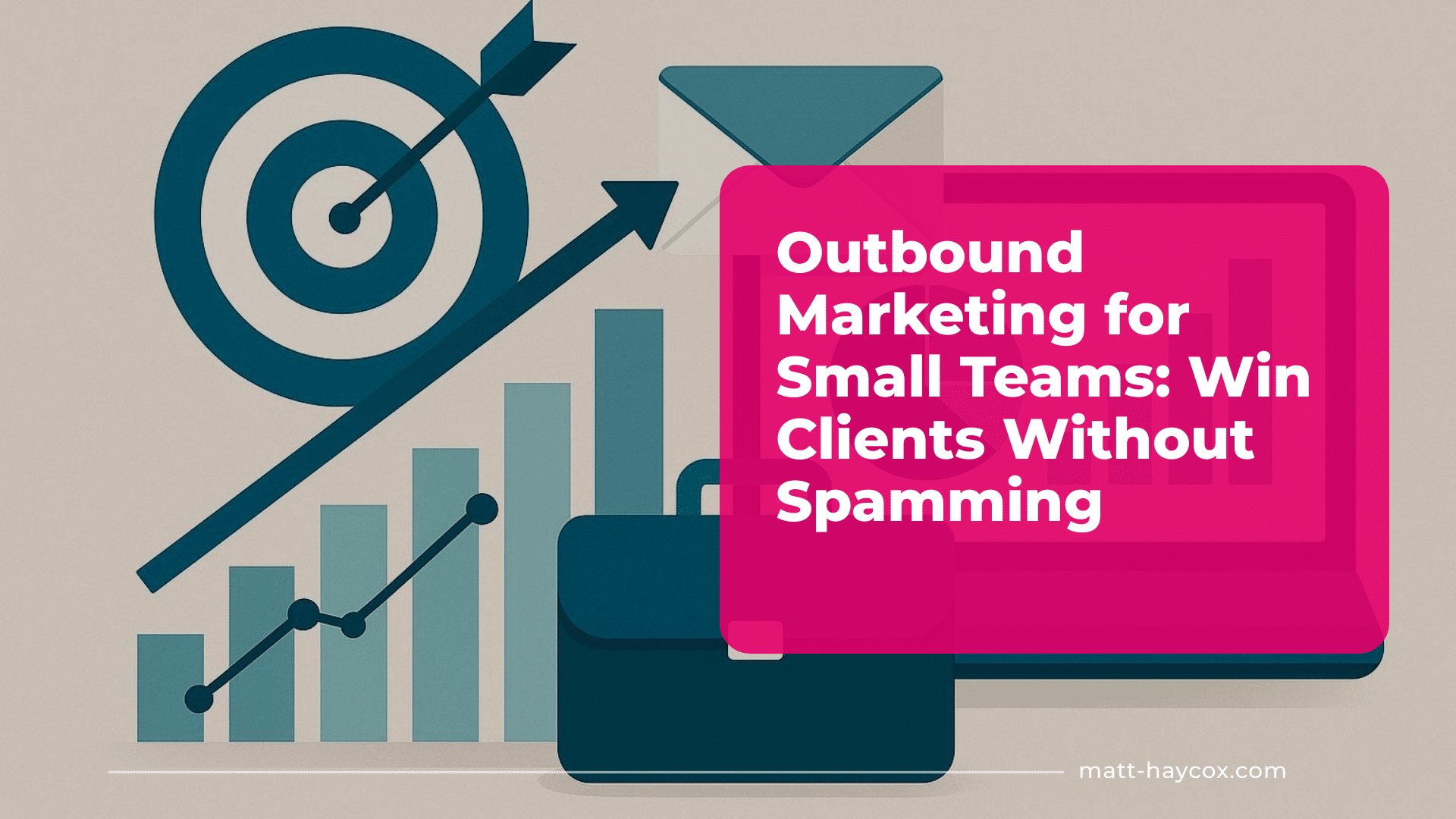

Cold outreach has a bad name because most of it is lazy. Small teams can win with outbound when they respect the buyer’s time, target precisely and offer something useful right away. For channel choices and sequencing across your whole go‑to‑market, cross‑reference Business Marketing Strategy: The Complete Playbook for Growing Your Brand and Pipeline, then use this piece to run outbound the right way.
In this article, we’re going to discuss how to:
- Design An Outbound Plan That Builds Trust, Not Complaints
- Write Offers And Messages That Earn Replies From The Right People
- Validate Results Quickly And Scale Without Damaging Your Brand
Outbound Marketing Strategy For Small Teams: What It Really Means
A practical outbound marketing strategy is a focused plan to start real conversations with specific buyers using short, respectful touches across email, LinkedIn and phone. It is not a blast, it is a sequence. The goal is to move a qualified person from ‘never heard of you’ to ‘worth a short call’ without tricks.
Sense‑checks before you start:
- You can describe your Ideal Customer in one sentence: role, company type, clear pain.
- Your outreach list is hand‑built from signals you can defend, not scraped at random.
- Every message has a tangible next step, for example a short diagnostic or a quick audit with a specific outcome.
- You can measure replies, positive interest, meetings and opportunities by sequence, not just by channel.
Gather Signals In A Morning
Good outbound starts with evidence you already have. Pull internal signals first, then scan the market.
Internal evidence to collect today:
- Notes from the last 15 discovery calls: pains, phrases, objections, timing.
- CRM outcomes by source: which inbound pages or referrals turned into revenue.
- ‘How did you hear about us’ answers: the places and people that already spark interest.
- Closed‑won contracts: roles that signed, budget range, typical trigger events.
Public signals to add quickly:
- Role changes on LinkedIn: new hires in your buyer role within the last 90 days.
- Technology fingerprints: firms using software you integrate with.
- Growth triggers: funding, new locations, hiring spikes, regulatory dates.
- Local cues if relevant: service areas, franchise lists, industry associations.
Build your first wave from the overlap between internal and public signals. This is where your messages will feel timely rather than intrusive.
Build Smart Lists Without Buying Databases
Most reputational damage comes from bad lists. Start small and specific.
- Define a micro‑segment: for example ‘Ops managers at food manufacturers, 50 to 250 staff, in the North West, using X ERP’.
- Hand‑craft 60 to 120 accounts: you need quality, not scale. Record why each account made the cut.
- Pick one role to own: avoid spraying three job titles with the same note. Start with the person most likely to feel the pain and control the diary.
- Map a trigger for each account: job change, product launch, new site, a compliance date. Mention it to show you did the work.
A clear list reduces unsubscribes and increases positive replies because your email looks like it was written for one person, not a crowd.
Offers And Messages That Earn Replies
You are interrupting someone’s day. Make the interruption worthwhile by offering something they can use even if they never become a customer.
One‑sentence offer template to fill:
‘If you’re [role] dealing with [specific pain], I can show you [concrete outcome] in [short time] on a quick call, shall we pencil [day/time]?’
Examples you can adapt:
- ‘If you run a fleet and diesel spend is rising, I can surface three routes to cut refuelling cost in under 30 minutes, does Tuesday morning work?’
- ‘If you manage paid search for multi‑location clinics, I can benchmark your location structure and share two fixes in 20 minutes, is Thursday after lunch open?’
- ‘If onboarding takes longer than four weeks, I can map the three biggest bottlenecks and a one‑page fix plan in half an hour, could we do Friday?’
Message principles that protect your brand:
- Lead with relevance from the first line: role, trigger, and the job they care about.
- Keep it short: 60 to 120 words, single ask, no attachments on the first touch.
- Show receipts: one proof point or short vignette for their sector.
- Close with a simple choice: a time suggestion or a yes/no question.
- Never bait‑and‑switch. If you promise a diagnostic, deliver a diagnostic.
Tactics That Respect People And Still Book Meetings
Outbound is stronger as a sequence of light touches across channels rather than a single ‘silver bullet’. Choose a simple micro‑cadence you can run without sounding robotic.
Email That Gets To The Point
- Touch 1: Relevance plus offer. 2 to 3 sentences, one clear outcome, one time proposal.
- Touch 2: Proof and angle shift. A short result from a similar client, a different subject line.
- Touch 3: Nudge with a calendar link. Invite them to pick a slot or reply with a better contact.
- Touch 4: Close the loop. A polite ‘should I step away’ that makes it easy to say yes or no.
LinkedIn Plays That Don’t Annoy
- Send a connection request referencing the trigger without a pitch.
- When accepted, share a useful artefact: a 2‑minute clip, a checklist or a teardown related to their role.
- If there is engagement, ask a short question that tees up the call. No five‑paragraph essays.
Phone Etiquette That Helps
- Call with a clear ‘why you, why now’.
- If you leave a voicemail, keep it under 20 seconds with a single statement of value and your number.
- Follow with an email that references the call. Respect their preferred channel if they ask for it.
A 12‑Day Validation Sprint
Prove your approach fast before you scale it. This sprint keeps risk low while giving you real numbers.
Day 1 to 2: list and offer
- Finalise one micro‑segment and build 100 contacts with reasons to believe.
- Write your one‑sentence offer and two variants.
Day 3 to 4: assets and rules
- Prepare a 1‑page diagnostic outline you can share on the call.
- Draft four emails and two LinkedIn notes. Set boundaries on send times and frequency.
Day 5 to 8: outreach in waves
- Send to 25 contacts per day to avoid spikes.
- Mix email and LinkedIn touches. Add two respectful calls where there is a strong trigger.
- Track replies, positive interest and meetings on a simple sheet.
Day 9 to 10: iterate
- Rewrite subject lines and first sentences using words from real replies.
- Swap the proof point if it misses. Trim anything that reads like fluff.
Day 11 to 12: review and decide
- Keep the version that produced the most positive replies and meetings.
- Decide whether to scale this segment or test a sister segment with the same structure.
Healthy baselines for the sprint
- Reply rate across the four email touches: 5 to 12 percent.
- Positive reply rate: 2 to 5 percent of total contacts.
- Meetings booked: 1.5 to 3 percent of total contacts should schedule a call.
- Show rate: at least 75 percent of booked calls should happen.
If you are below these marks, tighten the segment and the offer before you add volume.
Maths And Budget For A Frugal Team
You do outbound to create profitable pipeline, not to fill a CRM with ghosts.
Worked example for a micro‑segment of 200 contacts
- Spend: £250 on enrichment and a light dialler or scheduling tool.
- Time: two half days to build the list and assets, two hours per day to run the cadence.
- Targets: 10 to 20 positive replies, 4 to 8 meetings, 1 to 3 qualified opportunities.
- If win rate from opportunity is 25 percent: expect 1 to 2 clients from the segment.
If the first project gross profit averages £600 and you win two clients, you generate £1,200 contribution on roughly £250 hard cost and modest time. If results fall short, fix list quality and the offer before touching send volume.
Guard the economics: keep acquisition spend per client to about one pound for every three pounds of first‑sale gross profit. Review this weekly while you are testing.
Operational Rules And Compliance
Outbound can build or break reputation. Set rules that your team can follow without debate.
- Identity and opt‑out: clearly identify who you are and give a simple way to stop future emails.
- Target relevance: only approach business contacts whose role aligns with your service.
- Data hygiene: update lists weekly, remove bounced or uninterested contacts immediately.
- Cadence limits: no more than four emails and two LinkedIn touches in 14 days to the same person.
- Response speed: get back to positive replies inside 25 minutes during working hours, offer two clear time options, and include a booking link.
- Legal note: regulations vary by region. Treat this as operational guidance, not legal advice. Check the rules that apply to your market.
Micro Cases From The Field
Facilities maintenance provider, Oxford
Segment: office parks with 100 to 300 staff. Trigger: new facilities manager hires. Offer: ‘15‑minute energy‑waste check with a two‑point savings estimate’.
Results in 3 weeks: 11 positive replies from 220 contacts, 6 meetings, 2 contracts at £1,100 per month. Compliments on brevity, zero spam complaints.
HR consultancy, Belfast
Segment: charities with 20 to 60 employees. Trigger: trustee changes filed publicly. Offer: ‘Board induction pack review with a one‑page improvement plan’.
Results in 4 weeks: 8 meetings from 180 contacts, 3 retainers at £750 per month. Most replies referenced the trigger.
IT support firm, Reading
Segment: manufacturers adopting a new MES. Trigger: vendor press releases. Offer: ‘30‑minute compatibility check, with a readiness scorecard’.
Results in 5 weeks: 15 positive replies from 250 contacts, 7 meetings, 3 opportunities, 1 closed at £9k project value.
B2B video agency, Dundee
Segment: SaaS companies hiring sales engineers. Trigger: job posts. Offer: ‘Demo video critique with a 48‑hour storyboard’.
Results in 2 weeks: 9 meetings from 160 contacts, 2 projects at £3.5k each. No pushback on outreach thanks to the specific offer.
Risks And Simple Hedges
- Risk: sending to the wrong people. Hedge by naming one buyer role and one trigger per segment, and prove it before you scale.
- Risk: writing for yourself. Hedge by lifting phrases from real call notes and objections.
- Risk: over‑automation. Hedge by personalising the first two lines and limiting volume per day so you can reply like a human.
- Risk: weak follow‑through. Hedge with a calendar link, two time options and a brief agenda in the reply.
- Risk: hurting brand perception. Hedge by offering value in the first message, never faking familiarity, and honouring opt‑outs instantly.
Do And Don’t Checklist
Do
- Build small lists with clear triggers and a single buyer role.
- Offer a short diagnostic with a defined deliverable and a time suggestion.
- Track replies, positive interest, meetings and opportunities by sequence, then improve one variable at a time.
Don’t
- Buy giant databases and hope.
- Hide your identity or bury opt‑out instructions.
- Write long emails with three asks. Keep it short and specific.
Get Scripts That Book Meetings Without Burning Bridges
If you want ready‑to‑use wording for each touch, download the Outbound Scripts & Templates Pack. It includes first‑line openers by trigger, concise follow‑ups, LinkedIn notes, and a calendar reply library so you can run a respectful sequence and measure results without guesswork.
Key Takeaways
- A good outbound marketing strategy targets a narrow segment, references real triggers and offers a concrete, low‑risk next step.
- Validate with a 12‑day sprint, judge success on positive replies and meetings, then scale the winning segment rather than turning up the volume blindly.
- Protect brand and margin with clear identity, fast replies, data hygiene and spend limits tied to first‑sale gross profit.
If you want to learn more about lead generation for founders, read our latest blog: Outbound Lead Generation for Founders
FAQ For Outbound Marketing For Small Teams
What makes an outbound email feel non‑spammy?
Relevance in the first line, a useful offer, and a single clear ask. If your note could apply to anyone, it will offend everyone.
How many touches should we use in a sequence?
Four short emails and a couple of LinkedIn touches are enough to get a signal. If there is no engagement after that, change the offer or the segment, not the volume.
Do phone calls still work?
Yes if you have a strong trigger and a short point. Keep voicemails under 20 seconds, reference the value, and follow with an email.
What reply rates are realistic for small teams?
Across a 12‑day micro‑cadence, 5 to 12 percent overall replies and 2 to 5 percent positive replies are realistic. Lists built from live triggers usually outperform generic lists.
Should we personalise every email?
Personalise the first two lines and the offer, not the entire essay. Mention the trigger and the role. Templates do the rest.
How fast should we respond to interest?
Aim to reply inside 25 minutes in working hours, give two times, and include a booking link. Momentum matters.
Is outbound compatible with brand‑led marketing?
Yes. Use content and PR to warm the market, then outbound to start specific conversations. Done right, your emails feel like a continuation of what buyers already see.
What tools do we actually need?
A CRM, a scheduling link, light email sequencing, and a place to keep snippets. Add enrichment only when list quality becomes the bottleneck.