
Most SME marketing fails for one reason: you’re doing activities, not running a system. A simple funnel fixes that by showing what to do next, what to measure and what to stop. If you want the bigger picture alongside this, cross-reference Business Marketing: The Complete Playbook for Growing Your Brand and Pipeline and then come back here to build the funnel you can actually operate week to week.
In this article, we’re going to discuss how to:
- Map your funnel stages from awareness to conversion using real behaviours
- Build a trackable measurement set that takes under 2 hours to set up
- Validate offers and channels in 7 to 14 days without burning margin
A Simple Marketing Funnel Strategy For SMEs, In Practical Terms
A marketing funnel strategy is a written, measured path that takes a stranger to a paying customer through specific actions, with a target conversion rate at each stage and an owner for every metric. It’s not a diagram on a slide deck. It’s a weekly operating rhythm: traffic, leads, conversations, sales, retention.
Here’s the sense-check that tells you it’s working:
- Every stage has one job: reduce uncertainty and move someone to the next step.
- You can name the artefact: landing page, lead magnet, booking link, quote template, checkout.
- You can measure it: volumes and % rates, not ‘brand awareness’ vibes.
- You can improve it: one change, one hypothesis, one week.
Start With The Funnel You Can Run, Not The Funnel You Wish You Had
Founders overbuild funnels. You don’t need 12 stages, five automations and a CRM that needs a full-time admin. You need a basic model you can review on a Monday morning and take action on by Monday lunch.
Use this SME-friendly funnel map. It’s short, but it covers the whole journey:
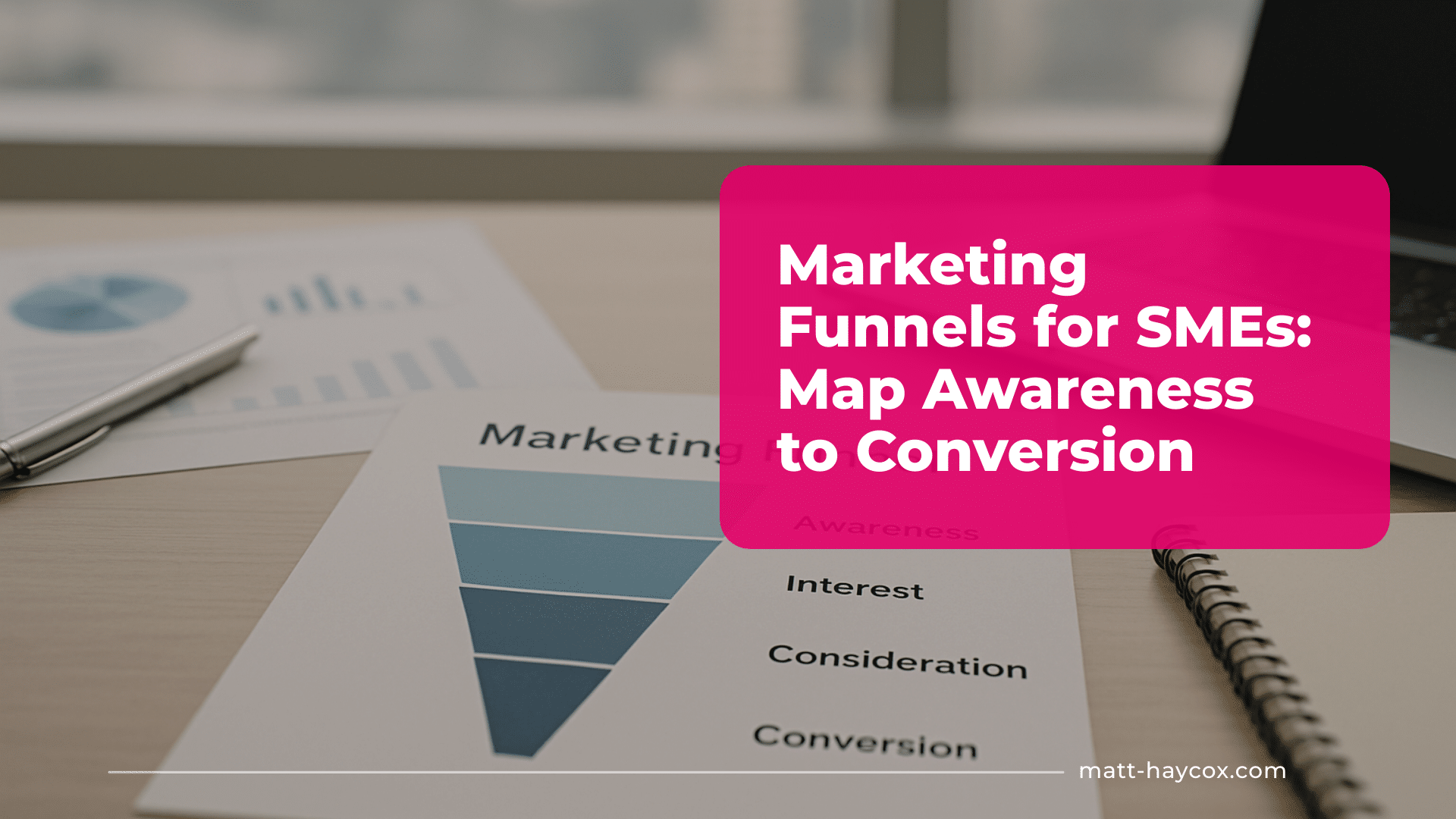
Awareness (reach and first contact) → Engagement (proof and relevance) → Lead Capture (permission to follow up) → Sales Conversation (diagnosis and fit) → Conversion (payment and onboarding) → Repeat/Referral (retention and advocacy)
The trick is to define each stage by a behaviour, not a feeling:
- Awareness: a unique person sees or hears about you, then clicks, searches, visits or asks.
- Engagement: they spend time, read, watch, compare or request details.
- Lead Capture: they give contact details or book time.
- Sales Conversation: you speak, scope, quote, demo or propose.
- Conversion: they pay, sign or commit to a trial with a clear next step.
- Repeat/Referral: they buy again, renew, expand or introduce you.
Gather Signals And Data In A Few Hours (Internal First, Then Public)
You can’t improve what you don’t measure, but you also can’t measure everything. Here’s a fast, founder-friendly way to get enough signal to build a marketing funnel strategy that’s grounded in reality.
Internal Signals You Can Pull Today
Block 90 minutes. Pull these numbers from whatever you have, even if it’s messy. Spreadsheets count.
- Last 30 to 90 days lead sources: where did enquiries actually come from, not where you ‘marketed’.
- Sales cycle length: average days from first contact to paid.
- Win rate: quotes/proposals vs closed deals.
- Average order value (AOV): paid amount on first transaction.
- Gross margin: after direct costs, before overhead.
- Capacity constraint: how many new clients per week can you deliver without quality dropping.
Completion check: if you can’t produce these in 90 minutes, your first funnel task is not marketing, it’s basic instrumentation.
Public Signals That Take One Hour
Now look outward, but keep it practical:
- Competitor offer pages: what are they promising, how are they packaging it, what proof do they show.
- Review sites and forums: what buyers complain about, what they praise, what they regret.
- Search results pages: what questions show up in ‘People also ask’, what local packs appear, what content ranks.
- LinkedIn job titles engaging with similar businesses: who’s actually the buyer, who’s the influencer.
You’re not copying competitors, you’re spotting buying language and proof gaps you can exploit.
Pick One Primary Conversion, Then Build Backwards
Funnels break when you’re trying to get three different outcomes from the same traffic. Choose one primary conversion for the next 30 days. Everything else becomes secondary.
For most SMEs, the primary conversion is one of these:
- A booked call (high consideration, service-led)
- A quote request (project-based B2B)
- A checkout purchase (ecommerce or simple productised service)
- A site visit booking (local and premises-based)
Now build backwards. If the conversion is ‘booked call’, then your lead capture artefact is a calendar link with qualification questions, your engagement artefact might be a case study page, and your awareness artefact might be a targeted LinkedIn post or a local SEO page.
Write A One-Sentence Offer That Pulls People Through
You don’t need clever copy. You need clarity. Here’s a one-sentence template that works because it matches how buyers think:
Offer template: ‘We help [specific customer] get [measurable result] in [timeframe] without [common pain], using [your method].’
Examples you can adapt:
- ‘We help independent dental practices add 10 to 15 new private patients a month in 90 days without discounting, using a referral and recall system.’
- ‘We help UK SMEs cut IT support tickets by 30% in 60 days without hiring more staff, using a standardised device and access setup.’
- ‘We help family-run builders win higher-margin extensions in 45 days without chasing tyre-kickers, using a pre-qualification and estimate process.’
This offer becomes the spine of your pages, ads, emails and sales script. If you can’t fill the blanks honestly, your funnel will leak no matter how good your marketing looks.
Build The Minimum Viable Funnel Artefacts
Founders get stuck because they think a funnel means funnels software. It doesn’t. It means a small set of artefacts that move people stage to stage.
For a service SME, a minimum viable funnel usually looks like this:
- One landing page: offer, proof, FAQs, one call to action.
- One proof asset: a case study with numbers, before/after, timeline, constraints.
- One lead capture mechanism: calendar booking or a short form with a guaranteed response time.
- One follow-up sequence: 3 to 5 emails or messages that handle objections and push to the next step.
- One sales call structure: discovery checklist and a standard proposal.
Completion check: if a prospect can’t go from first click to booked call in under 3 minutes, your funnel is not ‘simple’, it’s hostile.
Measurement That Fits On One Page
A marketing funnel strategy only works if you can see where it’s leaking. Keep your dashboard small. One page in Google Sheets is fine.
Track this weekly:
- Awareness: unique visits, impressions or reach (choose one primary).
- Engagement: % of visitors who view key pages, average time on page, video completion rate.
- Lead capture: conversion rate to form fill or booking.
- Sales conversation: show-up rate, qualified rate.
- Conversion: close rate, revenue, gross profit.
- Repeat/referral: repeat purchase rate, renewal rate, referral asks made.
Now add two founder metrics that stop you from buying vanity growth:
- Cost per gross profit: marketing spend divided by gross profit generated.
- Time per acquisition: founder or team hours spent to land one new customer.
These two protect your sanity and your margin.
Run A 7 To 14 Day Validation Path (Small Tests, Real Decisions)
You don’t need a 6-month plan to know if a funnel works. You need a short test with clean rules.
Pick One Channel And One Conversion Event
Choose a channel you can execute without waiting on other people. Examples: LinkedIn outbound, Google Ads to a landing page, partner outreach, local SEO page plus Google Business Profile posting.
Set one conversion event: booked calls, quote requests or purchases. Keep it binary.
Set A Budget And A Timebox You Won’t Cheat On
Example: £500 and 10 working days. Or 2 hours per day of outbound for 7 days. The goal is learning, not scaling.
Decide your pass/fail thresholds in advance. For a booked-call funnel, a practical starting point might be:
- Landing page conversion rate: 2% to 5%
- Show-up rate: 70%+
- Close rate on qualified calls: 20%+
If your numbers are below this, don’t panic. It just tells you where to focus: offer, proof, targeting or follow-up.
Use A Simple Decision Tree
At day 14, make one of three moves:
- Scale: if you’re hitting thresholds and delivery can cope, increase spend or outreach by 20% to 30%.
- Tune: if you’re close, change one variable only (headline, audience, call script) and run another 7 days.
- Stop: if you’re miles off, kill it and redeploy effort to a different channel or offer.
The founder skill here is decisiveness. Keep the test small, but be ruthless about the result.
Pricing And Unit Economics That Hold At Small Scale
Funnels can make you busy and broke if pricing isn’t tight. You want unit economics that work when you’ve only got 10 to 50 customers, not when you imagine 10,000.
Use this quick calculation before you pour fuel on marketing:
- Gross profit per sale: price minus direct costs.
- Allowed acquisition cost (AAC): gross profit per sale x 30% to 50% (depending on how fast you need payback).
- Payback period: how many days until you recoup marketing spend from gross profit.
Example: You sell a £2,000 service package at 60% gross margin. Gross profit is £1,200. If you set AAC at 40%, you can spend up to £480 to land a customer and still keep £720 gross profit to cover overhead and growth.
If your funnel is generating leads at £30 but you only close 5%, your cost per sale is £600. That’s not a marketing problem. It’s either a sales qualification problem or a mispriced offer.
Operational Guardrails That Protect Margin And Time
Operators win by setting guardrails early. These are the rules that stop marketing becoming a chaos machine.
- Response time: commit to under 5 minutes for inbound during business hours, or under 2 hours as a minimum standard.
- Qualification: ask 3 questions before a call (budget range, timeline, decision maker) to stop dead-end meetings.
- Capacity cap: only release X slots per week, scarcity through reality not theatrics.
- Offer boundaries: define what’s included and excluded, then enforce it in proposals.
- Follow-up ownership: name one person responsible for chasing no-shows and stalled deals.
Completion check: if you can’t say who owns the follow-up, you don’t have a funnel, you’ve got an inbox.
Micro Cases: What Simple Funnels Look Like In The Real World
These are deliberately small and realistic. The goal is repeatable execution, not flashy campaigns.
Case 1: Local accounting firm in Leeds
They offered a fixed-fee ‘CIS compliance health check’ for subcontractor-heavy trades. Awareness came from 2 local SEO pages and a monthly breakfast with a builders’ merchant. Lead capture was a 6-question form, sales was a 20-minute call. In 14 days, they got 11 leads, booked 6 calls, closed 2 at £1,500 each, then upsold ongoing bookkeeping.
Case 2: B2B SaaS for warehouse ops
They stopped pushing ‘platform features’ and instead offered ‘reduce pick errors by 25% in 30 days’. Awareness was outbound to operations managers with a short Loom audit. Lead capture was a booked demo, conversion was a paid pilot. Their show-up rate jumped from 52% to 78% just by adding a pre-demo email with a 3-bullet agenda and a case study.
Case 3: Ecommerce brand in home fitness
They built a funnel around ‘starter bundles’ instead of single items. Awareness was Meta retargeting only, engagement was a comparison page, lead capture was email via a sizing guide. Their AOV moved from £48 to £76, which gave them room to pay more for acquisition without sacrificing margin.
Risks And Hedges So You Don’t Make Naïve Mistakes
Funnels are simple, but the mistakes are predictable. Here are the ones I see operators repeat.
- Risk: You optimise the wrong stage. Hedge: Fix the biggest leak first. If your close rate is 10%, don’t obsess over a 0.5% landing page tweak.
- Risk: You attract the wrong customer. Hedge: Tighten qualification and add a ‘not for you’ line on the page to repel poor-fit leads.
- Risk: You scale spend before delivery is stable. Hedge: Put a capacity cap on bookings and build a waitlist if needed.
- Risk: You rely on one channel. Hedge: Once one funnel works, build a second acquisition source that shares the same offer and proof.
- Risk: You confuse activity with progress. Hedge: Weekly review the funnel metrics, then choose one improvement action only.
Do And Don’t Checklist For A Founder-Run Funnel
If you want to keep this clean and operational, stick to these rules.
- Do: Define each stage by a behaviour you can track.
- Do: Use one primary conversion goal for 30 days.
- Do: Track cost per gross profit and time per acquisition.
- Do: Run 7 to 14 day tests with pass/fail thresholds.
- Don’t: Build automations before you’ve got consistent lead flow.
- Don’t: Discount to ‘make the funnel work’. Fix the offer or targeting first.
- Don’t: Let calls happen without pre-qualification.
- Don’t: Add stages unless they remove friction or increase conversion.
Download The Inbound Lead Generation Checklist And Build Your Funnel This Week
If you want a no-nonsense way to implement this without overthinking it, download the Inbound Lead Generation Checklist and use it to set up your stages, artefacts and weekly metrics in one sitting. Then run one 7 to 14 day test and let the numbers tell you what to fix.
Key Takeaways
- Build your funnel around observable behaviours and a single primary conversion, then work backwards to the minimum artefacts needed.
- Validate fast with a 7 to 14 day test, pre-set thresholds and unit economics that protect gross profit, not just lead volume.
- Use operational guardrails like qualification, response time and capacity caps to stop your funnel creating low-margin chaos.
FAQ For Marketing Funnels For SMEs
What’s the difference between a funnel and a customer journey?
A customer journey describes what buyers do and feel. A funnel is the version you can operate: defined stages, owned metrics and specific artefacts that move people forward.
How many stages should an SME funnel have?
Enough to spot the leak, not so many you can’t manage it. For most SMEs, 5 to 7 stages is plenty if each stage is defined by a behaviour and a measurable %.
What metrics matter most in a marketing funnel strategy?
Start with conversion rates between stages and gross profit per customer, then add cost per gross profit and time per acquisition. Those two stop you chasing volume that doesn’t pay.
How do I know if my offer is the real problem?
If you can drive clicks but people won’t book, enquire or buy, your offer or proof is weak. If they book but don’t close, your offer may be fine but qualification, pricing or sales process needs tightening.
Should I use marketing automation tools from day one?
Not unless you’ve got consistent lead flow and a repeatable follow-up process. Start with manual follow-up and simple templates, then automate what’s proven and predictable.
What’s a realistic first test budget for an SME funnel?
Pick a number you can afford to lose for learning, often £300 to £1,500, or timeboxed outreach of 7 to 10 hours total. The point is signal, not scale.
How long should I wait before scaling a funnel?
Scale when you’ve hit your pass thresholds for at least 2 consecutive weeks and delivery can absorb more customers without quality slipping. If delivery is fragile, scaling will just amplify complaints and churn.
What if I’m local and most of my business is referrals?
Great, your funnel starts with retention and referral asks, then adds a small awareness layer like local SEO and partnerships. The goal is to reduce dependence on luck by making referrals predictable.