
Elon Musk, the billionaire entrepreneur behind Tesla and SpaceX, has become a global phenomenon. His astonishing rise has left many wondering exactly how did Elon Musk become rich, and what’s behind the unprecedented speed and scale of his wealth accumulation in recent years?
Elon Musk became rich through a series of successful entrepreneurial ventures and strategic investments. He started by co-founding Zip2, a software company, which he sold for $307 million in 1999, netting him $22 million as an early investor. He then founded X.com, an online payment company where Musk was also an early investor, which later became PayPal and was acquired by eBay for $1.5 billion in 2002, earning Musk $175 million.
However, Musk’s wealth skyrocketed primarily due to his involvement with Tesla and SpaceX. As CEO of Tesla, Musk benefited enormously from the company’s soaring stock prices, particularly from 2020 onwards. SpaceX’s successful missions and contracts further contributed to his wealth accumulation. His fortune is now measured in the hundreds of billions of dollars, and some describe his pay package as an unfathomable sum.
In 2020 alone, Musk’s net worth increased by over $140 billion, largely due to Tesla’s exceptional stock market performance and its inclusion in the S&P 500 index, according to Business Insider. His continued investments in innovative ventures like Neuralink and The Boring Company have also played a role in his wealth growth, solidifying his status as one of the world’s richest individuals.
Need help with business funding or private coaching for entrepreneurs? Get in touch today.
Early Life and Background
A common misconception about Elon Musk is whether he was born into wealth. In reality, Musk’s family in South Africa was comfortably middle-class but not extravagantly affluent. His father was an engineer and his mother was a dietitian and model, and the family’s background was rooted in hard work and education rather than privilege. Born in Pretoria in 1971, Elon Musk demonstrated an early fascination with technology, computers and innovation, laying the foundations for his future successes. He purchased his first computer at age 10 and taught himself programming, showcasing early entrepreneurial promise by creating and selling his own video game by age 12.
Despite a somewhat challenging upbringing marked by bullying and social difficulties, Musk’s curiosity and perseverance fuelled his ambitions. His drive intensified when, at age 17, he emigrated to Canada, later moving to the United States. Musk attended Queen’s University in Canada before transferring to the University of Pennsylvania, graduating with degrees in physics and economics. He was also accepted into a graduate program at Stanford University in materials science, but chose not to enroll, opting instead to pursue entrepreneurial ventures in Silicon Valley.
His early exposure to both adversity and opportunity helped shape his resilience and innovative mindset, laying essential groundwork for Musk’s subsequent ventures, from Zip2 and PayPal to revolutionary companies like Tesla and SpaceX. Musk’s formative years clearly established the entrepreneurial foundation critical to his later extraordinary wealth accumulation.
How Did Elon Musk Become Rich: The Beginnings of Wealth Accumulation
Elon Musk’s first significant step towards wealth came when he co-founded Zip2 in 1995, alongside his brother Kimbal Musk. Zip2, an innovative online city guide and directory for newspapers, quickly attracted attention from major media corporations. Demonstrating his early knack for combining technology with business acumen, Musk successfully sold Zip2 to Compaq in 1999 for an impressive $307 million. This deal alone made Musk a multi-millionaire at just 27, answering the frequently asked question of how wealthy Musk was in his 20s.
Building upon this success, Musk founded his next venture, X.com, an online payment system which later evolved into PayPal. Under Musk’s leadership, PayPal rapidly grew, revolutionising online financial transactions. Its potential quickly drew the interest of internet giant eBay, which acquired the company in 2002 for a staggering $1.5 billion. Musk’s 11.7% stake in PayPal earned him roughly $175 million from the sale, significantly boosting his wealth.
These early entrepreneurial ventures, particularly Zip2 and PayPal, served as essential stepping stones in Musk’s journey to billionaire status. The success of these companies enabled Musk to invest in multiple companies and other businesses, laying the foundation for his later wealth. They not only increased his personal wealth dramatically but also provided him with crucial financial capital for his subsequent groundbreaking projects, including Tesla Motors and SpaceX.
Tesla, SpaceX and Major Ventures
Musk’s journey from early ventures like Zip2 and PayPal to major successes with Tesla and SpaceX showcases his innovative mindset and relentless drive. Elon Musk’s transformation from millionaire to billionaire hinged significantly on his visionary investments in two ambitious companies: Tesla Motors and SpaceX. In 2002, Musk founded SpaceX (Space Exploration Technologies Corp.), driven by his dream to revolutionise space travel and make humanity a multi-planetary species. The SpaceX valuation Musk achieved over the years is a testament to his ability to push the boundaries of aerospace technology. SpaceX became a landmark success, securing major contracts with NASA and successfully developing reusable rocket technology, dramatically reducing the costs associated with space exploration.
Shortly after, in 2004, Musk joined Tesla Motors (now Tesla Inc.), initially as an investor and soon after as CEO. Musk led the company through its transformation into the world’s leading electric vehicle manufacturer. Tesla’s cutting-edge technology, stylish designs, and Musk’s charismatic yet often controversial leadership quickly transformed the automotive industry. Notable Tesla Model vehicles, such as the Tesla Model S and Model 3, exemplify the innovation and public appeal that have driven Tesla’s growth. The rise of the electric vehicle market disruption can largely be attributed to Tesla’s dominance, making sustainable transportation mainstream. Tesla’s skyrocketing stock prices, particularly from 2020 onwards, were instrumental in multiplying Musk’s wealth exponentially, reinforcing the link between Tesla stock and Musk’s financial success. Tesla’s valuation has played a critical role in the fluctuations of Musk’s net worth, as his wealth is closely tied to the company’s market value.
Musk’s involvement in the growth and innovation of both Tesla and SpaceX has been central to their success, as he has actively shaped their strategic direction and public image.
Musk also diversified his investments into other ambitious ventures, such as Neuralink, aiming to integrate artificial intelligence with the human brain; The Boring Company, targeting innovative transport solutions; and OpenAI, advocating safe artificial intelligence development. Collectively, these groundbreaking companies solidified Musk’s billionaire story and strengthened his reputation as a pioneering entrepreneur. Discover more about his top inventions in our blog on the top inventions of Elon Musk.
Artificial Intelligence, Neuralink and New Frontiers
Elon Musk’s relentless pursuit of innovation has led him far beyond electric vehicles and rockets, propelling him into the cutting-edge realms of artificial intelligence and neurotechnology. In 2016, Musk co-founded Neuralink, a neurotechnology company with the ambitious goal of integrating the human brain with artificial intelligence. Neuralink’s primary focus is on developing brain-machine interfaces (BMIs) that could one day treat conditions like paralysis, depression and anxiety, while also aiming for a future where humans and AI achieve true symbiosis. This bold vision reflects Musk’s belief that merging the human brain with advanced AI is essential for humanity’s long-term survival and competitiveness.
Artificial intelligence
Musk’s involvement in artificial intelligence doesn’t stop with Neuralink. He was also a founding force behind OpenAI, a non-profit research company dedicated to ensuring that AI development benefits all of humanity. Musk’s early $1 billion donation helped establish OpenAI as a leader in the field, though he later stepped down from the board to avoid conflicts with his other ventures, particularly Tesla, which itself is a major player in AI-driven autonomous vehicles.
In 2023, Musk announced the launch of xAI, a new AI company designed to push the boundaries of artificial intelligence even further. xAI focuses on advanced technologies such as natural language processing and computer vision, and is positioned as a direct competitor to OpenAI. Musk has stated that xAI will prioritise the safe and ethical development of AI, aligning with his long-standing concerns about the risks of unregulated artificial intelligence.
These ventures have not only expanded Musk’s influence but have also contributed significantly to his wealth accumulation. His ownership stakes in Neuralink and xAI, alongside his leadership in Tesla and SpaceX, have helped Musk achieve a net worth estimated at over $200 billion, cementing his status as the world’s richest person. Government contracts have played a role as well, with Neuralink receiving funding from the Defense Department for military applications of brain-machine interfaces, and Tesla benefiting from government support for its AI-driven autonomous vehicle technologies.
Musk’s family has also been involved in these groundbreaking business ventures. His brother, Kimbal Musk, has played a key role in Neuralink’s development, while his first wife, Justine Musk, has contributed as a consultant for Tesla. Even his son, Nevada Musk, has been linked to the development of xAI, highlighting the family’s deep involvement in Musk’s expanding empire.
The Boring Company
The Boring Company, another of Musk’s innovative projects, has leveraged artificial intelligence and machine learning to optimise tunneling operations, further demonstrating Musk’s commitment to integrating advanced technology across all his enterprises. These efforts not only drive efficiency but also reinforce Musk’s reputation as a pioneer at the intersection of technology and infrastructure.
However, Musk’s journey into AI and neurotechnology hasn’t been without controversy. He has been an outspoken critic of the potential dangers posed by unchecked AI development, frequently calling for greater regulation and oversight to prevent misuse in areas like autonomous weapons and surveillance. His acquisition of Twitter (now X) for $44 billion in 2022 further fueled debate, as critics questioned whether Musk’s control over a major social media platform could be used to advance his own business interests or influence public discourse.
Tax criticisms
Musk’s tax rate and approach to wealth have also drawn scrutiny, with some arguing that his contributions are not commensurate with his vast fortune. Despite these debates, there’s no denying that Musk’s business ventures in AI, neurotechnology and beyond have fundamentally shaped the landscape of modern technology and entrepreneurship.
As Musk continues to push the boundaries of what’s possible, his investments in artificial intelligence, brain-machine interfaces and other new frontiers are poised to have a profound impact on the world. Whether through Neuralink’s quest to unlock the human brain’s potential, xAI’s drive for advanced and ethical AI or the integration of smart technologies across his companies, Musk’s journey exemplifies how visionary leadership and strategic risk-taking can redefine industries. And, potentially, the future of humanity itself.
The Rapid Growth of Wealth in Recent Years
Elon Musk’s wealth grew astonishingly in recent years, especially from 2020 onward, and many people have been wondering bot how he got so rich so fast and how much he plans to give away. This massive increase was mainly because of Tesla’s own strong performance in the stock market, fuelled by demand for electric cars, strong production milestones and renewed confidence from institutional investors. Tesla’s market capitalisation climbed to historically unseen heights, eclipsing the legacy automotive firms, as it joined America’s elite symbol of industry, the S&P 500, in December 2020, a move which accelerated Musk’s net worth into stratospheric territory. Changes in Tesla’s stock price had a direct and dramatic impact on Musk’s net worth, with major surges in value translating into billions added to his fortune. Tesla’s board played a crucial role in approving major decisions, including CEO compensation packages, that significantly influenced Musk’s wealth.
In 2020 alone, Musk’s wealth soared by over $140 billion, catapulting the man to virtual overnight status as one of the richest in the world. It was an abrupt climb and covered widely, creating an awareness and impression of Musk’s quickly growing fortune. Musk’s wealth was propelled even more by SpaceX’s success with missions and contracts as well, building on the astonishing growth of Tesla to establish Musk as an innovator, if not a genius and a billionaire visionary.
Musk’s calculation to diversify into avant-garde pursuits such as Neuralink, which investigates brain-machine interfaces, and The Boring Company, dedicated to revolutionising transportation infrastructure, contributed to his unparalleled rise in financial fortune. These three ventures catapulted Musk to the crown jewels of the entrepreneurial world, showcasing both his money-making skills and prophetic thought leadership.
Key Milestones in 2020
The key driver behind Musk’s spectacular financial leap was undoubtedly Tesla’s exceptional performance on the stock market. Tesla’s shares surged over 700% throughout the year, driven by robust electric vehicle sales, profitability milestones and increased investor optimism about clean energy technology.
A defining event in Musk’s financial ascent occurred in December 2020 when Tesla was officially included in the prestigious S&P 500 index. This inclusion triggered immense demand for Tesla shares among institutional investors and index funds, resulting in further exponential growth of Musk’s personal fortune. By the end of 2020, Musk’s net worth increased by approximately $140 billion, briefly surpassing Amazon founder Jeff Bezos. At this point, Musk became the world’s richest person and was widely recognised as the richest man globally, with his wealth primarily tied to the soaring value of his Tesla and SpaceX stock holdings.
Moreover, SpaceX reached notable milestones in the same year, including the successful launch of the Crew Dragon mission, which transported NASA astronauts to the International Space Station: a historic achievement for commercial space travel. These critical events throughout 2020 not only magnified Musk’s financial success but also solidified his position as a globally influential entrepreneur, innovator and trailblazer in technology and sustainable energy.
What Were the Key Milestones in Elon Musk’s Career?
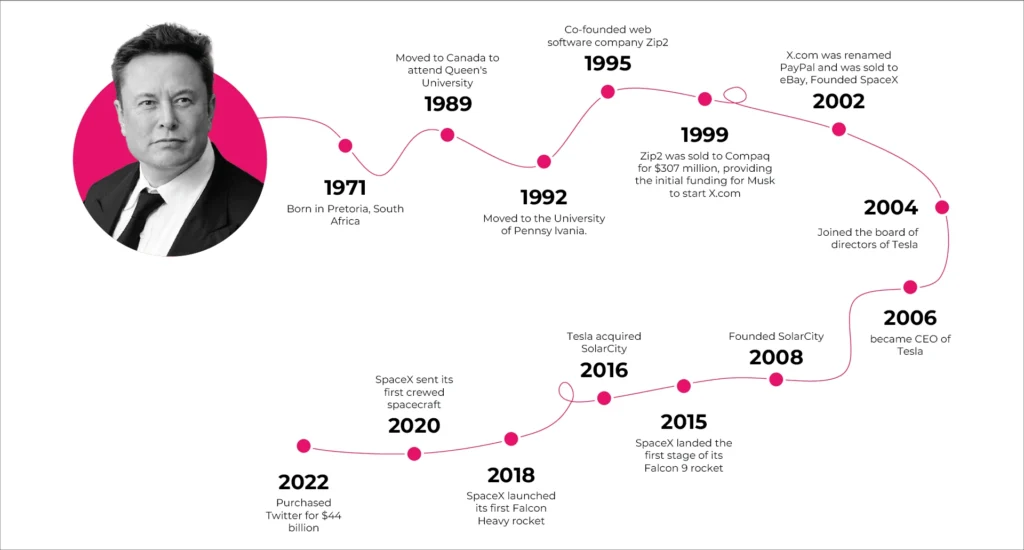
Elon Musk’s career has been marked by several key milestones that have contributed to his rise as one of the world’s most influential entrepreneurs and innovators:
- Zip2 (1995-1999): Musk co-founded Zip2, an online city guide, which was sold to Compaq for $307 million in 1999. He netted $22 million from this sale, providing capital for his future ventures.
- PayPal (2000-2002): Musk co-founded X.com, which merged with Confinity to form PayPal. eBay acquired PayPal in 2002 for $1.5 billion, earning Musk $175 million.
- SpaceX (2002-present): Founded in 2002, SpaceX has achieved numerous milestones, including being the first private company to send a craft to the International Space Station and launch astronauts to orbit. The company’s board has played a significant role in approving major decisions and supporting Musk’s vision.
- Tesla (2004-present): Musk invested in Tesla in 2004 and became CEO in 2008. Under his leadership, Tesla has become a leading electric vehicle manufacturer and briefly became the world’s most valuable carmaker in 2020. The company’s board has been instrumental in governance, executive compensation and major corporate decisions, sometimes leading to high-profile disagreements with Musk.
- SolarCity (2006): Musk invested in and became chairman of SolarCity, aiming to revolutionise solar energy adoption.
- The Boring Company (2016): Founded to construct tunnels for high-occupancy vehicles.
- Neuralink (2016): Co-founded by Musk to develop brain-computer interfaces.
- Twitter/X Acquisition (2022): Musk bought Twitter in 2022 and renamed it X, marking his entry into social media ownership. The acquisition process was highly publicised, with Musk’s purchase leading to significant changes in the company’s leadership and policies.
- Starship Development (2019-present): SpaceX’s ongoing project to develop a reusable, super heavy-lift launch vehicle, with a successful third test flight in 2024.
In addition to his business ventures, Musk established the Musk Foundation, which focuses on supporting renewable energy, space exploration and AI safety through strategic partnerships and philanthropic initiatives.
These milestones showcase Musk’s diverse interests and his impact across multiple industries, from digital payments to space exploration and sustainable energy. Discover more about his most revolutionary creations in our blog on Elon Musk’s top inventions. These milestones showcase Musk’s diverse interests and his impact across multiple industries, from digital payments to space exploration and sustainable energy.
How did SpaceX and Tesla contribute to Elon Musk’s wealth?
SpaceX and Tesla have been the primary drivers of Elon Musk’s wealth, with recent developments significantly impacting his net worth:
SpaceX’s Rising Value:
- SpaceX is now valued at approximately $350 billion, making it Musk’s most valuable asset.
- Musk’s 42% stake in SpaceX is worth about $147 billion, surpassing his Tesla holdings for the first time in five years.
- A recent insider share sale at SpaceX contributed nearly $50 billion to Musk’s wealth.
Tesla’s Fluctuating Contribution:
- Despite recent declines, Tesla remains a significant source of Musk’s wealth.
- Musk’s 13% stake in Tesla is valued at approximately $92.6 billion.
- Tesla’s stock has experienced volatility, with a 50% decline since mid-December 2024, impacting Musk’s net worth.
- Legal and compensation issues have also played a role, with a Delaware judge issuing key rulings on Musk’s Tesla pay package.
Government Support:
- Both SpaceX and Tesla have benefited from substantial government contracts and aid, totaling about $38 billion over 20 years.
- SpaceX received around $22.6 billion in government contracts, primarily from NASA and the Defense Department.
- Tesla earned $11.4 billion in regulatory credits and benefited from various government programs.
- During the Trump administration, Musk served as a Senior Advisor and had direct interactions with the White House, further strengthening his companies’ access to government initiatives and contracts.
Recent Wealth Milestones:
- In December 2024, Musk became the first person to exceed a net worth of $400 billion.
- As of March 2025, Musk’s total fortune is estimated at $329 billion, with SpaceX and Tesla combined accounting for more than 80% of this wealth1.
Other Contributing Factors:
- Musk’s wealth also includes stakes in xAI, X Corp, The Boring Company and Neuralink, adding approximately $45 billion to his net worth.
- Political factors, such as Trump’s re-election, have influenced Musk’s wealth, with his net worth increasing by 77% following the election.
Lessons from Elon Musk’s Success
Elon Musk’s extraordinary journey from tech entrepreneur to one of the world’s richest individuals offers invaluable lessons in entrepreneurship, innovation and wealth creation. Below are key insights from Musk’s success story:
- Embrace Bold Innovation: Musk consistently pursues groundbreaking ideas, such as electric vehicles with Tesla, reusable rockets at SpaceX, and human-computer interfaces through Neuralink. His willingness to push boundaries inspires entrepreneurs to innovate fearlessly.
- Think Long-Term: Musk’s ventures, especially Tesla and SpaceX, were built on long-term visions rather than immediate profits. His commitment to future-oriented projects demonstrates that enduring success often requires patience and sustained focus.
- Take Calculated Risks: Musk repeatedly invested significant portions of his wealth into ambitious projects despite substantial risks. His calculated risk-taking highlights the importance of having confidence in one’s vision and the courage to pursue it.
- Resilience in the Face of Setbacks: Musk encountered numerous failures, including rocket explosions and production difficulties at Tesla. Yet, he remained resilient, using each setback as an opportunity to learn, innovate and grow. Elon Musk’s net worth journey reflects the power of persistence and adaptability, a crucial aspect of his entrepreneurial success that continues to inspire business leaders worldwide.
- Diversify Strategically: Musk diversified his investments across industries, including transport, finance, energy and technology, reducing risk while multiplying growth opportunities.
These principles underline that Musk’s incredible wealth accumulation is not merely luck but the result of visionary leadership, calculated risk-taking, relentless innovation and strategic resilience.
Fancy being the next Elon Musk or curious how other business titans, like Donald Trump, built and maintain their wealth? Check out our deep dive into Donald Trump’s net worth in 2026. Whether your ambitions lie in tech innovation or diversified investment.
Grow Your Wealth – Start Today
Elon Musk’s journey to extraordinary wealth showcases how relentless innovation, calculated risks, and visionary leadership combine to produce monumental success. By understanding the milestones of his remarkable career, from Zip2 to Tesla and SpaceX, aspiring entrepreneurs can draw invaluable inspiration to build their own path to financial achievement and impact. Discover also the story of the best 10 startups in Dubai before you start your journey.

Work with Matt Haycox to Fast-Track Your Success
Matt Haycox has helped countless entrepreneurs and business owners grow their companies, secure funding, and adopt the right financial mindset. Whether you need:
- Expert coaching to refine your business strategy
- Funding opportunities to scale your venture
- Business advisor to make bold but smart financial decisions
You don’t have to figure it all out alone. Learn from someone who has been there, done it, and helped others succeed.
Get in touch with Matt Haycox today and take the next step toward building your own financial success.