
What Is a Balance Sheet?
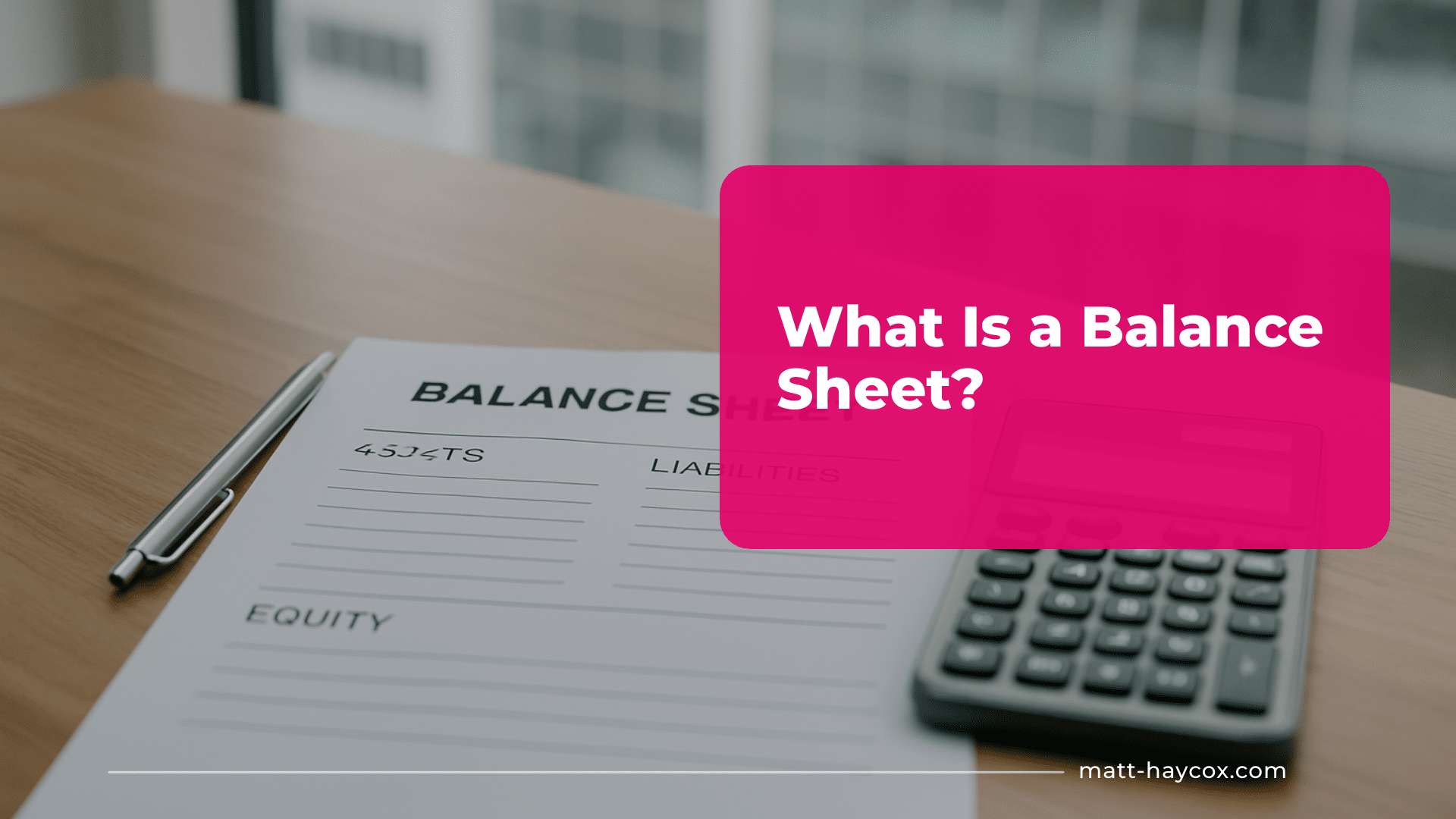
If you’ve ever wondered what is a balance sheet and why every business relies on one, this guide breaks it down in plain language. A balance sheet is a snapshot of what a company owns, what it owes, and what’s left for the owners at a specific point in time.
Unlike a profit and loss statement (which covers a period), the balance sheet captures a single date—such as the end of the month, quarter, or year. Understanding it helps you assess liquidity, debt levels, financial stability, and overall business health.
What Is a Balance Sheet (Definition and Purpose)
A balance sheet is a financial statement that reports a company’s assets, liabilities, and equity on a specific date. It’s used by owners, lenders, investors, and management to evaluate whether the business can pay its bills, manage debt responsibly, and finance future growth.
The balance sheet works because of a foundational rule in accounting:
Assets = Liabilities + Equity
This is called the accounting equation. It must always “balance,” which is where the statement gets its name.
The Three Parts of a Balance Sheet
To understand what a balance sheet shows, focus on its three building blocks: assets, liabilities, and equity. Each section tells a different part of the story.
1) Assets (What the Business Owns)
Assets are resources the business controls that are expected to provide future economic benefit. Assets are usually listed from most liquid (easiest to convert into cash) to least liquid.
Assets commonly fall into two categories:
- Current assets: expected to be used, sold, or converted to cash within one year.
- Non-current (long-term) assets: expected to provide value for more than one year.
Current Assets (Examples)
Current assets support day-to-day operations and short-term obligations. Typical current assets include:
- Cash and cash equivalents (cash on hand, checking accounts, money market funds)
- Accounts receivable (money customers owe you)
- Inventory (products held for sale)
- Prepaid expenses (insurance or rent paid in advance)
Non-Current Assets (Examples)
Long-term assets help the business generate revenue over time. Examples include:
- Property, plant, and equipment (PP&E) (buildings, machinery, vehicles)
- Intangible assets (patents, trademarks, software, goodwill)
- Long-term investments (investments not expected to be sold within a year)
Many long-term assets are recorded at historical cost and reduced over time through depreciation (for tangible assets) or amortization (for certain intangible assets).
2) Liabilities (What the Business Owes)
Liabilities are obligations the business must pay to others. Like assets, liabilities are often separated into short-term and long-term categories.
- Current liabilities: due within one year.
- Non-current (long-term) liabilities: due after one year.
Current Liabilities (Examples)
Current liabilities represent bills and commitments that come due soon. Common current liabilities include:
- Accounts payable (money owed to vendors)
- Short-term loans or the current portion of long-term debt
- Accrued expenses (wages payable, interest payable, utilities incurred but not yet paid)
- Taxes payable (income tax or sales tax owed)
- Deferred (unearned) revenue (cash received for services/products not yet delivered)
Long-Term Liabilities (Examples)
Long-term liabilities are obligations that extend beyond a year, such as:
- Bank loans and notes payable (long-term debt)
- Lease liabilities (for certain long-term leases)
- Pension or other long-term benefit obligations (where applicable)
3) Equity (What’s Left for Owners)
Equity (also called shareholders’ equity or owners’ equity) is the residual value after liabilities are subtracted from assets. It represents the owners’ claim on the business.
Equity commonly includes:
- Owner’s capital or common stock (money invested by owners/shareholders)
- Retained earnings (profits kept in the business rather than paid out)
- Additional paid-in capital (for corporations)
- Distributions/dividends (which reduce equity)
In simple terms, if you sold all assets and paid off all debts, equity is what would remain for the owners (subject to valuation and market realities).
How the Accounting Equation Keeps the Balance Sheet Balanced
The accounting equation is more than a slogan—it explains how every transaction affects the balance sheet:
- If you buy equipment with cash, one asset (cash) decreases and another asset (equipment) increases. Total assets stay the same.
- If you take a loan, assets (cash) increase and liabilities (loan payable) increase.
- If you earn a profit, equity increases through retained earnings (after closing entries), and assets may increase (cash/receivables) depending on how you got paid.
This framework makes the balance sheet a powerful tool for understanding what changed—and why—between reporting dates.
A Simple Balance Sheet Example (Easy to Visualize)
Here’s a simplified example of how a small business balance sheet might look at month-end:
- Assets
- Cash: $20,000
- Accounts Receivable: $8,000
- Inventory: $12,000
- Equipment (net): $30,000
- Total Assets: $70,000
- Liabilities
- Accounts Payable: $9,000
- Short-Term Loan: $6,000
- Long-Term Debt: $15,000
- Total Liabilities: $30,000
- Equity
- Owner Capital: $25,000
- Retained Earnings: $15,000
- Total Equity: $40,000
In this example, the accounting equation holds: $70,000 assets = $30,000 liabilities + $40,000 equity.
How to Read a Balance Sheet (What to Look For)
Knowing what is a balance sheet is step one. Step two is learning how to interpret it. These are the most common areas to analyze.
Liquidity: Can the Business Pay Its Near-Term Bills?
Liquidity measures how easily the business can cover short-term obligations using current assets. A quick starting point is comparing current assets to current liabilities.
- Current ratio = Current Assets ÷ Current Liabilities
- Quick ratio = (Cash + Accounts Receivable) ÷ Current Liabilities
In general, a higher ratio suggests more short-term financial flexibility, but “good” depends on the industry and business model.
Leverage: How Much Debt Is the Business Using?
Leverage shows how much of the company is financed through borrowing. A common measure is:
- Debt-to-equity ratio = Total Liabilities ÷ Total Equity
More debt can accelerate growth, but it also increases risk—especially if cash flow is inconsistent.
Working Capital: Day-to-Day Operating Cushion
Working capital is a practical metric for operational stability:
- Working capital = Current Assets − Current Liabilities
Positive working capital can indicate the business can fund operations without constantly needing new borrowing.
Balance Sheet vs. Income Statement vs. Cash Flow Statement
These three statements work together, but they answer different questions:
- Balance sheet: What do we own and owe today?
- Income statement (P&L): Did we earn a profit over a period of time?
- Cash flow statement: Where did cash come from and where did it go during a period of time?
A business can be profitable on the income statement and still face cash pressure if receivables are slow or debt payments are high—something the balance sheet helps reveal.
How to Prepare a Balance Sheet (Basic Process)
If you’re creating a balance sheet for your business, the general workflow looks like this:
- Choose a reporting date (for example, December 31).
- List and total assets (separate current vs. non-current).
- List and total liabilities (separate current vs. long-term).
- Calculate equity (or verify it from your accounting records).
- Confirm the accounting equation balances (Assets = Liabilities + Equity).
Most accounting software generates a balance sheet automatically, but accuracy still depends on correct bookkeeping—especially around receivables, inventory counts, and loan balances.
Common Balance Sheet Mistakes to Avoid
Errors on the balance sheet can lead to poor decisions, loan issues, or tax complications. Watch for these frequent problems:
- Not reconciling bank accounts, causing cash to be overstated or understated.
- Ignoring accounts receivable aging, which can overstate collectible assets.
- Misclassifying liabilities (for example, leaving the current portion of long-term debt in long-term liabilities).
- Forgetting accrued expenses like payroll, interest, or taxes payable.
- Not updating inventory after counts, write-offs, or shrinkage.
- Overlooking depreciation/amortization, leading to inflated asset values.
Why Balance Sheets Matter for Small Businesses
Even if you’re not seeking investors, the balance sheet can help you run the business with clarity. It’s especially useful for:
- Loan applications (lenders evaluate leverage, liquidity, and net worth).
- Cash planning (spotting short-term pressure before it becomes a crisis).
- Growth decisions (understanding whether expansion should be financed by cash, debt, or equity).
- Valuation conversations (a starting point for assessing the business’s financial position).
FAQs About Balance Sheets
What is a balance sheet used for?
A balance sheet is used to evaluate a company’s financial position at a specific point in time. It helps assess liquidity (ability to pay bills), solvency (ability to meet long-term obligations), and overall stability.
What is included on a balance sheet?
A balance sheet includes assets (what the company owns), liabilities (what it owes), and equity (the owners’ residual interest). Items are typically categorized as current vs. non-current.
Why does a balance sheet have to balance?
It must balance because of the accounting equation: Assets = Liabilities + Equity. Every business transaction affects at least two accounts in a way that keeps this equation true.
Is cash the same as profit on a balance sheet?
No. Cash is an asset shown on the balance sheet at a point in time. Profit is calculated on the income statement over a period. A business can have profit but low cash if customers haven’t paid yet or if debt payments and expenses consume cash.
How often should a business prepare a balance sheet?
Many businesses review balance sheets monthly for internal decision-making, and at least quarterly and annually for reporting and taxes. The best schedule depends on how quickly your cash flow and obligations change.
Key Takeaway
If you’re asking what is a balance sheet, the simplest answer is: it’s a snapshot of your business’s financial position. By breaking the statement into assets, liabilities, and equity, you can quickly see what the business owns, what it owes, and what’s left for the owners—then use that insight to make smarter financial decisions.