
If your idea of ‘building a product brand’ is slapping your logo on some generic factory crap and running a few Facebook ads, this is for you.
I’m Matt Haycox. I’ve imported my fair share of questionable products, filled warehouses with stuff I couldn’t shift and learned the hard way that a real physical product business is very different from a quick cash-grab hustle.
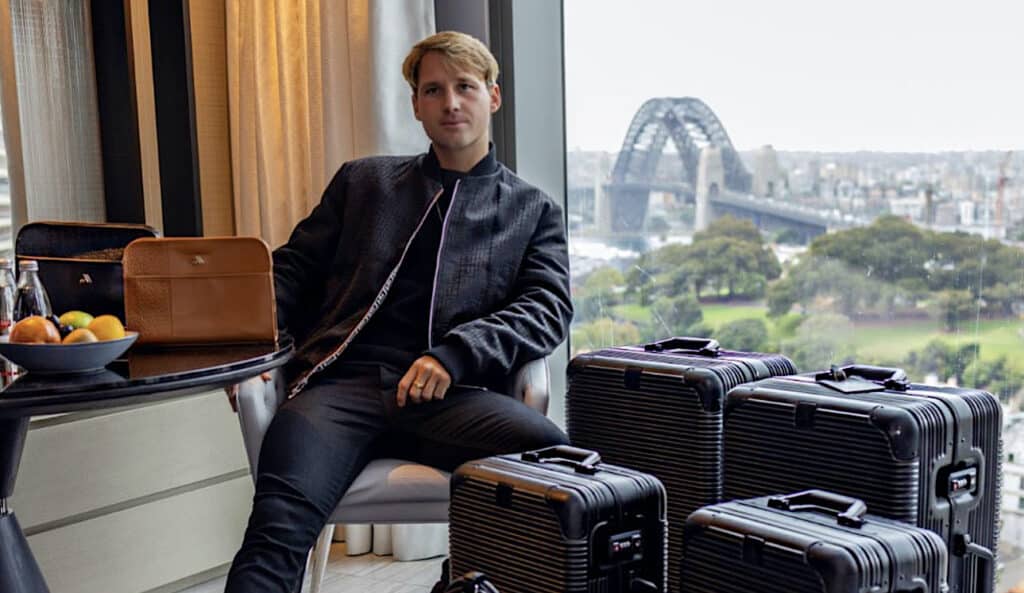
That’s why I brought on Aidan Walsh, founder of Aidan The Brand, an Australian pearl-farm kid who now runs a luxury luggage brand out of New York. He’s bootstrapped from a single carry-on case to tens of thousands of units a year, partnered with Bloomingdale’s, Macy’s and David Jones, and landed co-branded deals with the Dallas Cowboys and New York Yankees, all off his own back.
He also spent around 300 grand and three years doing the unsexy stuff like patents, sampling, factories and moulds, before most people would even admit they’d started.
This isn’t a ‘follow your passion’ story. It’s how to build a physical product business without going bankrupt, delusional or both.
From Pearl Farms To Planes: Turning A Weird Upbringing Into A Moat
Aidan didn’t grow up in a WeWork.
He grew up on a pearl farm off the coast of Western Australia, literally spending half his childhood at sea, half on land. His parents built one of the top three pearling operations in Australia, doing hundreds of millions in turnover, with 300–400 staff split between motherships and land-based operations.
As a kid, his jobs weren’t glamorous:
- Scraping barnacles off shells
- Cleaning algae and sea lice with a toothbrush
- Polishing boats
- Working his way up to skippering 50–65ft boats before he was even a teenager
That matters, because a lot of founders today are trying to build ‘luxury brands’ without ever having seen real luxury or doing any real work.
By his teens, Aidan was travelling with his parents, selling pearls to high-end buyers in France, Switzerland and Japan, the proper luxury world. Then, when most kids would have happily inherited the farm, he walked away.
He backpacked. Laboured. Met entrepreneurs in hostels and on boats. Eventually blagged his way into yacht broking in Monaco by pestering one of the top brokers on earth until the guy basically said:
‘Fly to Saint-Tropez and meet me. If you show up, I’ll know you’re serious.’
He showed up. With ten mates. Got the job.
From there:
- Yacht broking in Monaco
- Investing in hospitality concepts in LA and New York
- Learning how rich people travel, socialise and spend
So when he eventually decided to build a physical product business in luggage, it wasn’t random. He’d lived luxury. He understood travel. He knew materials, boats, engineering and rich people’s psychology.
Most of you have your own version of this sitting under your nose – industry knowledge, weird upbringing, niche obsession – and you’re ignoring it while you chase whatever’s trending on TikTok.
That’s your first lesson:
Your unfair advantage is probably behind you, not in front of you.
The Real Problem: You Think A Product Is The Business
Here’s the uncomfortable bit.
Most founders who want to sell ‘stuff’ make the same mistakes:
- They think the product is the business.
- They underestimate how long and expensive it is to get a world-class product.
- They assume ‘brand’ means fonts and a nice photoshoot, not IP, materials and distribution.
In my own career, I’ve imported containers of products that were basically the same generic junk 50 other people were selling. We stuck a logo on, hoped marketing would do the heavy lifting, and wondered why margins were crap and customers didn’t care.
Aidan did the opposite.
He spent years and serious money before he let the market see anything, because he wasn’t trying to flog luggage; he was trying to build a brand that belonged in the luxury travel space.
If you want to build a physical product business, the product is just the entry ticket. The real game is:
- IP (what you truly own)
- Engineering (why yours is better)
- Distribution (how it actually gets into people’s hands)
Most people skip all three and then tell themselves, ‘it’s a marketing problem.’
The Real Cost To Build A Physical Product Business
In 2019, after a big hospitality season in New York, Aidan was on a long-haul flight back to Australia. He was looking around the cabin and saw the same thing over and over:
Cheap, boring luggage. No pride. No status. No story.
Travel used to be glamorous. Now it’s tracksuits and generic hard shells.
So he opened his laptop and started digging into the luggage space. That was the moment the idea for Aidan The Brand was born.
Here’s what it actually cost.
3 Years Of R&D And About £300k
From 2019 to the end of 2021, he:
- Spent months in and out of factories in Asia
- Went through around 30 different factories before he found one that could build to his standard
- Learned that every small change – handle, wheel, dimensions – means a new mould
- Paid around $5,000 per mould just for a single carry-on
- Waited 45 days per sample to see if each idea actually worked
- Filed global patents and trademarks so the design and IP were properly his
By his own admission, he’s a perfectionist. Could he have done it cheaper? Yes.
But here’s the point:
‘Once you have that design, you own it. It’s yours.’
He wasn’t building a dropshipping store. He was building an asset.
I’ve blown six figures not doing this – selling into markets where I owned nothing, built no moat and got undercut by the next guy who found the same supplier. So when I hear someone spend 300 grand getting the foundations right, I don’t think ‘overkill’. I think ‘that’s what serious looks like’.
If you’re going to build a physical product business, be honest with yourself:
- Are you trying to make quick cash from arbitrage?
- Or are you actually trying to own something defensible in 5–10 years?
Those are different strategies. Pick one on purpose.
Design For Durability First, Aesthetics Second
Let’s talk about how he actually built the thing.
I’m the perfect example of the ‘smash it up’ customer. I travel a lot, I throw cases down stairs, airlines treat luggage like it owes them money. Historically, I’ve bought cheap bags because I assume they’ll get destroyed anyway.
Aidan decided to solve that tension:
‘Be a high-end brand, but an affordable one – entry-level luxury – and make durability non-negotiable.’
His approach:
- Shells
- Sourced from Germany, using aero-grade polycarbonate
- Built to handle the abuse we all know happens behind the scenes
- Interiors
- Suede, leather and internal materials sourced from Italy
- Assembly
- Done in Asia, but with components sourced globally based on who’s best at what
Most brands will do everything in one region because it’s easier. Same factory, same city, job done. The issue is you end up compromising somewhere, usually where the margin’s tightest.
Aidan did the harder thing: follow the quality, then figure out how to assemble it efficiently.
If you’re building a product:
- Identify the critical failure point (in luggage: shell and wheels).
- Spend more time and money fixing that, not obsessing over box colours.
- Source from where the expertise is, not just where the supplier is cheapest.
It’s not sexy. It does, however, keep your Trustpilot from turning into a car crash.

Your First 500 Units Are A Lab, Not A Payday
Aidan’s original launch plan was modest: 100 pieces of one carry-on, in black. One SKU. Keep it tight.
Then Covid hit.
Perfect time to launch a travel brand, right?
He pushed on anyway. His first container of 500 carry-on cases turned up in Perth. He popped the doors, and all the boxes literally fell on him because he hadn’t palletised them properly.
He and his mum spent 12 hours unloading 500 suitcases by hand into a warehouse. Covered in sweat, knackered, surrounded by boxes… but he was in.
Then he did something most of you wouldn’t:
He didn’t chase strangers. He went to friends and family first.
- Discounted pricing
- Some units were given away
- Real feedback from people who would actually tell him if it was shit
- Used cases during Covid: road trips, local travel, daily use
For six months, he treated those 500 units as a testing ground, not a profit centre.
That’s exactly how you should think about your first run:
Your first production run is tuition. Profit comes later.
If you try to squeeze every pound of margin out of batch one, you’ll rush the process, resist feedback and lock in flaws you’ll spend years apologising for.
From Shopify To Bloomingdale’s: Distribution Beats Hype
After the friends-and-family phase, Aidan launched properly in 2022 with 21 SKUs:
- Three suitcase sizes
- All black to start
- Soft goods: duffel bags, backpacks and daily-use pieces
Go-to-market:
- Direct-to-consumer via Shopify
- Build an email list
- Leverage his network and contacts from travel and hospitality
Then he did what most DTC ‘brands’ never do: he got serious about wholesale distribution.
Step 1: Luggage Where People Actually Buy Luggage
In Australia:
- David Jones
- Qantas Marketplace
- The Iconic
In the US:
- Bloomingdale’s
- Macy’s
- Multiple independent brick-and-mortar luggage stores in New York, Miami, LA, Dallas, Houston
He realised something very simple:
‘Anyone buying luggage will really go to a luggage store… not necessarily a department store.’
So he didn’t snub the ‘boring’ specialist retailers. He embraced them.
Too many founders are allergic to wholesale because they don’t like giving up margin. But if you’re in a low-frequency category like luggage, distribution is everything. People don’t buy a suitcase every month. When they’re finally ready, you need to be in front of them.
If you want to build a physical product business that lasts:
- Let go of the fantasy that pure DTC is always superior.
- Follow the buyer’s actual behaviour, not your ego.
- Use wholesale to build credibility and volume, then let your DTC benefit from the halo effect.
Step 2: Brand Partnerships That Actually Sell Units
This is where it gets clever.
By 2024, Aidan The Brand became:
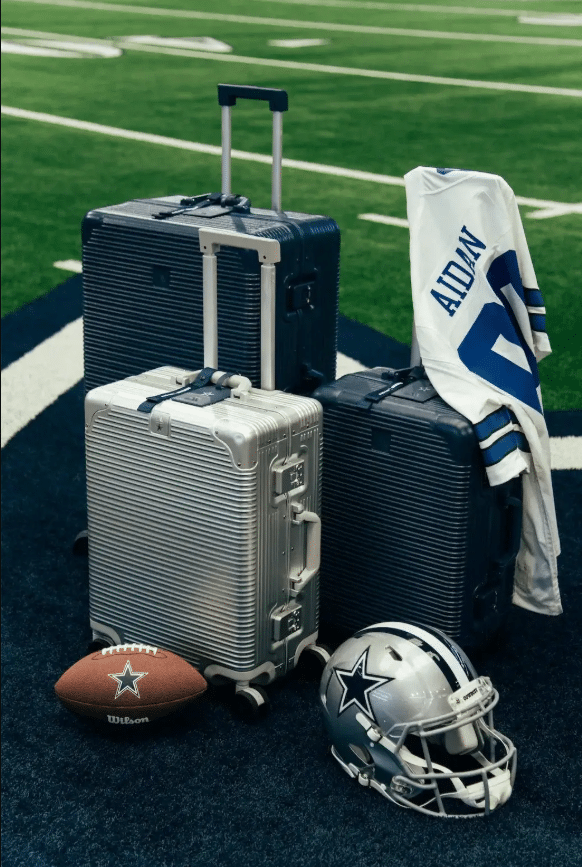
- Official luggage partner of the Dallas Cowboys
- Proud luggage partner of the New York Yankees
These aren’t just logos on a deck.
They’re co-branded products:
- New York Yankees luggage
- Dallas Cowboys luggage
- Sold in team stores and on Fanatics.com – the biggest sports merch platform on the planet
Result?
- Immediate distribution to millions of fans
- Built-in emotional connection (team pride + travel)
- Volume that pushes the brand towards hundreds of thousands of units a year potential
I’ve seen founders chase ‘influencer collabs’ that produce nothing but grid posts and zero sales. This is different. It’s distribution dressed as marketing.
Ask yourself:
- Who already has your ideal customer in one place?
- How could you build something physical that they can sell under both brands?
- How does that scale into real volume, not just vanity impressions?
That’s partnership done properly.
Mini Case Study: From Empty Warehouse To Stadium Screens
Let me connect the dots.
Starting point:
Aidan was stood in a warehouse in Perth with his mum, staring at 500 boxes they had just dragged out of a container by hand. No customers, no stockists, just a Shopify store and a stubborn idea.
What he did:
- Spent 3 years and ~300 grand getting the product right instead of rushing a prototype.
- Started small: 1 SKU, 500 units, friends and family to battle-test.
- Launched DTC, then aggressively chased specialist luggage stores where real buyers go.
- Layered on department stores and airline/marketplace listings.
- Landed NFL and MLB partnerships with co-branded products in team channels.
Where he is now:
- Moving 35,000–50,000 units a year
- On track to double that
- Doing a couple of million dollars in revenue, with upside towards 1 million units a year longer term
What this means for you:
You don’t need 27 products, 14 colourways and a viral TikTok sound.
You need:
- One genuinely good product
- A sober understanding of what it costs to get there
- A clear plan for where this thing will actually be sold
Everything else is noise.
Scar Tissue: Where I’ve Cocked This Up
Quick reality check from my side.
I’ve:
- Imported entire containers of products on a ‘gut feeling’ without ever testing demand properly
- Built no IP – so as soon as something worked, five competitors copied it and undercut us
- Trusted DTC alone and refused to ‘give away margin’ to wholesalers, then sat on stock for years
So when I tell you to slow down, validate properly and think about ownership and distribution, it’s not theory.
It’s because I’ve already done the dumb version, so you don’t have to.
A Simple 7-Day Plan To Move Your Product Idea Out Of Fantasy Land
If you’re serious about building a physical product business, here’s a week’s worth of work that’ll move you from daydreaming to doing.
Day 1 – Define Your Advantage
Write down, in brutal honesty:
- What unfair advantage you actually have (industry, contacts, skills, background)
- Why you, specifically, should be the one to build this product
If you can’t answer that, rethink the category.
Day 2 – Map The Real Buyer Journey
Forget what you wish would happen. Ask 10 people who’ve recently bought something similar:
- Where did they buy?
- How did they choose the brand?
- What nearly stopped them?
Highlight where wholesale, marketplaces or partnerships fit in. Don’t assume DTC is king.
Day 3 – Identify The Critical Failure Point
For your product, what’s the equivalent of:
- Luggage shells cracking
- Wheels snapping
- Zips failing
That’s where your engineering and material budget goes first. If you’ve got £10k to spend, put £8k there and £2k on ‘nice to haves’.
Day 4 – Price Your Reality, Not Your Fantasy
Write down:
- Expected R&D costs (sampling, travel, moulds, design)
- Minimum order quantities and deposits
- Patents/trademarks if relevant
Double it. That’s closer to the truth.
If the business doesn’t make sense at that level, don’t kid yourself that you’ll magically do it cheaper than everyone else.
Day 5 – Design A 100–500 Unit Test
Instead of daydreaming about selling 10,000 units, answer:
- What’s the smallest serious first run you can do?
- Who will you give/sell those units to for brutally honest feedback?
- How will you collect it? (Surveys, calls, DMs?)
Treat that run as paid research, not your retirement fund.
Day 6 – Build A Shortlist Of 5–10 Partners
Not influencers. Partners.
- Specialist retailers
- Organisations with fanbases (clubs, associations, events)
- Platforms (airlines, marketplaces)
Ask: ‘What product could we co-create that makes them money as well as me?’
Day 7 – Make One Ballsy Ask
Channel your inner Aidan, pestering that yacht broker.
Pick one person you think is out of reach, like a potential partner, supplier or mentor, and send a direct, specific ask.
Something like, ‘Can I come to your office and show you the prototype?’ or ‘Can I buy you lunch and ask how you’d structure this deal?’
If they say ‘fly to Saint-Tropez’, book the flight.
The Big Lesson
The big lesson from Aidan’s journey is simple:
A physical product business isn’t built on vibes. It’s built on materials, margins and distribution, with your story layered on top.
If you treat it like a side hustle, it will pay you like one.
If you treat it like a serious long-term asset, understanding the cost, doing the work, owning the IP and getting the product in front of real buyers, then yeah, you might end up with your logo rolling through airports and NFL stadiums instead of gathering dust in a storage unit.
You don’t have to spend 300 grand to learn this.
But you do have to get out of fantasy mode and into the real game.
Ready To Get Your Product Idea Out Of Fantasy Land?
If you’ve read this and realised your physical product idea lives more in your head than in the real world, do something about it.
Pick one product you’re serious about, and get it torn apart properly: the costs, the margins, the IP and the distribution. Whether that’s a deep-dive call, a proper audit, or watching a full breakdown episode, the point is the same:
Stop guessing. Start building like a grown-up.
If you know this is a real goal for you and not just something you talk about in the pub, take the next step and get an honest review of your plan before you start writing big cheques.
For more expert insights from those who have been there and done that, check out my No Bollocks Podcast for way more like this.
Listen to the Full Podcast
FAQs with Aidan Walsh
How much money do you really need to build a physical product business?
It depends on the complexity of the product, but it’s almost always more than you think. Aidan spent around 300 grand over three years on R&D, sampling, moulds and IP before his first full launch.
Even if you don’t go that far, you’ll still have to cover design, sampling, minimum orders and basic IP. Run the numbers honestly, double them, and ask yourself if the business still makes sense.
Is it worth investing in patents and trademarks for a small product brand?
If you’re just arbitraging generic products, probably not. If you’re serious about building a defensible brand with unique design or engineering, then yes. Trademarks are a no-brainer, and patents can be a powerful asset. Aidan filed global patents and trademarks before launch because he knew he wanted something he truly owned, not just a logo.
Should I start DTC only, or go straight to wholesale?
Start where you can move fastest and learn cheapest – DTC is good for that – but don’t get religious about it. Aidan launched DTC, then leaned hard into luggage stores, department stores and big partnerships because that’s where people actually buy suitcases.
If your buyers are used to going into specialist shops, ignoring wholesale is just self-sabotage.
How do I stop my physical product becoming a commodity?
Own something others can’t just copy overnight. That might be:
- A genuinely better design or material choice
- A protected IP position
- Exclusive partnerships and distribution (like sports teams or airlines)
Aidan didn’t just make another black suitcase; he obsessed over durability, sourced materials from Germany and Italy, and then plugged into the Dallas Cowboys and Yankees ecosystem. That’s very different to a random Amazon seller.
What’s the biggest mistake new product founders make?
They confuse ‘having a product’ with ‘having a business’. They rush to launch, underinvest in engineering, ignore IP, and have no real distribution plan. Then they blame marketing. The smarter move is to start smaller, test harder, and think about where and how this thing will actually be sold long before you obsess over Instagram shots.