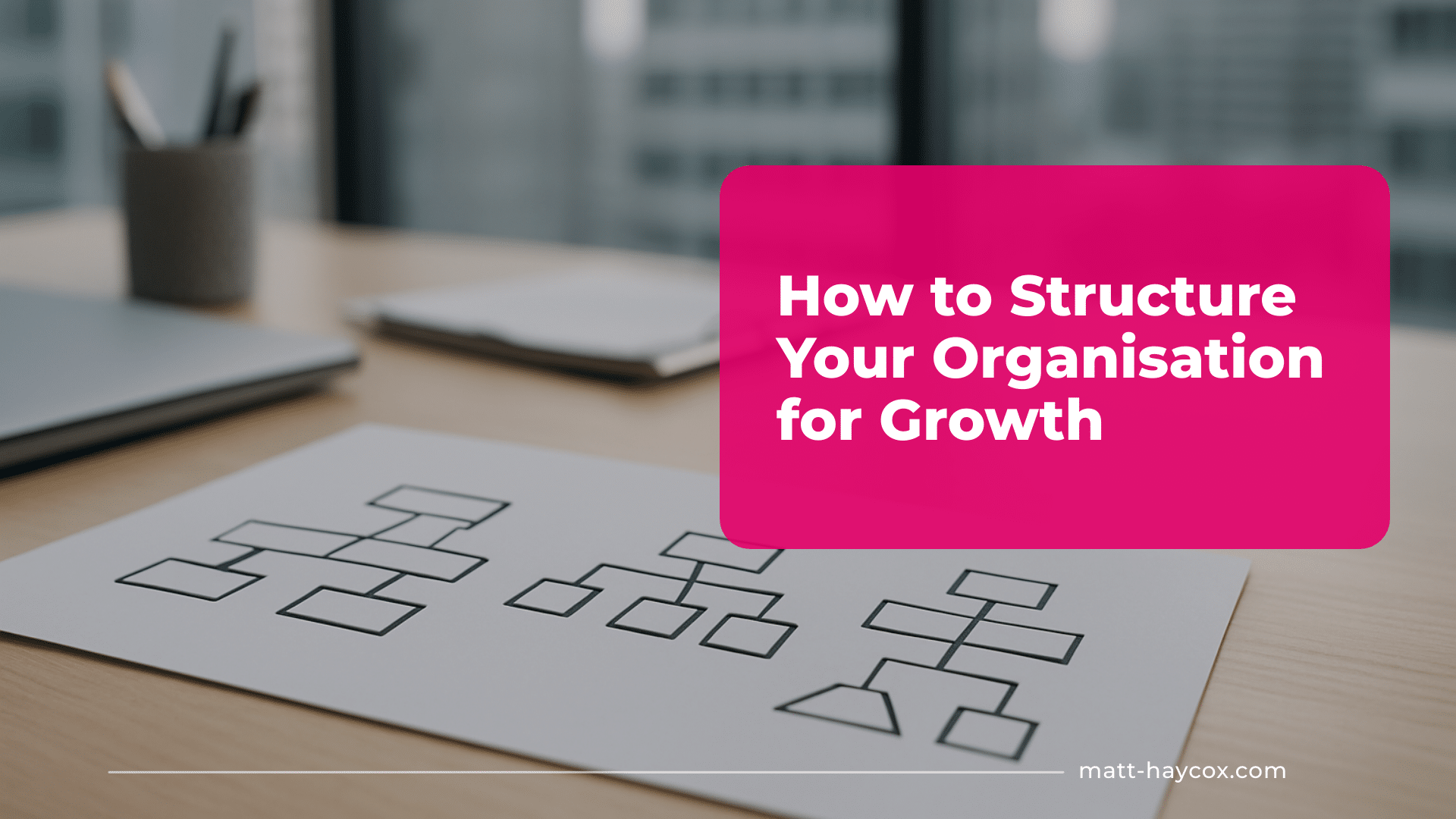

If you want organisational growth, your biggest constraint usually is not marketing, it is how work moves through your business. Fix the structure and the same people deliver more, faster, with less drama. If you need a broader scaling reference point, cross-reference Business Growth: The Complete Scale-Up Playbook for Founders as you read this.
In this article, we’re going to discuss how to:
- Choose an org design that matches your stage, margins and delivery model
- Test pods, squads, vertical leads and hybrid structures in 7 to 14 days
- Put guardrails in place so growth doesn’t eat your time and profit
What Organisational Growth Actually Means In Practice
Organisational growth is your ability to increase output, quality and speed without increasing founder oversight at the same rate. In plain terms: you can add customers, revenue and complexity, and the business still runs on a clear operating rhythm.
Here’s a quick sense-check. Organisational growth is working when:
- Cycle time drops: Work moves from request to done faster, even as volume rises.
- Span of control is healthy: Leads manage 4 to 8 direct reports with clear accountability.
- Margin holds: Gross margin stays within 3% to 5% of target as you add headcount.
- Decisions move down: Teams don’t need you for routine trade-offs.
If the opposite is happening, you are not scaling, you are just getting busy.
Start With Evidence: The 2-Hour Org Design Audit
Before you redesign anything, pull data you already have. Don’t start with job titles and boxes, start with flows, constraints and money.
Internal Signals To Gather First
You can pull most of this in a couple of hours from your finance tool, CRM and project system:
- Revenue mix: Top 10 customers, product lines, delivery types, renewal dates.
- Gross margin by line: If you don’t have it, approximate with delivery hours x blended cost rate.
- Demand pattern: Lead source, sales cycle length, close rate, average deal size.
- Delivery load: Current work-in-progress, average handoffs per project, missed deadlines in the last 30 days.
- Founder dependency map: List the last 25 decisions you made. Group them by theme.
Completion check: you should be able to say, in one sentence, where the bottleneck is. Example: ‘Sales is fine, fulfilment is blocked by approvals and specialist availability’.
Public Signals That Help You Avoid Navel-Gazing
Then do a quick external scan. You are looking for proof of how your market organises work, not inspiration.
- Competitor job ads: Look for repeated roles like ‘Implementation Lead’, ‘Customer Success Manager’ or ‘Category GM’. That shows their operating model.
- LinkedIn org hints: Search who reports to whom. You will see patterns like pods by segment or squads by product.
- Pricing pages: Packaging shapes structure. If competitors sell tiers, they often organise by customer segment.
Completion check: write down 2 organisational patterns you see in the market and whether they fit your margins.
Match Structure To Your Offer Before You Hire
Most org design problems are offer problems in disguise. If your offer is vague, every team becomes a custom project team, and the founder becomes the translator.
Use this one-sentence offer template and fill it in:
Offer template: ‘We help [ideal customer] achieve [measurable outcome] in [timeframe] without [common pain], using [your method], for £[price] with [clear deliverable].’
Once you can say that clearly, your org structure becomes a question of what work needs to happen repeatedly to deliver that promise.
Pods: The Fastest Way To Scale Delivery Without Losing Quality
A pod is a small, repeatable unit that owns an end-to-end outcome for a defined customer segment or service line. Think of it as a mini business inside the business: fewer handoffs, faster decisions.
When Pods Work Best
Pods are strong when you sell repeatable work with clear demand, like implementation, paid media management, bookkeeping or onboarding.
Typical pod shape:
- Pod lead: Owns delivery outcome, quality and resourcing.
- Producer(s): Do the core work.
- Client-facing role: Owns updates, expectations and renewals.
- Specialist access: Shared experts used on a schedule, not on-demand.
Pod Guardrails That Protect Margin
Pods fail when they become a free-for-all. Set rules that make the system stable:
- Capacity cap: A pod should run at 80% planned utilisation, not 100%. The 20% is for surprises.
- Standard handoff: One intake form, one definition of done, one weekly pod review.
- WIP limits: No more than 3 active projects per producer at once.
Quick calc you can do today: if a pod has 2 producers at 30 hours per week of billable capacity each, that is 60 hours. At a blended delivery cost of £35 per hour and a client billing rate equivalent of £100 per hour, your gross margin is roughly (100-35) / 100 = 65%. If your actual margin is 40% to 45%, your structure is not the problem, your scope and packaging is.
Squads: Build Speed When Product And Tech Drive Value
A squad is a cross-functional team that owns a product or customer journey slice, not a segment. Squads suit businesses where value is created through continuous improvement, releases and experiments.
When Squads Beat Pods
Use squads when the work is discovery-led and you need tight collaboration between functions, like product, engineering, growth and design.
A practical squad setup:
- Product owner: Owns priorities and ROI.
- Tech lead: Owns architecture, quality and delivery cadence.
- Delivery manager: Owns flow, blockers and cadence.
Key metric: lead time from idea to shipped. If it takes 8 weeks to ship a change that should take 8 days, you have too many dependencies or the wrong structure.
Validation Path: A 10-Day Squad Pilot
Don’t reorganise the whole company. Pilot one squad on one measurable outcome, with a fixed timebox.
- Day 1: Pick one outcome, for example ‘reduce onboarding drop-off from 38% to 30%’.
- Days 2 to 3: Map the journey, identify 3 bottlenecks, choose 1 experiment.
- Days 4 to 9: Build and ship, no side quests.
- Day 10: Review impact, then decide: keep, tweak or kill.
Completion check: the squad should produce a shipped change and a before and after metric, not a deck.
Vertical Leads: The Simple Structure That Stops Founder Bottlenecks
Vertical leads is the classic functional structure done properly. You appoint accountable leaders for Sales, Marketing, Delivery, Customer Success and Finance or Ops. They run their functions and negotiate capacity with each other through a weekly operating rhythm.
This model is boring, which is why it works. It is the fastest route to lowering founder involvement if your business is still building basic management muscle.
What To Put In A Vertical Lead Role Description
Keep it outcome-based, not task-based. Example:
- Sales lead outcome: £250k pipeline added per month with 25% win rate, average cycle under 30 days.
- Delivery lead outcome: 90% on-time delivery and 50%+ gross margin at the project level.
- CS lead outcome: Net revenue retention at 105%+ with churn below 2% monthly.
Completion check: each vertical lead should have 3 to 5 metrics they own end-to-end, and the authority to make trade-offs.
Hybrid Structures: Where Most Real Companies End Up
Hybrid structures combine functional leadership with pods or squads. That is not a compromise, it is usually the most sensible answer.
A common hybrid: vertical leads own standards, hiring and capability. Pods own customer outcomes and daily priorities. This gives you consistency without killing ownership.
A Simple Hybrid Blueprint You Can Copy
Use this structure when you have 10 to 50 staff, multiple customer segments and a growing delivery team:
- Head of Delivery: Owns quality, capacity planning and training.
- Pod leads: Own delivery outcomes for segment A, segment B and enterprise.
- Shared specialists: One data analyst, one designer, one solutions architect, scheduled across pods.
Guardrail: pod leads can prioritise work inside their pod, but they cannot change service scope, pricing or delivery standards without the functional owner signing off.
How To Choose The Right Structure For Organisational Growth
If you are debating structures in abstract, you will pick based on taste. Use a decision scorecard instead. Rate each statement 1 to 5 and choose the model that best fits your answers.
- Work repeatability: Our work is packaged and repeatable.
- Dependency level: Our work needs frequent cross-functional collaboration.
- Customer segmentation: Different segments need meaningfully different delivery.
- Founder dependency: Too many decisions still route through the founder.
- Margin stability: We can measure gross margin by customer or project.
Interpretation:
- High repeatability + high segmentation: Pods.
- High dependency + product-led value: Squads.
- Low management maturity: Vertical leads first, then hybrid.
This is the core of organisational growth: pick the minimum structure that removes the current constraint, then review every 90 days.
Pricing And Unit Economics That Hold At Small Scale
You cannot design a sane organisation on weak unit economics. If each deal is different, your staffing model becomes guesswork.
Set A Minimum Viable Margin Rule
Pick a floor you will protect. For many service businesses, that is 50% gross margin. For software, it might be 80%+. If you cannot hit the floor, you are buying revenue and borrowing pain from the future.
Use a basic delivery allowance per client:
- Monthly price: £2,000
- Target gross margin: 55%
- Max delivery cost: £900
- If your loaded cost rate: £45 per hour
- Allowed hours per month: £900 / £45 = 20 hours
Now your pod lead can manage to an allowance, not a feeling. That is how you scale without constantly renegotiating reality.
Two Pricing Moves That Make Structure Easier
Keep it practical:
- Tier by outcomes, not effort: Include a clear deliverable and response time in each tier.
- Charge for complexity: Add-ons for integrations, multi-site, custom reporting or dedicated support.
Operational Guardrails That Protect Margin And Founder Time
Once you pick a structure, you need operating rules that stop the same chaos reappearing with new names.
Three Rituals That Pay For Themselves
Keep them short and consistent:
- Weekly capacity review (30 minutes): Compare planned vs actual hours, update next 2 weeks.
- Weekly KPI huddle (20 minutes): One dashboard, no storytelling, owners commit to next actions.
- Monthly pricing and scope review (60 minutes): Review the top 10 margin leaks, fix packaging or terms.
Artefacts You Should Be Able To Show Tomorrow
If your structure is real, it leaves evidence. Build these once and keep them current:
- One-page accountability map: Who owns what, who approves what, who is consulted.
- Service catalogue: What you do, what you do not do, and what it costs.
- Escalation ladder: What teams handle, what leaders handle, what the founder sees.
Completion check: if a new hire cannot answer ‘who decides this?’ in under 60 seconds, your design is not yet operational.
Mini Examples: How Different Structures Play Out
Here are four micro cases, all real-world patterns. Use them to sanity-check your own situation.
Case 1: Leeds Marketing Agency Using Pods
A 12-person agency kept missing deadlines because every client request became a mini project. They created 2 pods, each with a lead, 2 producers and one shared designer. Within 30 days, on-time delivery moved from 70% to 88%, and weekly founder interruptions dropped by half.
Case 2: Manchester SaaS Company Using Squads
A B2B SaaS business had 5 engineers working in functional silos and shipping monthly. They formed one onboarding squad and ran a 10-day pilot. Activation went from 42% to 51% and support tickets per new user dropped 18% because fixes shipped faster.
Case 3: Bristol Consultancy Moving To Vertical Leads
A consultancy scaled to £1.8m but the founder still approved every proposal and plan. They appointed a Delivery lead and a Sales lead with clear targets and approval limits. In 6 weeks, proposal turnaround fell from 5 days to 2 days and founder time freed up by 8 hours a week.
Case 4: London E-commerce Brand Using A Hybrid
A brand had a functional marketing team but constant conflict with ops and CX. They created a retention pod that included one CX lead, one email marketer and one analyst, while functional heads kept standards. Repeat purchase rate increased from 23% to 27% over 60 days with no headcount increase.
Common Risks And How To Hedge Them
Most re-org pain is predictable. Plan for it and you will avoid a costly reset.
Risk 1: You Rename Roles But Keep The Same Decisions
If the founder still approves pricing, scope and hiring, the structure is theatre. Hedge it by setting explicit decision rights and a spending limit per lead.
Risk 2: Pods Become Mini Kingdoms
Pods can drift into inconsistent quality and duplicated work. Hedge it with functional standards, shared training and a monthly quality review led by the functional owner.
Risk 3: Squads Ship Fast But Break Things
Speed without quality will bite you in 90 days. Hedge it with a definition of done that includes tests, documentation and a release checklist.
Risk 4: You Over-Hire To Compensate For Bad Flow
Headcount masks broken systems until cash gets tight. Hedge it by adding a WIP limit and measuring cycle time before you add people.
A Practical Do And Don’t Checklist Before You Reorganise
- Do: Start with where margin leaks and decisions stack up, not with titles.
- Do: Pilot one team in 7 to 14 days and measure one outcome.
- Do: Write decision rights down and publish them.
- Don’t: Change the whole org chart at once and hope the work sorts itself out.
- Don’t: Add layers just to feel ‘grown up’.
- Don’t: Let custom work creep into your core offer without charging for it.
Build Your Leadership Operating Rhythm
If you want your new structure to stick, you need a simple cadence that makes accountability real. Download the Leadership Operating System (LOS): Weekly Rituals for High-Growth Teams and use it to set weekly reviews, decision rights and KPI ownership, so your organisational growth is built on routines, not motivation.
- Your structure should match your offer and your constraints, not your ego or a trendy org chart.
- Validate pods, squads, vertical leads or a hybrid with a small pilot and one measurable outcome, while protecting gross margin with clear allowances.
- Guardrails like capacity caps, WIP limits and decision rights stop growth from stealing your time and turning profit into overtime.
FAQ For Structuring Your Organisation For Growth
What is the biggest sign my org structure is holding back organisational growth?
If routine decisions keep escalating to you, your structure lacks clear decision rights. You will also see rising lead time, more handoffs and margin wobble as volume increases.
Should I use pods or vertical leads first?
If your offer is repeatable and delivery is the constraint, start with pods. If you have weak management accountability and everything routes through you, install vertical leads first then move to a hybrid.
How many people should be in a pod?
Start with 4 to 7 people including a pod lead, producers and a client-facing role. If a pod needs more than 8 to 10 people to function, split it or you will recreate a department with slower decisions.
How do I stop pods from duplicating work?
Keep capability standards central, for example QA checklists, templates and training, and let pods own priorities and outcomes. Run a monthly cross-pod review where you remove duplication and agree changes to standards.
What metrics should I track to prove the new structure is working?
Track one flow metric, one money metric and one customer metric, for example cycle time, gross margin and churn. Review them weekly for the first 6 weeks so you catch drift before it becomes culture.
How do I test a new org design without upsetting everyone?
Run a timeboxed pilot with clear rules, a single objective and an agreed review date. Tell the team it is a test, measure the result and commit to keeping what works and dropping what does not.
When do squads make more sense than pods?
Squads win when product changes, experiments and releases are the main value driver. If your bottleneck is delivery consistency and scope control, pods usually deliver organisational growth faster.