
If your team keeps asking the same questions, your business isn’t ‘busy’, it’s leaking time and margin. The fix is rarely more people, it’s clearer processes that make good work repeatable. If you want the wider systems view, cross-reference Business Operations: The Complete Systems Playbook for SMEs as you read this.
In this article, we’re going to discuss how to:
- Separate processes from tasks and workflows so everyone uses the same language
- Capture the minimum artefacts you need to run a process without bureaucracy
- Validate and price a process so it holds margin at small scale
What Is A Business Process In Practical Terms?
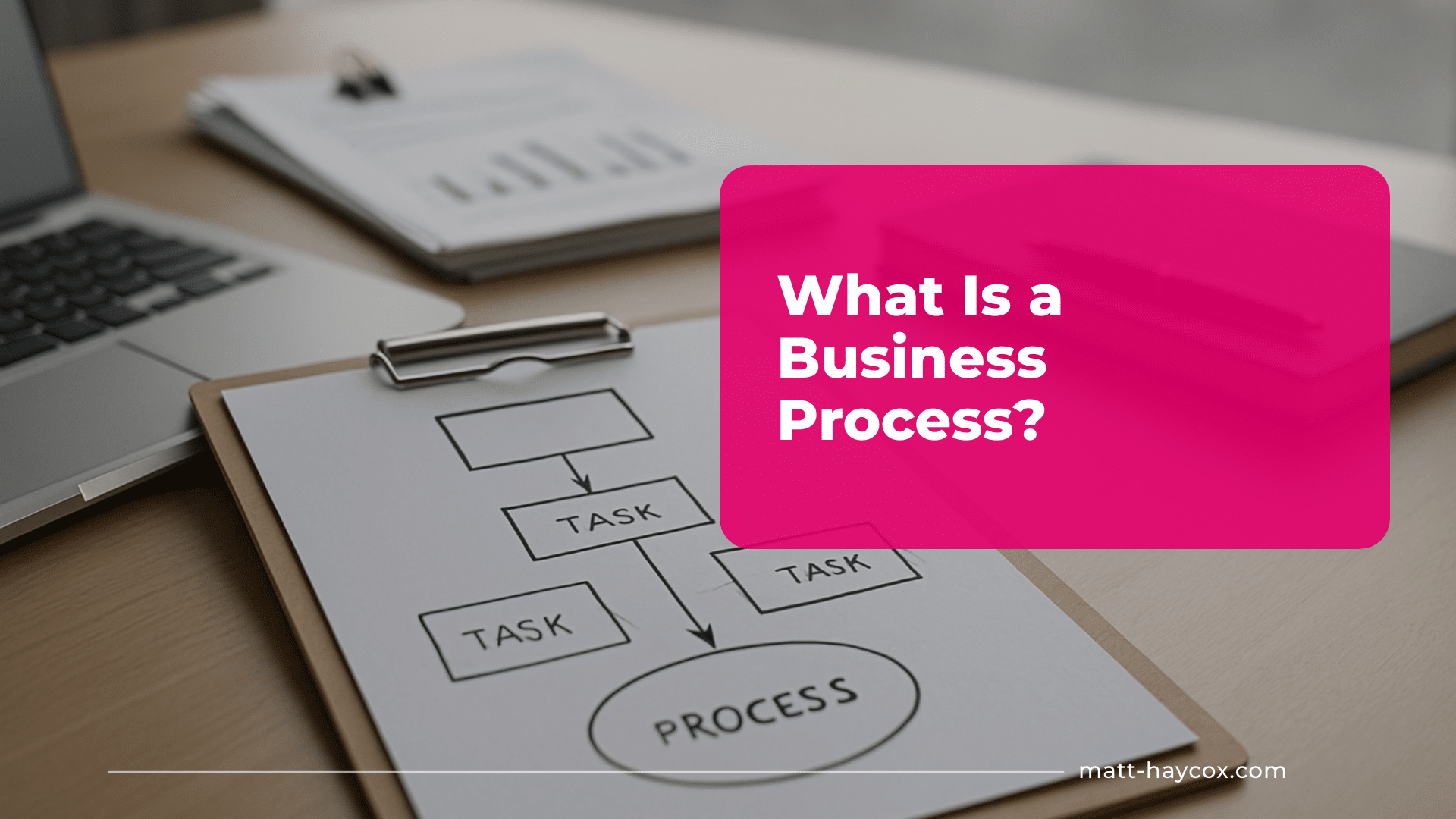
Here’s the straight answer to ‘what is a business process’: it’s a repeatable sequence of steps that turns an input into a measurable outcome, with a clear owner, clear handoffs and a defined completion check.
Processes exist to produce outcomes you can trust, not to create paperwork. If you can’t tell whether the outcome was achieved, you don’t have a process, you have ‘effort’.
- Input: A trigger like ‘new lead submitted’ or ‘invoice overdue by 14 days’.
- Outcome: Something you can evidence, like ‘proposal sent within 24 hours’ or ‘cash collected’.
- Owner: One role accountable, even if five people contribute.
- Standard: A few rules that define ‘good’, not a novel.
- Measurement: A number that tells you if it’s working, weekly.
If you’re still wondering ‘what is a business process’ in your business, the fastest check is this: can a capable person follow it without you, and hit the same result?
Processes Vs Tasks Vs Workflows: The Operator’s Distinction
Teams get messy because they use these words interchangeably. Stop that and a lot of operational friction disappears.
A task is one action. ‘Send the invoice.’ ‘Call the customer.’ It has a start and finish, but it doesn’t guarantee an outcome.
A workflow is the movement of work between people or systems. It’s the routing: who gets notified, who approves, what tool it sits in. Workflows are often visual, like a Kanban board or a CRM pipeline.
A process is the end-to-end path to a result, usually made up of multiple tasks and one or more workflows. It includes the decision points, standards and completion checks.
A Quick Test You Can Use In A Meeting
When someone says ‘our onboarding process is broken’, ask these three questions:
- What outcome are we trying to produce? If they can’t answer, you’re not talking about a process yet.
- Where does it start and end? ‘When we win the deal’ is not a start, it’s a milestone. Start is a trigger.
- How do we know it’s done? If it’s ‘when the client is happy’, you need a measurable proxy.
This distinction matters because you improve different things. You optimise tasks with training, you optimise workflows with tools and handoffs, you optimise processes with standards, ownership and metrics.
The Minimum Artefacts Every Process Needs
You don’t need a 40-page SOP to run a decent operation. You need a small set of artefacts that make execution consistent and measurable.
Build your processes with these five components, in this order:
- Name and purpose: One sentence on what the process achieves and for who.
- Trigger and scope: What starts it, what’s included, what’s excluded.
- Steps with decision points: The shortest path to the outcome, with ‘if this, then that’ moments.
- Definition of done: Evidence you can check, like ‘welcome email sent, contract countersigned, first delivery booked’.
- Metrics and cadence: One leading metric and one lagging metric reviewed weekly.
That’s enough to run. Anything beyond that should earn its place by reducing errors or increasing speed.
How To Find The Right Processes To Fix In 2 Hours
The trap is documenting everything. Instead, identify the processes that drive revenue, delivery and cash, then tighten those first.
Start With Internal Signals (60 Minutes)
Pull the data you already have. You’re looking for friction, delays and rework.
- Sales: Lead to call booked time, proposal turnaround time, win rate by lead source.
- Delivery: Time from start to first value delivered, rework rate, missed deadlines.
- Cash: Days sales outstanding, % invoices disputed, average time to resolve disputes.
- Support: Top 10 ticket reasons, time to first response, time to resolution.
Pick the one area where a 10% improvement would be felt immediately. For most SMEs, it’s client onboarding, quoting, billing or issue resolution.
Then Check Public Signals (30 Minutes)
Now look outward to confirm what customers care about. This stops you optimising the wrong thing.
- Competitor reviews: Look for repeated complaints, like ‘slow to respond’ or ‘unclear timelines’.
- Your own reviews and churn reasons: Categorise them into themes, don’t just read them.
- Job ads: If competitors hire ‘implementation managers’ or ‘customer success’, that’s a clue where process maturity sits in the market.
Use this as triangulation, not as your primary dataset. Your internal numbers tell you where the operational bleeding is.
Write The Offer First, Then Build The Process Backwards
Most teams document what they currently do, then wonder why it doesn’t scale. Flip it. Start with a clear promise, then design the steps that make it true.
Here’s a one-sentence offer template you can fill in:
‘We help [customer type] achieve [measurable outcome] in [timeframe] without [common pain], using [your method], for £[price].’
Now map the process backwards from the outcome. Ask: what must be true 24 hours before completion, then 7 days before, then at the start? This forces you to define prerequisites, handoffs and evidence.
Example: if you promise ‘first qualified leads in 10 days’, your process must include access requests, tracking setup, approval windows and a hard stop when the client drags their feet. Otherwise your promise becomes a hostage negotiation.
Validate With 7 To 14 Day Micro-Tests Before You Standardise
Before you turn anything into a formal process, run small tests that prove the steps work and the numbers hold. You’re validating two things: customer behaviour and operational cost.
Use this simple validation path:
- Test 1, 48 hours: Run the process manually on one real case, time every step in minutes.
- Test 2, 7 days: Run it on 3 customers, same offer, same timeline, track where it breaks.
- Test 3, 14 days: Hand it to someone else with your artefacts and see if they can hit the outcome.
Completion check: if the outcome is consistent on 3 runs and a second person can execute it with less than 20% extra time, you’re ready to standardise.
Pricing And Unit Economics That Don’t Collapse At Small Scale
A process is only useful if it’s profitable. If it takes you 6 hours longer than you assumed, your ‘great service’ turns into a loss leader.
Here’s a quick unit economics model you can run this week:
- Step time: Track minutes per step for one full run.
- Blended delivery cost: Use a realistic hourly cost, not salary divided by hours. Include employer costs and overhead allocation. Example: £35 per hour.
- Gross margin target: Set a floor. For many service SMEs, 60% gross margin is a decent target, adjust for your category.
Micro calc: If a client onboarding process takes 4.5 hours end to end and your blended cost is £35 per hour, your delivery cost is £157.50. If you charge £500 for setup, gross margin is 68.5%. If it takes 8 hours, cost is £280 and margin drops to 44%. That’s the difference between growth and stress. To achieve sustainable growth, you need to systemise your business.
Now tie pricing to the process, not to vibes. If you can’t improve the time, improve the price, narrow the scope or change the promise.
Operational Guardrails That Protect Margin And Time
Processes fail when they get bypassed or stretched. Guardrails stop a small exception turning into your new normal.
Put These Rules In Writing
- Entry criteria: What must be true before the process starts, like ‘signed agreement’ or ‘deposit paid’.
- WIP limit: A hard cap on how many live cases can sit in the process at once, per person or per team.
- Timeboxes: A maximum time you’ll wait for inputs. Example: ‘We pause delivery if we’re missing access for 5 working days’.
- Escalation triggers: When to involve a manager, based on time or risk, not emotion.
- Scope boundaries: What’s included and what becomes a paid change request.
Guardrails are not about being difficult. They’re how you protect the customer experience and your team’s sanity at the same time.
Three Mini Examples You Can Borrow
These are small, real-world process patterns you’ll recognise. Notice how each one has a trigger, an owner and a measurable completion check.
Example 1: Paid Discovery For A B2B Agency
Trigger: inbound lead asks for a proposal. Owner: account lead. Steps: qualify in 15 minutes, sell paid discovery, run 90-minute workshop, deliver a 2-page plan within 48 hours. Completion check: plan delivered and signed off, next step booked. Metric: % qualified leads that accept paid discovery.
Example 2: Returns Handling For An Ecommerce Brand
Trigger: customer requests return. Owner: support lead. Steps: confirm order, send label, inspect within 24 hours of receipt, refund or replacement decision. Completion check: customer notified and refund processed. Metric: average resolution time and % returns due to product issues.
Example 3: Monthly Close For A 12-Person Consultancy
Trigger: last day of month. Owner: finance manager. Steps: timesheets locked by day 2, invoices drafted by day 3, approvals by day 4, sent by day 5. Completion check: all invoices sent, aged debt report produced. Metric: invoice value sent by day 5 and days sales outstanding.
If you want a deeper look at turning these into repeatable systems, refer back to Business Operations: The Complete Systems Playbook for SMEs and build out your process library from there.
Common Risks And How To Hedge Them
Most operational mistakes are predictable. Here are the ones that waste the most time, plus simple hedges.
Risk: You document a process that only works with your personal involvement.
Hedge: Run the ‘second person’ test within 14 days. If they can’t execute, your process is missing standards or decision rules.
Risk: You confuse workflow tools with process design.
Hedge: Define the outcome and completion check first, then build the workflow in your tool. Software doesn’t create clarity.
Risk: Exceptions become the norm and margin disappears.
Hedge: Put entry criteria and scope boundaries into your proposal and onboarding, then enforce them politely and consistently.
Risk: You measure only lagging metrics like churn and profit.
Hedge: Add one leading metric per process, like ‘time to first value’ or ‘proposal sent within 24 hours’.
Risk: You overbuild documentation and nobody reads it.
Hedge: Keep the core artefacts to one page, then add short checklists only where errors are expensive.
Download The Business Systems Blueprint And Turn This Into Action
If you want to turn ‘what is a business process’ into something your team can actually run, download the Business Systems Blueprint: How to Systemise Your Entire Operation and use it to map your top 3 revenue and delivery processes this week.
Key Takeaways
- A business process is an end-to-end, owned sequence that turns a trigger into an evidenced outcome, not a list of tasks.
- Validate processes with 7 to 14 day micro-tests and a simple time and cost model, so pricing and margin hold early.
- Guardrails like entry criteria, WIP limits and escalation triggers protect delivery quality, time and profit as you grow.
FAQ For Business Processes
What Is The Difference Between A Process And A Procedure?
A process is the end-to-end path to an outcome, including handoffs, decisions and metrics. A procedure is the detailed ‘how’ for a specific step inside that process.
How Many Steps Should A Business Process Have?
As few as possible while still producing a consistent result. If you can’t explain the process on one page, you’ve probably mixed multiple processes together.
Who Should Own A Process In A Small Business?
One role should be accountable for the outcome, even if several people contribute tasks. If ownership is shared, accountability disappears and the process degrades.
How Do I Measure If A Process Is Working?
Use one leading metric to catch issues early, like cycle time or first response time, and one lagging metric like conversion rate or defect rate. Review both weekly and change only one variable at a time.
When Should I Automate A Process?
After you’ve run it manually enough times to know the decision rules and typical exceptions. Automating a broken process just makes the wrong results happen faster.
What’s The Fastest Way To Document A Process Without Killing Momentum?
Record one real run, write the steps as a short checklist and add a clear completion check. Then test it with a second person and tighten only what causes errors or delays.
How Do Processes Improve Customer Experience?
They remove avoidable waiting and reduce inconsistent delivery, which customers feel immediately. Good processes also make timelines and expectations explicit so trust goes up.
What Is A Business Process Example For A Solo Founder?
A simple sales follow-up process works well: trigger is ‘new enquiry’, steps are ‘reply within 2 hours, book call, send proposal within 24 hours’, completion check is ‘proposal sent and follow-up scheduled’. The metric is response time and proposal-to-win rate.