
Most founders undercharge because they let the client set the first number, even if it’s unspoken. If you want to raise prices without losing good customers, you need a tighter frame, a better anchor and the confidence to hold it. For the wider context, cross-reference Pricing Strategy for Your Businesses: The Complete Playbook before you start changing anything.
In this article, we’re going to discuss how to:
- Set A credible anchor that makes your price feel fair
- Use anchoring in proposals and calls without sounding salesy
- Validate higher pricing in days and protect margin with simple guardrails
What Anchoring Really Means In Sales Conversations
Anchoring is the deliberate act of setting the first meaningful reference point for value and price, so the rest of the conversation happens in your range, not theirs. In practice, it’s not about ‘tricking’ anyone. It’s about stopping price from being the first thing your buyer evaluates you on.
A practical definition you can use with your team: Anchoring is framing the size of the problem and the size of the outcome, so your fee is judged against impact, not effort.
Quick sense-checks that your anchor is doing its job:
- You’re comparing options, not defending a single number.
- The buyer repeats your numbers back (revenue, time saved, risk reduced), not just your fee.
- Your price is spoken after value, not before discovery is done.
- You can walk away because the unit economics still work without discounting.
Why Anchoring Works, And When It Backfires
Buyers need a frame. When there’s uncertainty, they lean on the first solid figure they hear, then adjust from there. That’s why a £12k offer can feel ‘reasonable’ if it’s positioned against a £80k problem, and ‘expensive’ if it’s positioned against a £2k freelancer quote.
Anchoring backfires when founders use it as theatre, not logic. If you throw out a massive number with no evidence, you don’t create a premium perception, you create mistrust.
Use anchoring when:
There’s a measurable outcome, a real risk, a time constraint or a decision the buyer has to make anyway.
Avoid anchoring when:
The outcome is vague, the scope is messy or you haven’t diagnosed the problem well enough to put money on it.
The Data You Can Pull In 2 Hours Before You Set An Anchor
Most pricing mistakes come from anchoring to your costs or competitors instead of the buyer’s reality. Do a quick evidence sweep before you write a proposal or jump on a call. Start internal, then go public.
Internal Signals (60 Minutes)
Pull these from your CRM, time tracking and bank feed. Don’t overthink it, you’re looking for ranges.
- Deal velocity: Average days from first call to signed, plus where deals stall.
- Discount rate: What % of deals needed a discount, and how big.
- Delivery drag: Where your team spends time that the client doesn’t value (rework, meetings, change requests).
- Best customers: The top 10 accounts by gross margin, not revenue, and what they bought.
A useful anchor baseline: if your top-margin customers happily buy at £X, your anchor should be set so that £X is your ‘middle’ option, not your ceiling.
Public Signals (60 Minutes)
You’re not copying pricing here, you’re calibrating what the buyer already believes is normal.
- Alternatives: 3 to 5 comparable providers and how they package outcomes (not just price).
- Buyer economics: If they’re hiring for this problem, what’s the salary band? If they’re buying software, what’s the typical budget owner?
- Risk events: Compliance fines, downtime costs, churn rates, missed pipeline targets.
When you do this properly, your anchor stops being ‘we charge £10k’. It becomes ‘this decision sits in a £50k to £200k impact range’.
How To Set Your Anchor In Proposals Without Sounding Pricey
Proposals are where founders accidentally un-anchor themselves. They lead with deliverables, list tasks, then slap a number at the end. That invites the buyer to compare your hours to someone else’s hours. You want them comparing outcomes to the cost of doing nothing.
Build A Three-Line Value Stack
Use this structure near the top of the proposal, before the price table:
- Current state cost: What the problem is costing them each month or quarter.
- Target state value: The measurable upside you’re aiming for.
- Time-to-impact: When they’ll see the first result and what ‘done’ looks like.
Example numbers help. Even if the buyer corrects you, you win because you’ve moved the conversation into their economics.
Quick calc you can do live: If a sales team of 6 wastes 3 hours a week on admin, that’s 18 hours. At a loaded cost of £60/hour, that’s £1,080/week, roughly £4.3k/month. If your fix saves 50% of that, you’ve framed a £2k/month gain before pricing is even discussed.
Use Good–Better–Best With A Clear Decoy
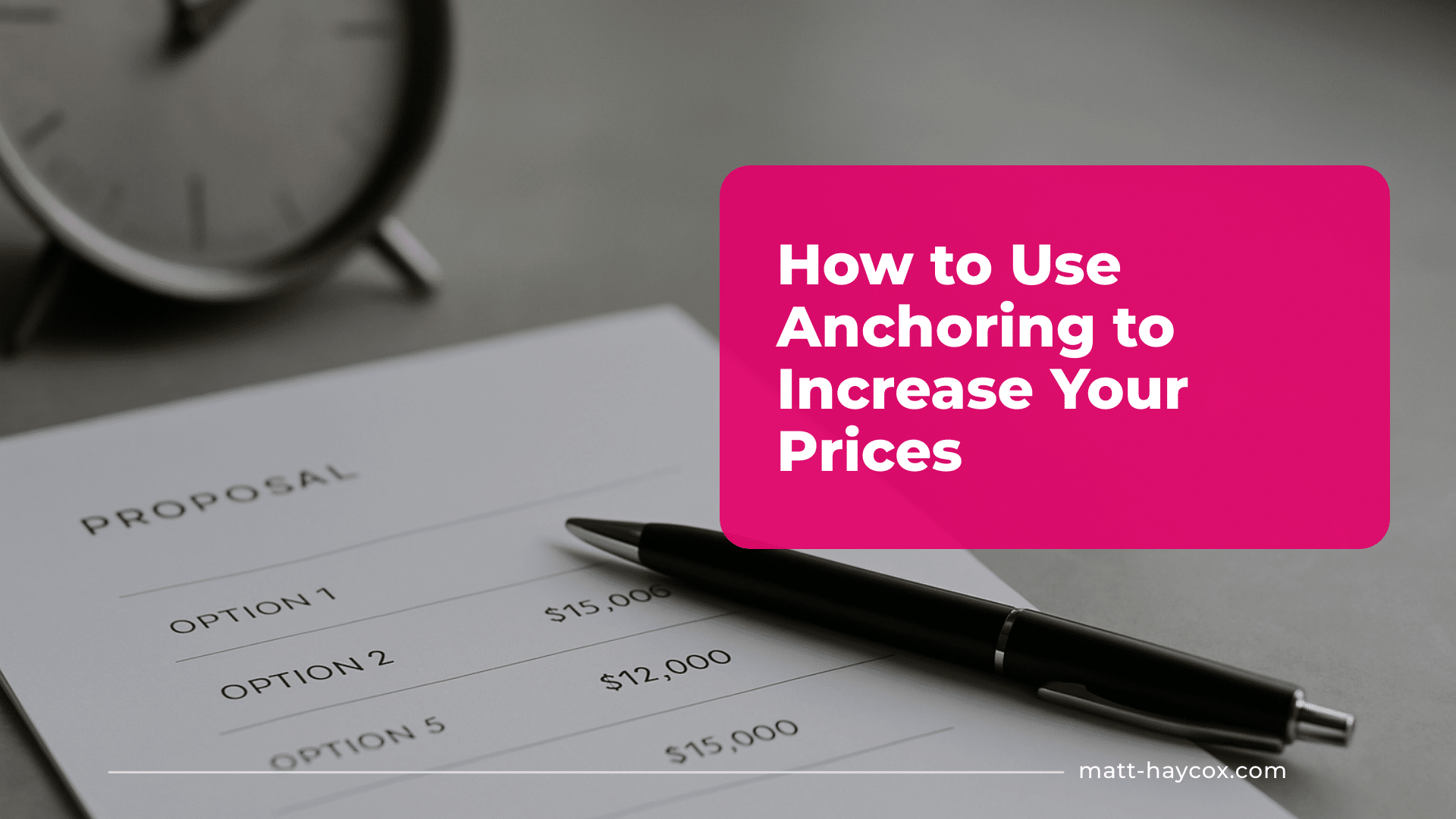
For anchoring pricing in a proposal, a 3-option table is the cleanest tool you’ve got. The point is not to push everyone into ‘best’. The point is to make the middle option feel like the sensible decision.
Rules that keep it ethical and effective:
- Each tier must be viable: No ‘bad’ option that sabotages the buyer.
- Change scope, not just features: Speed, risk, certainty, access, service level.
- Name the outcome: ‘Pipeline Stabilise’ beats ‘Standard’ every day.
If you want more depth on structuring tiers and packaging, refer to Pricing Strategy for Your Businesses: The Complete Playbook and adapt it to your delivery model.
Anchoring Pricing On Calls: Scripts That Don’t Feel Scripted
Calls are where anchoring pricing wins or loses. The anchor is rarely a single number. It’s the chain of logic that makes your number make sense.
The First 5 Minutes: Frame The Problem In Money
Don’t start with ‘tell me about your business’. Start with decision-level context.
Try:
‘What’s the cost to you if this is still a problem in 90 days?’
If they can’t answer, you’ve learned something important. They might not be ready to buy, or they’re not the right buyer. Either way, you can’t anchor without stakes.
The Anchor Drop: A Clean Sentence
You want one line you can say calmly, then shut up. Use this fill-in template:
‘Based on what you’ve told me, this sits in the £[low] to £[high] range depending on how fast you want it fixed and how much certainty you need.’
Notice what this does:
- Gives a range: You’re not pinned to a single number too early.
- Links price to levers: Speed and certainty, not your effort.
- Invites collaboration: They choose a path, you don’t just ‘quote’.
Handling The ‘That’s Expensive’ Reflex
Don’t argue. Go back to the anchor logic and ask a choice question.
A simple three-step response:
- Confirm: ‘I get it, it’s a meaningful investment.’
- Re-anchor: ‘Compared to £[cost of problem] over the next [timeframe], it’s built to pay for itself.’
- Choose: ‘Do you want to reduce scope, slow it down or keep the outcome and keep the fee?’
This protects margin because you’re trading variables, not discounting out of fear.
Quick Validation Tests You Can Run In 7 To 14 Days
You don’t need a quarter of research to test anchoring. You need a handful of controlled reps. The goal is to prove that your new anchor increases close rate at higher prices, or maintains close rate while lifting average order value.
Pick one channel and run a short sprint:
- 10 proposal tests: Send 5 with your current structure, 5 with a 3-tier anchored table and a value stack.
- 10 call tests: Same offer, but introduce the range anchor after discovery on half the calls.
- 1 price rise cohort: Raise price by 10% to 15% for new deals only, keep everything else constant.
Completion checks at the end of the sprint:
- Was the first number spoken by you? If not, you weren’t anchoring.
- Did average deal value move? Even a £1k lift on 10 deals is a signal.
- Did sales cycle change? If it gets shorter, your anchor clarified the decision.
- Did discounting drop? A 5% discount reduction can be worth more than a higher list price.
Keep it clean: change one variable, measure, then iterate. That’s how operators win.
Unit Economics That Keep The Anchor Honest
Your anchor must survive delivery. If you sell a premium project but your fulfilment is chaotic, the margin disappears and you end up resenting your own customers.
Use this simple unit economics check before you put an anchor in front of anyone:
- Gross margin floor: Decide your minimum, for many services that’s 60% to 75% gross margin if you want room for sales and overhead.
- Delivery hours cap: If you sell £12k and want 70% gross margin with £60/hour fully loaded cost, your max delivery cost is £3.6k, which is 60 hours. If you routinely spend 90 hours, your anchor is fantasy.
- Acquisition payback: If you spend £1.5k to close a deal (time, ads, commission), a one-off £4k project is fragile. A £12k project or a retainer makes payback sensible.
Anchoring pricing works best when your operations can actually deliver the promise within clear limits. Premium positioning with budget delivery is where refunds and bad reviews come from.
Operational Guardrails So Higher Prices Don’t Create Chaos
When you raise prices, you attract buyers who expect clarity. Your guardrails are what make the work scalable and keep your calendar sane.
Three guardrails that pay off immediately:
- Scope gates: Define what counts as a change request, and price it. Put it in the proposal, not as an afterthought.
- Decision cadence: Weekly 30-minute decision call, max 2 stakeholders. No ‘committee drift’.
- Asset checklist: List what you need from the client by week 1. If they don’t supply it, timeline moves, not your team.
A simple operator rule: any request that adds time must remove something else, increase fee or extend timeline. If you don’t enforce one of those, your anchor gets eroded after the deal is signed.
Mini Cases: Anchors In The Wild
These are small, realistic examples you can steal from. Notice how the anchor is built from buyer economics, not bravado.
Case 1: Manchester B2B SaaS, churn problem
They were quoting £6k for onboarding optimisation and getting pushed down to £4k. We reframed the anchor: the average customer was worth £9k ARR and churn was 4 customers a quarter, roughly £36k ARR leaking. Proposal switched to tiers at £7.5k, £12k and £18k with faster implementation and retention reporting in the top tier. Discounts dropped to 0%, and the middle tier became the default.
Case 2: London consultancy, leadership programme
They led with workshop days, so procurement compared day rates. We anchored to management time: 12 managers, 2 hours/week lost to poor prioritisation, loaded cost £80/hour, around £7.7k/month. The offer became a 10-week programme priced at £15k to £25k depending on cohort size and coaching access. The buyer could justify it as ‘less than 4 months of waste’.
Case 3: Bristol agency, paid media audits
They sold £1k audits and got treated like a commodity. We anchored to error cost: one retailer was spending £40k/month on ads, a 10% efficiency gain was £4k/month. They introduced a £3.5k audit with a 30-day implementation support add-on. Close rate dipped slightly, but average deal value tripled and delivery was cleaner because the client was more engaged.
Risks, Hedges And A Simple Do / Don’t Checklist
Anchoring is powerful, which means you can misuse it. Here’s what to watch for, and how to keep it grounded.
Risk 1: Anchoring too high and killing trust
Hedge: Show your assumptions and invite correction. ‘If your average deal size is closer to £15k than £30k, the numbers change, talk me through it.’
Risk 2: Anchoring to outcomes you can’t control
Hedge: Anchor to what you influence and what you’ll measure. If you’re not responsible for sales close rate, don’t anchor on revenue, anchor on qualified pipeline, speed-to-lead or conversion rate lift.
Risk 3: Discounting after anchoring and looking weak
Hedge: Trade value for price. Remove a deliverable, reduce access or extend timeline. Never just ‘do 15% off’ because they asked.
Risk 4: Selling premium and delivering chaos
Hedge: Put delivery limits in writing: meeting count, response times, revision rounds, client inputs, change request pricing.
Do / Don’t checklist:
- Do anchor early on calls, after you’ve quantified the problem.
- Do use ranges and tie them to speed and certainty.
- Do put a 3-tier table in proposals so the buyer compares options.
- Don’t anchor with made-up numbers or industry myths.
- Don’t apologise for pricing, it invites negotiation.
- Don’t discount without changing scope, timeline or terms.
Download The Price Raise Toolkit And Anchor With Confidence
If you’re going to change your anchor, you need the language to back it up in writing and on calls. Download the Price Raise Toolkit: Scripts, Emails & Client-Ready Explanations and use it to roll out a clean increase, handle pushback and protect margin without getting into awkward back-and-forth.
- Set the anchor using buyer economics, then present options so you’re not defending a single number.
- Validate anchoring pricing in 7 to 14 days with small tests, and track deal value, discounting and sales cycle time.
- Protect your higher price with unit economics checks and operational guardrails that stop scope creep.
FAQ For Anchoring Pricing In Proposals And Calls
What’s the best time to introduce price on a sales call?
After you’ve quantified the problem and agreed what success looks like, but before you go deep into delivery detail. If you wait until the end, the buyer has already anchored on effort and will try to push your fee down.
Should I use a price range or a single number?
Use a range early, then narrow it once scope and constraints are clear. Ranges keep you from being pinned down while still setting a strong frame for the decision.
How high should my anchor be?
High enough that your ideal package sits in the middle of your options, not at the top. If 80% of buyers choose your most expensive tier, your anchor is probably too low and you’ve left money on the table.
Does anchoring work for low-ticket offers?
Yes, but the anchor needs to be about comparison, not drama. For a £299 product, anchor against the cost of the problem over a month, or against the typical alternative like an agency minimum or staff time.
What if a client says they have a fixed budget?
Ask what outcome that budget has to buy and what trade-offs they’re willing to accept. If the budget is real, you can repackage scope or timeline, but keep the anchor tied to value so you don’t become a commodity.
How do I anchor without sounding manipulative?
Show your assumptions, use the buyer’s own numbers and invite correction. The moment you’re transparent about the logic, it stops being ‘sales tactics’ and starts being decision support.
Should I anchor with competitor pricing?
Only if it helps the buyer understand categories, not to justify your fee. Your strongest anchor is always the cost of inaction, the cost of risk or the value of speed in their business.
How do I stop discounting becoming automatic?
Make discounting a trade, not a reaction: reduce scope, reduce access, extend timeline or improve payment terms. If you can’t make the unit economics work without discounting, your offer packaging needs fixing before your pricing does.