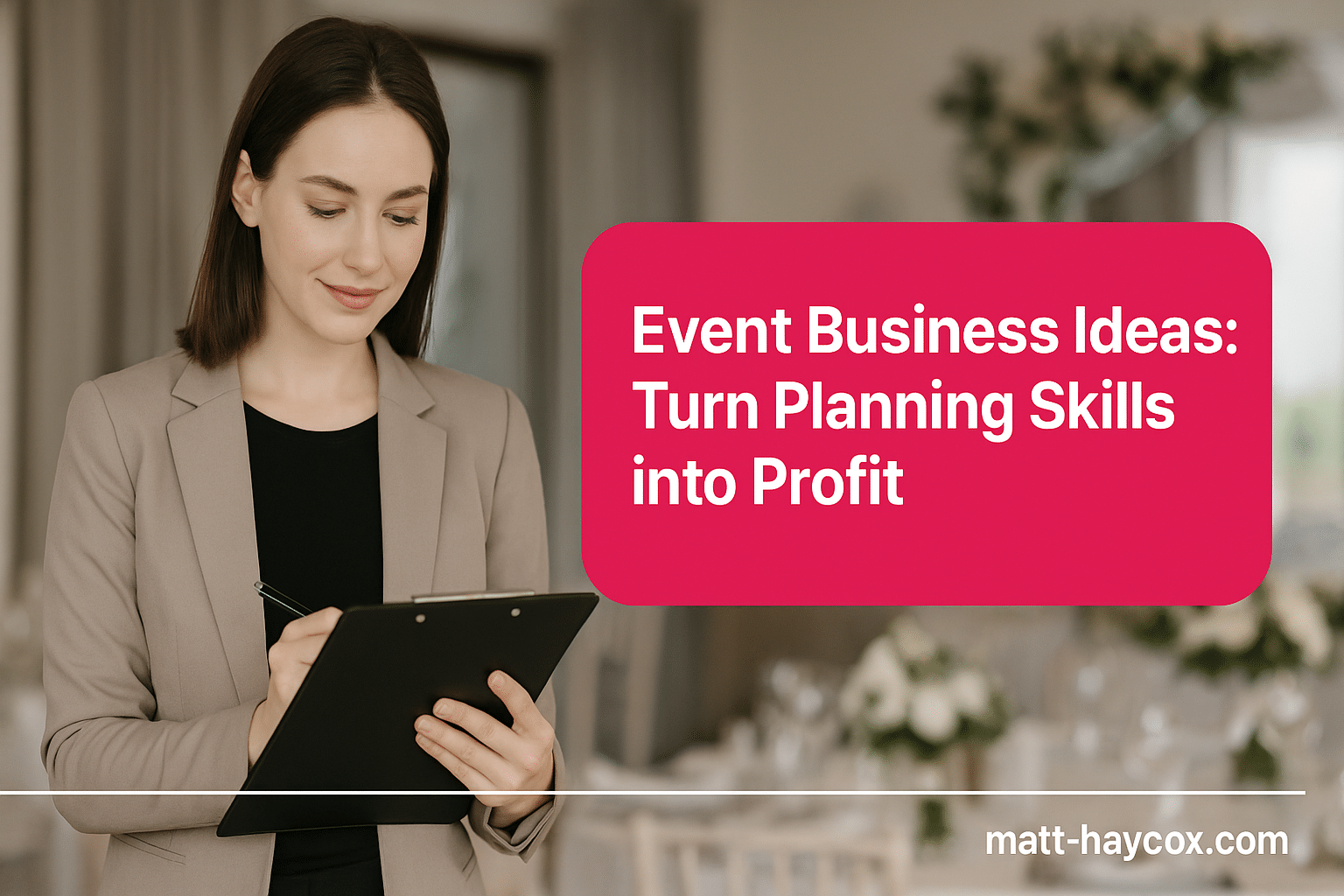

If you’re good at organising people, budgets and timelines, you’ve probably been told: ‘You should run events’. The problem is most event businesses fail for boring reasons: they price wrong, they say yes to everything, and they don’t validate demand before they sink weeks into a proposal.
This guide walks you through event business ideas you can validate fast, across corporate, weddings and local events. If you want a broader scan of options and how to choose an idea, cross-reference Business Ideas: The Full Guide to Finding, Testing and Choosing the Right Idea as you go.
In this article, we’re going to discuss how to:
- Choose an event model that matches your strengths and lifestyle
- Validate demand and pricing in 7 to 14 days using lean tests
- Build guardrails that protect your time, margin and reputation
Event Business Ideas In Practical Terms
Here’s a practical way to frame event business ideas: you’re selling a predictable outcome (a smooth event that hits a goal) while managing uncertainty (people, suppliers, venues, weather, tech).
If your idea doesn’t reduce uncertainty for the client, it’s not a business yet, it’s just ‘helping out’.
Quick sense-check before you go further:
- Clear buyer: You can name who signs the contract and who pays the invoice.
- Clear win condition: You can state what success looks like, in one sentence.
- Repeatable delivery: 60% to 80% of the work can be templated (run sheets, supplier lists, timelines).
- Measurable value: The client can point to savings, revenue, attendance, brand impact, stress reduction, or time saved.
Pick A Lane: Corporate, Weddings Or Local
Most first-time founders fail in events because they try to serve everyone. Pick a lane, get traction, then expand. Corporate, weddings and local events have different sales cycles, risk profiles and cashflow patterns.
Corporate Events: B2B Outcomes, Higher Standards
Corporate buyers pay for reliability, compliance and brand safety. They don’t want ‘cute ideas’, they want fewer problems and a supplier who can slot into their process.
Strong corporate event business ideas include:
- Internal offsites and leadership retreats (venue sourcing, agendas, logistics, facilitation support)
- Client events (product demos, roundtables, hospitality evenings)
- Conferences and awards nights (speaker management, sponsor packages, production)
Micro case: A former EA in Manchester offered ‘offsite-in-a-box’ for 15 to 40 people. She validated with 12 outreach emails to HR leaders, sold 2 pilot days at £2,250 each, then productised venue shortlists and a standard agenda pack so delivery stayed consistent.
Weddings: Emotional Value, Operational Complexity
Weddings are often one-shot purchases with high emotion, lots of stakeholders and a big penalty for mistakes. The upside is pricing power when you’re trusted.
Examples that can work without becoming a 24/7 therapist:
- Month-of coordination for couples who’ve booked suppliers but need a pro to run the day
- Micro-wedding planning (10 to 30 guests, venue and suppliers, tight timeline)
- Cultural wedding specialist if you understand specific ceremonies, vendors and expectations
Micro case: A planner in Birmingham switched from full-service planning to month-of coordination only. She capped clients at 3 per month, charged £1,250 to £1,750, and required a structured handover call plus a supplier list by a fixed deadline to stop scope creep.
Local Events: Fast Feedback, Lower Ticket Value
Local events are great for speed: you can launch, learn and iterate quickly. The downside is lower budgets unless you build a repeatable engine with sponsors, venues, or a loyal audience.
Local event business ideas that validate quickly:
- Pop-up markets with stallholder fees and local sponsors
- Community workshops (fitness, cooking, crafts) where you partner with instructors
- Venue-led nights where a bar or restaurant needs footfall on quiet days
Micro case: A founder in Bristol ran a monthly ‘Indie Food Friday’ inside a venue that was dead on weekdays. She got the venue free in exchange for bar sales, charged 18 stallholders £55 each, spent £120 on local ads, and broke even on the first event while building an email list for the next one.
Signals To Gather In A Few Hours (Internal First, Then Public)
You don’t need a 40-page business plan. You need signals that tell you whether this model will sell and whether you can deliver it without hating your life.
Internal Signals You Can Pull Today
Start with what you’ve already got. These are unfair advantages you can use immediately:
- Your ‘closest to cash’ network: 20 names who could introduce you to a decision-maker (HR, office managers, venue owners, photographers, caterers).
- Your proof assets: Photos, run sheets, supplier lists, budgets, timelines, testimonials, even if they’re from charity or internal work.
- Your tolerance profile: Late nights, weekend work, client hand-holding, vendor wrangling. Be honest, it affects your lane choice.
- Your local supply chain: 5 venues and 10 suppliers you can call this week and get realistic rates from.
Completion check: you should be able to write a one-page ‘capability sheet’ with your niche, your packages, a price range and 3 proof points.
Public Signals You Can Validate In 2 to 3 Hours
Now look outside. You’re not hunting for perfect data, you’re looking for directional demand and pricing anchors.
- Venue calendars: Find 10 venues in your area, look at their event schedules and gaps. Gaps are opportunities.
- Job boards and LinkedIn: Search ‘event manager contract’ and note day rates, skills requested and frequency.
- Facebook groups and forums: Count posts per week asking for planners, coordinators, recommended vendors.
- Competitor packaging: Snapshot 10 competitor packages and their starting prices, plus what’s excluded.
- Search intent: Autocomplete and ‘People also ask’ questions reveal what buyers worry about (cost, timelines, what’s included).
Completion check: you should have a simple spreadsheet with 10 competitors, 3 package tiers each, and your notes on positioning.
Write A One-Sentence Offer Template You Can Fill In
If you can’t explain what you do quickly, you’ll drown in bespoke requests. Keep it simple, outcome-led and specific.
Offer template: ‘I help [specific buyer] run [specific event type] in [location] so they get [measurable outcome], without [main headache], using a fixed package starting at £[price].’
Examples you can adapt:
‘I help founders run investor and client dinners in London so they can host 12 to 25 guests smoothly, without spending nights chasing suppliers, using a fixed package starting at £1,800.’
‘I help couples in Surrey coordinate their wedding month so the day runs to plan, without last-minute panic, starting at £1,450.’
A Lean Validation Path You Can Run In 7 To 14 Days
Your job isn’t to perfect the brand, it’s to prove someone will pay and you can deliver profitably. Here’s a lean path that keeps risk low and learning high.
Days 1 to 2: Build A ‘Sell Before You Build’ Asset
Create one landing page or PDF with: who it’s for, 3 packages, starting prices, what’s included, what’s excluded, and a clear call to book a 15-minute call. Add 3 proof assets, even if they’re from internal projects.
Completion check: you can send one link and it answers 80% of basic questions.
Days 3 to 6: Outreach And Discovery Calls
Run 30 to 50 targeted messages. Keep it personal and low-pressure. You’re looking for problems, budgets and buying process.
Targets that mean you’re onto something:
- Response rate: 20%+ from warm introductions, 10%+ from cold but targeted.
- Call conversion: 6 to 10 calls booked from 30 to 50 messages.
- Budget clarity: At least half can state a range within 10 minutes.
Days 7 to 10: Offer A Paid Pilot With A Tight Scope
Sell a small, defined pilot: a 3-hour planning session, a venue shortlist and budget plan, or day-of coordination for a small event. The goal is paid learning, not heroics.
Ask for a deposit. If people won’t put money down, you don’t have validation.
Days 11 to 14: Review, Refine, Raise The Bar
After each pilot, capture artefacts: run sheet, supplier template, budget template, client email scripts, a post-event debrief. These become your delivery engine.
Completion check: you can deliver the next job in 20% less time because you’ve standardised.
Pricing And Unit Economics That Hold Up At Small Scale
Events can look profitable until you count your hours, the revisions, the onsite days and the ‘just one more thing’ requests. If you want a business and not a stressful job, you need pricing that survives reality.
Start With A Simple Time And Margin Model
Use this quick calculation:
Gross profit = Price minus direct costs (contractors, travel, software, print, paid ads, insurance allocated per project).
Effective hourly rate = Gross profit divided by delivery hours (including calls, supplier chasing, travel, on-the-day time and follow-up).
If your effective hourly rate is below what you’d earn as a contractor doing similar work, your model is broken or your scope is leaking.
Corporate Example: Offsite Planning Package
Package price: £3,500 for a 1-day offsite for 20 people.
Direct costs: £450 contractor support, £120 travel, £80 software and printing allocation. Total £650.
Gross profit: £2,850. Delivery hours: 18 hours (sales, planning, supplier management, onsite). Effective rate: £158/hour.
Guardrail: cap revisions (one agenda revision, one venue shortlist revision) and charge £95/hour for extra changes.
Wedding Example: Month-Of Coordination
Package price: £1,650.
Direct costs: £150 assistant for the day, £40 travel and expenses. Total £190.
Gross profit: £1,460. Delivery hours: 14 hours (handover, timeline build, supplier confirmations, rehearsal call, wedding day). Effective rate: £104/hour.
Guardrail: a ‘handover deadline’ 30 days out. If details arrive late, the client buys an extra planning block.
Local Example: Pop-Up Market Night
Revenue: 22 stallholders at £60 each = £1,320, plus £300 sponsor = £1,620.
Direct costs: £250 marketing, £120 signage and wristbands, £180 security. Total £550.
Gross profit: £1,070. Delivery hours: 16 hours. Effective rate: £66/hour.
Guardrail: negotiate venue terms so you don’t pay room hire until you can consistently hit 25+ stallholders, or tie hire to bar spend.
Pricing Moves That Protect You
- Charge for planning separately if clients want ‘helping choose’ without committing.
- Use deposits of 30% to 50% to protect cashflow and commitment.
- Hold a contingency line in budgets, typically 5% to 10%, so surprises don’t eat your margin.
Operational Guardrails That Protect Margin And Time
Your biggest enemy isn’t competition, it’s chaos. Guardrails let you deliver a great experience without bleeding hours.
Scope Control That Feels Professional, Not Rigid
Put boundaries in writing and repeat them calmly. It’s not being difficult, it’s being predictable.
- Packages, not menus: define what’s included and what triggers additional fees.
- Communication windows: for example, replies within 24 hours Monday to Friday.
- Decision deadlines: venue, menu, suppliers locked by specific dates.
Supplier Management Systems That Stop Firefighting
Create a supplier pack: briefing template, payment schedule, arrival times, contingency contacts, and a ‘what success looks like’ section. Suppliers perform better when the brief is tight.
Use a single source of truth: one run sheet, one budget sheet, one timeline. If the client, venue and suppliers are reading different versions, you’ll pay for it on the day.
Quality Control On The Day
On the day, you’re running a checklist business. Build your event day kit and standard checks:
- Arrival buffer: plan to be onsite 60 to 90 minutes before suppliers.
- Three-point checks: signage, audio, seating, repeated before doors open.
- Escalation ladder: who approves spend, who approves schedule changes, who’s the final decision-maker.
Common Risks And How To Hedge Them Without Overthinking
Events punish naïve optimism. You can still move fast, just don’t move blind.
Cashflow Risk
Hedge with deposits, staged payments and supplier terms aligned to when you get paid. If your suppliers need 100% upfront but clients pay after, you’re financing their event.
Reputation Risk
Hedge with clear expectations and documented decisions. After every call, send a short recap with what was agreed and what’s next.
Liability And Compliance Risk
Hedge with the boring basics: public liability insurance, clear contracts, cancellation terms, and knowing venue rules. If you’re doing corporate work, expect GDPR, vendor onboarding and risk assessments.
Seasonality And Pipeline Risk
Hedge by mixing products: one-off events plus a recurring offer like quarterly offsites, monthly markets, or venue partnerships. You’re building stability, not chasing random peaks.
Do / Don’t Checklist Before You Say Yes To A Job
- Do: Ask who owns the final decision, and get it in writing.
- Do: Quote based on scope and constraints, not on ‘what feels fair’.
- Do: Build a supplier bench so you’re not scrambling when someone drops out.
- Don’t: Start planning without a deposit and a signed agreement.
- Don’t: Promise unlimited revisions, it turns one job into ten.
- Don’t: Take on complex production until you’ve got a trusted AV partner.
Download The 7-Day Business Idea Validation Plan And Get Moving
If you want to validate event business ideas quickly without spending months polishing a brand, download the 7-Day Business Idea Validation Plan: Test Your Idea Without Spending a Penny and run the outreach, offer and pricing checks this week. You’ll know fast whether you’ve got a sellable model, and what to tweak before you scale.
- Choose one lane (corporate, weddings, or local) and write an outcome-led offer that a buyer can say yes to.
- Validate with paid pilots and deposits, then confirm your unit economics so your margins survive real delivery.
- Protect your time with scope guardrails, supplier systems and a single source of truth on every event.
FAQ For Event Business Ideas
What are the most profitable event business ideas?
Corporate events are usually the most profitable because budgets are bigger and buyers pay for reliability. Weddings can be highly profitable too, but only if you control scope and protect your weekends.
How do I validate an event business idea without a portfolio?
Sell a tightly scoped paid pilot, like a planning workshop or a small coordination package, and collect artefacts and testimonials from that delivery. You can also use proof from internal work, charity events, or supplier references while you build your own case studies.
How much should I charge as a new event planner in the UK?
Start with packages and a price floor based on hours and direct costs, not on what competitors ‘say’ online. As a rough guide, many viable starters land around £1,200 to £2,500 for defined packages, then move up once systems and demand are proven.
Do I need to specialise in corporate or weddings straight away?
You don’t need to pick a niche forever, but you do need a clear first offer so people understand what to buy. Specialising for your first 10 to 20 customers makes validation quicker and marketing cheaper.
What’s the fastest way to get my first paying client?
Use warm introductions to a specific buyer list and offer a paid pilot with a fixed scope and start date. Aim for 30 to 50 targeted messages and 6 to 10 calls within a week, then close with a deposit.
What are the biggest mistakes in starting an events business?
Underpricing, saying yes to unlimited revisions, and treating ‘interest’ as validation are the main ones. The fix is deposits, boundaries in writing and tracking effective hourly rate per job.
How do I avoid being glued to my phone during events?
Build a run sheet, assign a second-in-command for supplier queries and set an escalation ladder so only true decisions reach you. The more you standardise pre-event, the quieter your event day becomes.
Can I run local events as a side business?
Yes, if you productise and cap complexity: repeat the format, reuse suppliers, and batch marketing. The side-hustle version only works when you control the calendar and don’t reinvent the event every time.