
Most job ads read like procurement forms. Candidates skim them, shrug, and move on. If you want people who can deliver, you need clarity, not clichés. A sharp description anchored to outcomes will filter time wasters and pull in operators who can win. For the wider system that makes those hires stick, read People & Culture: The Business Leadership Playbook and cross-reference as you build.
In this article, we’re going to discuss how to:
- Define the work in outcomes so strong candidates can self-select
- Use a simple structure that doubles as your job description template
- Publish, screen, and validate the ad with numbers in 7 to 14 days
What A Job Description Is In Practice
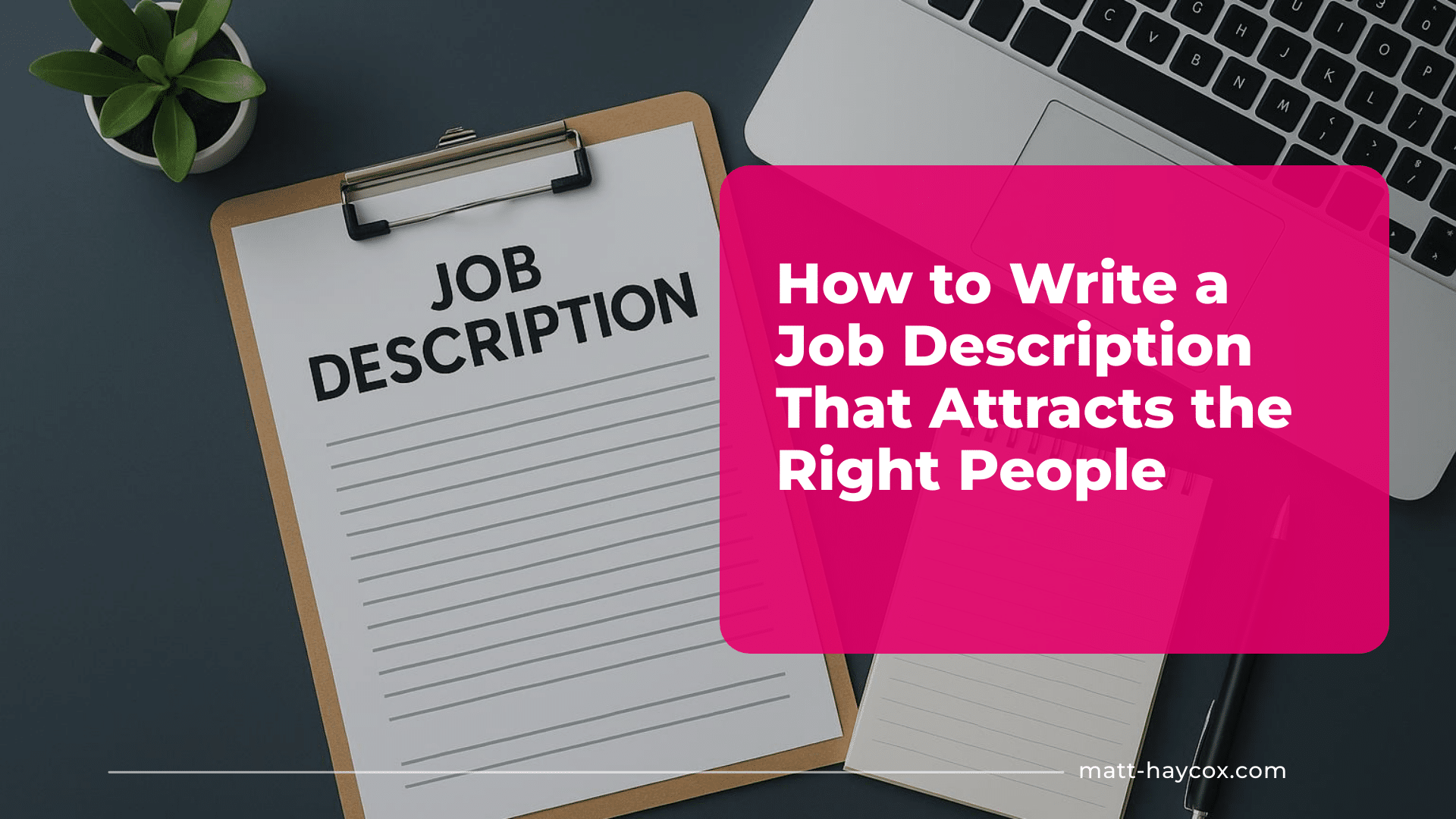
A job description is a promise. It tells a capable adult what they will own, how success will be measured, and what constraints they will live with. It is not a wish list. It is a practical contract between outcomes and accountability. When done well, the description attracts people who recognise their craft in your words and it repels those who cannot show evidence.
Sense checks that you are on the right track: you can state the role’s 90-day results in a sentence; a stranger could plan their first two weeks after reading the description; and the interview plan in the ad matches the way you will actually decide. If any of those fail, rewrite before you post.
The Scorecard Is Your Backbone
Start with a one-page scorecard, then turn it outward. The scorecard names three to five business outcomes for the first 90 days, the handful of competencies you will test, and the behaviours that matter in your shop. Once this exists, converting it into an advert is easy. Without it, you will pad the ad with adjectives and end up interviewing on ‘vibe’.
If you need a refresher on how this fits into hiring, onboarding, and management cadence, refer to People & Culture: The Business Leadership Playbook and keep your language consistent across all documents.
Job Description Template: The No-Fluff Structure
Here is a lean structure you can copy. It is your practical job description template and it maps one-to-one with your interviewing and onboarding. Keep each section tight.
Role purpose, one paragraph
Explain why the role exists in your company’s operating model and which customer or internal outcome it serves. Avoid mission poetry. Be specific.
Outcomes for the first 90 days
List three to five business results with numbers and dates. These are the targets the person will discuss in interview, plan in onboarding, and report against in 1:1s.
Competencies you will test
Name the skills you will assess directly, not a shopping list of buzzwords. Reference the work sample you will run.
Behaviours that matter here
State the two or three behaviours you reward and tolerate. Tie them to examples. Keep it real.
Tools and constraints
Name the systems, budget, and limits. Good operators love constraints. Tourists hate them.
Who they work with
Show immediate manager, peers, and the customer surface area. This helps candidates calibrate scope.
Pay, level, and progression
Publish a range tied to a level band. Explain how progression is evidenced. Credibility increases acceptance.
How you will evaluate
State the flow: short screen, job-realistic work sample, structured interview, fast decision. This filters chancers and signals you are serious.
Writing Each Section So It Converts
1. Role Purpose That Signals Reality
Strip sentiment. Describe the job a customer would recognise. If you are hiring a customer success manager, say ‘keep active customers profitable and happy by resolving issues within set times and expanding usage where it makes sense’, not ‘be the voice of the customer’.
2. Outcomes That Anchor Expectations
Pick numbers that matter to the business. For a marketing generalist: ‘Deliver 60 qualified leads at £80 CPL by day 90’, ‘Publish eight case studies customers actually share’, ‘Lift conversion on the pricing page from 2.1 percent to 2.8 percent’. For a project coordinator: ‘Reduce overdue tasks from 23 percent to under 8 percent’, ‘Move on-time delivery from 61 to 80 percent by the end of month three’. These are concrete and auditable.
3. Competencies You Will Test For
Choose the few you will score in the work sample and interview. For a finance hire: spreadsheet fluency, variance analysis, narrative clarity in write-ups. For sales: discovery, qualification, objection handling, crisp follow-up writing. State them upfront so grown-ups can decide whether to apply.
4. Behaviours That Fit Your Culture
Translate values into observable behaviours. ‘Own the outcome’ becomes ‘publish your weekly plan by Monday 10am, ask for help 24 hours before deadlines slip, write a post-mortem when something breaks’. This sets expectations without corporate jargon and helps candidates picture the day-to-day.
5. Tools And Constraints That Shape The Work
If the role lives in HubSpot and Notion with £8k per month of media budget, say so. If travel is required twice a month, say so. If your data is messy and part of the job is cleaning it, admit it. Operators will appreciate the honesty and self-select.
6. Who They Work With
Map reporting lines and key collaborators in one or two sentences. ‘You report to the Head of Delivery, work daily with two PMs and three developers, and join fortnightly customer calls on key accounts.’ Clarity beats mystery every time.
7. Pay, Level, And Progression
Publish the range, tie it to level bands, and explain how progression is evidenced over two to three months of consistent behaviour. This reduces noise in negotiation and increases acceptance rates. It also signals fairness.
8. How You Will Evaluate
Write the process into the ad. ‘15-minute screen for outcomes fit and logistics, a 75-minute work sample that mirrors week two of the role, a structured interview with the hiring manager, and a quick decision. Two references before offer.’ This is the same flow you should actually run.
Two Contrasting Examples, Line By Line
Example A: Project Coordinator (Services, £1.2m revenue)
Purpose: Keep projects on time, scope tight, and customers informed so margin holds.
Outcomes: reduce overdue tasks below 8 percent by day 90; move on-time delivery to 80 percent; publish weekly client updates by Friday 2pm with next steps and risks.
Competencies: board hygiene, written client updates, meeting facilitation.
Behaviours: plan your week, raise flags early, deliver clean notes same day.
Tools: Asana, Google Docs, Slack. Constraints: no new hires, tidy what exists first.
Evaluation: short screen, 60-minute triage work sample, structured interview.
Example B: Marketing Generalist (E-commerce, £4m revenue)
Purpose: Grow profitable traffic and improve conversion without adding agency overhead.
Outcomes: 60 qualified leads at £80 CPL by day 90; eight case studies; pricing page conversion from 2.1 to 2.8 percent.
Competencies: ad copy, simple landing pages, analytics readouts, basic email automation.
Behaviours: write it down, test small, ship weekly.
Tools: Meta/Google Ads, Webflow, Klaviyo, GA4.
Evaluation: 75-minute plan-and-present work sample, then structured interview.
Both examples are short, plain, and about results. That is why they convert.
Where To Post And How To Match Channel To Role
Referrals, targeted outreach, and one niche channel will usually beat a city-wide blast. Ask five operators you trust for introductions and offer a simple bounty payable at 90 days. Block 45 minutes a day for targeted messages that reference the 90-day outcomes. Then pick the community where your people actually spend time, not the noisiest job board. Measure response rate and time to shortlist. If you cannot get two credible interviews on the calendar within 7 to 14 days, adjust the ad, the ask, or the channel.
Legal And Fairness Essentials (UK Focus)
Keep it lawful and boring. Confirm right to work. Avoid discriminatory language in the ad. Publish a range tied to a level band. Make reasonable adjustments available during selection. If the role involves regulated tasks or safeguarding, list the checks you will run. Keep notes you would be happy to share. Fairness is not just ethics, it is risk management.
Validation Path In 7 To 14 Days
You do not need a grand HR programme. Run small tests and keep what works.
Days 1 to 2: Write the scorecard and convert it into the ad using the structure above.
Days 3 to 4: Message 50 targeted prospects with a two-paragraph note that leads with outcomes and the evaluation flow.
Days 5 to 6: Post to one niche community and send the ad plus referral bounty to five trusted operators.
Days 7 to 10: Run three 15-minute screens and one job-realistic work sample.
Days 11 to 14: Decide, offer, and gather one metric per stage so you can refine version two.
This is a publishing exercise with feedback loops, not a ceremony.
Metrics And Unit Economics You Should Track
Track four numbers for every live role. Response rate to targeted outreach tells you whether the message lands. Time to shortlist tells you whether the role and the channels match. Pass-through rate from screen to sample to offer tells you whether your filters are calibrated. Offer acceptance rate tells you whether the range, manager confidence, and speed are competitive. Price your own time at an internal rate and include it in cost per hire so you can compare channels with a straight face.
Common Failure Modes And How To Hedge
The most common failure is writing for everyone. That attracts no one. Be specific about outcomes and tools. Over-promising is another. Candidates can smell desperation and they will hold you to it later. Keep to reality. Slow decisions kill acceptance. Book a 20-minute decision chat right after the final interview and commit to a yes or no within 48 hours. Finally, make sure the ad and the interview process match. If you write about outcomes but interview on opinions, you will hire storytellers rather than doers.
Where This Fits In Your People System
A good ad is the first chapter in a consistent book. The scorecard flows into the work sample, the offer repeats the outcomes, onboarding turns them into a 30–60–90 plan, and 1:1s track progress. That consistency reduces churn and speeds ramp. If you want the bigger picture, check People & Culture: The Business Leadership Playbook and align your job descriptions with your cadence and performance processes.
Steal The Templates And Ship Your Ad This Week
Skip the blank page. Download the First Hire Toolkit: Job Descriptions, Scorecards & Interview Scripts and plug the templates straight into your next role. You will get a ready-to-use job description template, a proven work sample rubric, and structured interview scripts so you can publish and hire faster. Download the First Hire Toolkit and have version one live by Friday.
Key Takeaways
- Treat the ad as a promise: outcomes, constraints, and evaluation signals that adults respect.
- Use a consistent job description template that mirrors your scorecard, work sample, and onboarding plan.
- Validate in 7 to 14 days with response rate, time to shortlist, pass-through, and acceptance, then refine.
FAQ For Writing Job Descriptions
What makes a job description convert better than average
Outcomes with numbers, honesty about constraints, and a clear evaluation flow. Strong candidates want to know what they will own, how you measure success, and how you decide.
Should I publish a salary range or keep it flexible
Publish it. A clear range tied to a level band increases qualified applications and acceptance rates, and it reduces wasted interviews.
How long should a job description be
One to two pages is plenty. If you cannot explain the role’s purpose, outcomes, tools, and process within that space, the role is probably undefined.
Do I need to customise the job description for each channel
Keep the spine identical, but adjust the opener and examples to match the audience. A niche community may appreciate tool specifics; a referral note can be shorter and more personal.
How do I avoid attracting generalists who cannot deliver
Lead with the 90-day outcomes and preview the work sample. Tourists will self-select out. Operators will lean in because they recognise the work.
Can a job description double as the interview and onboarding plan
Yes. That is the point. The outcomes become interview prompts and the 30–60–90 plan. The competencies shape the work sample. The behaviours inform your 1:1s and reviews.
What if I am hiring my first employee and I am not sure of the numbers
Start with conservative outcomes you can measure and adjust the ad after your first week of conversations. Clarity beats precision. You can refine as signal arrives.
Is it acceptable to include constraints like ‘messy data’ or ‘limited budget’
You should. Operators prefer reality. Stating constraints filters mismatches and increases trust, which helps later when you need decisions under pressure.