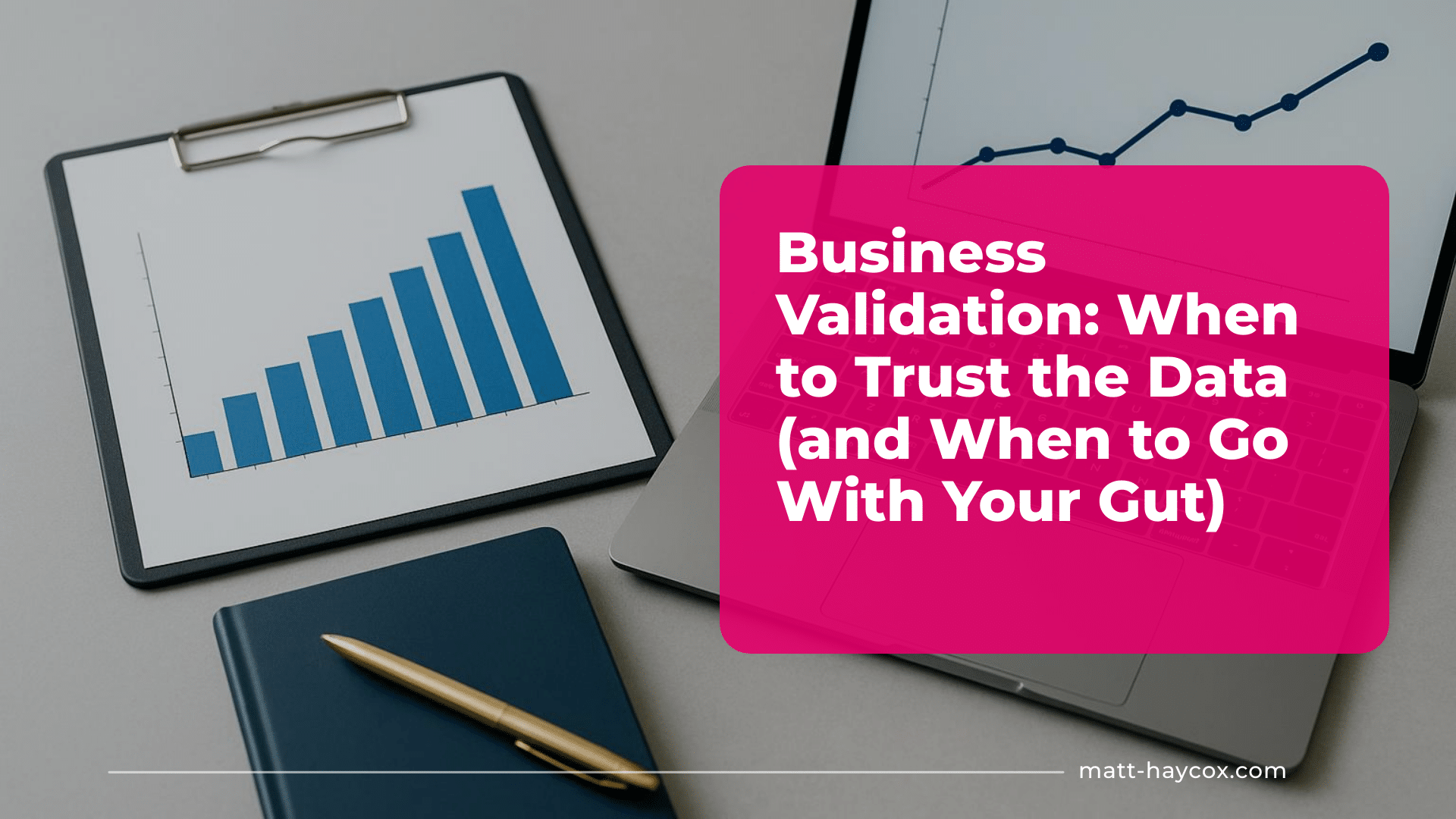

Spreadsheets can tell you a lot, but they can’t think for you. Founder instinct can spot an opening before the numbers exist, but it can also lead you into a cul-de-sac. The skill is knowing when the data should call the shot and when your judgement should pull rank.
In this article, we’re going to discuss how to:
- Build A Clear Lens For Weighing Evidence Against Intuition
- Run Short Tests That Respect Both Signal And Speed
- Create Rules So You can pivot or commit without second guessing
Define The Business Validation Balance In Practical Terms
Treat every decision as a blend of three things: evidence, reversibility, timing.
- Evidence: the strength, quality and relevance of what you can actually observe
- Reversibility: how costly it would be to unwind the move if you’re wrong
- Timing: the half-life of the opportunity and the cash runway you have
When evidence is strong, the move is hard to undo, and time is short, let the numbers lead. When evidence is thin but the move is cheap to try and the window is closing, let your informed gut run a controlled experiment.
Where Useful Signals Come From
Most founders say they’re “data driven”, then rely on opinion polls. Start where the behaviour lives.
Inside your own operation: recent win–loss notes in the CRM, refund reasons, first response time, delivery hours per job, objections logged on calls, how quickly deposits arrive after quotes, and which offers get forwarded inside client teams. These are immediate, cheap and specific.
Out in the wild: fresh tenders with required outputs and scoring weights, one and two-star reviews that mention missed deadlines or cost, job posts that telegraph budgeted pain, competitor pricing pages and roadmaps, platform rule changes, and buyer comments on Reddit or LinkedIn that quote real events. Save the exact lines, not screenshots of dashboards.
You don’t need a lab. You need a morning with a notepad and a rule that says “no entry without a timestamp or a quote”.
A Practical Business Validation Guide: When Data Rules, When Gut Leads
Use this simple decision frame. Score each axis from 1 to 5, then read the outcome.
- Signal quality: how clean and repeatable is the evidence
- Cost to reverse: write the cash and time you’d burn to undo the move
- Speed pressure: how fast the window closes or the cash burns
- Founder edge: domain knowledge, network access, and pattern recognition you’ve earned
If signal is 4–5 and reversal cost is 3–5: follow the data, tighten scope, and commit.
If signal is 1–2 but reversal cost is 1–2 and speed is 4–5: run a bounded bet driven by instinct.
If everything scores mid-table: gather more signal before you spend.
If founder edge is 5 and the market is new: use instinct to draft the first offer, then impose strict tests so you aren’t guessing for long.
Write these scores on a one-pager. It’s your living business validation guide for this decision, not a slogan.
The ‘Good Data’ Checklist
Not all numbers deserve a vote. Give weight only to data that is:
- Close to cash: deposits, signed orders, invoice cycle days
- Recent: last 30 to 90 days unless you’re explicitly measuring seasonality
- At the right granularity: unit economics at 10 to 50 customers, not hand-wavy TAM
- Traceable: a link or log you can show a sceptic
- Comparable: apples to apples against the baseline you’re replacing
If a metric fails two or more of those checks, treat it as colour, not a compass.
Decision Frames When Signals Clash
Two common collisions and how to deal with them:
High interest, low buying: lots of clicks and calls, few deposits. Don’t add more awareness. Rewrite the offer in buyer language, publish acceptance criteria, raise the price to test value perception, and ask for a small paid diagnostic. If a 10 to 20 percent share of qualified calls won’t place a deposit within 14 days, stop nursing it.
Great early unit economics, poor line of sight to scale: three pilots look amazing but require your personal heroics. Freeze new sales for two weeks, document steps, trim scope to what actually moved the number, and sell two more at a higher floor price with a junior operator shadowing you. If margin dies without you in the room, you’re optimising a craft project, not validating a business.
Fast Experiments That Respect Data And Judgement
Keep tests tiny, timed and tied to a specific outcome.
- One-pager offer: problem in buyer words, result by a date, artefacts to prove it, fee format, booking or deposit step.
- Demand pulse: 20 tailored messages to named buyers this week. Success is paid commitments, not “sounds great”.
- Delivery spike: 2 or 3 completions in 7 to 14 days with clocks, costs and evidence captured.
- Decision gate: if you don’t see deposits or you can’t hit the completion checklist at the floor price, archive or pivot.
This cadence lets instinct propose and data judge, quickly enough to preserve cash.
Pricing And Small-Scale Economics
Before you take a big bet, make the maths work at low volume. Write the floor on your one-pager.
Floor price = direct delivery per unit
+ selling time × your internal hourly rate
+ overhead share per unit
+ target profit per unit
Run a sensitivity nudge. Drop price 20 percent, drop win rate 20 percent, add 20 percent to delivery hours, add a small refund rate, then see if contribution survives. If it doesn’t, simplify scope or change buyer before you chase more signal.
Operating Guardrails That Reduce Bias
Process helps you treat your own ideas fairly.
- Completion rules: name the artefacts that end the job, for example before and after captures, logs, or a signed summary
- Two variants, then stop: define A and B before you start, run both for a week, pick the winner, move on
- Fixed delivery windows: sell into pre-set slots so enthusiasm doesn’t wreck your calendar
- Friday numbers: publish conversations, booked slots, deposits, delivery hours per job, contribution per job. Decide one change for next week
When the machine is simple and visible, it’s easier to bin weak ideas without drama.
Mini Field Notes
Intuition got the first move, data kept it honest
A founder felt a new social format would sell. Evidence was thin but the move was cheap to try, so they wrote a 14-day “format to revenue” sprint and booked five tests through a partner’s list. Two buyers converted, three didn’t. The artefacts and cycle times from those wins became the spine of the repeatable offer. The rest was dropped.
Data said yes, ops said no
Three early projects showed 60 percent contribution but only worked when the principal ran the room. A two-week pause to codify checklists and fix scope reduced average hours by 35 percent. A junior shadowed two jobs, contribution settled at 48 percent without the founder present. Scale decision made with eyes open.
Numbers lagged, gut called the pivot
A compliance vendor’s dashboard still looked fine, but DMs from key customers kept mentioning a new regulator checklist. The founder pulled a one-week spike to ship an “evidence refresh” pack, sold three in eight days, saw invoice cycle shrink, and pointed the roadmap there. The retention curve followed one month later.
Common Failure Modes And Safety Nets
- Cherry picking: you remember the flattering data and forget the rest. Force yourself to paste the exact quotes and timestamps into your sheet.
- Endless A/B: you keep testing tiny tweaks to dodge a hard ‘no’. Limit to two variants per cycle.
- Vanity metrics: you track page views, not deposits. Tie dashboards to money and time.
- Overconfidence in edge cases: a spectacular win tempts you to scale a unicorn. Ask how many of those you can actually find in a normal month.
- Platform roulette: one channel controls discovery. Add a second route before you assume the numbers will hold.
Keep Learning Without Spinning
After each test, update your one-pager with real hours, costs, conversion and approvals. Archive what failed with a one-paragraph note so you remember why. Promote what paid. For a broader playbook to keep your approach honest, use high probability business ideas as a companion reference.
Make Calls You Can Defend With Calm Confidence
Trust numbers first. Download the 7-Day Business Idea Validation Plan: Test Your Idea Without Spending a Penny and confirm your instincts with data.
Key Takeaways
- Treat choices as a mix of evidence, reversibility and timing so you know when to let data lead and when to run a controlled hunch
- Use a one-pager, a 20-message pulse and 2 to 3 fast completions to judge ideas in 7 to 14 days
- Protect margin with a firm floor price, clear completion rules and a weekly numbers ritual so your decisions compound
FAQs for Business Validation
When should I trust instinct over data?
When the move is cheap to try, the window is short and you have a real edge. Write a tiny offer, cap the test to 14 days and judge it by deposits and delivery hours, not applause.
What counts as strong enough data to override my gut?
Recent, traceable, close to cash and comparable at small volumes. Deposits, win–loss notes, tender outcomes and invoice timings beat surveys and likes.
How do I stop analysis paralysis?
Impose a two-step test with a fixed end date. If you haven’t won paid commitments or hit the completion checklist at the floor price, stop or change something material.
Can a single outlier result justify scaling?
No. Require at least two more wins at the new scope and price, delivered by someone other than the founder, before you call it proven.
What if my data sources contradict each other?
Weight sources by quality. A fresh signed order outweighs a month-old poll. If still unclear, run a bounded test where the result is unambiguous.
How do I blend this with long product bets?
Ring-fence a small budget and timeline for discovery, then demand early signals that customers will pay for interim outcomes. Use the same playbook to test service wrappers while the product matures.