
Gordon Ramsay’s estimated net worth is around $220 million, but the exact figure is not publicly confirmed. The sensible way to understand his wealth is not by obsessing over one headline number. It is by looking at the machine behind it: restaurants, television, production ownership, brand licensing, books, social media and global food concepts.
Ramsay is not just a chef. He is a media business, a restaurant group, a personal brand and a global licensing asset wrapped into one very loud Scottish package.
He has built his wealth through four main engines:
- Restaurants: A global restaurant group with more than 100 locations across multiple markets.
- Television: Long-running shows including Hell’s Kitchen, Kitchen Nightmares, MasterChef and newer formats.
- Production ownership: Studio Ramsay Global, the production venture co-owned with FOX Entertainment.
- Brand leverage: Books, products, digital content, events, partnerships and licensing.
Celebrity Net Worth estimates Ramsay’s fortune at $220 million and says his ventures earn tens of millions of dollars annually. That estimate should be treated as a public estimate, not a confirmed balance sheet. His official restaurant group says it now operates more than 100 restaurants globally, while FOX Corporation describes Studio Ramsay Global as a worldwide production venture developing culinary and lifestyle programming for FOX, Tubi and global markets.
Key Financial Metrics
| Category | Metric | Estimated Value | Notes |
| Estimated personal wealth | Public net worth estimate | Around $220m | Public estimate, not confirmed by Ramsay |
| Restaurant footprint | Global restaurants | 100+ | Based on Gordon Ramsay Restaurants |
| Michelin credibility | Restaurant Gordon Ramsay | Three Michelin stars | Flagship Chelsea restaurant has long-standing elite status |
| Michelin portfolio | Current Michelin-starred restaurants | Six | Based on Gordon Ramsay Restaurants Michelin page |
| TV production | Studio Ramsay Global | Co-owned with FOX | Develops and produces culinary/lifestyle programming |
| Annual earnings | Public annual earning estimates | Tens of millions | Varies by source and year |
| Core wealth drivers | Restaurants, TV, production, brand | High | The business is diversified across hospitality and media |
Evidence note: Gordon Ramsay’s private wealth cannot be calculated exactly from public information. This article uses public estimates, official business information and commercial analysis. Peter Jones’s £500m compounding blueprint shows the investor’s version of a UK empire built patiently. Where figures are not confirmed, they are treated as estimates.
Gordon Ramsay Primary Income Streams
Restaurant Earnings
Restaurants are the foundation of the Ramsay brand.
He built credibility in proper kitchens before becoming a global TV figure. That matters. The TV fame works because it is built on genuine culinary authority, not just personality.
Restaurant Gordon Ramsay in Chelsea is the flagship asset. It opened in the late nineties and became one of the most important fine dining restaurants in the UK. Gordon Ramsay Restaurants says the wider group now includes more than 100 restaurants around the world. It also highlights the long-running three-Michelin-star status of Restaurant Gordon Ramsay and the recent expansion of Michelin-starred concepts within the group.
The restaurant business is not just one type of venue. It includes:
| Restaurant Category | Examples | Wealth Relevance |
| Fine dining | Restaurant Gordon Ramsay, Pétrus, Restaurant Gordon Ramsay High | Prestige, awards, premium pricing |
| Casual dining | Bread Street Kitchen, Street Pizza, Street Burger | Scalable formats |
| Destination venues | Hell’s Kitchen, Gordon Ramsay Steak, Gordon Ramsay Burger | Tourism, licensing and brand reach |
| International venues | Restaurants across the US, Europe, Asia and the Middle East | Global expansion |
| Hospitality experiences | Chef’s tables, bars, premium dining rooms | High-value customer spend |
The key point is simple: Ramsay’s restaurant empire is not just about selling meals. It is about turning culinary credibility into scalable hospitality formats. Jeremy Clarkson’s pub and farm empire is fast becoming the other great TV-to-hospitality fortune.
Television Earnings
Television turned Ramsay from a top chef into a global brand.
Shows like Hell’s Kitchen, Kitchen Nightmares, MasterChef, Hotel Hell and Next Level Chef gave him reach far beyond restaurants. They also gave him a character: demanding, blunt, funny, aggressive, standards-obsessed and commercially memorable.
That character became valuable.
Ramsay’s TV model works because it combines three things:
- Conflict: Viewers remember pressure.
- Expertise: He can actually cook and run restaurants.
- Transformation: Bad kitchens, weak chefs and failing businesses create clear storylines.
Most chefs never build that mix. Ramsay did.
The money comes from hosting fees, production economics, international formats, reruns, streaming, advertising and brand spin-offs. It is not one cheque. It is a long-running media machine.
Studio Ramsay Global
Studio Ramsay Global is one of the most important parts of the wealth story.
FOX Corporation says Ramsay and FOX Entertainment formed Studio Ramsay Global as a worldwide production venture with offices in London, Los Angeles and Glasgow. The company develops, produces and distributes culinary and lifestyle programming for FOX, Tubi and global markets.
This matters because production ownership is different from being hired talent.
A presenter gets paid.
A production owner builds assets.
Studio Ramsay Global gives Ramsay a bigger seat at the table. It connects his personal brand to content development, format ownership, distribution and production economics. That is a much stronger position than just turning up to shout at contestants.
Books, Publishing and Digital Products
Ramsay has also made money from cookbooks, food education, recipes, online content and digital products.
This is not likely to be the largest part of his fortune, but it matters because it spreads the brand into homes. A restaurant visit is occasional. A TV show is passive. A cookbook or recipe platform makes the audience feel closer to the chef.
That is useful brand depth.
Social Media and Digital Attention
Ramsay has stayed relevant because he adapted to digital culture.
A lot of legacy TV personalities struggle online. Ramsay does not. His short-form food reactions, blunt critiques and creator collaborations fit naturally into TikTok, Instagram, YouTube and other platforms.
That matters commercially because attention is now portable. It can drive restaurant bookings, product launches, show launches, books, partnerships and press.
Ramsay’s old-school kitchen authority now feeds a modern creator-style distribution machine.
Gordon Ramsay Secondary Income Streams
Brand Partnerships and Licensing
Ramsay’s name carries commercial weight.
A Gordon Ramsay-branded product, restaurant, show or event has immediate recognition. That can support partnerships across food, hospitality, media, retail, apps and live experiences.
The brand works because it is clear. People know what they are getting: standards, intensity, quality control and no tolerance for rubbish.
That clarity is worth money.
International Restaurant Expansion
International expansion has been a major driver of his business model.
The restaurant group lists locations and concepts across the UK, US, Asia, the Middle East and other markets. The power of this model is that the Ramsay name travels. A tourist in Las Vegas, a diner in London and a customer in Dubai all understand the brand promise without needing a long explanation.
That is what scalable branding looks like.
Food Formats and Consumer Concepts
Ramsay’s casual concepts give him more scale than fine dining alone.
Fine dining builds reputation. Casual and branded formats build volume.
Street Pizza, Street Burger, Bread Street Kitchen, Gordon Ramsay Burger, Gordon Ramsay Steak and Hell’s Kitchen-style venues all serve different parts of the market. That spread helps reduce dependence on one type of customer.
The commercial lesson is obvious: prestige gets attention, but scalable formats create reach.
Gordon Ramsay Asset Portfolio Analysis
Restaurant Group and Hospitality Assets
The biggest asset is the hospitality platform itself.
This includes the operating company, restaurant concepts, leases, partnerships, brand systems, staff training, menus, supplier relationships and international expansion model.
Not every restaurant will be equally profitable. Hospitality is hard. Labour costs, rent, food costs, energy, reviews and local execution all matter. But Ramsay’s advantage is that his brand can open doors that an unknown operator cannot.
Television and Production Assets
The production side is likely one of his most valuable assets.
Studio Ramsay Global gives Ramsay more than screen time. It creates a platform for developing formats, selling shows and building media IP. FOX’s own description of the venture makes clear that it is designed for worldwide culinary and lifestyle programming, not just one show.
This is where the Ramsay wealth story becomes more interesting. He has moved from chef to talent, then from talent to media owner.
Property, Cars and Luxury Assets
Ramsay is often reported to own expensive property and a serious car collection, especially Ferraris. These assets are part of the public image, but they are not the main wealth engine.
The real money is not in the cars.
The real money is in the brand, restaurants, production company and global licensing power.
That distinction matters. Lifestyle assets are what wealthy people buy. Operating assets are what made them wealthy.
Brand Equity
This is the hardest asset to value, but probably the most important.
The Gordon Ramsay name can sell:
- Restaurant seats
- TV shows
- Books
- Food products
- Digital content
- International concepts
- Experiences
- Partnerships
That is not normal celebrity fame. That is commercial trust, even if the trust is built around a shouty, terrifying kitchen persona.
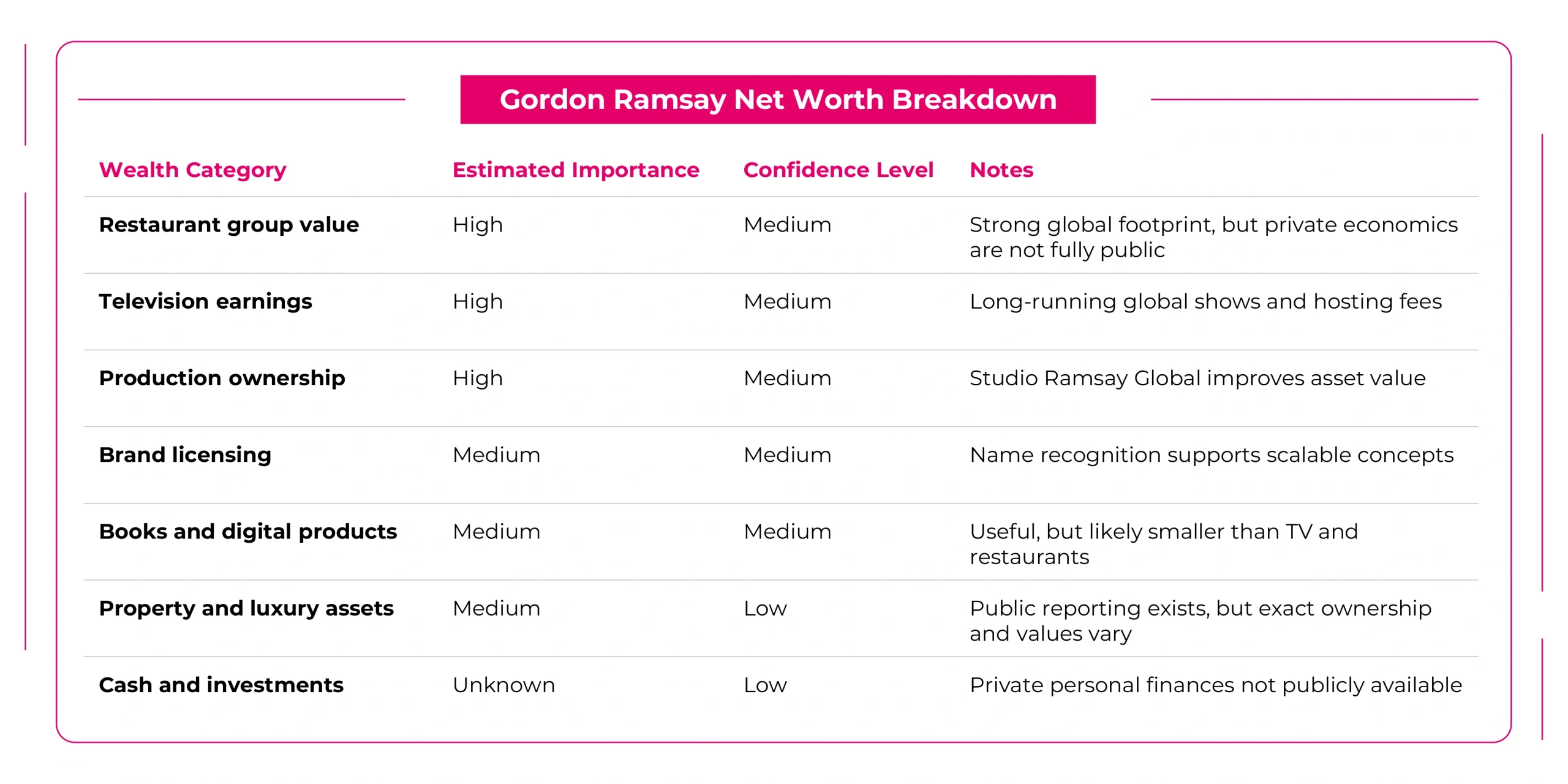
Net Worth Breakdown
This is an estimated model, not a confirmed personal balance sheet.
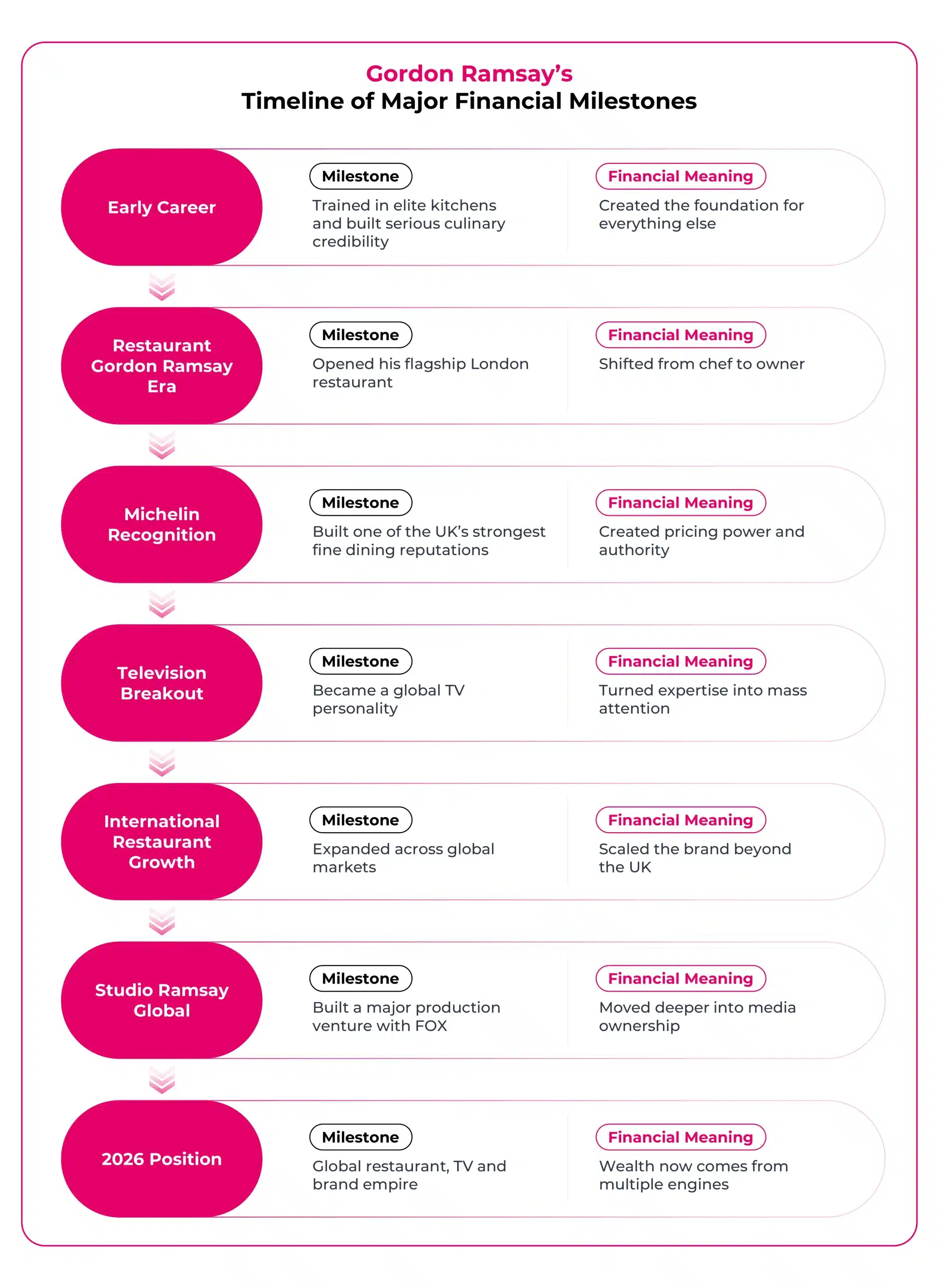
Timeline of Major Financial Milestones
Strategic Pillars Behind Gordon Ramsay’s Wealth-Building
1. Credibility Before Celebrity
Ramsay did not become famous first and learn the craft later. He built the craft first.
That is why the brand lasted. The shouting works because the standards behind it are real.
2. Turn Skill Into Media
Cooking made him respected. Television made him global.
This is the big commercial leap. Ramsay turned a high-skill profession into repeatable media formats watched around the world.
3. Own More Of The Machine
Studio Ramsay Global shows the shift from talent to owner.
That matters because ownership captures more value than appearance fees. Talent gets paid once. Owners benefit from the platform.
4. Use Prestige To Sell Scale
Fine dining created authority. Casual concepts created volume.
This is smart. A three-Michelin-star reputation gives credibility to the wider restaurant group, even when the customer is buying a burger, pizza or steak in a high-footfall location.
5. Keep The Brand Simple
The Ramsay brand is easy to understand.
High standards. Brutal honesty. Big pressure. Better food. No tolerance for nonsense.
Simple brands travel.
6. Stay Relevant Across Generations
Ramsay has survived because he moved from restaurants to TV, then from TV to social media and digital content.
That is not luck. That is adaptation.
7. Build Around A Memorable Personality
Lots of chefs are talented. Very few are unforgettable.
Ramsay’s personality is part of the product. Whether people love him or hate him, they remember him. In media and branding, that is valuable.

Actionable Insights: Lessons From Gordon Ramsay’s Wealth Blueprint
1. Mastery still matters
Ramsay’s media career only worked because the skill came first. He had the kitchen credibility to back up the performance.
Takeaway: Build real competence before trying to turn yourself into a brand.
2. Attention should become assets
TV fame alone would have made him rich. Restaurants, production ownership and licensing made the model much stronger.
Takeaway: Do not just monetise attention. Convert it into assets you own.
3. A strong personal brand can travel
The Ramsay brand works in London, Las Vegas, Dubai, Singapore and on television because the message is consistent.
Takeaway: If your brand is clear enough, it can move across markets.
4. Premium reputation can support mass-market products
Fine dining gives him authority. Casual concepts give him scale.
Takeaway: Use premium credibility to build wider commercial reach.
5. Reinvention protects wealth
Ramsay did not stay trapped in one format. He kept moving: kitchens, books, TV, production, restaurants, social media and global concepts.
Takeaway: If the market changes, your distribution strategy has to change with it.
6. Being memorable is commercial leverage
Polite and forgettable rarely wins attention.
Takeaway: A strong point of view beats bland professionalism.
Final Thoughts
Gordon Ramsay’s wealth is not just a chef story. It is a business story.
He did not become rich because he cooked nice food and shouted at a few contestants. He became rich because he built a machine around skill, standards, personality, media and ownership.
The Ramsay blueprint is about credibility, attention and scale. First, he became genuinely good. Then he became visible. Then he used that visibility to build restaurants, shows, formats, partnerships and a global brand.
For entrepreneurs, the lesson is simple. Do not just sell your skill. Package it. Distribute it. Turn it into assets.
That does not mean the model is easy. Restaurants are brutal. Television is competitive. Personal brands can become exhausting. And when your name is on the door, every failure lands on you.
But the blueprint is still powerful.
Build the skill.
Build the audience.
Build the assets.
Then protect the brand like it is the business.
That is the real story behind Gordon Ramsay’s fortune.
View more of our Wealth Network reports from Jeremy Clarkson, Tom Cruise, Donald Trump, Mark Zuckerberg, Elon Musk, Ryan Giggs, Jeff Bezos and more wealth reports on our No Bollocks Business HQ. Ben Francis’s one-brand billion proves focus can beat diversification. If you’re building a business of your own and want experienced support, you can work with Matt directly.