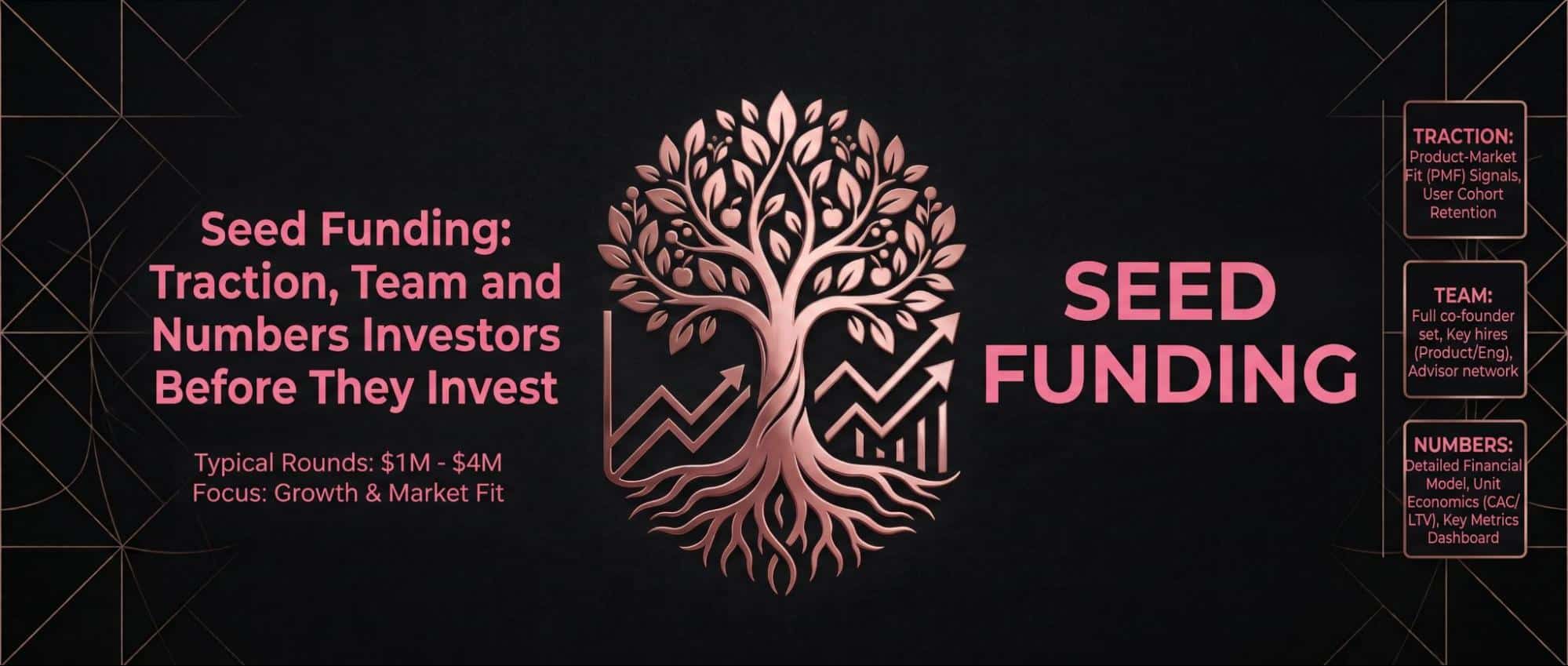

Seed funding is the round a company raises once it has a product and early evidence that customers want it. It pays to turn that early evidence into a business that can grow, and it’s often the first round led by a professional investor such as a seed fund rather than by individuals.
I’ve raised £250m+ for my own companies and funded more than 750 businesses with over £1bn, so I’ve seen seed rounds as a founder, as an investor and as a lender.
Seed vs Pre-Seed
Pre-seed is the money raised before there’s much to show: a founder, a plan and early signs of demand, usually from friends and family, angels and accelerators. A seed round comes once the product is in customers’ hands and there’s evidence that it sells.
That changes what investors look at. At pre-seed they’re mainly backing the founder. At seed they can look at what the business has done with its first money, and they expect to see the progress, the numbers and a plan for what the next round of money will achieve. The rounds also tend to be larger and more often led by a fund.
There’s no legal line between the two. A founder who got the business to a product and early sales on their own money can go straight to a seed round.
Traction at Seed
The progress a business has made so far is called traction, and it’s central to what a seed investor checks. Traction ranks by how much the customer has committed. From strongest to weakest: recurring paying customers, paying customers, signed contracts, paid pilots, pre-orders and deposits, letters of intent, free pilots that people use, a waitlist, and interest.
At seed, investors are looking for evidence that the business can repeat what it’s done. A handful of customers won through the founder’s own contacts proves the product can sell. Customers arriving through a channel the business can keep paying for, and staying once they’ve bought, show it can keep selling, and that’s what the seed money is meant to scale.
Seed investors pay more attention to the size of the opportunity and how fast the business is growing than to small, tidy numbers.
Team and Founder-Market Fit
A seed investor is still backing people as much as a business. They want to know who is building it, what they’ve done before and why they’re the right people for this market. That last part is called founder-market fit: experience in the industry, access to the customers or an insight into the problem that other founders don’t have.
Investors also look at the gaps. A technical founder with no one selling, or a sales-led team with no one who can build the product, will be asked how the seed money fills the gap, and the plan for the money needs to include those hires.
The shareholding matters too. Investors check that the founders own enough of the company to stay motivated through later rounds, and that the shareholders’ agreement deals with a founder leaving. That’s usually done with vesting, where founders earn their shares over time, and leaver clauses that set out what happens to a departing founder’s shares.
The Numbers Investors Check
Before a seed investor commits, they want to understand how the business makes money and what it does with each pound. The numbers they ask for usually include:
Revenue and growth. What the business is selling now, and how fast that’s rising month by month.
Gross margin. What’s left from each pound of sales after the direct cost of delivering the product or service. It shows how much of each sale is available to pay for growth.
Burn rate and runway. Burn rate is the cash the business spends each month beyond what comes in. Runway is how many months of cash are left at that rate.
Customer acquisition cost and lifetime value. What it costs to win a customer, against what that customer brings in over the time they stay. If winning a customer costs more than they bring in, growth makes the losses bigger.
Retention. The share of customers who keep buying or keep paying. Its opposite is churn, the share who leave.
These come from the management accounts, the up-to-date monthly figures a business produces for itself, and from financial projections showing how the seed money turns into growth. Every assumption in the projections has to hold up when an investor tests it, which is what makes them investor-ready financials.
Once an investor is interested, they check that what they’ve been told is true. This is called due diligence, and it covers the accounts, the company’s records, contracts, the share register and who owns the intellectual property. Setting up a data room, an online folder holding all of it, before the raise starts means the deal doesn’t stall while documents are found.
Round Size, Valuation and Dilution
The amount a seed round raises comes from the plan. The founder works out the next milestone, such as a level of revenue that would support a Series A round or the point where the business makes a profit, and costs everything needed to get there: people, product, sales and marketing, and the cost of the raise itself. On top of that goes runway for the time after the milestone while the next round is raised, and a margin in case things take longer or cost more.
In the UK, the British Business Bank’s Small Business Equity Tracker found that seed stage investment held steady at £2.1 billion in 2025 while the number of seed deals fell by 27%, so the money went to fewer companies. The median time between funding rounds for seed stage companies rose from 12.4 months to 14.4 months.
The investor’s share follows from the amount raised and the pre-money valuation, what the business is worth before the money goes in. The founder sets the valuation and has to justify it, and the investor brings their own number, so it’s a negotiation. Say a founder raises £1.5m at a pre-money valuation of £6m. The business is worth £7.5m afterwards and the investor owns 20%.
Seed investors may also ask for an option pool, a set of shares kept aside for future employees. If the pool is created before the money goes in, it comes out of the existing shareholders’ holding.
In the example above, if the founders owned all of the company before the round, a pool of 10% of the company after the round leaves them with 70% rather than 80%. The size of the pool and whether it comes before or after the money are both negotiable, and both change what the founders keep.
The founder’s percentage falls each time the company issues new shares, and that isn’t a problem in itself. A smaller share of a business with the money to grow can be worth far more than a bigger share of one without it. What does take value is raising more than the plan needs, because every extra pound is paid for in shares.
A business that already has steady revenue may be able to borrow part of what it needs instead, and for UK businesses Funding Guru arranges that kind of borrowing.
Seed rounds can also be raised without agreeing a valuation. In the US, Carta’s data shows that most early-stage rounds under $4 million in 2025 were raised on SAFEs or convertible notes, which turn into shares at the next priced round.
How a Seed Round Runs
A seed round is usually organised as a set amount raised from one or more investors, on the same terms, over a set period.
The investor list. It starts with investors matched on sector, stage and the size of cheque they write. A fund that backs software at seed is unlikely to back a consumer brand raising the same amount.
The approach. Approaching several investors at the same time, rather than one after another, keeps the round moving. With only one interested party, the conversation drifts towards their terms.
Meetings. An interested investor will want to meet, often more than once. They question the numbers and the plan, and judge whether the founders can deliver it.
The lead investor. One investor usually leads the round. At seed that’s often a seed fund or an experienced angel. They negotiate the terms, do most of the checking and often take a seat on the board. The others follow on the same terms.
The term sheet. A short document setting out the amount, the valuation and the main rights the investor will have, such as a board seat or a say over major decisions. Once it’s agreed, due diligence starts.
Completion. Lawyers turn the term sheet into the subscription agreement, the shareholders’ agreement and usually new articles of association, the company’s rulebook. The money arrives and the new shares are issued. If the round uses SEIS or EIS, the company then sends HMRC a compliance statement so the investors can claim their relief.
Seed Funding Rules by Country
How a seed round works is much the same everywhere, but the tax relief for investors and the rules on who a company can offer shares to differ by country.
- Seed funding in the UK can use both of the government’s tax-advantaged schemes. The Seed Enterprise Investment Scheme lets a company raise up to £250,000 if it has gross assets of no more than £350,000, fewer than 25 full-time employees and a trade no more than 3 years old.
Investors get income tax relief on 50% of what they invest under SEIS, and on 30% under the Enterprise Investment Scheme. From 6 April 2026, a company can raise up to £10 million a year and £24 million in total under EIS and the other venture capital schemes combined, with higher limits for knowledge-intensive companies, within 7 years of its first commercial sale. Companies can ask HMRC for advance assurance that the shares are likely to qualify before they raise.
- Private rounds are usually raised from accredited investors, individuals with a net worth over $1 million excluding their home, or income over $200,000 in each of the previous 2 years. A company can also raise up to $5 million in 12 months through Regulation Crowdfunding, using an SEC-registered platform.
Australia. Investors in a qualifying early stage innovation company get a 20% non-refundable tax offset, capped at A$200,000 a year, and gains on shares held for at least 12 months and less than 10 years can be disregarded for capital gains tax.
Singapore. The government’s Startup SG Equity scheme co-invests alongside independent investors in eligible technology startups.
UAE. The Dubai Financial Services Authority has regulated crowdfunding platforms in the Dubai International Financial Centre since 2017, including ones through which investors buy shares in businesses.
FAQs About Seed Funding
What is a seed round?
A seed round is a company’s first sizeable raise from investors, made once it has a product and early evidence that customers want it. It usually follows pre-seed and comes before Series A.
What do seed investors look for?
Seed investors look for traction, a team that can deliver the plan, numbers that show how the business makes money, and a market big enough for the business to grow large. They also check that the company’s records, accounts and share register are in order.
Is seed investment debt or equity?
Seed investment is usually equity: the investor pays for new shares and becomes a part-owner. Some seed rounds use a SAFE or convertible note instead, which turns into shares at the next priced round.
How much of the company do seed investors take?
There’s no fixed percentage. The investor’s share is the amount they put in divided by what the business is worth after the money goes in, so it depends on the size of the round and the pre-money valuation.
Next read
If you’re raising and want it run properly, from making the business investable to getting in front of the right investors, that’s what Capital Raiser does. If you’re earlier than that, join Capital Catalyst for free and learn how every type of funding works before you take any of it.