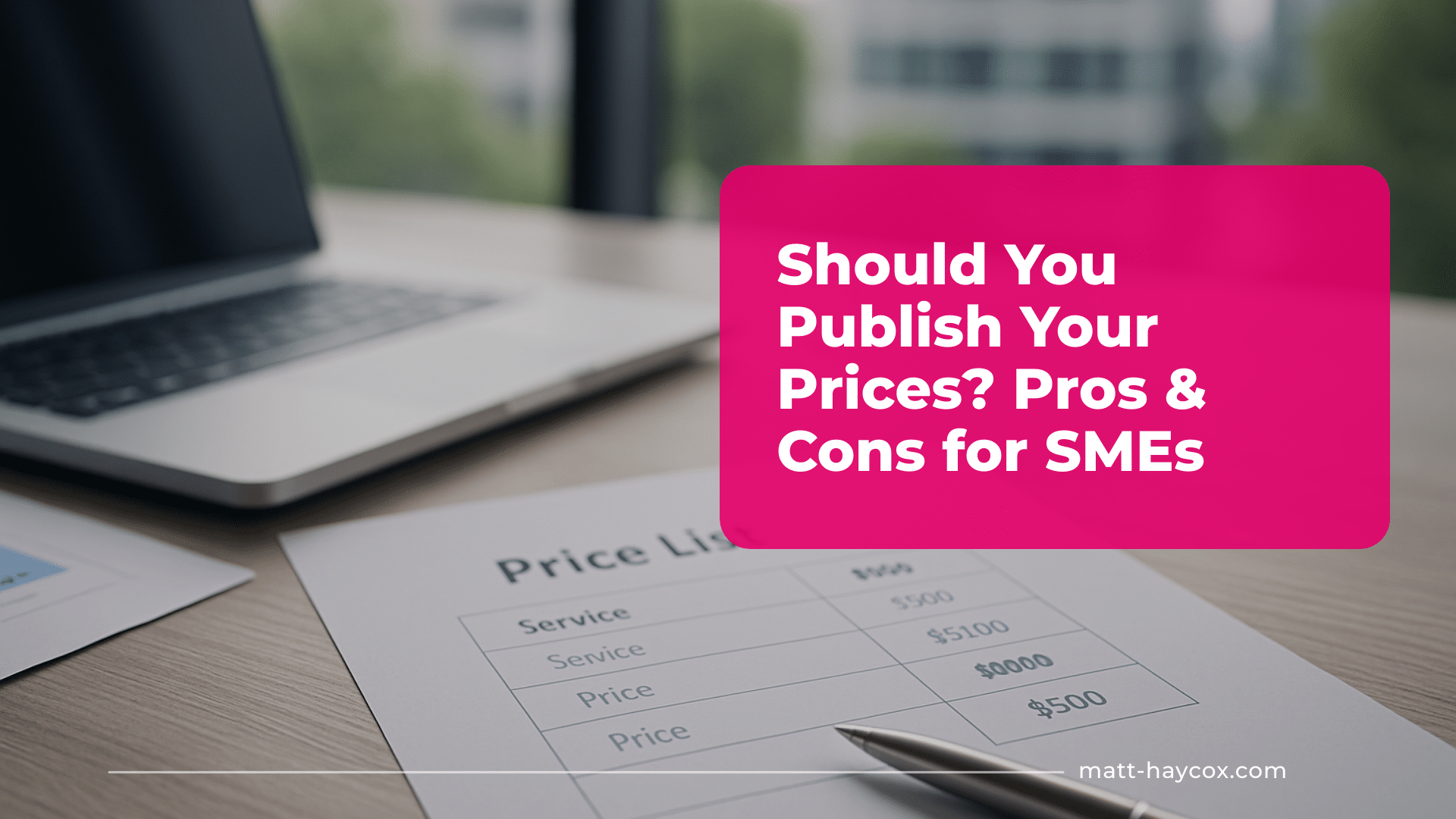

If you don’t publish prices, you’ll get more enquiries, but you’ll waste more time. If you do publish prices, you’ll filter harder, but you’ll also invite comparison. The point is not ‘transparent’ vs ‘secretive’, it’s choosing the model that protects margin and sales velocity. For the broader context, cross-reference Pricing Strategy for Your Businesses: The Complete Playbook.
In this article, we’re going to discuss how to:
- Decide when public pricing helps you sell more, faster
- Publish prices without trapping yourself in the wrong scope
- Validate transparency with small tests that protect margin
Price Transparency Vs Bespoke Quotes: A Practical Definition
Publishing prices means a buyer can self-serve a realistic cost expectation before speaking to you. It does not mean every job costs the same or that you can’t tailor solutions. Bespoke quoting means the buyer can’t anchor on any number until you’ve qualified, scoped and priced the work.
In operator terms, this is what you’re really choosing:
- Self-qualification: Can prospects decide ‘this is for me’ without a call?
- Sales effort: How many calls and proposals do you need per closed deal?
- Margin control: Do you have the process to stop scope creep and discount drift?
- Positioning: Are you selling ‘a productised outcome’ or ‘a tailored project’?
Sense-check: if your average deal is under £5k and you sell to busy owners, hiding pricing usually creates friction. If your average deal is £50k+ and the work varies wildly, ranges or ‘from’ pricing usually beat fixed numbers.
The Real Reasons SMEs Don’t Publish Prices
Most founders say they don’t publish prices because ‘it depends’. True, but incomplete. The real reasons tend to be about confidence, process or fear of being compared like a commodity.
Legitimate Reasons To Keep Pricing Off The Page (For Now)
There are a few cases where not publishing is sensible in the short term:
- Your scope varies more than 3x between deals and you don’t yet have a scoping system.
- You’re learning your buyer and still changing packaging monthly, publishing would lock you into old thinking.
- Regulated or tender-led work where pricing must be formally quoted, you can still publish benchmarks and minimums.
The Hidden Cost Of ‘Request A Quote’ Everywhere
When everything is bespoke, every lead becomes a mini consulting engagement. You’ll feel busy, but it’s often low-quality activity: calls with buyers who were never close to your budget, proposals written for people who wanted a ballpark and discount conversations that start too early.
A simple way to quantify it is ‘proposal burden’:
Proposal burden = (Proposals sent per month) x (Hours per proposal) x (Fully-loaded hourly cost)
If you send 20 proposals, each takes 2 hours and your fully-loaded cost is £60/hour, that’s £2,400/month before you’ve delivered anything. Public pricing, even as ranges, is a lever to reduce that burden.
Should I Publish Prices? A Decision Scorecard For SMEs
If you’re asking ‘should i publish prices’, don’t treat it as a branding debate. Treat it like an operating decision. Score yourself 0, 1 or 2 on each point, then add it up.
- Scope stability: 0 = every job is unique, 1 = 3 to 4 patterns, 2 = repeatable packages.
- Sales cycle: 0 = 6+ stakeholders, 1 = 2 to 3 stakeholders, 2 = owner-led or single decision-maker.
- Lead volume: 0 = low and precious, 1 = steady, 2 = high enough to filter.
- Competitive pressure: 0 = buyer can easily compare, 1 = partial comparison, 2 = you’re clearly differentiated on outcome or niche.
- Delivery capacity: 0 = over-subscribed, 1 = balanced, 2 = you need smoother utilisation.
- Pricing confidence: 0 = still guessing, 1 = basic cost plus margin, 2 = you can defend value with evidence.
8 to 12 points: publish pricing now, you’ll benefit from filtering and speed. 5 to 7 points: publish ranges and minimums, tighten scope and packaging. 0 to 4 points: don’t publish full pricing yet, but publish a clear minimum engagement and your buying process.
Signals And Data You Can Gather In 3 Hours
You don’t need market research theatre. You need a handful of internal facts and a few external anchors.
Internal Data First (90 Minutes)
Pull the last 20 deals, even if they’re messy. You’re looking for patterns that let you price publicly without getting burned.
- Deal size distribution: median, not average. Note the 25th and 75th percentile.
- Hours delivered: estimated vs actual, plus where scope changed.
- Gross margin: revenue minus direct delivery cost, as a %.
- Sales effort: number of calls and proposals per closed deal.
- Discount frequency: how often you discount and why.
Completion check: you should be able to name your ‘typical’ deal in one sentence, including range, timeline and the biggest driver of variance.
Public Signals Next (90 Minutes)
Now look outwards, but keep it practical:
- Competitor price positioning: not just numbers, but packaging, terms and what’s included.
- Buyer expectations: scan forums, procurement checklists, job specs, Reddit threads, YouTube reviews, anything where buyers talk plainly.
- Anchor services: if you’re in a local market, check what adjacent providers charge for comparable outcomes.
The goal is not to match the market, it’s to spot where your pricing needs explanation. If competitors publish and you don’t, buyers assume either ‘expensive’ or ‘disorganised’. Neither helps.
How To Publish Prices Without Boxing Yourself In
You can be transparent without being rigid. The trick is to publish the parts that are stable, and keep the parts that vary behind a qualification step.
Use A ‘From’ Price With Clear Conditions
A ‘from’ price works when you can define a minimum scope and a typical buyer profile. Put guardrails right next to the number so it doesn’t turn into a bait-and-switch.
Example format: ‘From £3,500 for a 4-week onboarding, includes X, Y and Z, assumes up to 2 stakeholders and one approval loop.’
Publish Ranges Based On Scope Drivers
Ranges are the sweet spot for many SMEs. The range should map to 2 to 3 drivers that buyers understand, like number of locations, size of database, number of staff, complexity of integrations.
Example: ‘£8k to £20k depending on number of systems we integrate (1 to 5) and how clean your data is.’
Tier With Good–Better–Best
If you can describe a path from minimum viable outcome to premium outcome, tiering is your friend. It’s also how you stop every buyer defaulting to the cheapest option, because you’ve framed the trade-offs.
Each tier needs a hard boundary, otherwise you’ll sell ‘Good’ then deliver ‘Best’ because the client asked nicely.
Show The Buying Path, Not Just The Number
Many buyers accept bespoke pricing if the process is clear. If you’re not ready to publish a price, publish what happens next: discovery call, scoping, proposal turnaround time and what inputs you need.
A One-Sentence Offer Template You Can Fill In Today
Use this to tighten your message before you touch the price page:
Offer template: ‘We help [specific customer] get [measurable outcome] in [timeframe] using [method], starting at £[minimum], as long as [key assumption].’
If you can’t fill the bracketed parts without waffling, your pricing will feel vague too. Fix the offer, then publish.
A Validation Path You Can Run In 7 To 14 Days
Don’t redesign your whole website and hope. Run small tests that tell you whether publishing prices improves conversion and deal quality.
Test 1: Add A Minimum Engagement Fee
Add one line to your services page: ‘Projects start at £X.’ Track what happens to enquiry volume and quality for 7 days. If volume drops but close rate rises, you’ve saved time and likely improved margin.
Test 2: Publish Ranges On A Single High-Intent Page
Pick the service that generates the most inbound interest. Add ranges and scope drivers. Compare:
- Enquiry-to-call rate
- Call-to-proposal rate
- Proposal-to-close rate
- Average first call duration
Completion check: your first call should shorten by 10% to 30% because you’re no longer doing budget education from scratch.
Test 3: Put Pricing Behind A Light Gate
If you want transparency but need context, gate pricing behind 3 questions: size, timeline, current solution. Deliver a tailored range instantly. You’ll learn what ‘typical’ looks like fast and you’ll collect qualification data without burning sales hours.
Test 4: Quote Faster Using A Standardised Price Book
Even if you don’t publish, standardise. Aim to send a price range within 24 hours of a qualified call. Speed is a competitive advantage, and it reduces discount requests because you look in control.
Unit Economics That Hold At Small Scale
Publishing prices only works if your numbers work. Don’t set a public price that requires heroic utilisation, free revisions and constant ‘quick calls’ to break even.
Start With A Simple Margin Floor
For most service SMEs, you need a gross margin floor that supports overhead and still leaves profit. A basic target is:
Gross margin floor: 55% to 70% depending on delivery model, subcontractor use and sales effort.
Quick calc: if you sell a £10k project and direct delivery cost is £4.5k, gross margin is 55%. If your overheads run at £30k/month and you sell £80k/month, overhead rate is 37.5%. That leaves 17.5% operating margin before tax, assuming you hold the line on scope.
Time-Based Teams Need A Utilisation Reality Check
If your work is labour-heavy, your public pricing must reflect utilisation. A team member is not billable 40 hours a week. Between internal work, meetings, QA and client comms, many SMEs land at 60% to 75% utilisation.
Completion check: if your price assumes 90% utilisation, it’s fantasy. Publish prices built on the real number, not the one you wish you had.
Protect Your CAC Payback
Public pricing often increases self-serve leads, but you still need the payback to make sense. If your fully-loaded cost to acquire a customer is £1,200 and your gross profit per month is £300, your payback is 4 months. If it’s 12 months, you’re one churn spike away from pain.
Operational Guardrails That Protect Margin And Time
Transparency fails when delivery is sloppy. Before you publish, install a few guardrails that stop ‘just one more thing’ from eating the margin you thought you were selling.
Write Scope As Inputs And Outputs
Stop writing scope as a vague activity list. Write it as inputs you need from the client and outputs you will ship. Then price the outputs.
Example: ‘Client provides access to X and Y within 3 days, we deliver 3 landing page variants, 1 tracking plan, 1 launch QA pass.’
Set A Change Control Rule
Pick one rule and enforce it:
- Rule: ‘Any request that changes the timeline, number of deliverables or approval loops triggers a re-quote within 24 hours.’
This is what makes published pricing safe. Without it, you’ll publish a number, then deliver custom work at a fixed price. That’s how founders burn out.
Install A Discount Policy You Can Defend
If you publish prices but discount ad hoc, buyers will learn to ask. Set discount rules tied to something real: upfront payment, longer commitment, reduced scope. If the buyer wants a lower price, remove something, don’t just cut margin.
Micro Cases: What It Looks Like In The Wild
These are condensed examples from typical SME situations. The numbers are illustrative, but the operating logic is the point.
Case 1: Regional Accountancy Firm (Bristol)
They hid pricing and got 60 enquiries/month, but only 8 were in budget. They published ‘from £250/month’ plus 3 tiers tied to turnover bands. Enquiries fell to 35/month, but qualified calls rose, proposal volume halved and average client value increased by 22% because buyers self-selected into higher tiers.
Case 2: B2B SaaS With A Sales-Led Motion
They worried competitors would undercut. They published pricing per seat, but gated implementation. This reduced ‘price fishing’ calls and moved conversations to outcomes. Close rate improved because prospects arrived already aligned on budget, and the team stopped over-building bespoke onboarding for small accounts.
Case 3: Design Studio Selling Projects
Scope varied from £4k landing pages to £40k rebrands. They published ranges based on deliverables and number of stakeholders, plus a £1k paid discovery credited against the project. They filtered tyre-kickers, got paid for the scoping work and protected margin when clients changed direction mid-project.
Case 4: Managed IT Provider (Multi-Site Retail)
They couldn’t publish a single number because sites varied. They published a per-site range plus a ‘minimum monthly’ and a clear list of what counts as out-of-scope. Result: fewer arguments, fewer emergency requests treated as free, and better utilisation planning because packages were more standard.
Risks And Hedges Before You Hit Publish
Publishing prices is not risk-free. It just changes the risks. Here are the common ones and how to hedge them.
- Risk: You get undercut. Hedge: publish what’s included and your proof, not just the number. If you’re truly premium, your price should look ‘high’ to the wrong buyer.
- Risk: You anchor too low. Hedge: publish ranges with a credible top end, and include premium tiers. Make the ‘best’ option the one you want to deliver.
- Risk: Clients weaponise the website price. Hedge: date-stamp pricing, state assumptions and reserve the right to quote based on scope. This isn’t legal trickery, it’s clarity.
- Risk: Your team starts making exceptions. Hedge: use a price book and approval rules, for example ‘anything below list needs founder sign-off’.
- Risk: You spend ages debating wording. Hedge: ship a v1 range page, then review data weekly for 4 weeks.
Do And Don’t Checklist For Price Transparency
- Do: Publish a minimum engagement price, even if everything else is bespoke.
- Do: Tie ranges to 2 to 3 scope drivers buyers understand.
- Do: Put boundaries in writing, especially approval loops and revisions.
- Don’t: Publish a single fixed price if delivery variance regularly exceeds 2x.
- Don’t: Hide behind ‘it depends’ if you already know the usual range.
- Don’t: Discount without trading scope, term or payment conditions.
If you’re still unsure, go back to the scorecard and the internal numbers. The right answer is the one that reduces wasted sales time and increases profitable closes.
Download The Good–Better–Best Tiering Templates And Build A Price Page That Converts
If you want to be transparent without getting boxed into the wrong work, tiering is the cleanest move. Download the Good–Better–Best Tiering Templates (Service, SaaS & Advisory) and use it to structure packages, set boundaries and publish pricing that filters and sells.
- Make the decision using a scorecard and real internal data, not gut feel about what competitors do.
- Validate fast with minimum fees, ranges and gated pricing tests, then keep what improves qualified leads and margin.
- Protect delivery with scope boundaries, change control and discount rules so published pricing doesn’t become ‘fixed price chaos’.
FAQ For Publishing Prices For SMEs
Should I publish prices if my service is bespoke?
Yes, but publish ranges and minimums rather than pretending every project is identical. You’re trying to set expectations and filter, not finalise a contract on a web page.
Will publishing prices reduce my leads?
Often, yes, but the better question is whether it reduces unqualified leads and improves close rate. If you track enquiry-to-close and time spent per deal, you’ll see quickly if it’s a win.
What if competitors copy my pricing?
They can copy numbers, they can’t copy your delivery quality, proof and positioning. If a competitor can beat you simply by matching your price, your differentiation is too thin and hiding pricing won’t fix it.
Should I publish prices on my homepage?
Not always. Put pricing where intent is high, like service pages and dedicated pricing pages, and link it clearly from navigation so buyers can find it when they’re ready.
How do I answer ‘I saw your website price, can you do better?’
Anchor back to scope and outcomes: ‘The price reflects X and Y, if you need it lower we can reduce scope or change terms.’ If you discount, trade it for something concrete like upfront payment or fewer deliverables.
Is it better to publish fixed prices or ranges?
Fixed prices work for productised, repeatable offers where variance is low. Ranges work when scope varies but you can explain the drivers clearly, which is most SMEs.
What’s the simplest way to start if I’m nervous?
Add a minimum engagement fee and a ‘typical project range’ line, then review lead quality for 7 to 14 days. That single change answers the ‘should i publish prices’ question with data, not opinions.
Do I need a pricing page or can I mention it in proposals only?
If you rely on inbound, a pricing page reduces friction and saves sales time, even if it’s just ranges and assumptions. If you sell exclusively through referrals and high-touch networks, publishing may be less urgent, but minimums still help set expectations early.