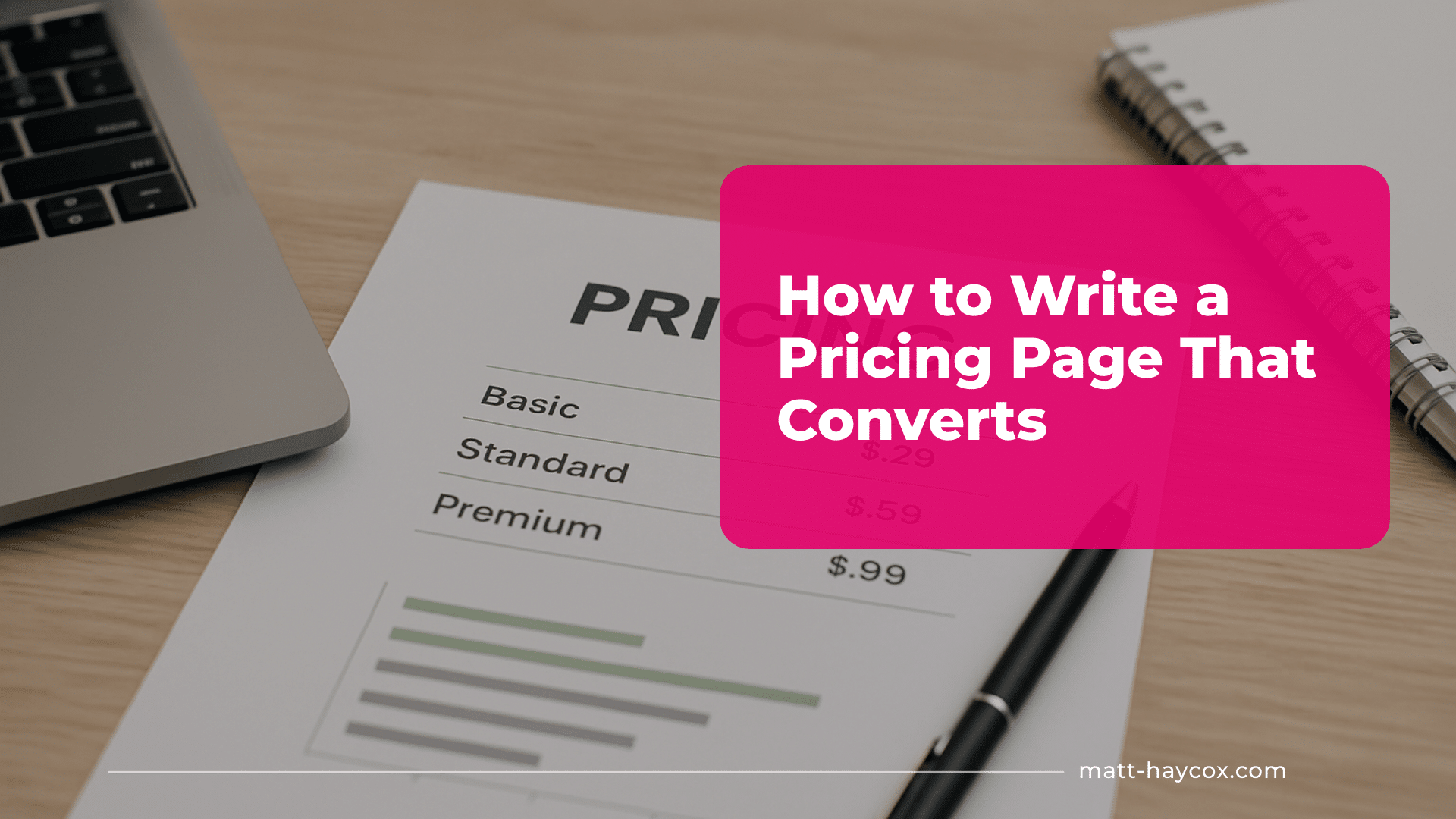

If your pricing page is vague, you’re forcing good buyers to guess, and guesswork kills conversions. The fix isn’t ‘better copy’, it’s clearer decisions, stronger proof and fewer dead ends. Before you rewrite anything, cross-reference Pricing Strategy for Your Businesses: The Complete Playbook so the page reflects a real pricing strategy, not a pretty layout.
In this article, we’re going to discuss how to:
- Design A pricing page layout that answers buyer questions in the right order
- Add Proof, anchors and toggles that make the decision feel safe and obvious
- Use FAQs and micro-tests to lift conversion without discounting
What A High-Converting Pricing Page Actually Does
A pricing page isn’t a list of numbers, it’s a decision page. Its job is to get a qualified buyer to pick an option, understand what happens next and feel confident they won’t look stupid internally for choosing you.
Practical definition: a high-converting pricing page reduces ‘decision friction’ faster than it increases ‘price anxiety’. It does that by sequencing clarity, proof, comparison and next steps.
Sense-checks you can run in 10 minutes:
- Clarity: Can a new visitor explain your tiers back to you in one sentence?
- Risk: Do you answer ‘What if this doesn’t work for us?’ without forcing a sales call?
- Action: Is there a single primary next step per tier, with no competing CTAs?
- Fit: Do you help the wrong buyer self-select out, politely?
Start With The Data You Can Gather In A Few Hours
Don’t start in Figma. Start with evidence. You can pull enough signal in an afternoon to know what your pricing page needs to say and what it can safely cut.
Internal Signals First
Pull these from your CRM, support inbox and call notes:
- Top 10 objections: Real wording, copy-paste, no paraphrasing.
- Time-to-close by plan: Median days from first touch to paid, per tier.
- Discount frequency: % of deals discounted, average discount, and which tier gets hit.
- Churn or refund reasons: The first 30 days are pricing-page feedback.
- Feature usage: For SaaS, what 3 features correlate with retention? For services, what deliverable correlates with referrals?
If you’re early stage and don’t have volume, use 10 to 20 customer interviews and two weeks of website behaviour. You’re looking for patterns, not statistical purity.
Public Signals Next
Then check external references. Not to copy, to calibrate:
- Competitor tier structure: How many options, what names, what limits?
- Common proof types: Case studies, G2 badges, compliance logos, guarantees.
- Anchors: Are they anchoring on ‘from £x’, seat-based pricing, usage, or outcomes?
- Friction points: Do they hide pricing behind ‘Book a demo’? If yes, what are they avoiding?
Your aim is not ‘matching the market’. Your aim is being clearer than the market about outcomes and risk.
Build Your Pricing Page Layout Around Buyer Questions
The best layout is basically a well-run sales call that never wastes the buyer’s time. It answers questions in the order they appear in someone’s head.
The Conversion Sequence That Works
Most buyers follow this chain: ‘Is this for me?’ then ‘What do I get?’ then ‘Why you?’ then ‘What does it cost?’ then ‘What happens next?’ Your pricing page should mirror that, not fight it.
Here’s a reliable structure you can implement this week:
- Above the fold: One-line positioning, who it’s for, and the pricing model in plain English.
- Tiers: 2 to 4 options, with a recommended choice and a clear ‘best for’ line.
- Comparison: A short table that highlights differences that matter, not every feature.
- Proof: Case snippets, logos, numbers, and risk reducers.
- FAQs: Objections, contracts, onboarding, security, cancellation.
- Final CTA: Repeat the next step with reassurance.
Completion check: a buyer should be able to decide in under 90 seconds whether they’re in the right place, and in under 3 minutes which option they want.
Write The Offer In One Sentence, Then Build The Page Around It
If you can’t say the offer cleanly, you’ll compensate with long descriptions and feature lists. That usually makes the pricing page slower, not better.
Use this fill-in template:
Offer template: ‘For [ideal customer], we help you achieve [measurable outcome] in [timeframe] using [method], starting at £[price] with [risk reducer].’
Example: ‘For 10 to 50 person agencies, we help you cut project overruns by 20% in 30 days using weekly delivery sprints, starting at £499 a month with a 14-day cancel-anytime option.’
Now your tiers, proof and FAQs have an anchor. If a section doesn’t support that sentence, cut it.
Use Pricing Anchors And Toggles Without Becoming Manipulative
Anchors and toggles are tools. Used properly, they help buyers compare options and understand trade-offs. Used badly, they create mistrust. If your buyer thinks ‘they’re playing games’, you’ve lost.
Anchors That Increase Clarity
Anchoring is simply giving context. A few practical anchors that work on a pricing page:
- Annual vs monthly toggle: Show the monthly equivalent clearly, and state the saving as a number, not a vague promise.
- ‘Most popular’ tier: Only use it if it’s genuinely where the majority of customers land, or where you want them to land because it delivers success.
- ‘From’ pricing with bounds: If pricing varies, add a range and what drives it. ‘From £2k’ alone just reads as ‘it’ll be £10k’.
A good rule: every anchor should reduce uncertainty. If it mainly increases pressure, it’s likely a short-term win and a long-term churn generator.
Toggles That Let Buyers Self-Qualify
Toggles are great when there are two real buyer modes. Examples: monthly vs annual, self-serve vs supported, UK vs international compliance, or 5 seats vs 25 seats. Don’t add a toggle just because you’ve seen it elsewhere.
Implementation detail that matters: when a toggle changes the price, it should also change the explanation. If annual is cheaper because onboarding costs are amortised, say that. Buyers respect economics.
Pricing Page Unit Economics: Make Sure The Numbers Hold At Small Scale
Conversion is pointless if each new customer quietly loses you money. Your pricing page should reflect unit economics that work when you’ve got 10 customers, not just when you’ve got 1,000.
Run a quick weekly gross margin check per tier:
- Revenue: Price paid per month or per project.
- Direct costs: Delivery hours, contractor costs, usage costs, onboarding time, payment fees.
- Gross margin: (Revenue minus direct costs) divided by revenue.
Operator thresholds that keep you sane:
- Services: If you’re under 50% gross margin, you’re buying stress. Aim for 60% to 75% unless you have a clear upsell path.
- SaaS: If your gross margin is under 70%, your pricing and infrastructure need attention.
- Hybrid: Separate platform margin from support margin, otherwise you’ll misprice support-heavy tiers.
Simple example: you sell a £1,200 monthly retainer. Delivery is 8 hours at an internal cost of £60 an hour (£480), plus tools at £40. Gross margin is (£1,200 – £520) / £1,200 = 56.7%. If that tier is your ‘most popular’ plan, your pricing page is steering buyers into your worst economics.
Proof That Converts: Show Evidence, Not Claims
Most pricing pages try to ‘persuade’. Better ones verify. The buyer wants to know you’ve solved this problem for someone like them, recently, without drama.
Proof Types That Earn Trust Fast
Rotate proof types so it doesn’t feel manufactured:
- Mini case snippets: One sentence outcome, one sentence method, one number.
- Operational artefacts: Example reports, dashboards, templates, or screenshots.
- Risk reducers: Clear cancellation terms, onboarding plan, or a scoped pilot.
- Third-party trust: Certifications, compliance, or partner logos where relevant.
Place proof near the moment of doubt, not buried at the bottom. If you see a drop in scroll depth right after the pricing cards, add proof immediately underneath.
Three Micro Cases You Can Copy
1) B2B SaaS for finance teams
They added a 3-line ‘Security & IT’ section on the pricing page: SSO availability, data hosting region and typical implementation time. Demo requests dropped by 12%, paid starts increased by 18% because fewer unqualified leads booked calls and more qualified buyers self-served.
2) UK-based fractional marketing service
They replaced a long feature list with ‘What you get in week 1, week 2, week 3’. Close rate improved from 22% to 29% because buyers could picture delivery, not just promises, and the operations team stopped improvising onboarding.
3) E-commerce retention consultancy
They introduced a ‘pilot’ tier priced at £3.5k for 14 days with a defined output: a retention audit plus 3 experiments. It reduced negotiation time by 30% and increased the number of deals that moved forward without discounting.
Comparison Tables: The Fastest Way To Remove ‘Option Paralysis’
Buyers don’t need every feature, they need the difference that affects success. A tight comparison table helps them justify the decision internally.
Rules that keep it useful:
- Keep it to 6 to 10 rows: Pick the levers that change outcomes, risk, or service level.
- Use limits honestly: Seats, usage, response times, implementation support.
- Write for procurement: Add contract length, invoicing, and data handling if it’s relevant.
Completion check: if a buyer screenshots your table and sends it to their boss, does it make you look organised or chaotic?
FAQs That Reduce Support Load And Lift Conversion
FAQs aren’t filler. They’re the ‘quiet objections’ people won’t ask on a call because they don’t want to look inexperienced or difficult. Your pricing page should answer them cleanly.
Good FAQ topics, in plain language:
- What’s included vs optional: Especially onboarding, migration, training.
- How cancellation works: Dates, notice period, any exit fees, data export.
- What happens if we go over limits: Overages, throttling, or upgrade paths.
- Who it’s not for: This saves you time and improves close rates.
Write each answer like you’re replying to a decent client on email. Two to four sentences, no corporate waffle.
Validation Path: Small Tests You Can Run In 7 To 14 Days
You don’t need a full rebuild to improve a pricing page. You need controlled tests with clear success metrics.
Pick One Metric And One Behaviour
Choose a primary metric based on your model:
- Self-serve SaaS: Pricing page to trial start %, trial to paid %.
- Sales-led: Pricing page to qualified demo request %, demo to close %.
- Services: Pricing page to enquiry %, enquiry to proposal %.
Then choose a behaviour to influence: scroll depth past tiers, clicks on ‘Compare plans’, or clicks on ‘Security’ section.
Three Practical Tests
Test 1: Reorder the page, not the copy
Move proof directly under the tier cards, and move long feature detail below comparison. Success looks like higher CTA clicks with the same traffic.
Test 2: Add a ‘best for’ line and remove 20% of text
Force your tiers to be about fit. If conversion improves, your issue was confusion, not price.
Test 3: Introduce a pilot or starter option
Make it time-boxed and output-defined. If you see more starts with stable gross margin, you’ve created a lower-risk entry without discounting.
Operational Guardrails That Protect Margin And Your Time
Your pricing page sets expectations. If it’s sloppy, your operations will pay for it. Guardrails make delivery predictable, margin stable and customers happier.
Build these into the page and the fulfilment behind it:
- Define the boundary: ‘Includes X, excludes Y’. Put it in tier descriptions, not just contracts.
- Set response times: If support is included, state hours and channels.
- Make upgrades obvious: Document what triggers an upgrade, such as seats, usage, or additional locations.
- Align onboarding: Every tier should have a clear onboarding promise you can actually deliver.
Live-ops tip: if you keep getting the same ‘Can you also…?’ request, it means you’ve accidentally created an unpriced add-on. Either package it properly or write it out of scope.
Risks And Hedges: Avoid These Naïve Pricing Page Mistakes
Most pricing page problems aren’t design problems, they’re positioning and operations problems showing up on the page.
- Risk: Hiding pricing to ‘increase leads’. Hedge: If you’re sales-led, publish ranges and drivers, then qualify on the call. You’ll waste less time.
- Risk: Too many tiers. Hedge: Cap at 4. If you need more, you need segmentation, not options.
- Risk: Discounts as a default. Hedge: Use incentives that protect margin, such as annual prepay, limited-scope pilots, or added onboarding.
- Risk: ‘Unlimited’ language. Hedge: Define fair use. Unlimited is an invitation for your worst-fit customers.
- Risk: Proof that’s all vibes. Hedge: Add numbers, timeframes and named roles where possible, even if anonymised.
Do And Don’t Checklist Before You Publish
A quick final pass you can run with your team in 30 minutes.
- Do: Make the primary CTA consistent across the whole pricing page.
- Do: Put a recommended plan only if you can justify why it’s best for most.
- Do: State what happens after the click, including timelines and onboarding steps.
- Don’t: Use clever tier names without describing who they’re for.
- Don’t: Hide terms, notice periods, or limitations in tiny text.
- Don’t: Let your comparison table turn into a feature dump.
Download The Good–Better–Best Tiering Templates And Fix Your Page Faster
If you want a quicker path to a clean, credible pricing page, download the Good–Better–Best Tiering Templates (Service, SaaS & Advisory). It’ll help you structure tiers around outcomes, set sensible limits, and write ‘best for’ lines that reduce back-and-forth on calls.
Key Takeaways
- Build your pricing page like a decision flow: fit, options, comparison, proof, FAQs, then a clear next step.
- Validate changes with small tests over 7 to 14 days, and make sure each tier’s unit economics hold at low volume.
- Protect margin and time with operational guardrails: boundaries, response times, upgrade triggers and honest limits.
FAQ For Writing A Pricing Page That Converts
Should I put pricing on my website or keep it behind a demo?
If you can price with reasonable consistency, publish it, even if it’s ranges. If you genuinely can’t, publish starting prices plus the 3 drivers that change cost so buyers know what league you’re in.
How many plans should a pricing page have?
Usually 3 works best because it supports comparison without overwhelm. If you can’t explain why you need 4, you probably don’t.
What’s the best way to show annual discounts?
Use a simple toggle and state the saving as a number, for example ‘Save £240 a year’, not vague ‘Save 20%’. Make sure the annual option includes a clear reason to commit, such as priority onboarding or price lock.
Do comparison tables increase conversion?
Yes when they highlight meaningful differences like limits, service level and implementation support. They hurt conversion when they become a long feature checklist that forces buyers to read instead of decide.
What proof should I put near the price?
Use evidence that reduces perceived risk: mini case results, implementation timelines, and trust signals like compliance or well-known customer logos. Keep it specific and recent, one strong proof block beats five vague testimonials.
How do I stop customers choosing the cheapest plan?
Price the entry plan so it still works economically, and make the mid-tier the best path to success, not just ‘more stuff’. Also cap key limits on the entry tier so growing customers naturally upgrade when value increases.
Should I offer a free trial or a paid pilot?
If setup is light and value is immediate, a trial can work. If success needs hands-on work or real commitment, a time-boxed paid pilot protects your team and attracts serious buyers.
What’s one quick fix that often lifts pricing page conversion?
Add a ‘What happens next’ section under the tiers with 3 steps and timeframes, such as ‘Sign up, onboarding call within 48 hours, first outcome in 7 days’. Buyers convert faster when the process feels predictable.