
You’ve got a business idea you can’t stop thinking about, and you’re worried someone will nick it. Fair. But most founders waste months hiding an idea that isn’t protectable yet, while the market moves on.
Before you clamp down on secrecy, get clear on what the UK actually protects, what it doesn’t, and what actions give you real leverage. If you’re still shaping the concept, cross-reference Business Ideas: The Full Guide to Finding, Testing and Choosing the Right Idea so you’re protecting something that customers actually want.
In this article, we’re going to discuss how to:
- Separate what’s protectable from what’s just a concept
- Use trademarks, copyright, NDAs and patents properly in the UK
- Validate fast while keeping your edge and your margins
Protecting An Idea: A Practical Founder Definition
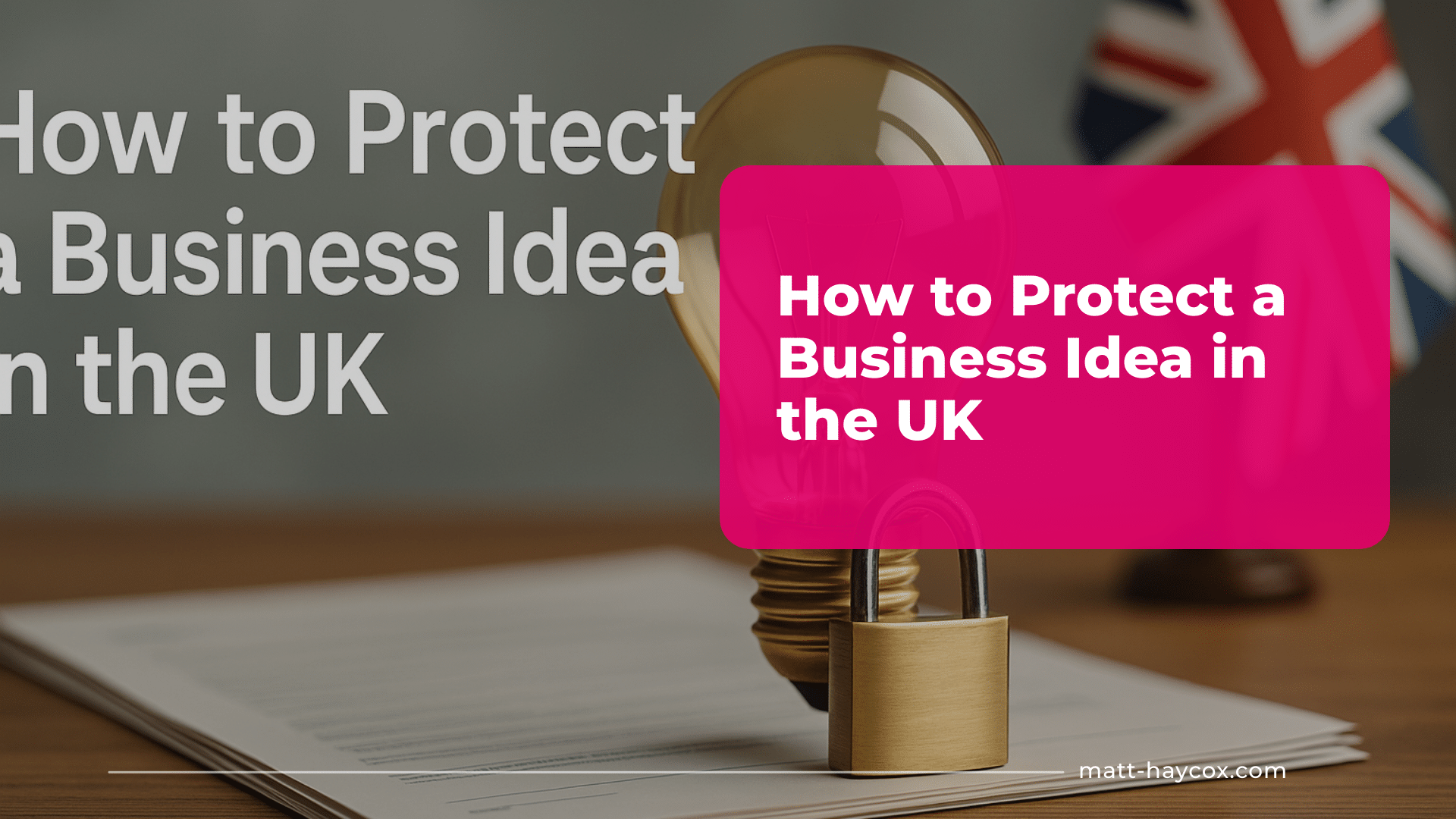
In the UK, you can’t really ‘protect an idea’ in the abstract. You protect specific assets that sit around the idea: a brand name, a design, code, a document, a process, confidential know-how, or a new invention. That distinction matters because it changes your plan from ‘keep it secret’ to ‘build evidence and lock down the assets as you create them’.
Here’s the founder framing I use: protection is about reducing the chance of a copycat catching up, and increasing your options if someone does.
- Reduce the chance: Control who sees what, and when.
- Increase your options: Register what’s registerable, and keep records for everything else.
- Keep momentum: The best protection is speed, distribution and customer love.
How To Protect A Business Idea UK: The Straight Answer
If you’re searching ‘how to protect a business idea uk’, you’re usually asking two different questions:
1) Can I stop someone taking the concept? Usually no. Concepts like ‘a marketplace for tradespeople’ or ‘a meal prep service for busy parents’ aren’t owned by anyone.
2) Can I stop someone using what I’ve built around the concept? Often yes. You can protect brand assets with trademarks, materials with copyright, secrecy with NDAs and trade secret discipline, and inventions with patents (if they’re genuinely new and not obvious).
The job is to map your idea into protectable components, then take the right action for each component, without slowing down validation.
What You Can And Can’t Protect In The UK
Let’s make this brutally clear, because it saves you time and legal fees.
What You Can’t Protect
You generally can’t protect:
- The raw idea: ‘An app that helps people save money’ is not protectable.
- A business model: Subscriptions, marketplaces, ‘freemium’, these are commercial patterns.
- Common features: ‘Next day delivery’, ‘AI recommendations’, ‘carbon neutral packaging’ are usually just table stakes.
What You Can Protect
You can often protect:
- Brand identifiers: Names, logos, and in some cases taglines, via trademarks.
- Original materials: Copy, images, code, pitch decks, proposals, and product photos via copyright (automatic, but you still need evidence).
- Confidential know-how: Pricing logic, supplier terms, scripts, datasets, workflows, and ‘how we do it’, via trade secret practices and NDAs.
- Inventions: New technical solutions via patents, if they meet the rules and you file before public disclosure.
- Design: The look and feel of a product, sometimes via registered designs.
Fast Signals To Gather In A Few Hours (Before You Worry About IP)
Founders obsess over IP when they’re actually unsure if anyone will pay. Spend 2 to 4 hours gathering signals so you’re not ‘protecting’ a problem no one cares about.
Internal first, 30 minutes: write a one-page ‘asset map’. Split what you have into Brand, Content, Process, Tech, Data, Relationships. If you can’t list 5 to 10 concrete assets, you’re still at concept stage.
Public checks, 90 minutes:
- Trademark conflict scan: Search your name ideas on Companies House, Google and the UKIPO database.
- Competitor feature scan: Find 5 direct competitors and list their core promises, pricing and positioning.
- Domain and social handles: Not legally decisive, but a fast proxy for how crowded a brand space is.
Evidence artefacts, 60 minutes: create a dated folder with your draft name shortlist, first landing page copy, screenshots of searches, and your ‘why now’ notes. If you ever need to prove timing and authorship, these artefacts matter.
Trademarks: Protect The Name, Not The Business
A trademark protects a sign that identifies your goods or services: your brand name, logo, sometimes a slogan. It does not protect the underlying business idea. But it’s still one of the most practical moves you can make early, because founders trade on trust, not novelty.
Trademarks become important when you’re doing any of these:
- Putting money into marketing: Ads, SEO, partnerships.
- Signing channel deals: Affiliates, resellers, distributors.
- Building a community: You don’t want another business riding your name.
Start by checking the UK Intellectual Property Office guidance on how to register a trade mark in the UK so you understand classes and what can be refused.
Operator tip: Don’t fall in love with a clever name you can’t defend. Choose a name that’s distinctive, easy to spell, and not descriptive. ‘London Plumbers Marketplace’ is hard to protect. ‘Fixly’ is more defensible.
Copyright: The Quiet Workhorse For Founders
Copyright is automatic in the UK. It protects the expression of your work: copy, blog posts, product photos, video scripts, and your software code. It doesn’t protect the idea behind them.
What founders miss is that copyright is only as useful as your ability to prove what you created, and when. Do this properly:
- Keep version history: Google Docs, Git, Notion, anything with timestamps.
- Use clean authorship: Make sure contractors assign IP to your company in writing.
- Store source files: Raw design files, code repos, original photo files.
If you’re hiring freelancers, the default is not always ‘we paid, we own it’. Get an IP assignment clause. It’s boring until you’re raising money or trying to sell.
NDAs And Trade Secrets: Use Them Like A Scalpel
NDAs (non-disclosure agreements) have their place, but they’re not a magic shield. A good NDA is a behavioural tool: it sets expectations, reduces loose talk, and gives you a route to challenge blatant misuse of confidential information.
Use an NDA when you’re sharing:
- Supplier pricing and terms: Minimum order quantities, rebates, exclusivity.
- Non-public financials: Unit economics, customer lists, churn, CAC, margins.
- Technical or data detail: Architecture, datasets, automation workflows, scripts.
Skip an NDA when you’re doing early customer conversations about the problem and outcomes. If you need an NDA just to ask someone about their pain points, you’re slowing yourself down.
Trade secret discipline is the bigger win: compartmentalise access, label confidential docs, and restrict sharing. If it’s not treated as confidential day-to-day, you’ll struggle to claim it was confidential later.
Founder reality: secrecy doesn’t create defensibility, it usually creates procrastination. Execution, distribution, and a brand people trust are what keep you ahead.
Patents: Powerful, Expensive, And Easy To Get Wrong
Patents can protect inventions, not business ideas. That means a technical solution, a method, or a product that is new, inventive and capable of industrial application. If you’re thinking patents, your biggest risk is speaking too early, because public disclosure can kill novelty.
Before you talk about your invention publicly, read the UKIPO overview on patenting an invention in the UK and speak to a qualified patent attorney if it’s potentially valuable.
Quick decision filter:
- Is it technical? ‘A new way to finance invoices’ is probably not. ‘A new encryption method for invoice verification’ might be.
- Is it novel? If it’s already online, it’s unlikely to be patentable.
- Is it worth it? Patents can cost £5k to £15k+ over time, more if you go international.
Founder tactic: If you’re pre-revenue, don’t default to patents as a comfort blanket. Put that money into validation, customer acquisition and a brand you can trademark.
The Offer Template That Helps You Share Without Oversharing
If you can’t describe your offer clearly, you’ll either share too much detail to feel ‘credible’ or you’ll share nothing and learn nothing. Use this one sentence:
Offer template: ‘We help [specific customer] achieve [measurable outcome] in [timeframe] without [common pain], using [your method or unique asset].’
Example: ‘We help independent cafés cut stock waste by 15% in 30 days without new hardware, using a simple ordering cadence and a lightweight forecasting tool.’
This gets you customer conversations, and it doesn’t give away confidential mechanics. You’re selling outcomes, not your internal workings.
A 7-Day Validation Path That Doesn’t Torch Your IP
Here’s a practical plan you can run in 7 days that builds evidence, creates protectable assets and keeps your idea moving.
Days 1 To 2: Build A Landing Page And A Dated Proof File
Put up a simple page with your promise, who it’s for, 3 FAQs and a call to action. Save a PDF screenshot, the source files, and the date. That’s your first copyright artefact.
Days 3 To 4: Run 10 To 15 Customer Calls
Don’t pitch the ‘idea’. Validate the pain, current workaround, budget and decision process. Track:
- Intensity: How often does the problem happen, weekly or monthly?
- Cost: Time lost, money wasted, missed revenue.
- Urgency: Would they switch in 30 days?
Completion check: you should hear at least 5 people describe the problem in their own words, without you leading them.
Days 5 To 6: Test A Paid Signal
Ask for one of these, depending on the model:
- A deposit: £50 to £250 to reserve early access.
- A letter of intent: For B2B, with a target price and timeline.
- A pilot agreement: 14 days, clear deliverables.
This is where the ‘how to protect a business idea uk’ question becomes real. If someone pays, you now have traction, and you can justify trademark and legal clean-up.
Day 7: Decide The First Protectable Assets To Lock In
Based on what you learned, pick 1 to 2 moves:
- File a trademark for the name you’re actually using.
- Write contractor IP assignments before you outsource build.
- Document your process and restrict access, so your know-how stays yours.
Pricing And Unit Economics That Work At Small Scale
Protection isn’t just legal. It’s also economic. If your margins are thin and your service is easy to copy, you’ll be in a race to the bottom. Build a model that can survive copycats.
Use a simple quick calc for a service or hybrid product:
- Price: £500 per month
- Direct delivery cost: 6 hours at £35 per hour, that’s £210
- Tooling: £40
- Gross profit: £500 – (£210 + £40) = £250, that’s 50%
At small scale, aim for 50%+ gross margin if there’s any delivery labour. If you can’t reach it, you’re relying on volume you don’t yet have.
For SaaS, early-stage economics can be messier, but your guardrail is still simple: don’t spend £1,000 acquiring a customer who pays you £39 per month unless you’re confident they’ll stick around long enough to pay it back.
Operational Guardrails That Actually Protect You
Most leaks and ‘idea theft’ don’t happen because a stranger overheard you in a café. They happen because your own operations are loose.
Set these guardrails early:
- One source of truth: A central folder or workspace with access controls.
- Need-to-know sharing: Contractors get slices, not the whole pie.
- IP assignment on day one: Anyone building, writing or designing signs it.
- Client confidentiality: Don’t share customer lists, results or screenshots without permission.
- Clear naming and labelling: Put ‘Confidential’ on your key documents.
If you ever have to prove someone misused confidential information, these behaviours matter. Courts look at whether you treated it like a secret.
Mini Cases: What Protection Looks Like In The Real World
Case 1: The Logistics Founder With A Great Name
A founder spends £3k on van livery and Google Ads, then finds a similar name already trading in a close category. The fix is painful and expensive. A 90-minute trademark and market scan up front would’ve saved the rebrand.
Case 2: The Coach Who Outsourced Their Course
A consultant hires a freelancer to write course materials and build slides. No IP assignment, no scope, no ownership clause. When the relationship sours, the freelancer claims ownership. Simple paperwork at the start avoids months of mess.
Case 3: The SaaS Operator Who Used NDAs Wrong
A SaaS founder insists every prospect signs an NDA before a demo. Prospects drop off, sales cycle doubles, and the pipeline dries up. The fix is to keep demos outcome-focused, use NDAs only when sharing internal architecture or partner terms.
Case 4: The Product Brand With A Copyable SKU
A physical product is easy to copy, so the founder builds defensibility through brand, community and supply chain terms. They register a trademark, secure better supplier MOQs, and create a subscription replenishment offer that raises repeat purchase.
Common Risks And Simple Hedges
These are the mistakes I see founders make when they’re trying to be ‘safe’.
- Risk: You talk publicly before filing a patent.
Hedge: If it’s truly patentable, keep it quiet and get advice early. - Risk: You build a brand on a name you can’t use.
Hedge: Search, then test, then file. Don’t print 1,000 boxes first. - Risk: You outsource work without ownership clauses.
Hedge: Use a standard contract with IP assignment and confidentiality. - Risk: You mistake secrecy for progress.
Hedge: Share the problem, sell the outcome, keep the mechanics limited to trusted parties.
Do And Don’t: A Founder Checklist
- Do: Keep dated records of drafts, designs, code and decisions.
- Do: Trademark the brand you’re investing in, not the name you might change.
- Do: Use NDAs for partners, suppliers and hires when sharing confidential specifics.
- Don’t: Assume a pitch deck copyright stops someone building a similar business.
- Don’t: Put ‘patent pending’ fantasies ahead of customer proof.
- Don’t: Hide your offer so well that you never get feedback.
Download The 7-Day Plan And Protect Your Idea By Moving Faster
If you want a simple, week-long structure that forces real market proof while you tighten up trademarks, NDAs and ownership basics, download the 7-Day Business Idea Validation Plan: Test Your Idea Without Spending a Penny and run it before you sink time into anything expensive.
- Protect assets, not fantasies: Map your idea into brand, content, know-how and inventions, then protect each properly.
- Validate before you litigate: Get paid signals in 7 days, and only then spend on registrations and legal clean-up.
- Build operational defensibility: Tight contracts, access controls, and documentation will save you far more than secrecy.
FAQs About Protecting a Business Idea in the UK
Can I copyright a business idea in the UK?
No, copyright protects the expression of an idea, like your written plan, website copy or code. It doesn’t stop someone taking the underlying concept and executing it differently.
Do I need an NDA before I tell anyone my idea?
Not for early customer discovery, where you’re testing the problem and outcomes. Use NDAs when you’re sharing confidential specifics like supplier terms, pricing logic or technical implementation.
What’s the quickest legal step to protect my business?
In most early-stage cases, it’s sorting IP ownership with contractors and choosing a brand you can trademark. Trademarks protect the name you’ll build trust around.
How much does it cost to trademark a name in the UK?
It depends on how many classes you apply in and whether you use an advisor. Budget for the UKIPO fees plus extra if you want help to avoid misfiling and objections.
Should I patent my app idea?
Most app ‘ideas’ aren’t patentable because they’re not a novel technical invention. If you believe you’ve created a genuine technical innovation, get advice before you publish details or demo it widely.
What if someone copies my idea anyway?
If they copy your branding, content or confidential information, you may have options, especially if you have registrations and records. If they simply launch a similar concept, your defence is execution: speed, customer relationships, distribution, and a brand that’s hard to displace.
Is registering a company name the same as owning the brand?
No. A company name registration doesn’t automatically give you trademark rights or stop others using a similar trading name. If the name matters, look at trademark protection.
How do I protect a business idea UK while still doing market research?
Talk about the customer problem and the outcome you deliver, and keep the ‘secret sauce’ limited to trusted parties under proper terms. That’s the cleanest way to answer how to protect a business idea uk without stalling momentum.