How AI Is Transforming Brand Video Production for Small Marketing Teams
When the Content Demand Outgrows the Team’s Capacity
Growing company marketing teams face a structural content production challenge distinct from large agencies or enterprise brands. Content demand is real and rising — more channels, formats, campaign moments and audience segments require tailored messaging — but team size and production budgets do not scale proportionally. Small teams managing social content, email campaigns, paid advertising and brand storytelling simultaneously often struggle to meet video requirements through traditional production methods.
The Format Explosion That Traditional Production Cannot Keep Up With
Five years ago, a team’s video needs were limited: a brand website video, occasional product launch assets, and social clips repurposed from existing footage. Today, a single product launch demands a hero brand video, 30-second paid social cuts, 15-second pre-roll versions, vertical formats for Stories and Reels, YouTube-optimised horizontal edits, and platform-specific variants. Adapting one master asset across all formats is practically unfeasible for teams without dedicated post-production support.
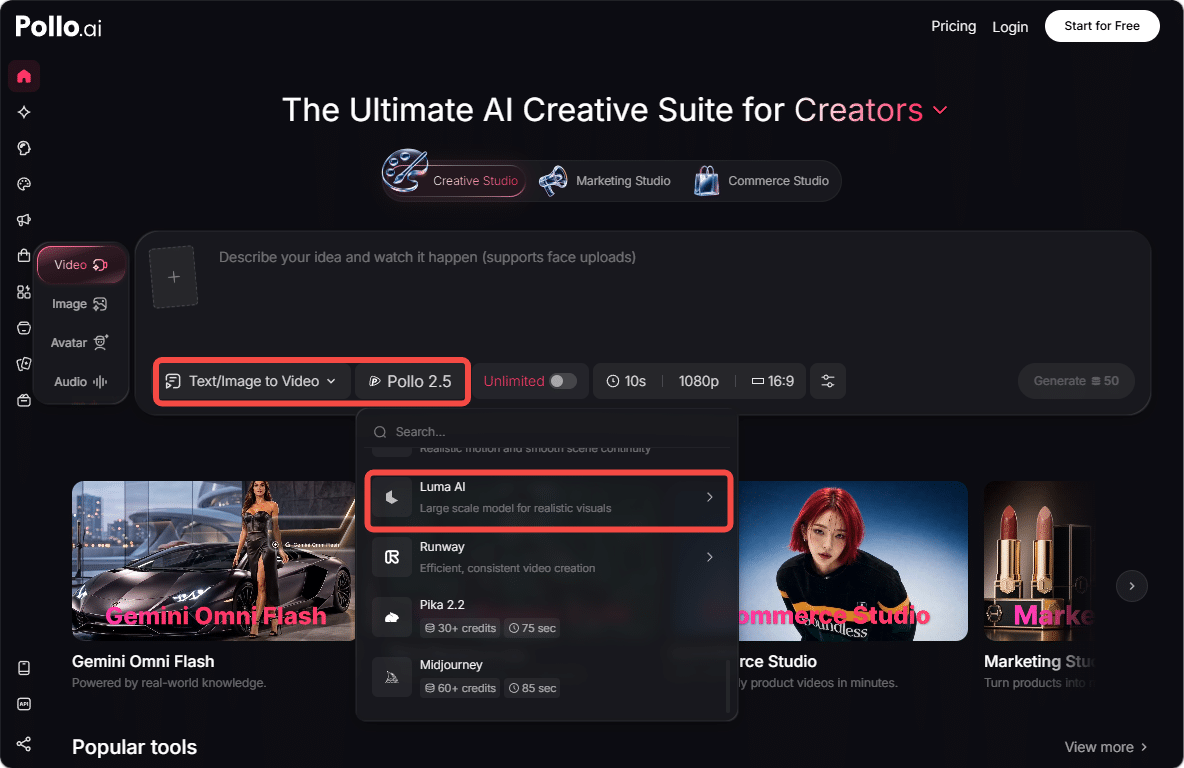
AI video generation addresses this by enabling direct, platform-native content creation. Luma AI, integrated within the Pollo AI platform, meets the cinematic quality standard brand video requires. Built on 3D modeling foundations, it produces physically accurate motion, realistic lighting, shadows and material rendering that avoids the obviously synthetic look of earlier generation tools. Text-to-video generation lets copywriters or brand strategists translate campaign concepts directly into visual sequences, while image-to-video animates existing brand photography into dynamic assets, extending the value of every photoshoot across more content formats.
How AI Generation Is Changing the Creative Development Process
Beyond production efficiency, AI reshapes the creative development process. Traditional video campaigns follow slow, sequential phases that force early creative commitments and often lead to conservative, low-risk choices.
AI compresses the concept-to-preview timeline to hours: teams can generate multiple visual interpretations of a concept, evaluate them against brand standards, and make decisions based on actual output rather than storyboards. This lowers creative risk, makes ambitious ideas testable, and empowers small generalist teams to deliver work that previously required specialist creative talent or external agency support.
Building a Sustainable Content Production Workflow
Step 1 — Map Your Content Calendar to Generation Workflows
Before adopting any AI generation tool, map your existing content calendar to the specific generation workflows each content type requires. Social video content, brand advertising, product showcase video, and event promotion content each have different visual requirements and different optimal generation approaches. Identifying these requirements in advance prevents the common mistake of applying a single generation workflow to all content types and producing output that is technically generated but not strategically appropriate for each format.
Step 2 — Establish Brand Visual Parameters for Generation
AI generation produces more consistent, on-brand output when it is guided by clear visual identity parameters expressed in generation-ready language. Document your brand’s visual identity in terms that translate directly into prompts: your colour palette and how it should appear in different scene contexts, the lighting character appropriate for your brand’s aesthetic register, the camera movement style that reflects your brand’s communication personality, and any visual elements — product presentation, logo context, environmental settings — that should appear consistently across generated content.
Step 3 — Generate Campaign Visual Concepts for Stakeholder Review
Use Luma AI within Pollo AI to generate multiple visual interpretations of each campaign concept before committing to a production direction. Generate at least two or three visual approaches for each campaign — different atmospheric treatments, different camera styles, different colour palettes — and present these to stakeholders as generated previews rather than finished concepts.
This approach accelerates the approval process because stakeholders are reacting to actual visual output rather than abstract descriptions, and it reduces the revision cycles that consume post-production time and budget.
Step 4 — Produce Platform-Specific Variations Systematically
Once a campaign visual direction is approved, use the generation workflow to produce platform-specific variations systematically rather than attempting to adapt a single master asset. Define the technical specifications for each platform — aspect ratio, duration, text-safe zones, opening-second requirements — and generate each variation to those specifications from the outset rather than cropping and reformatting after the fact.
Step 5 — Integrate Music-Synchronised Content for Social Distribution
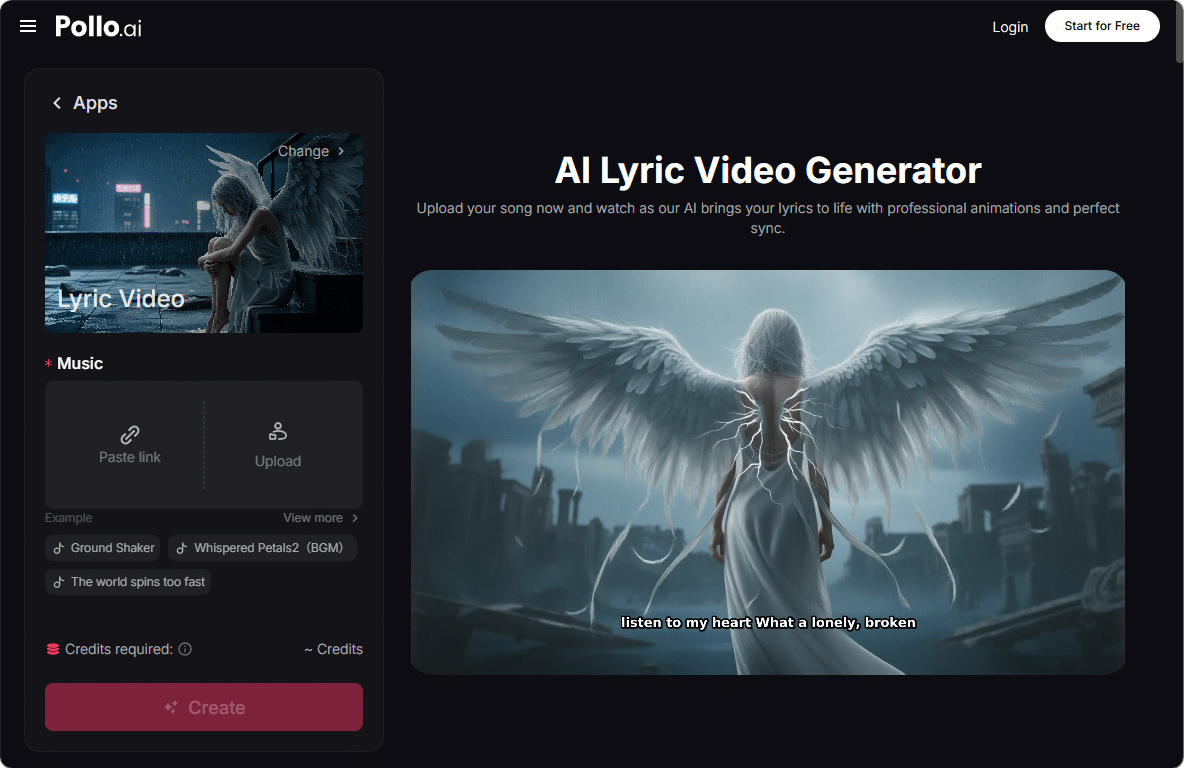
For social content that accompanies music releases, brand anthems, or campaign soundtracks, the Create Lyric Music Video capability within Pollo AI adds a content format that performs consistently well on music-adjacent social platforms. By uploading an audio file or inputting lyric text, the tool generates visual imagery matched to the song’s emotional character, dynamic captions synchronised to the beat, and optional AI virtual performer integration — producing a complete, publishable video asset that extends a campaign’s audio identity into a shareable visual format.
For marketing teams working with brand music or audio identity assets, this workflow creates social content that is more engaging than static branded posts and more cost-effective than commissioning a separate music video production. The beat-synchronised caption animation and mood-matched visual generation make the output appropriate for professional brand use rather than just personal music promotion.
 The Competitive Landscape Shift That Small Teams Need to Understand
The broader industry implication of AI video generation accessibility is that the production quality gap between large marketing operations and small ones is narrowing faster than most practitioners realise. Large agencies and enterprise brand teams are adopting AI generation tools to accelerate their existing workflows. Small teams are adopting the same tools to access production capabilities they previously could not afford. The net effect is a compression of the quality differential that has historically given large-budget marketing operations a structural advantage in visual content.
For small marketing teams, this compression is an opportunity — but only for those who build systematic AI video workflows rather than using generation tools sporadically. The teams that will benefit most are those who treat AI generation as a production infrastructure investment rather than a productivity shortcut, building prompt libraries, visual identity documentation, and content calendar workflows that make consistent, high-quality output a repeatable operational capability.
Conclusion: Systematic Adoption Beats Sporadic Experimentation
The marketing teams that are building durable competitive advantages from AI video generation are not those that produce the most content — they are those that build the most systematic production workflows and measure their impact most rigorously. Luma AI within Pollo AI delivers the cinematic quality standard that brand video requires, enabling small teams to produce visual content that competes credibly with agency-produced work.
The Create Lyric Music Video tool extends the content production capability into music-synchronised social formats that are increasingly central to brand visibility on short-form video platforms. Build the workflow, establish the visual identity parameters, and scale what produces measurable engagement results.