
The Phoenix
™
Framework
The No Bollocks System for Turning Around a Failing Business
By Matt Haycox — Serial entrepreneur, turnaround specialist, and the man who has rescued businesses that everyone else had written off. Some went on to become the most profitable in their sector.
How to Use This Framework
Your business is in trouble. Maybe you already know it. Maybe you’ve been avoiding it. Maybe someone just handed you this framework and said “read this.” Whatever brought you here, the fact that you are reading it means one of two things: either your business is already in crisis, or you are smart enough to prepare for one before it arrives.
This isn’t a guide about building a business. It’s a framework to saving one. The Phoenix Framework is a structured, step-by-step turnaround system for businesses that are bleeding cash, losing customers, drowning in debt, or simply failing to perform. It’s the system I have used — personally and through my portfolio companies — to rescue businesses that everyone else had written off. Some of those businesses went on to become the most profitable in their sector. Others were wound down in an orderly way that protected the founders and their stakeholders. Both outcomes are valid. Both require a system.
The Phoenix Framework has six phases. They are designed to be executed in order, under pressure, with limited resources and limited time. This is not a luxury exercise in strategic planning. This is battlefield medicine for businesses. The first three phases (Triage, Stabilise, Restructure) are about stopping the bleeding and keeping the patient alive. The last three phases (Reposition, Relaunch, Reinforce) are about building a business that is stronger, leaner, and more resilient than the one that nearly died.
One critical note before we begin: speed matters more than perfection. In a turnaround, the biggest risk is not making the wrong decision — it is making no decision. Every day you delay is a day the business burns cash it cannot afford to burn. Move fast. Decide fast. Correct fast. The luxury of careful deliberation is something you can afford when the business is healthy. Right now, it is not.
Why Businesses Fail (And Why Most Turnarounds Fail Too)
Businesses fail for many reasons, but they almost always fail slowly. The crisis that feels sudden — the missed payroll, the bounced payment, the key client who leaves — is almost never sudden. It is the culmination of months or years of warning signs that were ignored, minimised, or misunderstood. Understanding why businesses fail is the first step to saving one.
| Cause | How It Manifests | Warning Signs |
|---|---|---|
| Cash flow mismanagement | The business is profitable on paper but cannot pay its bills | Growing gap between invoicing and collection; increasing reliance on overdraft; delayed supplier payments |
| Loss of product-market fit | The product or service no longer meets customer needs | Declining retention; increasing customer complaints; competitors gaining share with different approaches |
| Over-expansion | The business grew too fast, too broadly, or into the wrong markets | Revenue growing but margins declining; new markets underperforming; management stretched thin |
| Key person dependency | The business relies too heavily on one person (usually the founder) | No documented processes; decisions bottlenecked at the top; inability to take time off without the business suffering |
| Competitive disruption | A competitor has changed the game and the business has not adapted | Market share declining; pricing pressure; customers asking for features or capabilities you do not offer |
| Debt overload | The business has taken on more debt than it can service | Debt payments consuming more than 50% of operating cash flow; covenant breaches; lender pressure |
| Leadership failure | The leadership team is not capable of managing the business at its current scale or complexity | Poor decision-making; lack of accountability; cultural dysfunction; high staff turnover |
Most turnarounds fail because they treat symptoms instead of causes. They cut costs without understanding why costs are too high. They chase revenue without understanding why customers are leaving. They restructure debt without fixing the business model that created the debt. The Phoenix Framework addresses causes, not symptoms.
The Six Phases: An Overview
| Phase | Name | Core Question | Timeline |
|---|---|---|---|
| 1 | TRIAGE | How bad is it, really? | Days 1-7 |
| 2 | STABILISE | How do I stop the bleeding? | Days 7-30 |
| 3 | RESTRUCTURE | What stays, what goes, and what changes? | Days 30-90 |
| 4 | REPOSITION | What is this business going to be now? | Days 60-120 |
| 5 | RELAUNCH | How do I rebuild momentum? | Days 90-180 |
| 6 | REINFORCE | How do I make sure this never happens again? | Day 180 onwards |
Notice the overlapping timelines. In a turnaround, you do not finish one phase before starting the next. You begin Restructure while still Stabilising. You begin Repositioning while still Restructuring. The phases are sequential in logic but overlapping in execution.

THE PHOENIX LIFECYCLE — SIX PHASES OF BUSINESS TURNAROUND

TRIAGE
"How bad is it, really?"
TRIAGE
"How bad is it, really?"
Days 1-7
What This Phase Is About
Triage is the most important phase of the entire framework, and it must be completed in seven days or less. Not seven weeks. Not seven months. Seven days. Because in a turnaround, the single most dangerous thing is not knowing how bad the situation actually is. Founders in crisis almost always underestimate the severity of the problem. They round down. They assume things will improve. They focus on the best-case scenario. Triage is about stripping away all of that and confronting the unvarnished truth.
The purpose of Triage is to answer three questions with absolute precision:
How much cash do we have, and how long will it last?
What is killing the business right now?
Do we have a viable path to survival?
The 72-Hour Cash Audit
Before you do anything else — before you talk to your team, before you call your advisors, before you make any decisions — you need to know exactly how much cash you have and exactly how long it will last. This is the single most important number in a turnaround, and most founders in crisis do not know it.
The Cash Audit Worksheet
| Line Item | Amount | Notes |
|---|---|---|
| Cash in bank (all accounts) | £ ___ | Check every account, including dormant ones |
| Available credit (overdraft, credit cards, credit lines) | £ ___ | Only include what is actually available, not the total facility |
| Cash owed to you (collectible within 30 days) | £ ___ | Be realistic — only include invoices you are confident will be paid |
| Assets that can be liquidated within 30 days | £ ___ | Equipment, inventory, investments — at fire-sale prices, not book value |
| TOTAL CASH AVAILABLE | £ ___ | |
| Payroll (including taxes and NI) | £ ___ | The most important obligation — miss this and you lose the team |
| Rent and utilities | £ ___ | Check lease terms for break clauses |
| Debt payments (loans, credit cards, finance agreements) | £ ___ | Include all scheduled payments |
| Supplier payments (critical suppliers only) | £ ___ | Only suppliers whose non-payment would shut down operations |
| Tax obligations (VAT, PAYE, Corporation Tax) | £ ___ | HMRC is a priority creditor — do not ignore them |
| Other essential costs | £ ___ | Insurance, software subscriptions, professional fees |
| TOTAL CASH REQUIRED | £ ___ | |
| Surplus / (Deficit) | £ ___ | Cash Available minus Cash Required |
| Months of runway at current burn | X months | Cash Available ÷ Monthly Cash Required |
The Runway Traffic Light
GREEN
6+ months
You have time to execute a structured turnaround
AMBER
3-6 months
You have limited time — move fast and prioritise ruthlessly
RED
1-3 months
You are in immediate danger — emergency measures required
CRITICAL
Less than 1 month
Survival is the only objective — seek professional advice immediately
The Diagnostic Assessment
With the cash position established, the next step is to diagnose what is actually wrong with the business. This requires looking at the business through five lenses:
Lens 1: Revenue
| Question | What to Look For |
|---|---|
| Is revenue growing, flat, or declining? | Trend over the last 12 months, monthly |
| Where is revenue coming from? | Breakdown by product, customer segment, and channel |
| Is revenue concentrated? | What percentage comes from the top 5 customers? If more than 50%, you have a concentration risk |
| What is the pipeline? | How much revenue is contracted but not yet delivered? How much is in active negotiation? |
| What is the churn rate? | How many customers are you losing each month, and why? |
Lens 2: Costs
| Question | What to Look For |
|---|---|
| What are the fixed costs? | Costs that do not change with revenue — rent, salaries, insurance, software |
| What are the variable costs? | Costs that change with revenue — materials, commissions, delivery |
| What is the gross margin? | Revenue minus direct costs, as a percentage. Is it improving or declining? |
| Where is the waste? | Costs that do not contribute to revenue or customer value |
| What is the breakeven point? | How much revenue do you need to cover all costs? |
Lens 3: Customers
| Question | What to Look For |
|---|---|
| Are customers satisfied? | NPS, reviews, complaint volume, renewal rates |
| Why are customers leaving? | Exit interviews, cancellation reasons, competitor analysis |
| Which customers are most profitable? | Revenue minus cost-to-serve for each customer or segment |
| Which customers are unprofitable? | Customers who consume more resources than they generate in revenue |
| What do customers want that you are not providing? | Feature requests, complaints, competitive gaps |
Lens 4: Team
| Question | What to Look For |
|---|---|
| Do you have the right people in the right roles? | Skills assessment, performance data, manager feedback |
| Is the team too large for the current revenue? | Revenue per employee compared to industry benchmarks |
| Are there toxic individuals affecting morale? | Staff turnover, anonymous feedback, direct observation |
| Is the leadership team capable of executing a turnaround? | Honest assessment of each leader’s skills, resilience, and commitment |
| What is the team’s morale? | Direct conversations, not assumptions |
Lens 5: Obligations
| Question | What to Look For |
|---|---|
| What debts does the business owe? | Full list of creditors, amounts, terms, and security |
| Are there any covenant breaches? | Review all loan agreements for compliance |
| Are there any legal claims or disputes? | Pending or threatened litigation, regulatory issues |
| What contractual obligations exist? | Leases, employment contracts, supplier agreements with minimum commitments |
| What are the tax obligations? | Outstanding VAT, PAYE, Corporation Tax — HMRC is a priority creditor |
The Triage Decision
At the end of Triage, you must make one of three decisions:
| Decision | When to Make It | What It Means |
|---|---|---|
| Turnaround | The business has a viable core, sufficient runway (3+ months), and the problems are fixable | Proceed to Phase 2 (Stabilise) and execute the full Phoenix Framework |
| Managed wind-down | The business model is fundamentally broken, but there are assets and obligations that need to be managed responsibly | Engage an insolvency practitioner, protect employees and creditors, preserve what value you can |
| Emergency restructuring | The business has less than 3 months of runway but a viable core — you need to act immediately to survive | Skip to the emergency measures in Phase 2 and execute them within 14 days |
This decision requires honesty, courage, and — ideally — the input of a trusted advisor who can see the situation without the emotional attachment that clouds the founder’s judgement.
Checklist — Complete Before Moving On
Completed the 72-Hour Cash Audit
Determined the runway (months of cash remaining)
Completed the Diagnostic Assessment across all 5 lenses
Identified the top 3 causes of the crisis
Made the Triage Decision (turnaround, wind-down, or emergency restructuring)
Communicated the decision to the leadership team
Engaged a professional advisor (accountant, turnaround specialist, or insolvency practitioner)
STABILISE
"How do I stop the bleeding?"
Days 7-30
What This Phase Is About
Stabilise is about buying time. The Triage told you how bad things are. Stabilise is about taking immediate, decisive action to slow the cash burn, protect the core business, and create enough breathing room to execute the deeper changes that come in Phases 3-6.
This phase is not about fixing the business. It is about keeping it alive long enough to fix it. The analogy is emergency medicine: you do not perform surgery in the ambulance. You stop the bleeding, stabilise the patient, and get them to the operating theatre. That is what this phase does.
The Emergency Cash Measures
If your Triage revealed less than 3 months of runway, these measures must be implemented within 14 days. If you have more runway, you have more time — but do not waste it. Every day of delay is a day of unnecessary cash burn.
Measure 1: Freeze All Non-Essential Spending
Implement an immediate spending freeze on everything that is not directly required to serve existing customers or maintain operations. If it’s your bank account that’s been frozen — not your own spending — read my Frozen book instead. Different fight, different playbook.
| Freeze Immediately | Keep Spending |
|---|---|
| All new hires | Existing payroll (for now) |
| All marketing spend (except what directly generates revenue within 30 days) | Critical supplier payments |
| All travel and entertainment | Rent and utilities |
| All software subscriptions not actively used | Insurance |
| All capital expenditure | Tax obligations |
| All consulting and professional fees (except turnaround-related) | Debt payments (for now — see Measure 4) |
Measure 2: Accelerate Cash Collection
Every pound owed to you is a pound you need. Implement an aggressive collection campaign:
| Action | Timeline | Expected Impact |
|---|---|---|
| Call every customer with an overdue invoice — personally | Days 1-3 | Recover 20-40% of overdue AR within 2 weeks |
| Offer a 5-10% discount for immediate payment of outstanding invoices | Days 1-7 | Accelerate collection of invoices not yet overdue |
| Switch to upfront or deposit-based payment for all new work | Immediately | Eliminate future AR growth |
| Engage a collections agency for invoices over 90 days | Days 7-14 | Recover some value from invoices you have written off |
Measure 3: Negotiate with Suppliers
Your suppliers do not want you to go under. A customer who pays late is better than a customer who does not pay at all. Use this leverage.
| Action | How to Approach It |
|---|---|
| Request extended payment terms (30 days to 60 or 90) | “We are restructuring our cash flow management. We value our relationship and want to continue working together. Could we move to 60-day terms for the next quarter?” |
| Negotiate discounts for bulk or prepayment | If you have cash for specific suppliers, offer to prepay at a discount |
| Identify alternative suppliers with better terms | Use competitive quotes as leverage in negotiations |
| Consolidate suppliers to increase your negotiating power | Fewer suppliers = larger orders = more leverage |
Measure 4: Renegotiate Debt
If debt payments are consuming a significant portion of your cash flow, contact your lenders proactively. Do not wait for them to contact you.
| Situation | What to Request |
|---|---|
| You can service the debt but it is tight | Request a temporary reduction in payments (interest-only for 3-6 months) |
| You cannot service the debt at current levels | Request a restructuring — extended term, reduced rate, or payment holiday |
| You are in breach of covenants | Disclose immediately and negotiate a waiver or amendment |
| The debt is unsecured and the business may not survive | Engage an insolvency practitioner to advise on options |
The Rule: Lenders respond better to proactive communication than to surprises. If you call your bank and say “we are having a difficult quarter and I want to discuss our options,” they will work with you. If they find out you are in trouble because you missed a payment, the conversation will be very different.
Measure 5: Generate Emergency Revenue
While you are cutting costs and collecting cash, you also need to generate new revenue as quickly as possible. This isn’t about long-term strategyy — it is about survival.
| Strategy | How It Works | Timeline |
|---|---|---|
| Sell excess inventory or assets | Liquidate anything that is not essential to operations | 7-14 days |
| Offer existing customers an upsell or add-on | Contact your best customers with a relevant additional service | 7-14 days |
| Run a limited-time promotion | Offer a discount on prepaid annual contracts or bulk purchases | 14-30 days |
| Reactivate lapsed customers | Contact former customers with a compelling return offer | 14-30 days |
| Monetise underutilised assets | Sublet office space, rent out equipment, licence IP | 14-30 days |
Communicating During a Crisis
How you communicate during the Stabilise phase will determine whether your team, your customers, and your stakeholders stay with you or abandon you. The temptation is to hide the truth, minimise the problem, and project confidence you do not feel. Resist this temptation. It will backfire.
| Audience | What to Tell Them | What Not to Tell Them |
|---|---|---|
| Leadership team | The full truth — cash position, diagnosis, plan, and their role in the turnaround | Nothing should be hidden from the leadership team |
| Employees | That the business is facing challenges, that you have a plan, and that you will keep them informed | Specific financial details or worst-case scenarios that will cause panic |
| Key customers | That you are committed to serving them and that service levels will be maintained | Internal financial details — they do not need to know your cash position |
| Suppliers | That you are restructuring and want to maintain the relationship | More than they need to know — keep it professional and specific to your request |
| Lenders | The full financial picture and your plan to address it | Nothing — full transparency is essential with lenders |
Checklist — Complete Before Moving On
Implemented a spending freeze on all non-essential costs
Launched an aggressive AR collection campaign
Contacted all major suppliers to negotiate terms
Contacted all lenders to discuss options (if applicable)
Identified and executed at least 2 emergency revenue measures
Communicated with the leadership team, employees, and key stakeholders
Established a daily cash monitoring process
Extended the runway by at least 2 months through the above measures
RESTRUCTURE
"What stays, what goes, and what changes?"
Days 30-90
What This Phase Is About
Stabilise bought you time. Restructure is where you use that time to fundamentally reshape the business. This is the hardest phase emotionally, because it requires you to make decisions that affect people’s livelihoods, kill projects you care about, and abandon strategies you believed in. But it is also the phase where the turnaround becomes real — where the business stops being a version of what it was and starts becoming a version of what it needs to be.
Restructuring is not about cutting for the sake of cutting. It is about aligning every resource — every person, every pound, every hour — with the activities that generate the most value. Everything else goes. Not because it is bad, but because you cannot afford it. In a turnaround, the business must become ruthlessly focused on what works, and ruthlessly honest about what does not.
The Restructuring Framework: The Three Cuts
Cut 1: Products and Services
Most struggling businesses are trying to do too many things. They have products that do not sell, services that are not profitable, and projects that consume resources without generating returns. The first cut is to identify which products and services are worth keeping and which must go.
The Product Profitability Matrix
High Revenue + High Margin
STARS
Keep and invest. These are your core.
Low Revenue + High Margin
POTENTIAL
Keep if they can scale. Kill if they cannot.
High Revenue + Low Margin
TRAPS
They look important because of revenue, but they are destroying your profitability. Fix the margin or kill them.
Low Revenue + Low Margin
DEAD WEIGHT
Kill immediately. They contribute nothing.
For every product or service, calculate the true profitability — not just the gross margin, but the fully loaded cost including the management time, the support costs, the opportunity cost of the resources they consume. Many businesses discover that their highest-revenue product is actually their least profitable when all costs are allocated.
| Category | Action | Timeline |
|---|---|---|
| Stars | Protect and invest — these fund the turnaround | Ongoing |
| Potential | Set a 90-day performance target. If they hit it, keep them. If not, kill them. | 90 days |
| Traps | Immediately investigate margin improvement. If margins cannot be fixed within 60 days, kill them. | 60 days |
| Dead Weight | Kill immediately. Redirect all resources to Stars. | This week |
Cut 2: Customers
This is the cut that most founders resist the hardest. “We cannot fire customers — we need every pound of revenue!” But the reality is that not all customers are equal, and some customers are actively destroying your business.
The Customer Profitability Analysis
| Metric | How to Calculate | What It Tells You |
|---|---|---|
| Revenue | Total revenue from this customer in the last 12 months | How much they pay you |
| Cost to serve | All direct costs of serving this customer — staff time, materials, support, customisation | How much they cost you |
| Net contribution | Revenue minus cost to serve | Whether they are actually profitable |
| Payment behaviour | Average days to pay, frequency of disputes, collection effort required | Whether they are reliable |
| Strategic value | Referrals generated, brand association, future growth potential | Whether they are worth keeping even if currently unprofitable |
The Customer Decision Matrix
Profitable + Easy to Serve
KEEP & GROW
Your ideal customer
Unprofitable + Easy to Serve
REPRICE
They are easy to serve, so the problem is pricing, not operations
Profitable + Difficult to Serve
STREAMLINE
Find ways to reduce the cost of serving them
Unprofitable + Difficult to Serve
EXIT
They cost more than they pay and consume disproportionate resources
How to Exit a Customer
Firing a customer requires care. Do it badly and you create enemies, bad reviews, and potential legal disputes. Do it well and you free up resources for customers who actually value what you do.
| Approach | When to Use It | How to Execute |
|---|---|---|
| Price increase | When the customer is unprofitable but the relationship is otherwise good | “We are restructuring our pricing to reflect the true cost of service. Your new rate will be £X, effective in 60 days.” |
| Service reduction | When the customer demands more than they pay for | “We are standardising our service levels. The service you require is available at our Premium tier for £X.” |
| Referral to a competitor | When the customer is a poor fit for your business | “We have concluded that [competitor] may be a better fit for your needs. We would be happy to facilitate an introduction.” |
| Contract non-renewal | When the contract has a natural end point | Simply do not renew. Provide adequate notice and assist with the transition. |
Cut 3: People
This is the most painful cut, and it must be handled with the utmost care, professionalism, and compassion. But it must be made. A business in turnaround almost always has more people than it can afford, and keeping people you cannot pay is not kindness — it is irresponsibility.
The Restructuring Headcount Framework
| Step | What to Do |
|---|---|
| 1. Map every role | Map every role to a revenue-generating or revenue-supporting activity. If a role does not directly generate revenue or directly support a revenue-generating activity, it is a candidate for elimination |
| 2. Benchmark | Compare your revenue per employee to industry benchmarks. If you are significantly below, you are overstaffed |
| 3. Identify redundancies | Are multiple people doing the same job? Can roles be combined? |
| 4. Assess performance | In a turnaround, you can only afford A-players and strong B-players. C-players must go, regardless of tenure or loyalty |
| 5. Calculate the cost | Statutory redundancy pay, notice periods, and any contractual entitlements |
How to Handle Redundancies
| Principle | Why It Matters |
|---|---|
| Be honest about the reason | “The business is being restructured and this role is being eliminated.” Do not pretend it is a performance issue if it is not. |
| Be generous where you can | If you can offer more than statutory redundancy, do so. If you can offer outplacement support, do so. These people gave you their time and effort. |
| Be swift | Once the decision is made, execute it quickly. Prolonged uncertainty is worse than bad news. |
| Be legal | Follow proper redundancy procedures. Consult with an employment lawyer. The cost of getting it wrong is far greater than the cost of getting it right. |
| Be human | These are people with mortgages, families, and fears. Treat them with dignity. How you handle redundancies will define your reputation — and your own self-respect — for years to come. |
Checklist — Complete Before Moving On
Completed the Product Profitability Matrix for all products/services
Killed all Dead Weight products immediately
Set 60-90 day performance targets for Traps and Potential products
Completed the Customer Profitability Analysis
Exited or repriced all unprofitable, difficult-to-serve customers
Completed the headcount review and identified necessary redundancies
Executed redundancies legally, compassionately, and swiftly
Recalculated the cash position and runway post-restructuring
Confirmed that the restructured business is cash-flow positive (or has a clear path to it within 90 days)
REPOSITION
"What is this business going to be now?"
Days 60-120
What This Phase Is About
The first three phases were about survival. Triage diagnosed the problem. Stabilise stopped the bleeding. Restructure removed the dead weight. Now you have a leaner, more focused business — but it is not yet a healthy one. It is a business that has been cut back to its core, and that core needs a new direction.
Repositioning is about answering the most fundamental question in business: "Why should anyone choose us?" Not why they chose you before. Not why they should have chosen you. Why they should choose you now, in the current market, against the current competition, given what you have been through.
This is not a branding exercise. It is a strategic exercise. It requires you to look at the market with fresh eyes, identify where you can win, and commit to a positioning that is specific, differentiated, and defensible.
Step 1: The Market Reality Check
Before you can reposition, you need to understand what the market looks like today — not what it looked like when you started the business. Markets change. Competitors emerge. Customer needs evolve. The business that failed may have been perfectly positioned for a market that no longer exists.
| Question | How to Answer It |
|---|---|
| What has changed in the market since we started? | Industry reports, competitor analysis, customer conversations |
| Who are the current market leaders and why? | Analyse their positioning, pricing, and value proposition |
| What are customers buying that they were not buying 2 years ago? | Customer interviews, review sites, industry forums |
| What are customers complaining about that nobody is solving? | Social media, review sites, support forums, direct conversations |
| Where is the market heading in the next 2-3 years? | Trend analysis, expert opinions, technology developments |
Step 2: The Competitive Advantage Audit
After the restructuring, what do you actually have that is valuable? What can you do better than anyone else? This is not about what you wish you could do — it is about what you can demonstrably do right now, with the resources you have.
| Asset | What It Is | How It Creates Value |
|---|---|---|
| Expertise | What does your team know that others do not? | Deep domain knowledge that enables better solutions |
| Relationships | Who do you know that others do not? | Access to customers, partners, or channels that competitors cannot easily replicate |
| Data | What information do you have that others do not? | Insights that enable better decisions, better products, or better service |
| Reputation | Despite the crisis, what positive reputation do you retain? | Trust, credibility, and brand recognition in specific segments |
| Infrastructure | What systems, processes, or assets do you have that would be expensive to replicate? | Operational capabilities that enable efficiency or quality |
| Experience | What have you learned from the failure that others have not? | Wisdom that prevents future mistakes and enables better strategy |
Step 3: The Ideal Customer Profile (ICP)
Post-restructuring, you need to be extremely specific about who you serve. The days of trying to be everything to everyone are over. Define your Ideal Customer Profile with surgical precision:
| Dimension | Definition |
|---|---|
| Industry / Sector | Which specific industries or sectors do you serve best? |
| Company size | What size of company (revenue, employees) is the best fit? |
| Geography | Where are your ideal customers located? |
| Problem | What specific problem do they have that you solve better than anyone? |
| Budget | What can they afford to pay, and is it enough to be profitable for you? |
| Decision-maker | Who makes the buying decision, and can you reach them? |
| Buying behaviour | How do they buy? Direct sales, online, referral, tender? |
The ICP Test: If you cannot describe your ideal customer in a single paragraph that is specific enough to identify them in a room, your ICP is too broad.
Step 4: The Value Proposition
With your market understanding, competitive advantages, and ICP defined, you can now craft a value proposition that is specific, differentiated, and compelling.
The Value Proposition Formula
We help [specific customer] solve [specific problem] through [specific approach], which results in [specific outcome] — unlike [alternative], which [specific limitation of the alternative].
We help property developers with portfolios of 10-50 units reduce their financing costs by 15-25% through our proprietary Capital Stack analysis, which identifies the optimal mix of debt and equity for each project — unlike traditional brokers, who push a single product regardless of the developer’s specific situation.
This is not a tagline. It is a strategic statement that drives every decision — who you sell to, what you build, how you price, and how you communicate. Every member of the team should be able to recite it and explain why each element matters.
Step 5: The Pricing Reset
A turnaround is the perfect moment to reset your pricing. The old pricing was set under different circumstances — different costs, different competition, different value proposition. The new pricing should reflect the new reality.
| Pricing Approach | When to Use It | How It Works |
|---|---|---|
| Value-based pricing | When you can quantify the value you deliver to the customer | Price based on the outcome you create, not the cost of delivery. If you save a customer £100K, charging £20K is a bargain. |
| Competitive pricing | When you are in a commoditised market with transparent pricing | Price at or slightly above the market rate, and differentiate on service, speed, or expertise. |
| Cost-plus pricing | When you need to ensure profitability on every engagement | Calculate the full cost of delivery and add a margin (typically 30-50% for services, 50-100% for products). |
| Tiered pricing | When you serve customers with different needs and budgets | Offer 2-3 tiers (e.g., Standard, Professional, Enterprise) with increasing levels of service and price. |
The Pricing Rules
| Rule | Why |
|---|---|
| Never compete on price alone | If price is your only differentiator, you are in a race to the bottom that you will eventually lose |
| Always anchor high | Present the most expensive option first. It makes the other options feel reasonable by comparison. |
| Make the value explicit | Do not assume customers understand the value you provide. Spell it out in pounds, hours, or percentages. |
| Review pricing quarterly | Markets change, costs change, and your value proposition evolves. Pricing should evolve with it. |
Checklist — Complete Before Moving On
Completed the Market Reality Check
Completed the Competitive Advantage Audit
Defined the Ideal Customer Profile with surgical precision
Crafted a specific, differentiated Value Proposition
Reset pricing to reflect the new positioning
Communicated the new positioning to the entire team
Updated all customer-facing materials (website, pitch deck, proposals) to reflect the new positioning
Tested the new positioning with 5-10 target customers and incorporated feedback
RELAUNCH
"How do I rebuild momentum?"
Days 90-180
What This Phase Is About
You have diagnosed the problem, stopped the bleeding, cut the dead weight, and defined a new direction. Now it is time to go back to market. The Relaunch is not about returning to where you were — it is about launching a fundamentally better business. One that is leaner, more focused, more disciplined, and more aligned with what the market actually wants.
The Relaunch requires a different mindset from the first three phases. Triage, Stabilise, and Restructure were about defence — protecting what you have. Relaunch is about offence — going out and winning new business, new customers, and new momentum. But it must be disciplined offence. You are not spraying and praying. You are targeting specific customers with a specific value proposition through specific channels, and measuring everything.
The 90-Day Relaunch Plan
The Relaunch should be structured as a 90-day sprint with specific targets, specific activities, and weekly accountability. Ninety days is long enough to generate meaningful results and short enough to maintain urgency.
Key Activities: Update all sales materials, website, and pitch deck to reflect new positioning. Build a target prospect list of 100 ideal customers. Train the team on the new value proposition and pricing.
Target Outcomes: Materials complete. Prospect list built. Team aligned.
Key Activities: Launch outreach campaign to target prospects. Reactivate relationships with former customers who fit the new ICP. Attend 2-3 industry events or networking opportunities. Publish 4-8 pieces of content demonstrating expertise.
Target Outcomes: 50+ conversations with target prospects. 10+ qualified opportunities in pipeline. 2+ pieces of content generating inbound interest.
Key Activities: Convert pipeline opportunities to paying customers. Collect testimonials and case studies from early wins. Refine the sales process based on what is working. Double down on the channels generating the best results.
Target Outcomes: 5-15 new customers (depending on deal size). 3+ testimonials or case studies. A repeatable sales process that the team can execute.
The Relaunch Sales Playbook
In a relaunch, every sales conversation carries extra weight. You are not just selling a product or service — you are selling the story of the turnaround. And that story, told correctly, is one of the most powerful sales tools you have.
The Relaunch Sales Narrative
| Element | What to Say | Why It Works |
|---|---|---|
| Acknowledge the past | “We went through a significant restructuring last year.” | Honesty builds trust. Trying to hide it will backfire. |
| Explain what changed | “We used that experience to fundamentally rethink our approach. We narrowed our focus to [ICP] and rebuilt our [product/service] around [specific improvement].” | Demonstrates self-awareness and strategic thinking. |
| Show the results | “Since the restructuring, we have [specific metric — new customers, improved outcomes, faster delivery].” | Proof that the turnaround is real, not theoretical. |
| Make the offer | “We believe we can help you [specific outcome] because [specific reason related to your advantage].” | Connects the story to the prospect’s specific needs. |
Relaunch Pricing Incentives
During the first 90 days, consider offering a “Relaunch Incentive” to accelerate customer acquisition:
| Incentive | How It Works | When to Use It |
|---|---|---|
| Pilot pricing | Offer the first 3 months at a reduced rate in exchange for a case study and testimonial | When you need social proof and are confident the customer will see value |
| Money-back guarantee | Offer a full refund if the customer does not see [specific result] within [specific timeframe] | When you are confident in your delivery and want to remove the prospect’s risk |
| Extended payment terms | Offer 60 or 90-day payment terms instead of the standard 30 | When the prospect’s budget cycle does not align with your timeline |
| Bundle discount | Offer a discount for purchasing multiple services or a longer commitment | When you want to increase deal size and lock in revenue |
The Rule: Relaunch incentives are temporary. They exist to build momentum and social proof during the first 90 days. After 90 days, revert to standard pricing. Do not let temporary incentives become permanent discounts.
The Content Relaunch
Content is the most cost-effective way to rebuild visibility and credibility during a relaunch. But it must be strategic content — not random posts or generic articles. Every piece of content should serve one of three purposes:
| Purpose | Content Type | Example |
|---|---|---|
| Demonstrate expertise | How-to guides, frameworks, industry analysis | “The 5 Most Common Cash Flow Mistakes Property Developers Make (And How to Fix Them)” |
| Provide social proof | Case studies, testimonials, results | “How We Helped [Client] Reduce Their Financing Costs by 22% in 6 Months” |
| Tell the story | Personal narrative, lessons learned, behind-the-scenes | “What Going Through a Business Turnaround Taught Me About Leadership” |
The Content Calendar (First 90 Days)
| Week | Content Piece | Channel | Purpose |
|---|---|---|---|
| 1 | “Why We Restructured — And What We Built Instead” | LinkedIn article + newsletter | Tell the story |
| 2 | How-to guide related to your core expertise | Blog + LinkedIn | Demonstrate expertise |
| 3 | Customer case study (early win from pilot programme) | LinkedIn + website | Social proof |
| 4 | Industry insight or contrarian take | LinkedIn post | Demonstrate expertise |
| 5-8 | Repeat the cycle with fresh content | All channels | Build consistency |
| 9-12 | Compile best-performing content into a downloadable guide | Website + email | Lead generation |
Checklist — Complete Before Moving On
Updated all sales materials, website, and pitch deck
Built a target prospect list of 100 ideal customers
Trained the team on the new value proposition and pricing
Launched outreach to target prospects
Reactivated relationships with former customers who fit the new ICP
Published at least 4 pieces of strategic content
Converted at least 5 new customers
Collected at least 3 testimonials or case studies
Identified the top 2-3 channels generating the best results
Documented a repeatable sales process
REINFORCE
"How do I make sure this never happens again?"
Day 180 onwards
What This Phase Is About
The turnaround is complete. The business is stabilised, restructured, repositioned, and relaunched. Revenue is growing. Customers are coming back. The team is aligned. You can breathe again.
And that is exactly when you are most vulnerable.
The Reinforce phase is about building the systems, habits, and structures that prevent the business from ever returning to crisis. It is about institutionalising the discipline that the crisis forced upon you — making it permanent, not temporary. Because the patterns that caused the first crisis are still in your DNA. The tendency to over-expand, to ignore warning signs, to avoid difficult decisions — these do not disappear because you survived a turnaround. They go dormant. And they will resurface unless you build systems that catch them early.
The Early Warning System
The most important system you can build post-turnaround is an Early Warning System — a set of metrics and triggers that alert you to problems before they become crises.
The Early Warning Dashboard
| Metric | Frequency | Green | Amber | Red |
|---|---|---|---|---|
| Cash runway | Weekly | 6+ months | 3-6 months | Under 3 months |
| Revenue vs forecast | Monthly | Within 10% | 10-20% below | 20%+ below |
| Gross margin | Monthly | At or above target | 1-5% below target | 5%+ below target |
| Customer churn | Monthly | Below industry average | At industry average | Above industry average |
| AR aging (% over 60 days) | Monthly | Under 10% | 10-20% | Over 20% |
| Employee satisfaction | Quarterly | Above 7/10 | 5-7/10 | Below 5/10 |
| NPS (Net Promoter Score) | Quarterly | Above 40 | 20-40 | Below 20 |
| Debt service coverage ratio | Monthly | Above 1.5x | 1.2-1.5x | Below 1.2x |
The Rule: If any metric hits Amber, investigate within 7 days. If any metric hits Red, convene the leadership team within 48 hours and implement corrective action within 14 days. Do not wait. Do not hope. Act.
The Quarterly Strategic Review
Every 90 days, step back from the day-to-day and conduct a structured strategic review. This is not a board meeting. It is not a financial review. It is a disciplined assessment of whether the business is on track, what has changed, and what needs to change.
| Topic | Questions to Answer | Time |
|---|---|---|
| Financial health | Are we on track against the financial plan? Where are we ahead? Where are we behind? Why? | 30 minutes |
| Customer health | Are customers happy? Is churn increasing or decreasing? What are they asking for? | 30 minutes |
| Competitive landscape | Has anything changed? New competitors? New technologies? Market shifts? | 20 minutes |
| Team health | Do we have the right people? Is morale strong? Are there gaps we need to fill? | 20 minutes |
| Strategic priorities | Are our top 3 priorities still the right ones? Do we need to adjust? | 30 minutes |
| Risk assessment | What are the top 3 risks to the business right now? What are we doing about them? | 20 minutes |
| Lessons learned | What worked well this quarter? What did not? What will we do differently? | 10 minutes |
The "Never Again" Commitments
Based on everything you have learned through the turnaround, document the specific commitments that will prevent a recurrence. These are not vague aspirations — they are specific, measurable, non-negotiable rules.
| Commitment | Specific Rule | How It Is Enforced |
|---|---|---|
| We will never run out of cash | Maintain a minimum of 4 months of operating expenses in reserve at all times | Monthly review by the CFO/finance lead; any dip below 4 months triggers an immediate spending review |
| We will never ignore warning signs | Review the Early Warning Dashboard every Monday; any Red metric triggers a 48-hour response | Weekly leadership meeting agenda item |
| We will never over-expand | No new product, market, or hire without a documented business case that passes the “Hell Yes or No” test | Quarterly strategic review approval required |
| We will never depend on a single customer | No single customer may represent more than 15% of total revenue | Monthly revenue concentration report |
| We will never neglect our team | Conduct quarterly anonymous employee satisfaction surveys; any score below 6/10 triggers an action plan | HR/People lead owns the process |
| We will never stop learning | Every member of the leadership team reads one business book per quarter and shares key takeaways | Quarterly review agenda item |
Checklist — Complete Before Moving On
Built and implemented the Early Warning Dashboard
Scheduled and conducted the first Quarterly Strategic Review
Documented the "Never Again" Commitments
Shared the commitments with the entire team
Appointed a specific person to own each commitment and its enforcement
Established a monthly financial review cadence
Created contingency plans for the top 3 risks identified
Celebrated the turnaround with the team — they earned it
Putting It All Together
| Phase | Name | Core Work | Timeline | Key Output |
|---|---|---|---|---|
| 1 | TRIAGE | Cash audit, diagnostic assessment, survival decision | Days 1-7 | Clear understanding of how bad things are and a decision on the path forward |
| 2 | STABILISE | Spending freeze, cash collection, supplier negotiation, emergency revenue | Days 7-30 | Extended runway, reduced burn rate, breathing room |
| 3 | RESTRUCTURE | Product cuts, customer exits, headcount reduction | Days 30-90 | A leaner, more focused business aligned with what actually works |
| 4 | REPOSITION | Market assessment, competitive advantage audit, new value proposition, pricing reset | Days 60-120 | A clear, differentiated positioning that the market wants |
| 5 | RELAUNCH | 90-day sales sprint, content campaign, customer acquisition | Days 90-180 | New customers, new revenue, new momentum |
| 6 | REINFORCE | Early warning system, quarterly reviews, "Never Again" commitments | Day 180+ | A business that is resilient, disciplined, and built to endure |
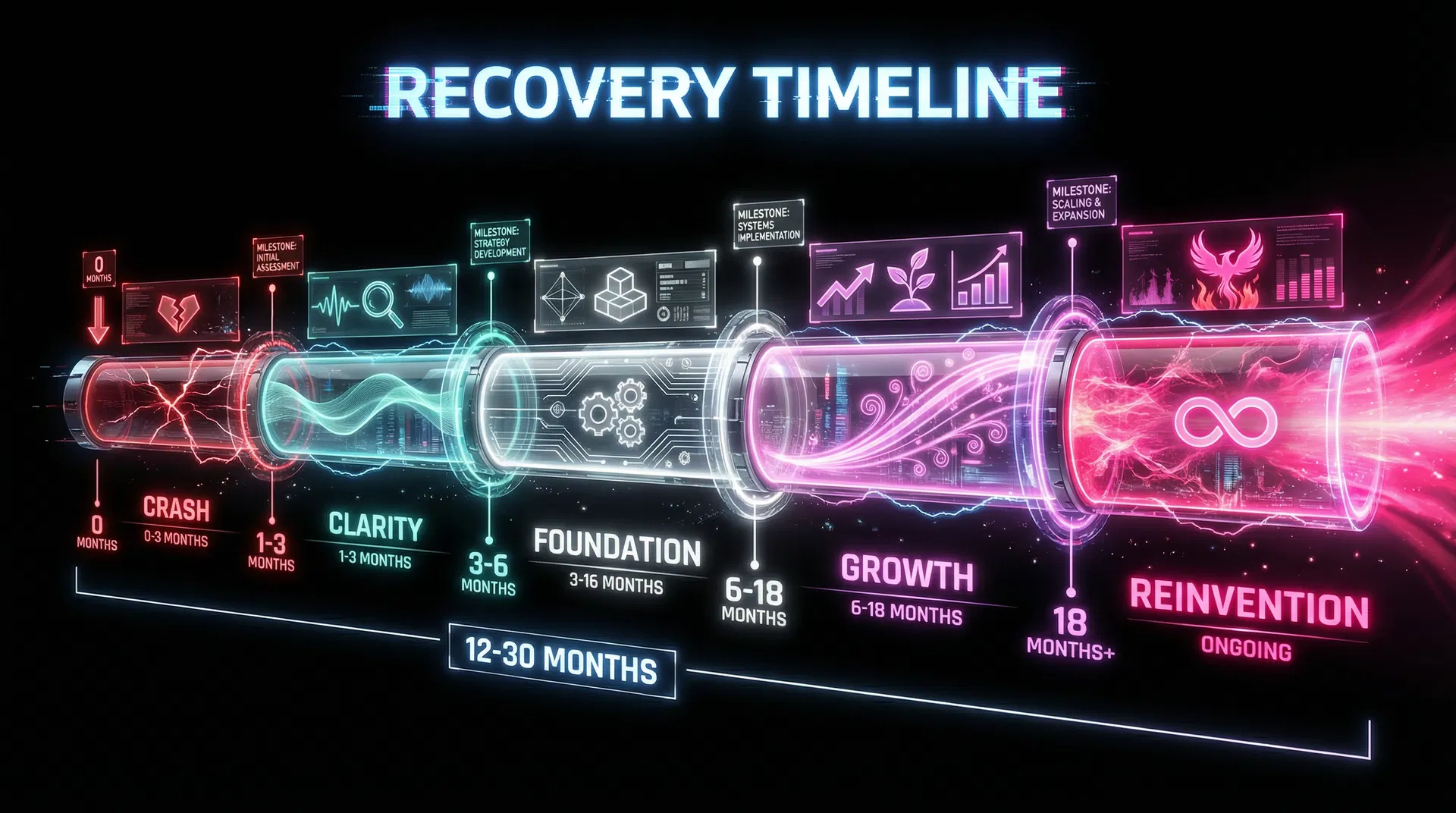
THE PHOENIX RECOVERY TIMELINE — OVERLAPPING PHASES FROM CRISIS TO RESILIENCE
Total timeline from crisis to recovery: 6-12 months. Some businesses move faster. Some take longer. The timeline depends on the severity of the crisis, the quality of the leadership, and the willingness to make hard decisions quickly.
The Phoenix Manifesto
Face the truth.
The business is in trouble. Denying it, minimising it, or hoping it will fix itself is not a strategy. It is a death sentence. Face the truth. All of it. Now. If part of that truth is an insolvency practitioner circling, read the Rigged book before you sign anything.
Move fast.
In a turnaround, speed is survival. Every day of delay is a day of unnecessary cash burn. Make decisions quickly, execute them immediately, and correct course as you go.
Cut deep, cut once.
Half-measures prolong the pain. If you need to cut costs, cut them deeply enough that you only have to do it once. Multiple rounds of cuts destroy morale and credibility.
Protect the core.
Not everything in the business is broken. Identify what works — the products that sell, the customers who pay, the people who deliver — and protect them fiercely. Everything else is negotiable.
Communicate honestly.
Your team, your customers, and your stakeholders deserve the truth. Not the full financial details, but an honest assessment of the situation and a clear plan for addressing it. Silence breeds fear. Honesty breeds trust.
Your story is your strength.
The turnaround is not a stain on your record. It is proof that you can handle adversity, make hard decisions, and come out the other side. Own it. Use it. It is the most compelling story you will ever tell.
Build systems, not just solutions.
Fixing the immediate crisis is necessary. Building systems that prevent the next crisis is essential. The Early Warning Dashboard, the Quarterly Review, the “Never Again” Commitments — these are what separate a temporary recovery from a permanent transformation.
Take care of yourself.
A turnaround is one of the most stressful experiences in business. It will test your resilience, your relationships, and your mental health. Get support. Talk to someone. Exercise. Sleep. You cannot save the business if you destroy yourself in the process.
The phoenix rises.
Every great business story includes a chapter of adversity. This is yours. And the business you build from the ashes will be stronger, leaner, and more resilient than the one that came before. That is not optimism. That is a pattern I have seen repeated across hundreds of businesses. The phoenix always rises.
More Matt Haycox Frameworks
Copyright Matt Haycox. All rights reserved. The Phoenix Framework™ is a trademark of Matt Haycox. This document may be shared freely but may not be reproduced for commercial purposes without written permission.