
The F.U.N.D.S.
™
Method
The No Bollocks Framework for Raising Capital for Your Business
By Matt Haycox — Serial entrepreneur, investor in 100+ companies, and the man who went from bankrupt to backing Britain's next generation of founders.
How to Use This Framework
This is not a summary. It is not a teaser for a course. It is the complete system — every concept, every framework, every template, every checklist — that I use when advising founders on how to raise capital. I have sat on both sides of the table: as a founder who needed money and as an investor who deploys it. This framework is built from that dual perspective.
The F.U.N.D.S.™ Method has five pillars, and they must be followed in order. Each pillar builds on the one before it. Skipping ahead is the single most common mistake founders make — and it is the reason most fundraising efforts fail. You would not build a house starting with the roof. Do not build a fundraising campaign starting with the pitch.
At the end of each pillar, there is a checklist. Do not move to the next pillar until you can answer every question on that checklist with confidence. If you cannot, go back and do the work. This is not a race. It is a process. And the founders who respect the process are the ones who raise capital.
Why Most Founders Fail to Raise Capital
Let me be direct with you. The majority of founders who try to raise capital fail. Not because their businesses are bad. Not because the market is unfair. Not because investors are stupid. They fail because they make the same five mistakes that I have seen repeated hundreds of times across the 100+ companies I have invested in and the thousands of pitches I have sat through. If a bank has already said no and you need the alternative-funding side of the story, the Declined book breaks this down source by source.
Leading with the product, not the problem
Founders fall in love with their solution and forget that investors fund problems, not products. If the investor does not feel the pain of the problem in the first 60 seconds, they have already mentally checked out.
Not knowing their numbers
When an investor asks about unit economics, CAC, LTV, or burn rate, too many founders fumble. If you do not know your numbers cold, you are telling the investor that you do not understand your own business.
Asking for money before building relationships
Fundraising is not a transaction. It is a relationship. Founders who send cold emails asking for money without first establishing credibility and trust are wasting everyone's time.
Not understanding investor incentives
Investors are not charities. They have a fund with a mandate, a timeline, and a return target. If you do not understand what they need, you cannot position your business as the answer.
Negotiating from ignorance
When a term sheet arrives, most founders are so relieved that they sign whatever is put in front of them. This is how you end up with liquidation preferences, anti-dilution clauses, and board structures that slowly strangle your company.
The F.U.N.D.S.™ Method exists to eliminate these mistakes. It is a five-pillar system that takes you from "I need capital" to "I have a signed term sheet and money in the bank" — with a clear process at every stage. No guesswork. No hoping for the best. Just a disciplined, proven approach that works.
The Five Pillars of F.U.N.D.S.™
Foundation
The problem, the team, the vision
Before you can convince anyone to invest in your business, you need to be able to articulate — with absolute clarity — what problem you are solving, why your team is the right team to solve it, and what the world looks like when you succeed.
Unfair Advantage
The moat, the IP, the unique insight
Foundation tells the investor why your business should exist. Unfair Advantage tells them why your business will survive. If your idea is good, someone else is already working on it. The question is whether you have something that makes you fundamentally difficult to beat.
Numbers
The model, the metrics, the valuation
If Foundation is the heart and Unfair Advantage is the brain, Numbers is the spine. It holds everything together. Without it, your pitch is a collection of nice stories and bold claims with nothing to support them.
Distribution
The outreach, the pitch, the follow-up
You have built your Foundation, identified your Unfair Advantage, and know your Numbers inside out. Now you need to get in front of the right people and convince them to write a cheque. Fundraising is sales — disciplined, systematic sales.
Structure
The deal, the terms, the close
An investor wants to move forward. They send you a term sheet. This is where more value is destroyed than at any other point in the fundraising process. Structure is the pillar that protects you.
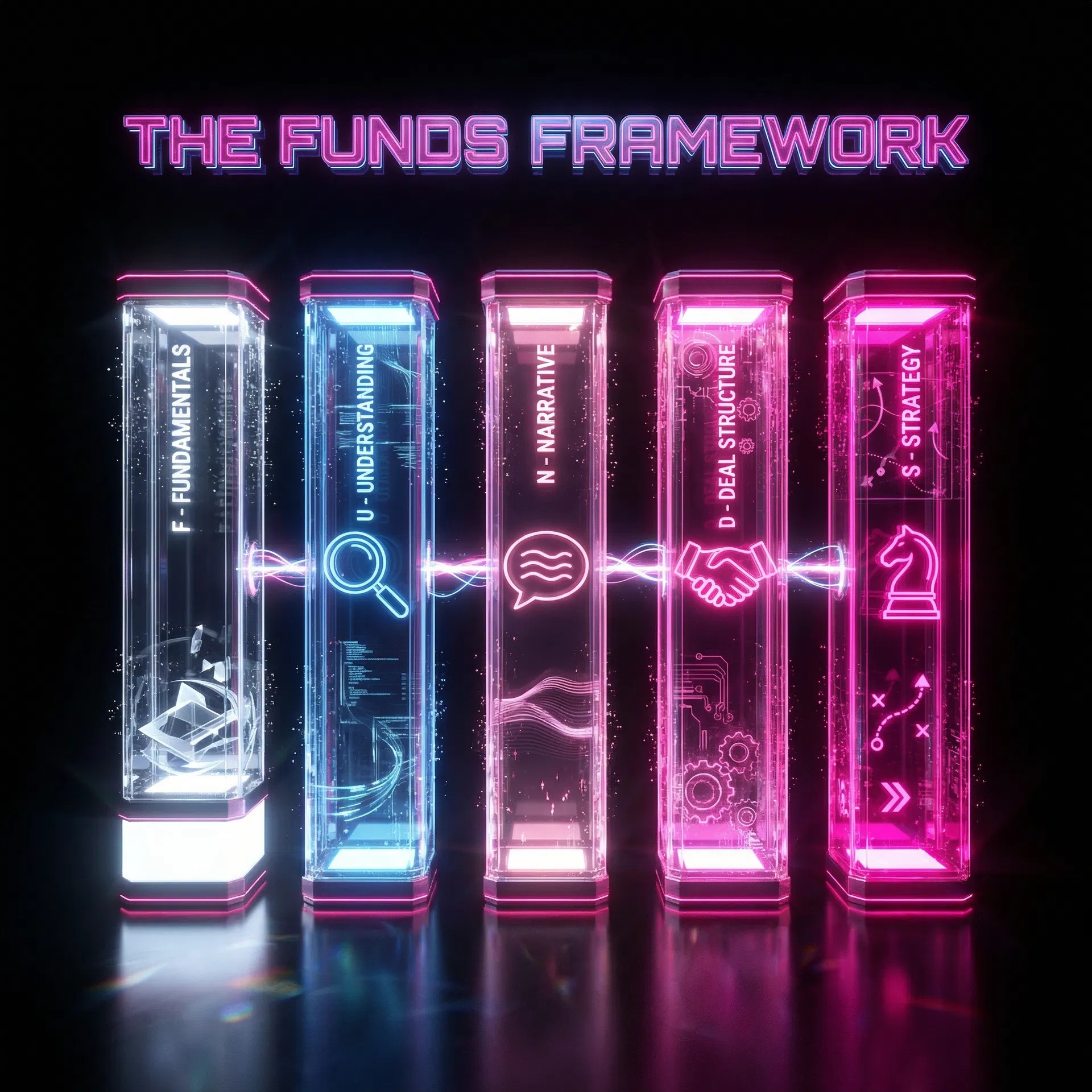
THE F.U.N.D.S.™ FRAMEWORK — FIVE PILLARS OF FUNDRAISING SUCCESS
FOUNDATION
"The problem, the team, the vision."
Foundation is the most important pillar in the entire F.U.N.D.S.™ Method. If you get this wrong, nothing else matters. You can have the best financial model in the world, the most polished pitch deck, and a target list of 200 investors — but if your Foundation is weak, you will not raise a penny.
Foundation answers three questions that every investor needs answered before they will even consider writing a cheque: What problem are you solving, and is it big enough to matter? Why is your team the right team to solve it? And what does the world look like when you succeed?
Component 1: The Problem Story
Every great business starts with a problem. Not a mild inconvenience. Not a "nice to have" improvement. A genuine, painful, expensive problem that a large number of people or businesses are desperate to solve. The Problem Story is how you communicate that problem to investors in a way that makes them feel the pain.
Most founders get this wrong. They start with their solution — "We have built an AI-powered platform that..." — and then work backwards to the problem. This is like a doctor prescribing medicine before diagnosing the illness. Investors do not care about your solution until they care about the problem. And they will not care about the problem until they feel it.
The Problem Story must answer four questions:
Be specific. "Small businesses struggle with cash flow" is vague. "62% of UK SMEs have had a late payment in the last 12 months, and the average late payment is £25,000 — enough to kill a small business" is specific.
Define your customer. Not "everyone" — investors hate that answer. A specific segment with a specific pain point.
Quantify it. In pounds, in hours wasted, in businesses lost. Investors think in numbers. Give them numbers.
This is the question that separates a real opportunity from a fantasy. If the problem is so obvious, why does it still exist? The answer reveals the market dynamics that create your opportunity.
Weak vs Strong Problem Stories
| Element | Weak Version (Avoid) | Strong Version (Use This) |
|---|---|---|
| Opening | "We noticed that small businesses have trouble getting loans." | "Last year, 400,000 viable UK businesses were rejected for bank loans. Not because they were bad businesses — because the banks' 30-year-old credit models cannot assess them properly." |
| Scale | "It's a big market." | "The UK SME lending gap is £22 billion per year. That is £22 billion of demand from creditworthy businesses that the banks are leaving on the table." |
| Impact | "Late payments are a problem." | "Late payments kill 50,000 UK businesses every year. That is 50,000 founders who did everything right — built a product, found customers, delivered value — and still went under because someone did not pay them on time." |
| Urgency | "This is a growing problem." | "The problem is accelerating. Since 2020, bank branch closures have increased by 40%, and the average time to process an SME loan application has gone from 3 weeks to 8 weeks. The gap between supply and demand is widening every quarter." |
The "Pub Test"
Here is a simple test for your Problem Story. Could you explain it to a stranger in a pub and have them immediately understand why it matters? If your explanation requires industry jargon, technical knowledge, or more than 60 seconds, it is not ready. Simplify. Sharpen. Cut the fat. The best Problem Stories are devastatingly simple.
Component 2: The Team
Investors do not fund businesses. They fund people. Specifically, they fund teams that they believe have the skills, the experience, the resilience, and the obsession required to turn an idea into a billion-pound company. Your team slide is not a formality. It is one of the most scrutinised parts of your entire pitch.
What Investors Are Looking For in a Team:
Founder-market fit
Why are you — specifically you — the right person to solve this problem? This is not about credentials. It is about lived experience, domain expertise, and obsession. If you are building a fintech company and you have spent 15 years in banking, that is founder-market fit. If you are building a fintech company because you read an article about it being a hot sector, that is not.
Complementary skills
A team of three technical co-founders with no commercial experience is a red flag. A solo founder trying to do everything is a red flag. Investors want to see a team where the skills are complementary — someone who can build the product, someone who can sell it, and someone who can manage the money.
Evidence of resilience
This is where Matt Haycox's personal story becomes a masterclass. Investors know that every startup will face moments of crisis. They want to know that the founding team will not crumble when things get hard. If you have been through adversity — a failed business, a career setback, a personal challenge — and come out the other side, that is not a weakness. It is one of your strongest assets.
Skin in the game
Have the founders invested their own money? Have they taken pay cuts? Have they turned down other opportunities to focus on this? Investors want to see that the founders are all in. If you are hedging your bets, they will hedge theirs.
The Team Narrative
Do not just list names and titles. Tell the story of the team. How did you meet? Why did you decide to work together? What have you already achieved together? The narrative should convey that this team is not a random collection of individuals — it is a unit that has been forged through shared experience and shared conviction.
| Team Element | What to Include | What to Avoid |
|---|---|---|
| Founder bios | Relevant experience, domain expertise, previous exits or achievements | Irrelevant credentials, padding, vanity metrics |
| Team structure | Clear roles, complementary skills, evidence of working together | Overlapping roles, solo founder with no plan to hire |
| Advisory board | Genuine advisors who are actively engaged and add specific value | Name-dropping advisors who have no real involvement |
| Gaps & hiring plan | Honest acknowledgment of gaps with a clear plan to fill them | Pretending you have no gaps |
Component 3: The Vision
The Vision is not a mission statement. It is not a vague aspiration about "changing the world." It is a specific, credible, and exciting picture of what the business looks like in 5-10 years if everything goes right. It is the answer to the question: "What am I buying into?"
The Vision must do three things:
It must be big enough to justify the investment
If you are raising £1 million, the investor needs to believe that the business can return 10-50x that investment. That means the vision needs to describe a business that is worth £50-100 million or more. If your vision is to build a nice, profitable lifestyle business doing £2 million a year, that is a perfectly valid ambition — but it is not a venture-fundable one. Be honest with yourself about what you are building and what type of capital is appropriate for it.
It must be specific enough to be credible
"We want to be the Uber of X" is not a vision. It is a cliché. A credible vision describes the specific market you will dominate, the specific milestones you will hit, and the specific competitive position you will occupy. "In five years, we will be the default payment infrastructure for 50,000 UK SMEs, processing £2 billion in annual transactions, with a 2% take rate and 85% gross margins" — that is a vision an investor can evaluate.
It must connect back to the problem
The vision should be the logical conclusion of the Problem Story. If the problem is that late payments kill small businesses, the vision should be a world where late payments no longer exist — and your company is the reason why.
The Foundation Checklist
Before you move to Pillar 2, you must be able to answer every one of these questions with confidence:
| # | Question | Your Answer Must Include |
|---|---|---|
| 1 | What is the problem you are solving? | A specific, quantified pain point affecting a large market |
| 2 | Who experiences this problem? | A clearly defined customer segment with willingness and ability to pay |
| 3 | How big is the problem in monetary terms? | A credible TAM/SAM/SOM with sources |
| 4 | Why does your solution work? | A clear explanation of the mechanism, not just the features |
| 5 | Why are you the right team? | Founder-market fit, complementary skills, evidence of resilience |
| 6 | What is the 5-year vision? | A specific, credible, and exciting picture of the future business |
| 7 | Can you explain all of this in under 60 seconds? | A rehearsed, compelling elevator pitch |
If any of these answers are weak, vague, or unconvincing, stop. Do not move to Pillar 2. Go back and do the work. The Foundation is everything. Get it right, and the rest of the process becomes dramatically easier. Get it wrong, and nothing else matters.
UNFAIR ADVANTAGE
"The moat, the IP, the unique insight."
Foundation tells the investor why your business should exist. Unfair Advantage tells them why your business will survive. Because here is the uncomfortable truth: if your idea is good, someone else is already working on it. Probably several someones. With more money, more experience, and more resources than you. The question is not whether you have competition — you do — but whether you have something that makes you fundamentally difficult to beat.
In investor language, this is called a "moat." Warren Buffett popularised the term, and it remains the single most important concept in investment analysis. A moat is a structural advantage that protects your business from competition over time. Without one, you are building on sand. With one, you are building a fortress.
Most founders, when asked about their competitive advantage, say something like "we have a better product" or "our team is more experienced" or "we move faster." These are not moats. They are temporary advantages that can be replicated by any well-funded competitor in 6-12 months. A true Unfair Advantage is something that gets stronger over time, not weaker. It is something that cannot be bought, copied, or shortcut.
The Seven Types of Moat
Not every business will have all seven. But every fundable business must have at least two, and ideally three or more. Here they are, in order of strength:
Network Effects
A network effect exists when your product or service becomes more valuable as more people use it. This is the most powerful moat in business because it creates a self-reinforcing cycle: more users attract more users, which attracts more users. Social networks, marketplaces, and payment platforms all benefit from network effects.
Key Question: Does every new customer make the product more valuable for every existing customer?
A lending marketplace where borrowers attract lenders and lenders attract borrowers. The more borrowers on the platform, the more competitive the rates, which attracts more borrowers. This is a genuine network effect.
Switching Costs
Switching costs exist when it is painful, expensive, or time-consuming for a customer to stop using your product and start using a competitor's. The higher the switching costs, the stickier your revenue. Enterprise software, financial infrastructure, and data-heavy platforms all benefit from high switching costs.
Key Question: If a competitor launched an identical product tomorrow at half the price, how many of your customers would switch?
If the answer is "most of them," your switching costs are low. If the answer is "very few, because migrating their data and retraining their team would take six months," your switching costs are high.
Proprietary Data
Data is only a moat if it is proprietary — meaning you have it and your competitors do not — and if it compounds over time. A business that collects unique data from its users and uses that data to improve the product creates a flywheel: better product attracts more users, more users generate more data, more data makes the product better.
Key Question: Do you have access to data that no one else has, and does that data make your product measurably better over time?
Brand & Trust
Brand is a moat when it creates a default preference in the customer's mind. When someone needs business funding and the first name they think of is Matt Haycox, that is a brand moat. Brand moats take years to build but are nearly impossible to replicate. They are particularly powerful in industries where trust is a prerequisite — financial services, healthcare, education.
Key Question: If a customer had to choose between your product and an identical one from an unknown company, would they choose yours? And would they pay more for it?
Regulatory Advantage
Some businesses operate in regulated industries where licences, certifications, or compliance requirements create barriers to entry. If you have a licence that takes two years and £500,000 to obtain, every new competitor faces that same barrier. This is not a glamorous moat, but it is an effective one.
Key Question: Are there legal, regulatory, or compliance barriers that prevent new competitors from entering your market quickly?
Cost Advantage
A cost advantage exists when you can deliver the same product or service at a meaningfully lower cost than your competitors. This can come from economies of scale, proprietary technology, unique supplier relationships, or operational efficiency. Cost advantages are powerful but fragile — they can be eroded by well-funded competitors willing to operate at a loss.
Key Question: Can you deliver the same value as your competitors at a cost that they cannot match without fundamentally restructuring their business?
Intellectual Property
Patents, trademarks, copyrights, and trade secrets are all forms of intellectual property that can create legal barriers to competition. However, IP is often the weakest moat because patents can be designed around, trade secrets can be reverse-engineered, and the legal cost of enforcement can be prohibitive for a startup.
Key Question: Do you have legally protected IP that would require a competitor to invest significant time and money to replicate or work around?
How to Identify Your Unfair Advantage
Most founders either overestimate or underestimate their moat. Here is a structured exercise to identify yours honestly.
List every advantage
Write down everything — your team's experience, your technology, your relationships, your data, your brand, your cost structure, your regulatory position. Do not filter. Just list.
Apply the "well-funded competitor" test
For each advantage, ask: "If a competitor raised £10 million tomorrow and decided to come after us, could they replicate this advantage within 18 months?" If the answer is yes, it is not a moat. Cross it off.
Apply the "time" test
For each remaining advantage, ask: "Does this advantage get stronger or weaker over time?" A true moat compounds. If your advantage is static or degrading, it is a temporary lead, not a structural advantage.
Rank what remains
Whatever survives both tests is your genuine Unfair Advantage. Rank them by strength and defensibility. These are what you will lead with when talking to investors.
How to Present Your Unfair Advantage to Investors
Investors are professional skeptics. They have heard every founder claim to have a "unique" product and a "world-class" team. Your job is not to make claims — it is to present evidence.
| Moat Type | Weak Evidence (Avoid) | Strong Evidence (Use This) |
|---|---|---|
| Network Effects | "We have a lot of users" | "Our user retention increases by 12% for every 1,000 new users on the platform, demonstrating a measurable network effect" |
| Switching Costs | "Our customers love us" | "Average customer tenure is 4.2 years, and our annual churn rate is 3%, compared to an industry average of 18%" |
| Proprietary Data | "We collect a lot of data" | "We have 14 million proprietary transaction records that power our risk model, which has reduced default rates by 40% compared to industry benchmarks" |
| Brand & Trust | "People know who we are" | "62% of our new customers cite word-of-mouth or brand recognition as their primary reason for choosing us, and our NPS is 72" |
| Regulatory | "We are regulated" | "We hold an FCA licence that took 18 months and £300,000 to obtain. There are only 47 companies in the UK with this licence" |
| Cost Advantage | "We are cheaper" | "Our unit cost is £0.12 compared to the industry average of £0.45, driven by our proprietary automation that eliminates 3 manual steps" |
| IP | "We have a patent" | "We hold 3 granted patents covering our core algorithm, with 2 additional patents pending. A freedom-to-operate analysis confirms no viable design-arounds" |
The "Unfair Advantage" Narrative
When you present your Unfair Advantage to investors, structure it as a narrative, not a list. The narrative should follow this arc:
Acknowledge the competition. Never pretend you have no competitors. Investors will lose trust immediately.
Explain why existing solutions fall short. What are the specific weaknesses of the current alternatives?
Introduce your moat. Explain what you have that they do not, and why it matters to the customer.
Show that the moat compounds. Explain how your advantage gets stronger over time.
Quantify the gap. Use specific metrics to show the current distance between you and the nearest competitor.
The Unfair Advantage Checklist
Before you move to Pillar 3, you must be able to answer every one of these questions:
| # | Question | Your Answer Must Include |
|---|---|---|
| 1 | Who are your top 3-5 competitors? | Names, funding, market position, strengths, and weaknesses |
| 2 | What do they do well? | An honest assessment — investors will know if you are being dismissive |
| 3 | What is your primary moat? | One of the seven moat types, with specific evidence |
| 4 | What is your secondary moat? | A second structural advantage that reinforces the first |
| 5 | Does your moat compound over time? | A clear explanation of the flywheel or reinforcing mechanism |
| 6 | Can a well-funded competitor replicate your moat in 18 months? | An honest "no" with a specific explanation of why not |
| 7 | How do you quantify your advantage? | Specific metrics that demonstrate the gap |
NUMBERS
"The model, the metrics, the valuation."
If Foundation is the heart of your pitch and Unfair Advantage is the brain, Numbers is the spine. It holds everything together. Without it, your pitch is a collection of nice stories and bold claims with nothing to support them. With it, your pitch becomes an investment thesis — a logical, evidence-based argument for why putting money into your business will generate a return.
Let me be direct: most founders are terrible at numbers. Not because they are stupid, but because they have never been taught what investors actually want to see. They build elaborate 50-tab spreadsheets with five-year projections down to the penny, and they think this demonstrates rigour. It does not. It demonstrates naivety. No investor believes your month-by-month revenue projection for Year 4. What they want to see is that you understand the fundamental economics of your business.
The Three Layers of Numbers
Unit Economics
The economics of a single transaction or customer. This is the foundation of your financial model and the thing investors scrutinise most closely.
The Business Model
How unit economics scale into a business. This is where revenue, costs, margins, and growth rates come together to paint a picture of the business at scale.
The Valuation
What the business is worth today, and what it could be worth in the future. This is where the negotiation happens.
Layer 1: Unit Economics
Unit economics is the single most important financial concept for any founder raising capital. It answers the question: "When you acquire one customer and serve them over their lifetime, do you make money or lose money?" If the answer is "lose money," no amount of growth will save you. You are just scaling losses.
Customer Acquisition Cost (CAC)
The total cost of acquiring one new customer. It includes all marketing spend, sales team salaries, software costs, and any other expense directly attributable to customer acquisition, divided by the number of new customers acquired in that period.
Lifetime Value (LTV)
The total revenue (or ideally, gross profit) you expect to generate from a single customer over the entire duration of their relationship with your business.
The LTV:CAC Ratio
The single most important ratio in your business. It tells you how much value you create for every pound you spend on acquisition.
| LTV:CAC Ratio | What It Means | Investor Reaction |
|---|---|---|
| Below 1:1 | You are losing money on every customer | "This business is not viable" |
| 1:1 to 2:1 | You are barely breaking even on acquisition | "This is too risky" |
| 3:1 | The gold standard for most industries | "This is a healthy, scalable business" |
| 5:1 or above | Exceptional economics | "Why aren't you spending more on acquisition?" |
A ratio below 3:1 means your acquisition is too expensive or your customers are not valuable enough. A ratio above 5:1 means you are likely under-investing in growth and leaving money on the table. Both are problems, but the second is a much nicer problem to have.
Gross Margin
The percentage of revenue that remains after deducting the direct costs of delivering your product or service. It is the single best indicator of the scalability of your business model.
| Business Type | Typical Gross Margin | Investor Expectation |
|---|---|---|
| SaaS / Software | 70-90% | 75%+ |
| Marketplace | 40-70% | 50%+ |
| E-commerce | 30-60% | 40%+ |
| Services / Agency | 40-60% | 50%+ |
| Lending / Fintech | 30-70% | Varies by risk model |
Churn Rate
The percentage of customers who stop paying you each month (or year). Churn is the silent killer of subscription businesses. Even a small difference in churn has a massive impact on LTV and long-term revenue.
| Monthly Churn | Annual Churn Equivalent | Impact on LTV |
|---|---|---|
| 1% | 11.4% | Average customer lifetime: ~8 years |
| 2% | 21.5% | Average customer lifetime: ~4 years |
| 5% | 46.0% | Average customer lifetime: ~1.7 years |
| 10% | 71.8% | Average customer lifetime: ~10 months |
If your monthly churn is above 5%, you do not have a growth problem. You have a retention problem. Fix it before you raise capital, because no investor will fund a leaky bucket.
Layer 2: The Business Model
Once you understand your unit economics, the next step is to show how those economics scale into a business. This is your financial model — and it needs to be simple, credible, and defensible.
The Golden Rule: Bottom-Up, Not Top-Down
A top-down model says: "The UK lending market is worth £50 billion. If we capture just 1% of that, we will do £500 million in revenue." This is the single fastest way to lose credibility with an investor. Every founder says "if we just get 1%." It is meaningless.
A bottom-up model says: "We currently have 200 customers paying an average of £500/month. Our sales team closes 15 new customers per month at a CAC of £1,200. If we hire 3 more salespeople and maintain the same close rate, we will add 45 customers per month, reaching 740 customers and £370,000 MRR by the end of Year 1." This is credible because every number is grounded in current performance.
| Component | Time Horizon | Level of Detail |
|---|---|---|
| Historical financials | Last 12-24 months | Actual numbers, monthly |
| Revenue forecast | Next 18-24 months | Monthly, bottom-up, assumption-driven |
| Cost structure | Next 18-24 months | Monthly, broken into fixed and variable |
| Cash flow projection | Next 18-24 months | Monthly, showing burn rate and runway |
| Key assumptions | Clearly stated | Each assumption should be testable and sourced |
| Sensitivity analysis | 3 scenarios | Base case, upside case, downside case |
Base Case
Your most likely outcome, based on current trends and reasonable assumptions. This is what you believe will happen if you execute well.
Upside Case
What happens if things go better than expected — a major partnership closes, a new channel outperforms, or churn drops significantly. This shows the investor the potential.
Downside Case
What happens if things go worse than expected — a key hire leaves, a competitor launches, or the market slows. This shows the investor that you have a plan for adversity.
Layer 3: The Valuation
Valuation is where most founders get emotional, and emotion is the enemy of a good deal. Your business is worth what someone will pay for it — no more, no less. Your job is not to arrive at a number you like. It is to arrive at a number you can defend.
| Growth Rate | Typical Revenue Multiple (SaaS) | Typical Revenue Multiple (Other) |
|---|---|---|
| Below 50% YoY | 5-10x | 2-5x |
| 50-100% YoY | 10-20x | 5-10x |
| Above 100% YoY | 20-40x+ | 10-20x |
How Much to Raise
The amount you raise should be determined by your plan, not your ambition. You should raise enough to hit a set of milestones that will make your next round significantly easier and at a significantly higher valuation. This is typically 18-24 months of runway.
The 1.5x buffer accounts for the fact that things always take longer and cost more than you expect. If your monthly burn is £30,000, you should raise at least £810,000.
How Much Equity to Give Away
The standard range for a seed round is 10-25% of the company. Giving away more than 25% at seed stage is a red flag — it suggests either a very low valuation or a very large round. Giving away less than 10% is unusual and may make the round unattractive to investors who need a meaningful stake.
The Numbers Checklist
Before you move to Pillar 4, you must be able to answer every one of these questions:
| # | Question | Your Answer Must Include |
|---|---|---|
| 1 | What is your CAC? | A specific number, with the methodology explained |
| 2 | What is your LTV? | A specific number, with assumptions stated |
| 3 | What is your LTV:CAC ratio? | A ratio of 3:1 or above, or a clear plan to get there |
| 4 | What is your gross margin? | A percentage, benchmarked against your industry |
| 5 | What is your monthly burn rate? | A specific number, broken into fixed and variable costs |
| 6 | How many months of runway do you have? | A specific number, based on current cash and burn |
| 7 | What are your revenue projections for the next 18 months? | A bottom-up model with clearly stated assumptions |
| 8 | What valuation are you targeting? | A range, anchored to comparable transactions |
| 9 | How much are you raising and why? | A specific amount tied to specific milestones |
| 10 | What does the downside case look like? | A scenario showing the business survives even if things go wrong |

Pillar 4
Time to Get in the Room
DISTRIBUTION
"The outreach, the pitch, the follow-up."
You have built your Foundation. You have identified your Unfair Advantage. You know your Numbers inside out. Now you need to get in front of the right people and convince them to write a cheque. This is Distribution — and it is where most founders either succeed spectacularly or fail miserably, because they treat fundraising like a lottery instead of a sales process.
Here is the mindset shift that separates founders who raise capital from founders who do not: fundraising is sales. It is not networking. It is not "getting your name out there." It is not attending events and hoping someone important notices you. It is a disciplined, systematic sales process with a target list, a pipeline, a pitch, a follow-up cadence, and a close. If you would not run your sales team the way you run your fundraising, you are doing it wrong.
This pillar covers four stages: Targeting, Outreach, The Pitch, and The Follow-Up. Master all four, and you will run a fundraising process that is efficient, professional, and — most importantly — successful.
Stage 1: Targeting
The single biggest waste of time in fundraising is pitching the wrong investors. It does not matter how good your pitch is if the person you are pitching does not invest in your stage, your sector, your geography, or your ticket size. Before you send a single email, you need to build a targeted investor list.
The Investor Qualification Framework
For every potential investor, you need to answer five questions. If the answer to any of them is "no" or "I don't know," that investor does not belong on your list.
| Question | Why It Matters |
|---|---|
| Do they invest in my stage? | A Series B fund will not lead your seed round. A pre-seed fund will not write a £5M cheque. |
| Do they invest in my sector? | A healthcare-focused fund will not invest in your fintech startup, no matter how good it is. |
| Do they invest in my geography? | Many funds have geographic mandates. A US-only fund will not invest in a UK company without a US presence. |
| What is their typical cheque size? | If you need a £500K lead and the fund writes £50K cheques, they are not your lead investor. |
| Have they invested in a competitor? | If they have, they are unlikely to invest in you. But they might be a valuable source of market intelligence. |
Building Your Target List: 50-100 Qualified Investors
This is not a typo. Fundraising is a numbers game, and even the best founders with the best businesses hear "no" far more often than they hear "yes." A typical conversion rate from first meeting to term sheet is 5-10%. That means you need 50-100 first meetings to generate 3-5 term sheets.
Where to Find Investors
Crunchbase & PitchBook
Search for investors by stage, sector, geography, and recent activity. Look for investors who have made investments in your space in the last 12 months — they are actively deploying capital.
AngelList & Seedrs
For angel investors and smaller funds, these platforms provide direct access to investors who are actively looking for deals.
Search for investment professionals at funds that match your criteria. Look at their recent activity — what have they posted about? What deals have they announced?
Your Existing Network
The most underutilised source. Your advisors, customers, suppliers, accountant, lawyer — all of them know people who invest. Ask for introductions.
Podcasts & Conferences
Investors who appear on podcasts or speak at conferences are signalling they are open to deal flow. Listen to their interviews to understand their thesis.
Organising Your Pipeline
Treat your investor pipeline exactly like a sales pipeline. Use a CRM or a simple spreadsheet with the following columns:
| Column | Purpose |
|---|---|
| Investor Name | The fund or individual |
| Contact Person | The specific partner or associate you are targeting |
| Stage | Pre-seed / Seed / Series A / etc. |
| Sector Focus | Their investment thesis |
| Cheque Size | Typical investment amount |
| Status | Not contacted / Intro requested / Meeting scheduled / Meeting held / Follow-up / Term sheet / Passed |
| Source | How you found them or who can introduce you |
| Last Contact Date | When you last communicated |
| Next Action | What you need to do next |
| Notes | Key insights from conversations |
Update this pipeline religiously. Every day. Fundraising is a full-time job, and your pipeline is your scoreboard.
Stage 2: Outreach
The goal of outreach is simple: get a meeting. Not close a deal. Not pitch your business. Just get 30 minutes of someone's time. Everything else happens in the meeting.
The Warm Introduction: The Gold Standard
A warm introduction from a trusted mutual contact is, by a significant margin, the most effective way to get a meeting with an investor. Research consistently shows that warm introductions convert to meetings at 5-10x the rate of cold outreach. This is not because investors are lazy or elitist — it is because they receive hundreds of cold pitches per week and use their network as a filter for quality.
The Forwardable Email Template
Hi [Introducer's Name],
Would you mind forwarding this to [Investor's Name]?
Hi [Investor's Name],
I am [Your Name], founder of [Company]. We are [one sentence about what you do and your traction]. I noticed that [Fund Name] invested in [similar company] and I believe there is a strong fit with your thesis.
I would love 20 minutes to share what we are building. Would you be open to a brief call next week?
Best,
[Your Name]
Cold Outreach: When You Have No Other Option
Sometimes you will not have a warm path to an investor. In those cases, cold outreach can work — but only if it is highly personalised and demonstrates that you have done your homework.
| Element | What to Include | What to Avoid |
|---|---|---|
| Subject Line | Specific and relevant: "[Company Name] — [Sector] — [One Key Metric]" | Generic: "Investment Opportunity" or "Exciting Startup" |
| Opening Line | Reference something specific about the investor: a recent investment, a blog post, a podcast appearance | "Dear Sir/Madam" or "I hope this email finds you well" |
| The Hook | One sentence about your business that creates curiosity: a surprising metric, a bold claim, a counterintuitive insight | A paragraph-long description of your product |
| The Ask | A specific, low-commitment request: "Would you have 20 minutes for a call next Tuesday or Wednesday?" | "I would love to discuss this further at your earliest convenience" |
| Length | 5-7 sentences maximum | Anything longer than a single screen on a mobile phone |
The Rule of Seven: On average, it takes seven touchpoints before a cold prospect responds. Do not send one email and give up. Follow up at Day 3, Day 7, Day 14, and Day 28. Each follow-up should add new information — a new milestone, a press mention, a new customer — not just repeat the original ask.
Stage 3: The Pitch
You have the meeting. Now what? The pitch is not a presentation. It is a conversation. The best pitches feel like a dialogue between two smart people exploring whether there is a mutual fit — not a monologue from a desperate founder begging for money.
The 15-Minute Pitch Structure
Most investor meetings are 30 minutes. You should aim to present for no more than 15 minutes, leaving the other 15 for questions and discussion.
| Minute | Section | Content | Pillar |
|---|---|---|---|
| 0-2 | The Problem | The pain, the cost, the urgency | Foundation |
| 2-4 | The Solution | How you solve it, the mechanism | Foundation |
| 4-6 | The Traction | What you have achieved so far — revenue, users, partnerships | Foundation + Numbers |
| 6-8 | The Market | How big the opportunity is (bottom-up TAM) | Numbers |
| 8-10 | The Moat | Why you will win and why competitors cannot catch you | Unfair Advantage |
| 10-12 | The Business Model | Unit economics, revenue model, growth trajectory | Numbers |
| 12-13 | The Team | Why this team will execute | Foundation |
| 13-14 | The Ask | How much you are raising, what you will do with it | Numbers |
| 14-15 | The Vision | Where this business is going in 5 years | Foundation |
The Three Rules of a Great Pitch
Lead with the problem, not the product
The first words out of your mouth should make the investor feel the pain of the problem you are solving. If they do not care about the problem, they will not care about the solution.
Show, do not tell
Instead of saying "we have strong traction," say "we went from £0 to £25,000 MRR in 6 months with zero paid marketing." Instead of saying "our team is experienced," say "our CTO built the fraud detection system at Revolut that processes £10 billion in transactions per year."
Know when to stop talking
The most powerful moment in any pitch is the silence after you make a strong point. Let it land. Do not fill every pause with more words. If the investor is thinking, that is a good sign. Let them think.
Handling Questions
The questions an investor asks tell you exactly what they care about and what concerns they have. Treat every question as an opportunity, not a threat.
If they ask about the market: They are interested but want to validate the opportunity size. Be ready with bottom-up market sizing and comparable companies.
If they ask about the competition: They are testing whether you are honest and self-aware. Acknowledge competitors, explain your differentiation, and present evidence.
If they ask about the team: They are evaluating execution risk. Tell the story of the team, emphasise founder-market fit, and address any gaps proactively.
If they ask about the numbers: They are doing due diligence in real time. Know your unit economics cold. If you do not know an answer, say so honestly and commit to following up within 24 hours.
If they do not ask questions: This is a bad sign. It usually means they have already decided to pass. Ask directly: "What concerns do you have about this opportunity?" This forces the conversation into honest territory.
Stage 4: The Follow-Up
The meeting is over. Now what? Most founders make one of two mistakes: they either follow up too aggressively (emailing every day) or they do not follow up at all (assuming the investor will reach out when they are ready). Both are wrong.
| Timing | Action | Content |
|---|---|---|
| Same day | Send a thank-you email | Thank them for their time. Attach any materials they requested. Restate the next steps agreed in the meeting. |
| 1 week later | Send a progress update | Share a new milestone, metric, or piece of news. Keep it brief — 3-4 sentences. |
| 2 weeks later | Send a soft check-in | "I wanted to follow up on our conversation. Is there any additional information I can provide to help with your decision?" |
| 4 weeks later | Send a final update | Share a significant update and restate your interest. If they have not responded, this is your last outreach before moving on. |
The "Social Proof" Follow-Up
The most powerful follow-up you can send is one that demonstrates momentum. "Since we last spoke, we have closed 12 new customers, hired our VP of Sales, and received a term sheet from [another fund]." This creates urgency and FOMO — two of the most powerful forces in investor psychology.
When They Say No
"No" is not the end of the relationship. It is the beginning of a different one. When an investor passes, always ask: "Thank you for your honesty. Could you share the specific reasons for your decision? And is there anyone in your network who might be a better fit for this opportunity?" This turns a rejection into market intelligence and a potential warm introduction.
The Distribution Checklist
Before you move to Pillar 5, you must have completed the following:
| # | Question | Your Answer Must Include |
|---|---|---|
| 1 | Built a target list of 50-100 qualified investors | Names, stages, sectors, cheque sizes, contact details |
| 2 | Identified warm introduction paths for at least 30% of the list | Mutual connections mapped and introduction requests sent |
| 3 | Drafted a forwardable introduction email | 3-4 sentences, easy for the introducer to forward |
| 4 | Drafted a cold outreach email template | Personalised, specific, 5-7 sentences maximum |
| 5 | Created a pitch deck of 12-15 slides | Covering all five pillars of F.U.N.D.S.™ |
| 6 | Rehearsed the 15-minute pitch until it is natural | Practised with advisors, peers, or a mirror |
| 7 | Prepared answers for the 20 most likely questions | Written out and rehearsed |
| 8 | Set up a CRM or pipeline tracker | Updated daily with status, next actions, and notes |
| 9 | Scheduled at least 10 meetings in the first two weeks | Meetings booked, not just emails sent |
| 10 | Established a follow-up cadence for every meeting | Same-day, 1-week, 2-week, 4-week touchpoints planned |
STRUCTURE
"The deal, the terms, the close."
You have done the work. An investor wants to move forward. They send you a term sheet. This is the moment most founders have been dreaming about — and it is also the moment where more value is destroyed than at any other point in the fundraising process. Because a term sheet is not a cheque. It is a negotiation. And if you do not understand what you are negotiating, you will sign away control, economics, and optionality that you will spend years regretting.
Structure is the pillar that protects you. It is the difference between a deal that sets you up for long-term success and a deal that looks good on paper but slowly strangles your business. I have sat on both sides of this table — as a founder raising capital and as an investor deploying it — and I can tell you that the terms of the deal matter as much as the amount of the deal. Sometimes more.
Understanding the Term Sheet
A term sheet is a non-binding document that outlines the key terms of a proposed investment. It is not a legal contract — it is a letter of intent that forms the basis for the final legal agreements. However, the terms agreed in the term sheet are very difficult to renegotiate later, so treat every clause as if it is final.
| Section | What It Covers | Why It Matters |
|---|---|---|
| Valuation | Pre-money valuation, post-money valuation, price per share | Determines how much of the company you are giving away |
| Investment Amount | Total round size, lead investor amount, allocation for others | Determines your runway and dilution |
| Equity Type | Common shares, preferred shares, convertible notes, SAFEs | Determines the rights and preferences of the new investors |
| Liquidation Preference | What happens to the investor's money if the company is sold or liquidated | Can dramatically reduce the founder's payout in an exit |
| Anti-Dilution | How the investor is protected if the company raises at a lower valuation | Can significantly increase dilution for founders in a down round |
| Board Composition | Who sits on the board and how decisions are made | Determines who controls the company |
| Vesting | How founder shares vest over time | Protects the company if a founder leaves early |
| Pro-Rata Rights | The investor's right to invest in future rounds | Standard and generally fair |
| Drag-Along / Tag-Along | Rights related to the sale of the company | Determines who can force or join a sale |
Valuation: Pre-Money vs Post-Money
This is the most basic and most misunderstood concept in fundraising. Pre-money valuation is what the company is worth before the investment. Post-money valuation is what the company is worth after the investment (pre-money + investment amount).
| Scenario | Pre-Money Valuation | Investment Amount | Post-Money Valuation | Investor Ownership |
|---|---|---|---|---|
| A | £4,000,000 | £1,000,000 | £5,000,000 | 20% |
| B | £3,000,000 | £1,000,000 | £4,000,000 | 25% |
The difference between a £4M and £3M pre-money valuation is 5% of your company. On a business that eventually exits for £50M, that 5% is worth £2.5M. Valuation matters.
A slightly lower valuation with a great investor who adds genuine strategic value is almost always better than a higher valuation with a passive investor who just writes a cheque.
Liquidation Preference: The Hidden Trap
Liquidation preference determines the order in which money is distributed when the company is sold or liquidated. It is the single most important economic term in the term sheet, and it is the one that most founders do not understand until it is too late.
1x Non-Participating Preferred STANDARD & FAIR
The investor gets their money back first (1x their investment), and then the remaining proceeds are split among all shareholders. Alternatively, the investor can convert to common shares and take their pro-rata share. They choose whichever gives them more.
| Exit Price | Investor Gets (1x Pref) | Investor Gets (Convert at 20%) | Investor Chooses | Founder Gets |
|---|---|---|---|---|
| £2,000,000 | £1,000,000 | £400,000 | £1,000,000 (preference) | £1,000,000 |
| £10,000,000 | £1,000,000 | £2,000,000 | £2,000,000 (convert) | £8,000,000 |
| £50,000,000 | £1,000,000 | £10,000,000 | £10,000,000 (convert) | £40,000,000 |
2x or 3x Participating Preferred DANGEROUS
The investor gets 2x or 3x their money back first, AND then participates in the remaining proceeds. This is sometimes called "double-dipping" and it can dramatically reduce the founder's payout.
| Exit Price | Investor Gets (2x Pref) | Investor Gets (20% of Remainder) | Total Investor Gets | Founder Gets |
|---|---|---|---|---|
| £2,000,000 | £2,000,000 | £0 | £2,000,000 | £0 |
| £10,000,000 | £2,000,000 | £1,600,000 | £3,600,000 | £6,400,000 |
| £50,000,000 | £2,000,000 | £9,600,000 | £11,600,000 | £38,400,000 |
Notice the difference. At a £2M exit with 2x participating, the founder gets nothing. At a £10M exit, the founder gets £1.6M less than they would with 1x non-participating.
The Rule: Accept 1x non-participating preferred. Push back hard on anything more aggressive. If an investor insists on 2x or participating preferred, it is a signal that they do not believe in the upside of your business and are protecting their downside at your expense.
Anti-Dilution: Protecting the Investor (At Your Expense)
Anti-dilution provisions protect the investor if the company raises a future round at a lower valuation (a "down round"). There are two types:
Broad-Based Weighted Average
STANDARD & FAIR
The investor's conversion price is adjusted downward based on a formula that takes into account the size of the down round relative to the company's total capitalisation. The adjustment is moderate and proportional.
Full Ratchet
AGGRESSIVE & UNFAIR
The investor's conversion price is adjusted to the price of the new round, regardless of the size of the down round. This can result in massive dilution for founders.
| Anti-Dilution Type | Investor's New Shares | Dilution to Founders |
|---|---|---|
| None | 100,000 | None |
| Broad-Based Weighted Average | ~130,000 (depends on formula) | Moderate |
| Full Ratchet | 200,000 | Severe |
The Rule: Accept broad-based weighted average. Never accept full ratchet. If an investor insists on full ratchet, walk away. It is a predatory term that will punish you disproportionately if the market turns.
Board Composition: Who Controls the Company?
The board of directors makes the most important decisions about the company — hiring and firing the CEO, approving budgets, authorising new fundraising rounds, and approving exits. Who sits on the board determines who controls the company.
Standard Structure (Seed/Series A)
| Seat | Held By |
|---|---|
| Seat 1 | Founder / CEO |
| Seat 2 | Founder / Co-Founder |
| Seat 3 | Lead Investor |
Founders retain 2-1 majority. Standard and fair.
Red Flag Structure
| Seat | Held By |
|---|---|
| Seat 1 | Founder / CEO |
| Seat 2 | Lead Investor |
| Seat 3 | Investor-appointed "Independent" |
Investor has effective control. The "independent" is almost always aligned with the investor. This is a power grab.
The Rule: Maintain board control through at least Series A. Accept an investor board seat, but ensure the founders retain a majority. If you lose board control early, you lose the ability to make decisions about your own company.
Vesting: Protecting Everyone
Vesting ensures that founder shares are earned over time, not granted upfront. This protects the company (and the investors) if a founder leaves early. It also protects the remaining founders from a departing co-founder walking away with a large chunk of equity they did not earn.
The Standard Vesting Schedule: 4-Year with 1-Year Cliff
Year 0-1 (The Cliff): No shares vest. If a founder leaves before the 1-year mark, they forfeit all their shares.
Year 1: 25% of shares vest on the 1-year anniversary.
Years 1-4: The remaining 75% vest monthly over the next 36 months.
Credit negotiation: If you have been working on the business for a significant period before raising, negotiate for "credit" — e.g., if you have been building for 18 months, argue that 18 months of vesting should be credited, so your effective cliff is only 6 months away.
Closing the Deal
Once you have agreed on terms, the process moves to legal documentation. This typically takes 4-8 weeks.
Step 1: Due Diligence
The investor's lawyers will review your corporate documents, financial records, contracts, IP ownership, and any potential liabilities. Have a clean data room prepared in advance.
Step 2: Legal Documentation
The term sheet is translated into binding legal agreements — typically a Share Purchase Agreement (SPA), a Shareholders' Agreement (SHA), and updated Articles of Association. Your lawyer should review every document.
Step 3: Completion
The documents are signed, the money is wired, and the shares are issued. Congratulations — you have raised capital.
Step 4: The Real Work Begins
Closing the round is not the finish line. It is the starting line. You now have investors, a board, and a set of milestones to hit. The real test of whether you deserved the investment is what you do with it.
The Due Diligence Data Room
| Category | Documents to Include |
|---|---|
| Corporate | Certificate of incorporation, articles of association, shareholder agreements, board minutes |
| Financial | Last 2-3 years of accounts, management accounts, bank statements, tax returns |
| Commercial | Key customer contracts, supplier agreements, partnership agreements |
| IP | Patent filings, trademark registrations, domain ownership, key software licences |
| Employment | Employment contracts, option pool details, any outstanding disputes |
| Legal | Any ongoing or threatened litigation, regulatory filings, compliance certificates |
The Structure Checklist
Before you sign anything, you must be able to confirm the following:
| # | Question | Your Answer Must Include |
|---|---|---|
| 1 | What is the liquidation preference? | 1x non-participating preferred |
| 2 | What is the anti-dilution provision? | Broad-based weighted average |
| 3 | Who controls the board? | Founders retain majority |
| 4 | What is the vesting schedule? | 4-year with 1-year cliff (with credit for time served) |
| 5 | Are there any "pay to play" provisions? | Understand the implications before accepting |
| 6 | What are the information rights? | Standard quarterly reporting — nothing onerous |
| 7 | Is there a drag-along clause? | Yes, but with a reasonable threshold (e.g., 75% of shareholders) |
| 8 | Has the term sheet been reviewed by an experienced startup lawyer? | Yes. Non-negotiable. |
| 9 | Do you understand every clause in the term sheet? | Yes. If not, ask your lawyer to explain until you do. |
| 10 | Is the data room complete and organised? | Yes. Every document is current, accurate, and accessible. |
The F.U.N.D.S.™ Method in Action
The F.U.N.D.S.™ Method is not a theory. It is a process. And like any process, it only works if you execute it with discipline, rigour, and honesty. Here is a summary of the entire framework, from start to finish:
| Phase | Pillar | Core Work | Time Required | Output |
|---|---|---|---|---|
| 1 | Foundation | Define the problem, build the team narrative, articulate the vision | 2-4 weeks | A compelling 60-second elevator pitch and the first 5 slides of your deck |
| 2 | Unfair Advantage | Identify your moats, map the competitive landscape, gather evidence | 1-2 weeks | A competitive analysis and a clear articulation of your defensibility |
| 3 | Numbers | Build the financial model, calculate unit economics, determine valuation range | 2-4 weeks | A complete financial model with 3 scenarios and a clear ask |
| 4 | Distribution | Build the target list, secure introductions, run the pitch process | 4-12 weeks | A pipeline of 50-100 investors with meetings scheduled |
| 5 | Structure | Negotiate terms, complete due diligence, close the deal | 4-8 weeks | Signed legal documents and money in the bank |

WHAT INVESTORS EVALUATE AT EACH STAGE — FROM SEED TO GROWTH
Total timeline: 13-30 weeks. This is not a quick process. Anyone who tells you they can help you raise capital in 2 weeks is lying. But it is a predictable process. If you follow the five pillars in order, do the work at each stage, and maintain the discipline to see it through, you will raise capital. Not because you are lucky. Because you are prepared.
The "No Bollocks" Fundraising Manifesto
Print these out. Stick them on your wall. Read them before every investor meeting.
Preparation beats talent
The best-prepared founder in the room will always beat the most talented founder who wings it. Do the work.
Investors are not your enemy
They are your partners. Treat them with respect, be honest with them, and build a relationship that will last longer than any single deal.
No means not yet
Every "no" is feedback. Learn from it. Improve. Come back stronger.
The terms matter as much as the money
A bad deal with good money is still a bad deal. Protect your economics, your control, and your optionality.
Speed kills — in a good way
Once you have momentum in a fundraising process, do not slow down. Schedule meetings back to back. Create urgency. Close quickly.
Your business is the pitch
The best pitch deck in the world cannot save a bad business. And a great business can survive a mediocre pitch deck. Focus on building something worth investing in.
Ask for help
You do not have to do this alone. Find mentors, advisors, and peers who have been through the process. Their experience will save you time, money, and heartache.
Never, ever, ever give up
I went from bankrupt to backing 100+ companies. The fundraising process is hard, frustrating, and sometimes humiliating. But if your business is worth building, it is worth fighting for. Keep going.
The Map Is Yours. Now Get the GPS.
This framework has given you the complete system. But a system is only as good as its execution. If you are serious about raising capital and want hands-on guidance through every stage of the F.U.N.D.S.™ Method, Capital Catalyst is where the real work happens.
It includes video walkthroughs of every pillar, downloadable templates for your financial model, pitch deck, and investor pipeline, live case studies of real fundraising rounds, and direct access to me and my team for feedback on your specific situation.
Copyright Matt Haycox. All rights reserved. The F.U.N.D.S.™ Method is a trademark of Matt Haycox. This document may be shared freely but may not be reproduced for commercial purposes without written permission.