
If you’ve ever filled in a canvas, felt productive, then shipped nothing, you’re not alone. The value proposition canvas is only useful if it changes what you build, what you say, and what you charge.
If you want the wider launch context, refer to Go-To-Market Strategy for Founders: The Complete Playbook. This piece is the hands-on bit: how to use the canvas as a weekly working tool, not a workshop souvenir.
In this article, we’re going to discuss how to:
- Extract real customer jobs, pains and gains from evidence you can collect in a few hours
- Translate the canvas into a clear offer and message you can ship this week
- Validate, price and operationalise the offer without wrecking your margin or your calendar
Define The Canvas In Practical Terms
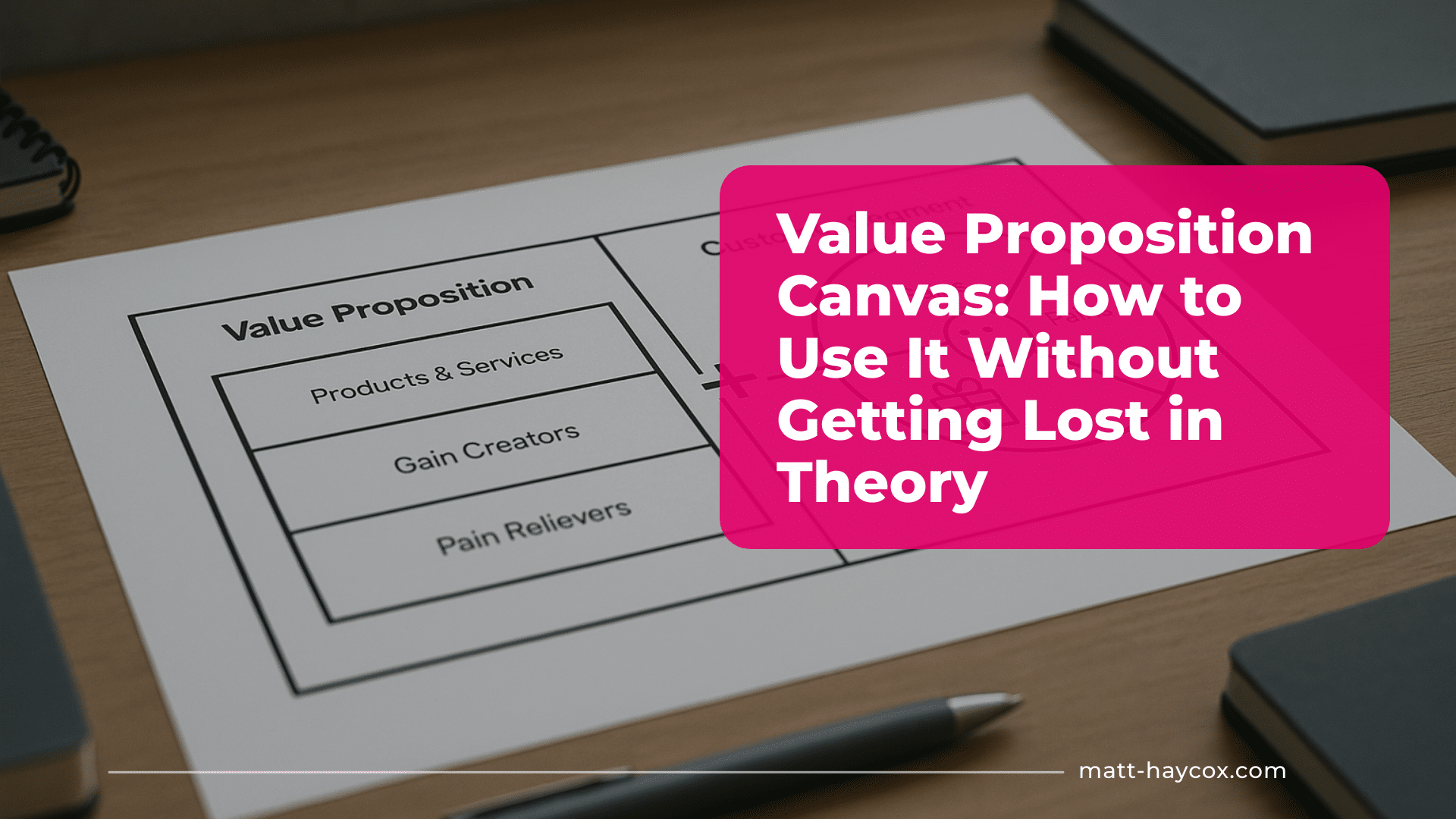
The value proposition canvas is a two-part map that forces you to match what customers actually need (their jobs, pains, gains) to what you actually do (your products, pain relievers, gain creators). Practically, it’s a decision tool: it helps you choose what to build, what to cut, what to lead with on the website, and what to charge for.
Here are quick sense-checks to keep it grounded:
- It’s not branding. If it doesn’t change your next landing page, email, demo or pricing page, it’s just words.
- It’s not an ICP document. It’s a microscope on one specific buyer situation, not a biography.
- It’s not meant to be complete. You’re aiming for the few items that drive buying decisions, not a list of everything that could be true.
- It should create trade-offs. A good canvas makes you say ‘no’ to features, channels and customer segments.
The Value Proposition Canvas In 45 Minutes
If you’ve got a team, timebox this. One canvas per segment, one segment per session. Don’t try to serve everyone in one go.
Step 1: Pick the specific buyer moment. Not ‘SMBs’, not ‘homeowners’. Pick a moment like ‘a finance manager trying to close month-end with messy receipts’ or ‘a founder hiring their first sales rep’.
Step 2: Fill the Customer Profile first. Jobs, pains, gains. No solutions allowed. If you catch yourself naming your product, stop.
Step 3: Rank ruthlessly. You only get:
- 3 top jobs that are frequent and urgent
- 3 top pains that are expensive or risky
- 3 top gains that are measurable or status-linked
Step 4: Fill the Value Map second. Your products and services, pain relievers and gain creators. The rule is simple: every pain reliever must map to a top pain, every gain creator must map to a top gain.
Step 5: Write the mismatch list. Circle anything you do that doesn’t map. That’s your complexity tax. Either remove it, reposition it, or price it properly.
Completion check: you should be able to point to one message you’ll change and one thing you’ll stop doing.
Gather Evidence Fast: Internal First, Then Public
The fastest way to ruin a canvas is to brainstorm customer problems in a room full of employees. Start with artefacts you already have, then go outside to confirm.
Internal Signals You Can Pull In 2 Hours
These are the inputs founders ignore, then later pay researchers to rediscover.
- Sales calls: 10 recent call notes, highlight exact phrases before a buyer asks about price.
- Lost deals: the last 10 ‘no’ emails, tag the real objection, not the polite one.
- Support tickets: top 20 ticket subjects by frequency, then rank by time-to-resolve.
- Refunds and cancellations: pull the top 5 reasons, and write what the customer expected versus what happened.
- Usage data: find the feature that correlates with retention, not the feature you’re proud of.
If you don’t have these, you don’t need a new canvas, you need basic instrumentation and note-taking.
Public Signals That Keep You Honest
Public sources won’t tell you everything, but they’ll stop you from inventing a fantasy market.
Scan competitor reviews and forums for repeated patterns. Then use lightweight usability testing to see what people actually understand and do on your page. The Nielsen Norman Group guide to usability testing is a solid reminder that you don’t need a lab to spot major friction.
Also, if you’re still in idea selection mode, cross-reference Business Ideas: The Full Guide to Finding, Testing and Choosing the Right Idea to make sure you’re not forcing a canvas onto a weak market.
Map Jobs, Pains And Gains That Actually Move Revenue
Most canvases fail because founders list generic jobs and vague pains. Buying decisions are triggered by specific costs, deadlines and risks.
Jobs: Focus On The Trigger, Not The Task
A job isn’t ‘manage invoices’. The job is ‘close month-end without surprises’ or ‘prove spend to the FD before Friday’. Write jobs with a trigger and a deadline.
Good job statements usually include one of these:
- Time pressure: ‘before month-end’, ‘before the board pack’, ‘before the event’
- Risk exposure: ‘avoid compliance issues’, ‘avoid chargebacks’, ‘avoid being blamed’
- Performance outcome: ‘hit quota’, ‘reduce turnaround time’, ‘increase conversion’
Pains: Make Them Expensive, Not Emotional
‘It’s frustrating’ isn’t a pain worth paying for. Translate the pain into a cost, a risk, or a credibility hit.
Examples of pains that usually matter:
- Waste: 6 hours a week of manual rework
- Uncertainty: can’t forecast, can’t plan, can’t commit
- Exposure: missed deadlines, legal risk, reputation damage
Practical move: for each top pain, write what it costs in money or time. If you can’t estimate it, you don’t understand it yet.
Gains: Write Them As A Before And After
Gains are not features. They’re outcomes the customer can point at. ‘Feeling confident’ is fine, but tie it to something observable like ‘send the report in 10 minutes’ or ‘ship without weekend work’.
A solid gain statement has a metric, a timeframe and a proof point.
Turn The Map Into A One-Sentence Offer
The canvas should end in an offer you can put on a homepage and in a sales email. Here’s a template that forces clarity without turning into marketing poetry.
Offer template: ‘For [specific buyer in a specific moment], we help you [primary job outcome] in [timeframe], without [top pain], using [your method], priced from [£X] for [clear unit].’
Now sanity-check it:
- If you remove the timeframe, does it still sound valuable? If not, you’re selling urgency, not outcome.
- If you remove ‘without [top pain]’, is it generic? If yes, your differentiation is still weak.
- Is the unit clear? Per user, per project, per site, per month. If it’s fuzzy, you’ll bleed margin.
This is where the value proposition canvas earns its keep. You’re not writing a manifesto, you’re building a usable offer spec.
Validate In 7 To 14 Days With Small Tests
Don’t validate by asking people if they like the idea. Validate by asking for time, money, or a meaningful commitment.
Here’s a practical validation path you can run in two weeks:
- Day 1 to 2: Write a one-page landing page with the offer sentence, 3 proof points, 1 clear call to action.
- Day 3 to 5: Run 10 customer conversations using the same script. Your goal is to hear the same pains repeated, not to pitch.
- Day 6 to 9: Put £200 to £500 behind targeted traffic or outbound. Measure: replies, booked calls, and drop-off points.
- Day 10 to 14: Ask for a paid pilot, deposit, or signed letter of intent. If you can’t ask, you don’t believe your own canvas.
What ‘good’ can look like at small scale:
- Cold outbound: 5% to 10% reply rate to a tight list, with 2% to 4% booking rate
- Landing page: 2% to 5% conversion to a call request for high-intent traffic
- Paid pilot: 3 to 5 paid pilots from 20 to 30 qualified conversations
Those numbers aren’t universal. They’re practical thresholds that tell you whether you’ve got a real job, a real pain and a real willingness to act.
Price It So The Numbers Work At Small Scale
A canvas that ignores pricing is a canvas that creates busy founders. Your price needs to match the size of the pain and the cost to serve.
Start with a simple unit economics check you can run in a spreadsheet:
- Gross margin: (Price minus direct costs) divided by price
- Delivery time per unit: hours per customer per month, or hours per project
- Payback: how many months of gross profit it takes to cover acquisition cost
Example: you charge £500 a month for an ops support service. Direct costs are 12 hours of delivery at £25 per hour, plus £50 of tools. That’s £350 direct cost, £150 gross profit, so 30% gross margin. If you’re also spending £300 to acquire the customer, your payback is 2 months of gross profit. That’s not terrible, unless churn is high, or your delivery hours creep up.
Don’t forget tax basics when you sanity-check your real take-home. If you sell in the UK, make sure you understand UK VAT rates and rules so you’re not surprised when you cross thresholds or change what you’re selling.
Rule of thumb: if your offer requires heavy founder time, the price has to buy your calendar back, not just cover costs.
Operational Guardrails That Stop The Canvas Becoming Scope Creep
The value proposition canvas will often reveal more things you could do. That’s the trap. You need guardrails that keep delivery tight and margin healthy.
Use these three:
- A clear unit of value: ‘per site audited’, ‘per team trained’, ‘per month supported’. If you can’t count it, you can’t control it.
- A stop rule: what you won’t do inside the package. Put it in writing, say it on the sales call, then stick to it.
- A proof schedule: define what ‘progress’ looks like weekly. If you can’t show progress, customers will invent their own expectations.
Founder move: write a one-page ‘delivery spec’ that mirrors your canvas mapping. If a request doesn’t map to a top pain or gain, it’s either out of scope, or it’s an upsell.
Mini Cases: Three Fast Examples You Can Steal
These are deliberately small and specific. The goal is to show how the canvas turns into an offer, not to tell heroic business stories.
1) B2B SaaS for security compliance (Manchester). Job: pass an audit in 30 days. Pain: evidence is scattered across tools and people. Gain: a single report the CTO can sign off. Offer shift: stop leading with ‘automated checks’, lead with ‘audit-ready pack in 7 days’, price per audit pack plus optional monitoring.
2) D2C supplement brand (Bristol). Job: stick to a routine without overthinking it. Pain: too many options and no feedback loop. Gain: visible progress in 14 days. Offer shift: bundle product with a simple tracker and onboarding emails, stop adding new SKUs, raise price 15% and reduce returns by tightening expectations.
3) Fractional finance operator (Dubai). Job: give founders weekly visibility on cash and runway. Pain: chaos across invoices, payroll, subscriptions. Gain: ‘sleep at night’ because numbers are current. Offer shift: sell a fixed monthly package with a weekly cadence, cap hours, standardise onboarding, upsell clean-up projects separately.
Risks And Hedges: How Founders Mess This Up
You can do a beautiful canvas and still lose if you fall into these common holes.
Risk 1: You map opinions, not evidence. Hedge it by attaching one data point to each top pain: a quote, a ticket count, a lost deal reason, or a time estimate.
Risk 2: You target ‘everyone with the problem’. Hedge it by picking one buying context and one budget owner. If the budget owner changes, you need a new canvas.
Risk 3: You promise gains you can’t operationalise. Hedge it with a delivery spec and a weekly proof schedule. If you can’t prove it, don’t claim it.
Risk 4: You underprice to win early customers. Hedge it by running a ‘founder time’ calculation. If your offer needs 10 hours a week and you price it at £400 a month, you’ve built yourself a job, not a business.
Risk 5: You keep adding features to cover weak positioning. Hedge it by cutting anything that doesn’t map to the top 3 pains and gains. If it’s not a lever, it’s noise.
Download The Value Proposition Toolkit And Put This Into Play
If you want a cleaner way to run this as an operator, download the Value Proposition Toolkit and use it to turn one canvas into one offer, one landing page and one 7 to 14 day validation plan.
- Build one canvas per buyer moment, then rank down to the few jobs, pains and gains that actually trigger buying.
- Validate fast by asking for commitment, and price with unit economics so early traction doesn’t destroy margin.
- Protect your time with a clear unit, a stop rule and a proof schedule, then keep iterating the canvas as you learn.
FAQs For Value Proposition Canvas Execution
What’s the difference between the value proposition canvas and a unique value proposition?
The canvas is a working map that links customer evidence to your offer design. A unique value proposition is the distilled message, the canvas is how you earn the right to say it.
How many customer interviews do I need before the canvas is useful?
Start with 5 to 10 conversations, then update the canvas as patterns repeat. You’re looking for consistent language and repeated pains, not statistical certainty.
Should I do one canvas for my whole business or one per segment?
One per segment or per buying context, otherwise it becomes vague. If the buyer, trigger, budget or success metric changes, treat it as a new canvas.
What if customers say they want everything?
They often will, because it costs them nothing to ask. Use ranking and willingness-to-pay tests to find what they’ll actually prioritise when time and money are on the line.
How do I know if a pain is ‘real’ enough to build around?
A real pain has an observable cost, deadline or risk, and customers already spend time or money dealing with it. If nobody has a workaround, it may not be urgent.
Can I use the canvas for services and advisory, not just products?
Yes, it’s often easier for services because you can adjust delivery fast. Just be strict about your unit of value and scope boundaries so it doesn’t turn into unlimited support.
How often should I update my canvas?
Update it after every 10 to 20 sales conversations, or when you change segment, price or channel. If conversion drops or churn rises, revisit the top pains and the promises you’re making.