
If your revenue feels ‘lumpy’, it’s rarely because you need more hustle. It’s because you don’t have a sales pipeline you can trust, and you’re guessing what’s coming next. Before you reinvent anything, cross-reference Sales & Client Acquisition: The Complete Founder’s Playbook and then build the pipeline that fits how you actually sell.
In this article, we’re going to discuss how to:
- Map pipeline stages with exit criteria you can enforce
- Run follow-ups that move deals forward without nagging
- Track the numbers that turn ‘hope’ into a forecast
What A Sales Pipeline Really Is
A sales pipeline is a live inventory of deals, each sitting in a defined stage with a clear next action, a realistic value and a date. The point isn’t a pretty CRM board. The point is control: you should know what to do today to increase the odds of cash landing in the bank in 30 to 90 days.
If your sales pipeline is working, you can answer these in under 60 seconds:
- How much is likely to close this month: Based on win rates, not vibes
- What’s stuck: Deals sat too long in one stage with no movement
- What you’re doing next: A next step scheduled for every active deal
- Where leads come from: Two to three sources you can double down on
If you can’t, you don’t have a pipeline yet. You have a list of names.
Building A Sales Pipeline With Stages You Can Police
Most founders copy stages from a CRM template and wonder why nothing moves. Your stages should match buyer behaviour, not software defaults. Keep it simple, then add detail only when it improves decisions.
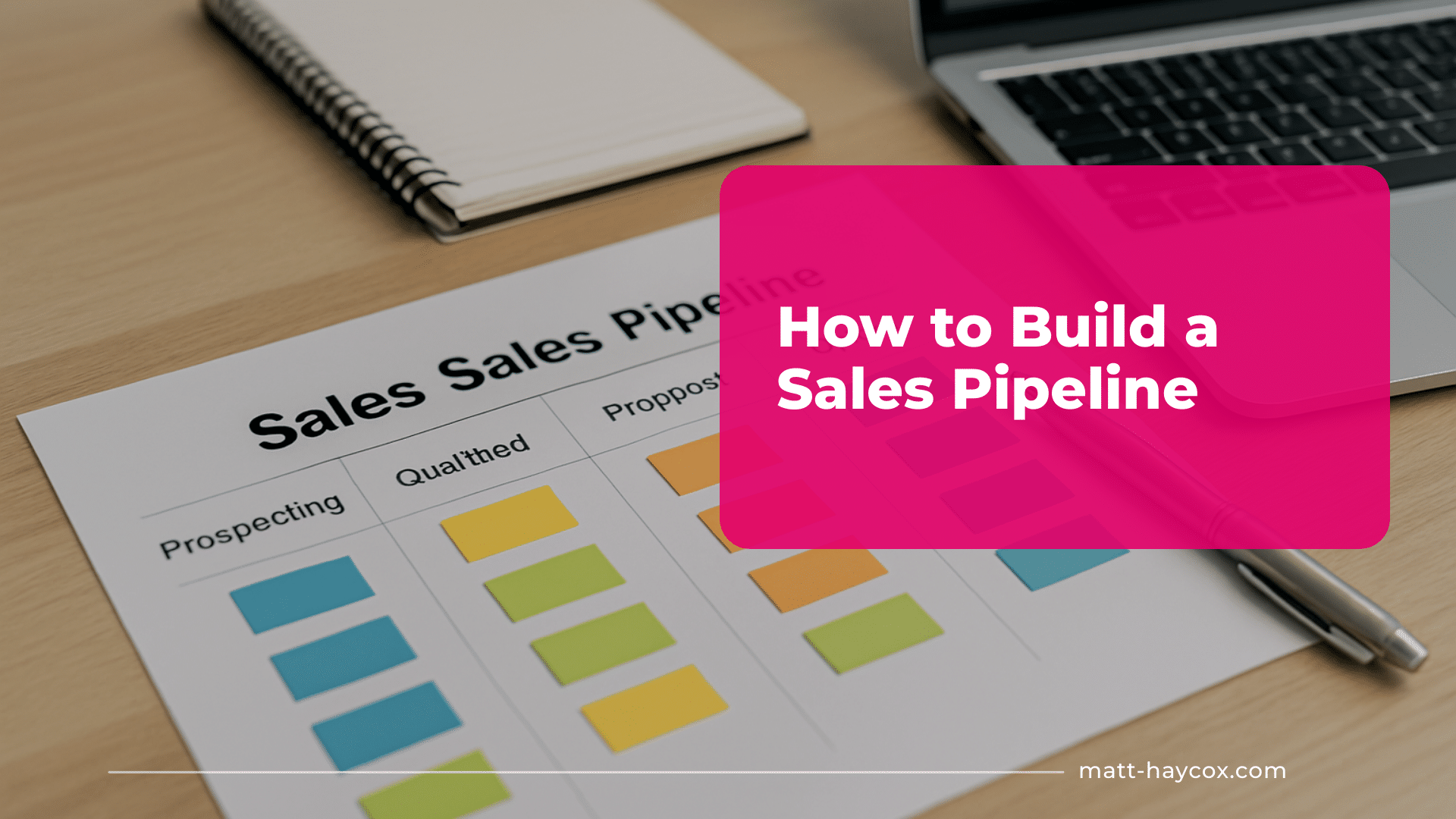
Start With 5 Stages And Add One Only If Needed
For most B2B services, SaaS and high-ticket B2C, this is enough:
- New Lead: Captured, not yet qualified
- Qualified: Fit confirmed, pain is real, next step agreed
- Discovery Done: Outcomes, constraints and decision process documented
- Proposal Sent: Pricing and scope shared, decision date set
- Closed Won or Closed Lost: Money in, or learned and logged
If your cycle is longer, add Commercials Agreed (after negotiation) or Legal or Procurement (if that’s a genuine stage). Don’t add stages just to feel organised.
Write Exit Criteria, Not Descriptions
Every stage needs an ‘entry’ and ‘exit’ rule. That’s how you stop deals rotting while your CRM looks busy.
Example exit criteria you can actually enforce:
- Qualified: Budget range confirmed, problem is linked to a £ cost, decision-maker identified, a next meeting booked
- Discovery Done: Current process mapped, success metric agreed, timeline and risks captured, stakeholder list complete
- Proposal Sent: Proposal delivered to the buyer live or on a call, decision date in calendar, procurement steps known
Completion check: if you can’t prove the exit criteria in notes, it stays in the previous stage.
Collect The Right Signals In 2 Hours
Before you ‘improve pipeline’, get the facts. Two hours is enough to pull signals that tell you where the leaks are. Start internal, then look outwards.
Internal Signals To Pull First
Open a spreadsheet and capture the last 20 to 50 deals you touched, even if your records are messy. You want evidence, not perfection.
- Lead source: Referral, outbound, paid, organic, partner
- Time to first response: Minutes or hours, not ‘same day’
- Sales cycle length: First contact to paid invoice
- Stage conversion: Qualified to discovery, discovery to proposal, proposal to won
- Average deal value: What you charged, not your list price
- Loss reasons: Price, timing, no pain, competitor, ghosted
Simple diagnosis rules:
- If Qualified to Discovery is under 40%, your qualification is too loose or your first call is weak.
- If Proposal to Won is under 20%, your proposal is unclear, your pricing isn’t anchored, or you’re sending quotes with no live walkthrough.
- If deals die after 10 to 14 days with no reply, your follow-up system is broken, not your product.
Public Signals To Cross-Check
Now validate what buyers are already telling the market:
- Competitor pricing pages: What they package, what they hide, where they anchor
- Job ads: Projects they’re hiring for show priorities and budgets
- Reviews and forums: Language customers use, especially complaints
- LinkedIn moves: New leaders, mergers, expansion, cost cuts
Completion check: you should end with 5 to 10 patterns you can name, such as ‘Ops directors care about deployment time, not features’ or ‘Founders buy when the offer is productised and time-boxed’.
Shape A Clear Offer Before You Chase More Leads
A sales pipeline doesn’t fix a fuzzy offer. If you don’t know what you sell, to whom and why it’s worth the money, you’ll end up with loads of ‘interested’ leads and very few decisions.
Here’s a one-sentence offer template you can fill in:
I help [specific buyer] achieve [measurable outcome] in [timeframe] without [common headache], using [your method or asset].
Examples that don’t waffle:
- I help independent gyms increase member retention by 10% to 15% in 8 weeks without discounting, using a simple referral and onboarding system.
- I help B2B founders shorten sales cycles by 20% in 30 days without adding headcount, using tighter qualification and proposal walkthroughs.
Completion check: if your prospect can’t repeat your offer back to you in their own words, it’s not clear enough.
Follow-Up That Moves Deals Forward
Most follow-up is either too timid or too spammy. A proper follow-up system is respectful, specific and always points to a next step. Your job is to reduce the energy it takes for a buyer to move.
Pick A Cadence And Stick To It
For a typical 2 to 6 week cycle, a sensible cadence looks like this:
- Day 0: Call summary and agreed next step, sent within 2 hours
- Day 2: A useful artefact, not a ‘just checking in’ email
- Day 5: Ask for a decision path or a short call
- Day 9: Address the likely objection, offer two options
- Day 14: Close the loop politely, leave the door open
The artefact is what makes this work. Examples: a one-page plan, a 3-line breakdown of costs, a short Loom walking through the proposal, a relevant case study with numbers.
Use ‘Two Options’ Follow-Up To Avoid Ping-Pong
When you need a reply, don’t ask open questions. Give two reasonable next steps. For example: ‘Do you want to review this on a 15-minute call tomorrow at 11:30 or would you rather I send a revised option with a smaller scope?’
Completion check: every follow-up message contains (1) context, (2) value, (3) a clear choice.
Tracking A Sales Pipeline Without Lying To Yourself
Founders often build a pipeline that looks big, then miss payroll because it wasn’t real. Tracking is there to reduce self-deception.
The Only Numbers You Need Early On
Whether you use a CRM or a spreadsheet, track these weekly:
- New qualified opportunities: Not leads, qualified deals
- Stage conversion rates: Where deals drop off
- Time in stage: Average days per stage, plus the worst offenders
- Next-step coverage: % of deals with a next meeting booked or next action due
- Weighted pipeline value: Deal value multiplied by a realistic stage probability
A simple weighting model is enough: 10% for New Lead, 30% for Qualified, 50% for Discovery Done, 70% for Proposal Sent. Tweak only after 30 to 50 deals.
Do A 10-Minute Weekly Pipeline Hygiene
Same time every week, you do three actions:
- Move or close: If there’s no next step, move it back or close it lost
- Update notes: Decision process, stakeholders, blockers
- Schedule actions: Calls, emails, artefacts to send
Completion check: 90%+ of active deals have a dated next step. If they don’t, your sales pipeline is theatre.
Pricing And Unit Economics That Hold At Small Scale
You can’t ‘pipeline’ your way out of weak pricing. Early-stage sales is meant to be profitable enough to fund learning, not just growth.
Run A Quick Contribution Check
Do this calculation for your main offer:
- Price: £5k
- Delivery cost: £1.5k (contractors, tools, direct costs)
- Gross profit: £3.5k
- Sales time per deal: 6 hours (calls, follow-up, proposal)
- Your internal hourly value: £150
- Sales cost (time): £900
- Net contribution before overhead: £2.6k
If that net contribution doesn’t feel worth the hassle, you need to raise price, reduce delivery scope, productise, or change who you sell to.
Set A Pipeline Coverage Target
Coverage is how much pipeline you need to hit a revenue goal, based on your win rate. If you want £50k this month and your close rate from Qualified to Won is 25%, you need roughly £200k of qualified pipeline.
Completion check: you can state your coverage target and you know whether you’re above or below it today.
Validation In 7 To 14 Days: Small Tests That Prove Movement
Don’t rebuild everything and wait a quarter to see if it worked. Run small tests that give you signals fast.
Here are four tests you can run in 7 to 14 days:
- Stage exit audit: Re-qualify 20 active deals against your exit criteria, close or downgrade anything that doesn’t qualify
- Offer clarity test: Send your one-sentence offer to 10 ideal buyers, ask them to reply with ‘what this does’, if they can’t, rewrite
- Proposal walkthrough test: For the next 5 proposals, insist on a 20-minute walkthrough call, measure proposal to won rate
- Follow-up artefact test: Add one useful artefact to every follow-up for a week, track reply rate and booked next steps
Completion check: you’re not just ‘busy’, you have a before and after number, like reply rate from 18% to 32% or proposal conversion from 1 in 10 to 3 in 10.
Operational Guardrails That Protect Margin And Time
The quickest way to kill a sales pipeline is to let selling eat your week and delivery eat your nights. You need guardrails so you can scale the same behaviours.
Practical guardrails I’d put in place early:
- Time blocks: Selling only happens in set windows, such as 10:00 to 12:00 Tuesday and Thursday
- Proposal rules: No proposal without discovery notes and a decision date
- Deal size floor: Don’t sell below a minimum contribution, even if you’re hungry
- Scope control: One standard package plus one premium, avoid bespoke everything
- Handover checklist: When a deal closes, delivery gets a one-page brief within 24 hours
Completion check: your average week has predictable selling time and you can take a day off without deals stalling.
Micro Cases: What This Looks Like In Real Businesses
These are short examples to make the mechanics concrete. Different sectors, same discipline.
A Leeds Marketing Studio Selling Retainers
They had 60 ‘active’ deals and no forecast accuracy. We cut stages to 5, enforced a rule that every proposal must be presented live and added a one-page ‘first 30 days plan’ artefact. Qualified pipeline fell by 35% but close rate doubled within 3 weeks, and the founder stopped chasing ghosts.
A Manchester SaaS With A 45-Day Cycle
They were losing deals in procurement because they discovered security requirements too late. We added a ‘Commercials Confirmed’ stage with exit criteria: security questionnaire received and timeline agreed. Time in stage dropped from 18 days to 9 days, and the team stopped forecasting deals that were never going to clear legal.
A London Fractional Finance Consultant
Leads came from referrals but follow-up was ad hoc. We created a 14-day cadence with two options in every message and a simple weekly hygiene review. Reply rate improved from 22% to 41%, and pipeline coverage became stable enough to plan hiring a contractor 1 day per week.
Common Risks And Simple Hedges
Building a sales pipeline is straightforward, but there are a few naïve mistakes that cost months.
- Risk: Counting ‘maybes’ as revenue. Hedge: Only forecast from Qualified onwards, and weight deals realistically.
- Risk: Too many stages that nobody follows. Hedge: Stick to 5 stages until you can prove a need for a sixth.
- Risk: Discounting to close. Hedge: Offer scope options before price drops, and keep a deal size floor.
- Risk: Founder becomes the bottleneck. Hedge: Document discovery questions, proposal templates and handover notes so others can run the process.
- Risk: Long follow-up chains with no next step. Hedge: Every touch includes a clear choice and a calendar option.
Completion check: you can point to one hedge you’ve added this week, not just a new idea you haven’t implemented.
Download The Simple Sales Process Blueprint And Put This Into Motion
If you want to implement this faster, download The Simple Sales Process Blueprint and use it to set your stages, exit criteria, follow-up cadence and tracking sheet in one sitting. Then run a weekly 10-minute pipeline hygiene and you’ll feel the difference in control within 14 days.
- Key Takeaway: A sales pipeline is only useful when stages have strict exit criteria and every deal has a next step.
- Key Takeaway: Validate improvements in 7 to 14 days with small tests, then use win rates and coverage to forecast honestly.
- Key Takeaway: Protect margin with pricing floors, proposal rules and time blocks so selling doesn’t wreck delivery.
FAQ For Building A Sales Pipeline
How Many Stages Should A Sales Pipeline Have?
Start with 5 stages and only add another when it changes decisions, such as a genuine legal or procurement step. More stages usually means less clarity and more admin.
What’s The Difference Between A Sales Pipeline And A Sales Funnel?
A funnel describes how a market narrows from awareness to purchase, often in marketing terms. A pipeline is your operational view of active deals, next steps and expected revenue.
How Often Should I Review My Sales Pipeline?
Do a 10-minute hygiene review weekly and a deeper review monthly to assess conversion rates and stage timing. Daily micro-checks are fine, but avoid turning it into constant busywork.
How Do I Stop Deals From Going Stale?
Enforce a rule that any active deal must have a dated next step, otherwise it gets downgraded or closed lost. Stale deals are usually a missing decision process or weak follow-up, so fix those notes early.
What Metrics Matter Most For Early-Stage Founders?
Track qualified opportunities created, stage conversion, time in stage and proposal to won rate. If you add one more, track next-step coverage because it predicts momentum better than a big list of leads.
Should I Use A CRM Or A Spreadsheet?
If you’ve got under 30 active deals, a spreadsheet can be enough if it forces next steps and stage dates. Move to a CRM when multiple people touch deals or you need automation for follow-up and reporting.
How Much Pipeline Do I Need To Hit My Target?
Use pipeline coverage: target revenue divided by your close rate from Qualified to Won. If your close rate is 25% and you want £40k, build roughly £160k of qualified pipeline.
When Should I Send A Proposal?
Only after discovery is done and you’ve agreed outcomes, scope boundaries and the decision process. If you send proposals to ‘keep things moving’, you’ll inflate the pipeline and drop your win rate.