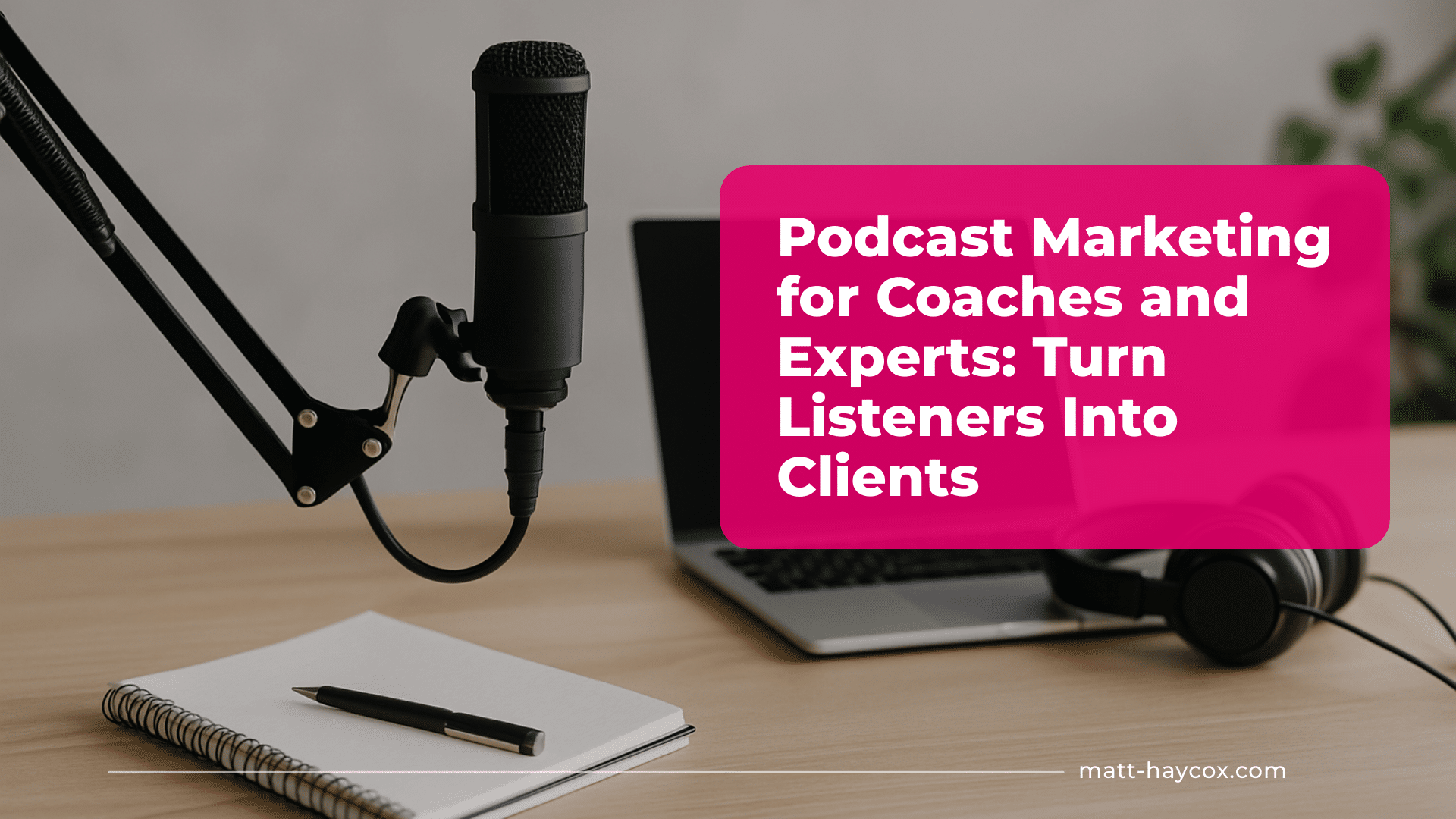

A podcast can be the most efficient trust-builder in your business, or a weekly time sink that produces ‘nice feedback’ and no revenue. The difference is having a podcast that’s designed like a product, with an offer, a funnel and a distribution engine. If you want the wider commercial backdrop, cross-reference Business Marketing: The Complete Playbook for Growing Your Brand and Pipeline before you start.
Most coaches and experts don’t need more content. They need a repeatable way to turn attention into conversations, then conversations into clients.
In this article, we’re going to discuss how to:
- Plan a show that attracts your buyers, not your peers
- Record and publish consistently without losing half your week
- Distribute each episode so it generates leads for months
Podcast Marketing Strategy In Founder Terms
A podcast marketing strategy is a simple operating plan that links your episodes to three business outcomes: qualified conversations, conversions and retained customers. It’s not about ‘growth hacks’. It’s about making your show a dependable acquisition and nurture channel.
Here’s a tight sense-check before you hit record:
- Audience: You can name the buyer and the moment they start looking for help.
- Offer: You’ve got a clear next step after the episode, not a vague ‘follow me’.
- Distribution: You’ll publish the same core message in at least 3 places weekly.
- Measurement: You track leads and revenue, not just downloads.
If any of those are missing, the fix is rarely better audio. It’s better decisions upstream.
Start With Buyer Signals, Not Episode Ideas
Before you decide on guests, artwork or intro music, spend 2 to 3 hours collecting signals. Start internal, then go public. Your goal is to build a show around problems people already pay to solve.
Internal Signals You Can Gather Today
Open your CRM, inbox and calendar. You’re hunting for repeated language, not your own opinions.
- Sales call notes: Pull the last 20 calls and highlight the exact phrases prospects used.
- Objection list: Write the top 10 ‘yes, but…’ objections and rank by frequency.
- Win reasons: Ask 5 recent clients, ‘What nearly stopped you buying?’ and ‘What made you confident?’
- Time sinks: Track what you explain repeatedly. Each repeat is a future episode.
Completion check: you should end with 10 to 15 problem statements written in the customer’s words, not yours.
Public Signals That Confirm Demand
Now validate externally so you don’t build a show around a niche you wish existed.
- Search: Type your topic into Google and note the ‘People also ask’ questions.
- YouTube: Look at view counts on problem-led titles published in the last 90 days.
- LinkedIn: Search for posts with high comment-to-like ratios, it signals real pain.
- Competitors: Scan their episode titles and note what they repeat. Repetition is demand.
Completion check: you can point to at least 10 external examples where your buyer is already consuming content about the same problem.
Choose A Show Angle That Makes Buying Feel Inevitable
Most podcasts fail commercially because they’re built around identity: ‘I’m a coach, so I’ll have a coaching podcast.’ Build around outcomes instead. Your angle should make the listener think, ‘This is for people like me, and this person solves the exact thing I’m stuck on.’
A practical way to land it is this three-part framing:
- Buyer: Who is it for, in one job title and one context?
- Pain: What’s the expensive problem they’re trying to stop?
- Payoff: What measurable outcome do they want within 30 to 90 days?
Example: ‘For boutique agency owners who are stuck doing delivery, this show helps you build a pipeline and a delivery team that doesn’t depend on you.’ It’s specific, commercial and it repels the wrong listeners, which is a good thing.
One-sentence offer template: ‘I help [specific buyer] achieve [measurable outcome] in [timeframe] without [common pain], using [your method].’
Put that sentence on your podcast description, your episode outro and your guest booking page. It becomes the spine of your podcast marketing strategy.
Plan A Six-Episode Launch That Produces Leads Fast
Don’t launch with 30 random episodes and hope the algorithm blesses you. Launch with 6 episodes that answer the core buying questions and push listeners towards a next step. Think of it as a sales page in audio form.
Here’s a tight 6-episode structure you can write in one afternoon:
- Episode 1: ‘The real cost of [problem]’ with numbers and a simple diagnostic.
- Episode 2: ‘How to fix [problem] in 7 to 14 days’ with a small test.
- Episode 3: ‘Why [common approach] fails’ and what to do instead.
- Episode 4: Client journey story, before and after, what changed.
- Episode 5: Tools and templates episode, practical assets and checklists.
- Episode 6: ‘If I was starting from zero…’ your step-by-step starter plan.
Each episode should include one clear CTA that fits the listener’s readiness. Early episodes can point to a diagnostic or checklist. Later episodes can invite a call.
Simple CTA Ladder That Doesn’t Feel Pushy
Use one CTA per episode and rotate based on intent:
- Low intent: Download a checklist, scorecard or template.
- Medium intent: Reply to an email with one answer, or DM a keyword.
- High intent: Book a 15-minute fit call with 3 qualifying questions.
Completion check: you can listen back and clearly hear what the listener should do next, in one sentence.
Record Like An Operator, Not A Hobbyist
Consistency is the edge. The only way to stay consistent is to set guardrails that protect your time and your energy. Your show needs a production system that works even when the week is messy.
A Lean Recording Setup That’s ‘Good Enough’
You don’t need a studio. You need clean audio and low friction.
- Mic: A £80 to £150 USB mic is fine for 99% of coaches.
- Room: Soft furnishings, no empty walls, shut windows, phones on airplane mode.
- Format: Choose solo, interview, or co-host. Don’t mix all three early.
Guardrail: never let gear decisions delay publishing. Your first 10 episodes are for learning, not perfection.
Timeboxed Workflow You Can Run Weekly
Try this as a baseline:
- 45 minutes: Outline and hook, one problem, three points, one CTA.
- 45 minutes: Record two episodes back-to-back.
- 15 minutes: Write show notes using your outline.
- 30 minutes: Approve edit, schedule and publish.
That’s roughly 2 hours 15 minutes for two episodes once you’re in rhythm, assuming you use a simple editor or a freelancer. The point is repeatability.
Distribution That Compounds, Not Just ‘Posting The Link’
Recording is only half the job. Distribution is where the growth and leads come from. A practical podcast marketing strategy treats each episode like a campaign: one core message, repackaged into multiple touchpoints.
Use this lightweight distribution stack:
- Newsletter: One email with the ‘why it matters’, then 3 bullets and the link.
- LinkedIn: One story post and one tactical post pulled from the episode.
- Short video: 2 to 4 clips, each with one point and a clear hook.
- Website: A page per episode with a tight summary and key links.
Completion check: within 24 hours of publishing, you can point to at least 5 pieces of distribution that came from the episode.
Make Episodes Searchable With Simple On-Page SEO
Podcasts are discoverable when the text around them is discoverable. You don’t need an SEO team, you need basic hygiene:
- Title: Lead with the outcome or problem, not the guest’s name.
- Show notes: 300 to 600 words that repeat the core phrase naturally.
- Links: Include one primary CTA link and any tools mentioned.
Small but meaningful change: if you interview a guest, put the buyer benefit first, then the guest. ‘How to raise prices without losing clients, with Sarah Ahmed’ will outperform ‘Sarah Ahmed on pricing’ for the right audience.
Turn Listeners Into Leads With A Clean Funnel
You’re not trying to turn every listener into a client. You’re trying to turn the right listeners into a next step that you can track. This is where most podcasts leak.
Keep your funnel simple:
- Episode: One problem, one shift, one CTA.
- Landing page: One promise, one form, one follow-up.
- Follow-up: 5 to 7 emails that teach and qualify.
- Call: A short fit call with a clear decision, yes or no.
Don’t send people to your homepage. Send them to one page built for the episode’s promise. If your CTA is ‘download the checklist’, the landing page should not also invite them to book a call, read your blog and watch a webinar. One job per page.
A Basic Qualification Script That Saves Time
Before anyone books time with you, ask these 3 questions on the form:
- Outcome: ‘What would make this worth it in 90 days?’
- Constraint: ‘What’s stopping you right now?’
- Commitment: ‘Are you ready to invest money, time and effort to solve it?’
Guardrail: if you’re doing more than 2 unqualified calls a week, your form and CTA are too vague.
Measure What Matters: A Practical Scorecard
Downloads are a vanity metric unless they correlate with leads and sales. You’re building a pipeline tool, so track pipeline indicators. Use a weekly scorecard you can check in 10 minutes.
Start with these metrics:
- Listener-to-lead rate: Leads from the podcast divided by unique listeners (or downloads as a proxy).
- Lead-to-call rate: Qualified bookings divided by leads.
- Call-to-close rate: Closed deals divided by qualified calls.
- Cost per lead: Editing, design and distribution costs divided by leads.
Quick calc example: you spend £600 a month on editing and tools. The podcast drives 12 leads. That’s £50 per lead. If 25% book a call, that’s 3 calls. If you close 33%, that’s 1 new client. If your average sale is £2k, the unit economics are strong even at small scale.
Completion check: by the end of month one, you can attribute at least 3 leads to the podcast via a link, a form question (‘How did you hear about us?’) and tagged email replies.
Pricing And Unit Economics That Work At Small Scale
Your podcast can be profitable long before it’s popular. The trap is chasing ‘reach’ while ignoring your real constraint: margin and time.
Think in two costs:
- Cash cost: Editing, hosting, artwork, clip creation, typically £250 to £1,200 per month depending on quality and volume.
- Time cost: Founder time for recording, prep and distribution. Assign a value to it, even if it’s just a notional £100 per hour.
Now decide what the podcast is for:
- Client acquisition: Highest leverage for coaches and consultants selling £1k+ offers.
- Ascension engine: Upsell existing clients into higher tiers or retainers.
- Partnership channel: Build relationships with referral partners and collaborators.
Sponsorship looks attractive but it’s rarely the first play for experts. You’ll often earn more by converting one right-fit client than by selling £150 ad slots. Treat sponsorship as optional upside once you have consistent listens and clear positioning.
Validation Tests You Can Run In Days
You don’t need 6 months to find out if your show can convert. Run small tests that give you signal quickly.
Try this 7-day validation path:
- Day 1: Publish one strong solo episode with one clear CTA and one landing page.
- Day 2: Send it to your email list and ask for one reply: ‘What part hit home?’
- Day 3: Post two clips on LinkedIn and track profile visits and DMs.
- Day 4: Ask 5 peers or clients to share it, then watch what audience it attracts.
- Day 5 to 7: Book 2 short calls from the CTA, even if they’re not perfect fits.
Success criteria: you’re not looking for big numbers, you’re looking for proof of intent. If you can generate 5 to 10 leads from your first 2 episodes using your existing audience, you’ve got something workable.
Mini Case Files: What This Looks Like In Real Life
Case 1, Leadership coach in Manchester: She ran a 10-episode season on ‘first-time managers’. Each episode ended with a link to a simple self-assessment. In 30 days she collected 47 downloads of the tool, booked 9 calls and closed 3 £1.5k packages. Her key move was making the CTA the same in every episode for one month.
Case 2, B2B sales trainer selling retainers: He switched from interviews to short solo episodes that answered one objection at a time. He added one question to his booking form: ‘Which episode brought you here?’ Close rate improved because prospects arrived pre-sold and specific about what they wanted fixed.
Case 3, Nutrition expert with a local clinic: She used the podcast to drive local demand by featuring GP partners and sports clubs. The show wasn’t huge, but it produced warm referrals and reduced her paid social spend by £800 a month. The play was partnerships, not downloads.
Risks And Hedges That Protect Margin And Momentum
Podcasts fail in predictable ways. If you hedge early, you keep your time and your brand intact.
- Risk: You chase famous guests and lose your niche. Hedge: Make the problem the star, the guest is just a supporting act.
- Risk: You publish inconsistently and the audience forgets you. Hedge: Batch record, schedule 4 weeks ahead, never rely on ‘when I get time’.
- Risk: You talk in concepts and the listener can’t act. Hedge: End with one assignment they can do in 20 minutes.
- Risk: You get listeners but no leads. Hedge: One CTA, one landing page, one follow-up sequence, track it weekly.
- Risk: Your podcast becomes a second business. Hedge: Cap founder time at 3 hours a week, outsource the rest.
Operator guardrail: if the podcast isn’t producing leads within 6 to 8 weeks, don’t quit, diagnose. Your angle, CTA, landing page and distribution are the usual culprits, not the format itself.
Download The Inbound Lead Generation Checklist And Put Your Podcast To Work
If you want a straightforward way to turn episodes into leads without overcomplicating it, download the Inbound Lead Generation Checklist and run it against your next 2 episodes. You’ll tighten your CTA, fix your landing page, and build a follow-up loop that creates conversations, not just listens.
- Build the show around buyer signals and a clear offer, not generic topics.
- Validate fast with small tests, then track listener-to-lead and lead-to-sale economics.
- Protect time and margin with batching, one CTA per episode and a distribution routine that compounds.
FAQ For Podcast Marketing for Coaches and Experts
How long should podcast episodes be for coaching and consulting offers?
Long enough to solve one problem properly, short enough to hold attention. For most experts, 15 to 35 minutes works well, especially if you publish weekly and keep a clear structure.
How do I get clients from a podcast with low download numbers?
Focus on conversion, not vanity reach: one strong CTA, one landing page and a short email follow-up sequence. A podcast with 200 highly relevant listeners can outperform one with 5,000 random listeners.
Should I do interviews or solo episodes?
Solo episodes are faster to control and often convert better because the message is tight. Interviews are great for partnerships and borrowing trust, but only if you keep the conversation anchored to your buyer’s problem.
What’s a realistic timeline for results?
You should see first leads within 2 to 6 weeks if you have an existing audience and a clear CTA. Consistent pipeline impact typically shows up in 8 to 12 weeks once distribution and follow-up are running smoothly.
What should my call to action be on every episode?
Pick one action that matches the episode’s promise, usually a checklist, diagnostic or short fit call. If you keep switching CTAs, you’ll confuse listeners and you won’t be able to measure what’s working.
Do I need video as well as audio?
No, but video clips make distribution easier, especially on LinkedIn and YouTube. If time is tight, record video while you record audio, then clip 2 to 4 moments per episode.
How do I track leads properly from my podcast?
Use one trackable link per CTA and add a mandatory form question asking where they found you. Then tag the lead in your CRM so you can see conversion rates and revenue over time.